Agentic AI vs Generative AI: How They Differ and Work Together
Generative AI creates content. Agentic AI takes action. Learn the real differences, how they work together, and when your team needs which approach.

By: Deepit Patil
Co-Founder and CTO
Published
Updated
Edited by Craze Editorial Team · See our Editorial Process
Every vendor in the AI space is talking about agentic AI right now. If you’ve been working with generative AI tools like ChatGPT or Claude for the past couple of years, the sudden shift in terminology can feel disorienting. What changed? Is agentic AI replacing generative AI? Do you need both?
The short answer: agentic AI is not replacing generative AI. It’s built on top of it. Generative AI gives machines the ability to create. Agentic AI gives them the ability to act. Understanding that relationship, not just the surface differences, is what helps teams make better decisions about where to invest.
This guide breaks down both concepts clearly, shows how the AI landscape evolved from one to the other, compares them across the dimensions that actually matter for business decisions, and gives you a practical framework for deciding when to use which.
TL;DR
- Generative AI creates content; agentic AI takes action. Generative AI responds to prompts with text, images, or code. Agentic AI autonomously plans, uses tools, and executes multi-step workflows to achieve a goal.
- They are not competitors. Agentic AI uses generative AI as its engine. Most agentic systems run a large language model as their reasoning core, then add tool access, memory, and planning on top.
- The evolution runs in three stages: predictive, generative, agentic. Each layer builds on the one before it. Enterprises are now adopting all three simultaneously.
- Enterprise adoption is real but early. Only 17% of organizations have deployed AI agents so far, yet over 60% expect to within two years.
- The question is not “which to adopt” but “when you need creation vs when you need autonomous execution.” Most real workflows need both.
What Is Generative AI?
Generative AI is artificial intelligence that creates new content, whether text, images, audio, video, or code, in response to a prompt. You ask, it produces.
Under the hood, it runs on large language models and diffusion models trained on massive datasets. When you prompt ChatGPT to draft an email or ask Midjourney to generate an image, you’re using generative AI. The system processes your input in what’s essentially a single pass: one prompt in, one output out.
The key characteristic is that generative AI is reactive. It waits for your instruction and creates something based on it. It doesn’t decide what to do next, access external tools, or take action on your behalf. You stay in the driver’s seat for every step.
Adoption has been fast. According to McKinsey’s 2025 State of AI survey , the majority of surveyed organizations now use AI in at least one business function, and more than two-thirds use it across multiple functions. The technology is mainstream for content creation, summarization, brainstorming, and code assistance.
But generative AI has a ceiling. It creates; it does not act. That limitation is exactly what agentic AI was designed to address.
What Is Agentic AI?
Agentic AI is the term for AI systems that can autonomously plan, make decisions, and execute multi-step tasks to reach a goal with minimal human supervision.
Where generative AI responds to a single prompt with a single output, agentic AI runs an iterative loop: it reasons about a goal, decides which action to take, executes that action (often using external tools like APIs, databases, or email), evaluates the result, and decides the next step. This loop continues until the goal is met or the system determines it needs human input.
The key characteristic is that agentic AI is proactive. You define the goal, “research our top five competitors and produce a pricing comparison,” and the system figures out how to get there. It searches sources, extracts data, cross-references findings, formats a report, and delivers it without you directing each step.
One distinction worth keeping straight: “agentic AI” refers to the paradigm of autonomous, goal-directed behavior. “ AI agents ” are the individual software units that operate within it. Think of agentic AI as the management philosophy and AI agents as the workers who carry it out.
Gartner places agentic AI at the Peak of Inflated Expectations in its 2026 Hype Cycle , which means interest and investment are high, but so is the risk of disillusionment for teams that deploy without clear use cases.
Neither paradigm appeared overnight. Both are stages in a longer evolution that helps explain why agentic AI exists and what it builds on.
The Three Paradigms: Predictive, Generative, Agentic
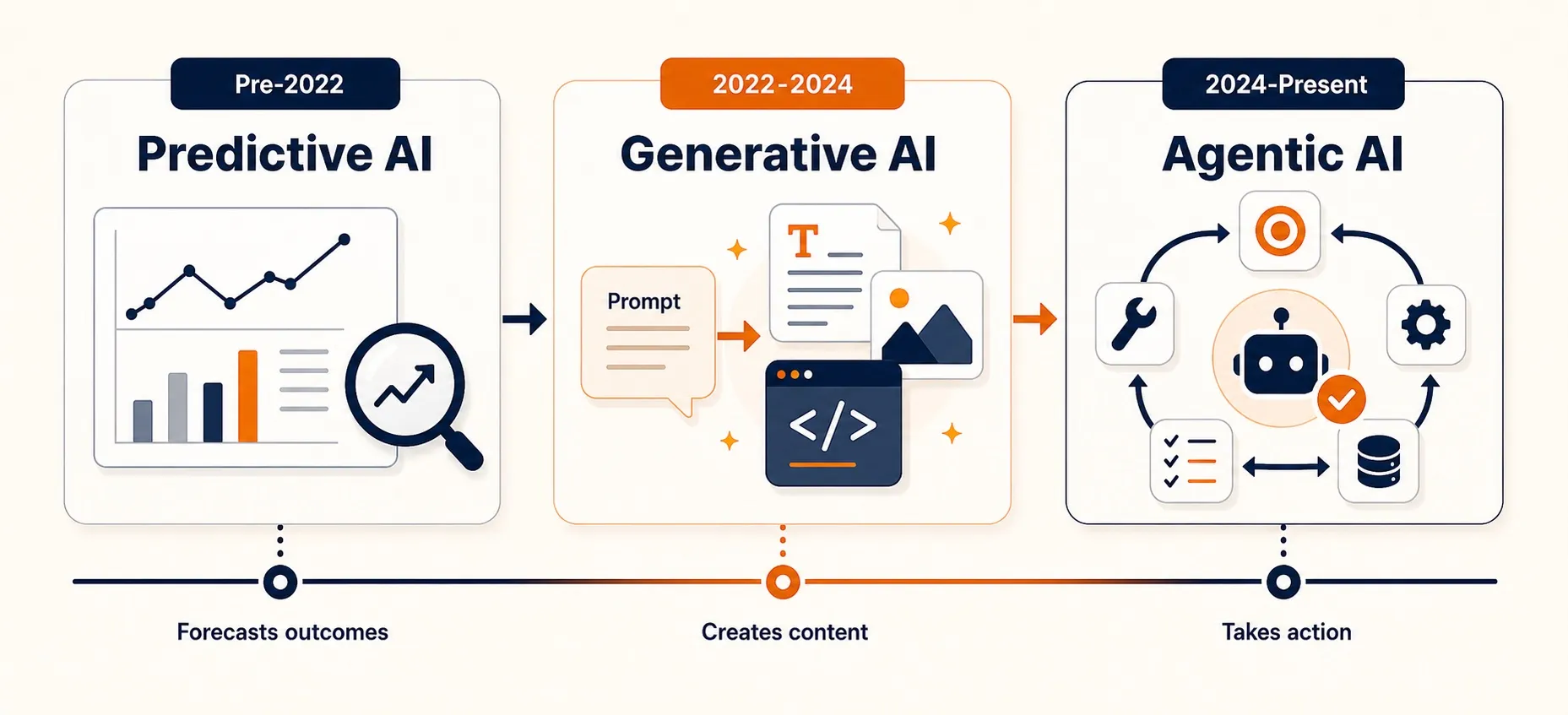
The shift from generative to agentic AI makes more sense when you see it as part of a larger evolution. AI hasn’t jumped from one paradigm to another. It has been adding layers.
Predictive AI (pre-2022) is where most enterprise AI started. These systems analyze historical data to forecast outcomes: credit scoring, demand forecasting, recommendation engines, fraud detection. They’re powerful for pattern recognition, but they can’t create new content or take autonomous action. Predictive AI tells you what might happen. It doesn’t create or do.
Generative AI (2022-2024) added the ability to create. When ChatGPT launched in late 2022, it showed that AI could produce useful text, code, and creative content from natural language prompts. The technology matured fast: by 2024, generative models handled complex reasoning, summarization, and multimodal content. But you still had to guide every step.
Agentic AI (2024-present) adds the ability to act. By combining generative models with tool access, memory, and planning loops, agentic systems can pursue multi-step goals autonomously. The key enablers include function calling (letting models invoke external tools), protocols like Anthropic’s Model Context Protocol (MCP) for standardized tool connections, and orchestration frameworks like LangGraph, CrewAI, and OpenAI’s Agent SDK.
These paradigms stack; they don’t replace each other. A company in 2026 might use predictive AI for demand forecasting, generative AI for content creation, and agentic AI to automate its customer support workflow. Each layer solves a different problem.
With the evolution clear, the next step is understanding exactly where generative and agentic AI differ in practice.
Key Differences Between Agentic AI and Generative AI
When you’re planning, budgeting, or making a deployment decision, here’s where the two paradigms actually diverge.
| Dimension | Generative AI | Agentic AI |
|---|---|---|
| Core function | Creates content | Executes tasks and solves problems |
| Interaction model | Reactive (prompt to response) | Proactive (goal to plan to execution) |
| Execution | Single-step (usually) | Multi-step, iterative |
| Tool use | Limited or none | Broad (APIs, databases, email, tools) |
| Memory | Session-based at most | Persistent goal and context tracking |
| Human oversight | High (user guides each step) | Low to moderate (human sets goal, agent executes) |
| Cost model | Per-request (one inference call) | Per-workflow (many inference calls + tool calls) |
Core function is the most fundamental split. Generative AI is a creation tool: you prompt it and it produces content. Agentic AI is an execution system: you give it a goal and it figures out the steps, picks the right tools, and gets the work done. A generative model writes your email. An agentic system researches the recipient, drafts the email, personalizes it from CRM data, schedules it, and follows up if there’s no reply.
Interaction model determines how you work with each. With generative AI, you’re always in the loop, guiding each request. With agentic AI, you define the goal and guardrails upfront, then the system operates autonomously within those boundaries. This is a meaningful shift in how teams interact with AI tools.
Cost model is often overlooked. A generative AI request typically involves one inference call: one prompt, one response, done. An agentic workflow might involve dozens of inference calls (reasoning, planning, tool selection, output evaluation) plus multiple tool calls (API requests, database queries, email sends). The per-task cost is higher, but the per-outcome cost can be lower when the alternative is hours of human work.
Human oversight is where governance gets important. Generative AI outputs always pass through a human before they reach anyone else. Agentic AI can take action autonomously, which means the guardrails need to be set before the system starts, not after. Gartner’s 2026 Hype Cycle notes that governance, security, and FinOps for agentic AI are appearing as distinct technologies on the curve , reflecting how early most organizations are in building the oversight infrastructure these systems require.
These differences might make the two paradigms sound like competitors, but the reality is the opposite.
How Agentic AI and Generative AI Work Together
The most important thing to understand about these two paradigms is that they are not either/or. Agentic AI is built on top of generative AI.
In practical terms, an agentic system uses a generative model (typically an LLM like GPT-4, Claude, or Gemini) as its reasoning engine. The LLM handles the thinking: understanding context, planning next steps, deciding which tool to call, and interpreting results. On top of that engine, the agentic layer adds tool access (APIs, databases, email), memory (tracking goals and context across steps), and planning (deciding what to do next based on what’s already happened).
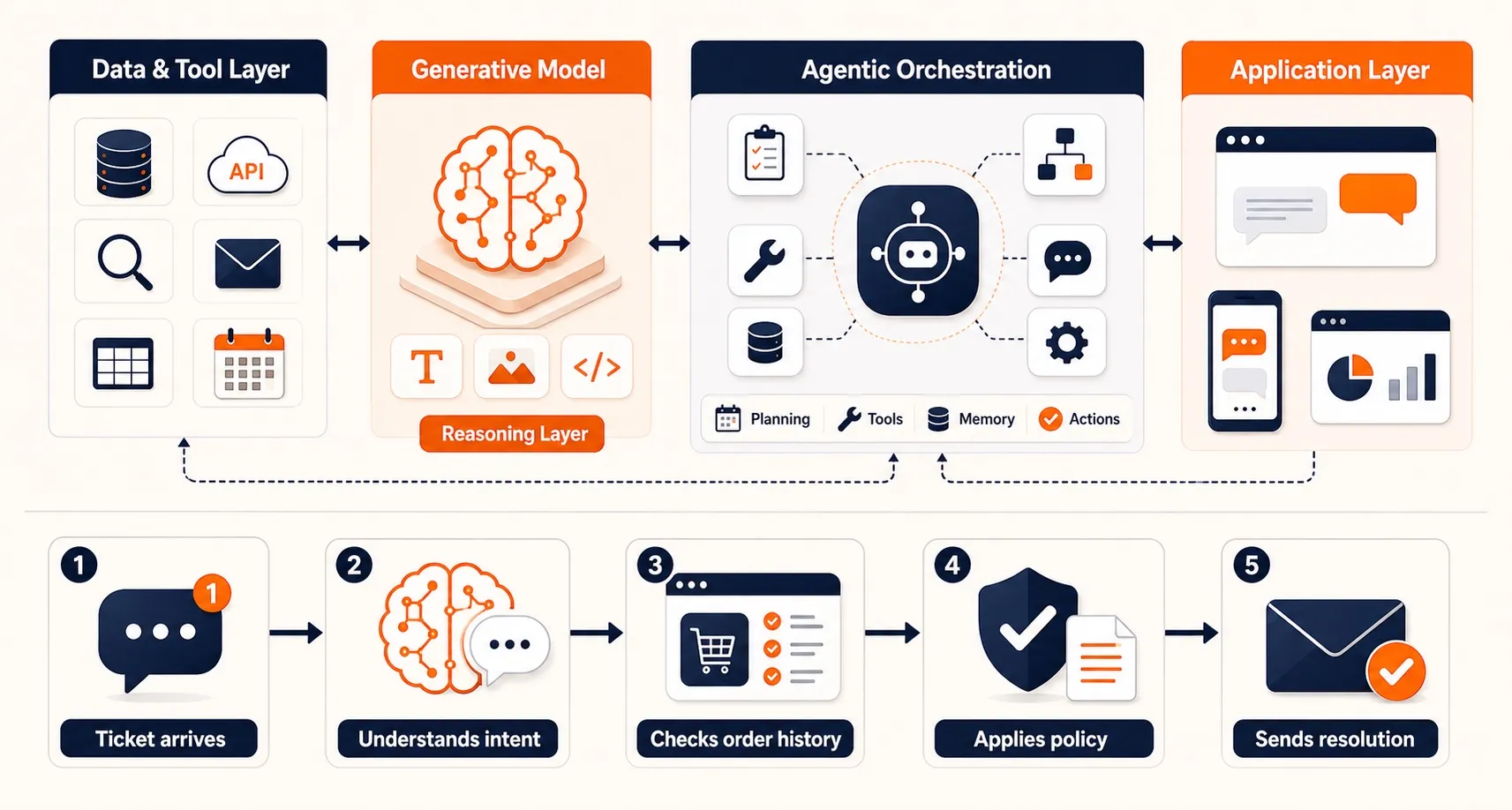
A concrete example makes this clearer. Consider customer support:
- A ticket arrives: “I received a damaged product and want a refund.”
- The generative layer reads and understands the message, identifying the intent and extracting key details (product, issue, request).
- The agentic layer takes over: it looks up the customer’s order in the database, checks the return policy, determines the customer qualifies for a refund, initiates the refund process, drafts a response email, and sends it.
- Steps 2 and 3 happen without a human managing each step. The human set the guardrails (refund policy rules, escalation triggers), and the system executed within them.
This pattern repeats across use cases. In content creation, the generative layer writes a draft while the agentic layer researches the topic, checks brand guidelines, formats for the CMS, and queues for review. In sales, the generative layer drafts outreach messages while the agentic layer identifies leads, personalizes messaging based on CRM data, schedules sends, and logs activity.
Platforms like Craze let you combine generative and agentic capabilities in one workspace, so you can build workflows that use both without switching between tools.
The takeaway: when you see “agentic AI vs generative AI,” think “agentic AI WITH generative AI.” The first can’t exist in its modern form without the second.
Understanding how they complement each other architecturally is one thing. Knowing which to reach for in a specific workflow is the practical next step.
When to Use Which: A Decision Framework
The practical question for most teams isn’t “which paradigm is better” but “which approach fits this specific workflow.”
Use generative AI when:
- The task is primarily about creating content: drafting emails, writing reports, generating images, summarizing documents, brainstorming ideas.
- The output needs human review and editing before it goes anywhere. Generative AI is a tool that makes you faster, not a system that acts on your behalf.
- The workflow is single-step or few-step: you ask, it produces, you refine.
- You want creative exploration: generating options, testing angles, prototyping ideas.
Use agentic AI when:
- The task involves multiple steps across different tools: checking a database, sending an email, updating a record, generating a report.
- The workflow benefits from autonomous execution: you define the goal, the system handles the steps.
- You need tool access: the system needs to interact with APIs, databases, CRMs, email, calendars, or other external systems.
- The task is repetitive and rule-based enough to set clear guardrails: what the agent can do, when to escalate, what requires human approval.
Use both when:
- The workflow combines content creation AND multi-step execution. Example: researching a topic (agentic), writing a report (generative), formatting and distributing it (agentic).
- You’re building an end-to-end process where different steps have different needs.
Here are four common scenarios mapped to the right approach:
| Scenario | Approach | Why |
|---|---|---|
| Writing marketing copy for a campaign | Generative AI | Single-step creation task, needs human editorial judgment |
| Processing and resolving customer refund requests | Agentic AI | Multi-step workflow across database, policy engine, and email |
| Creating and distributing a weekly analytics report | Both | Research and data gathering (agentic), report writing (generative), formatting and distribution (agentic) |
| Brainstorming product feature names | Generative AI | Creative exploration, single-step, human selects the winner |
Knowing which approach fits your workflow is the first step. The broader question is how far enterprises have actually gotten with each.
Enterprise Adoption: Where Things Stand in 2026
Both paradigms are seeing strong enterprise adoption, but at different stages of maturity.
Generative AI is mainstream. According to McKinsey’s 2025 State of AI survey , the majority of surveyed organizations now use AI in at least one business function. More than two-thirds report using it across multiple functions. The technology has moved past experimentation for most enterprises and into daily workflows for content, code, and customer interaction.
Agentic AI is accelerating but earlier. The numbers tell an interesting story:
- Only 17% of organizations have deployed AI agents so far, according to Gartner’s 2026 CIO and Technology Executive Survey
- Yet over 60% expect to deploy agents within two years, the most aggressive adoption curve among all emerging technologies measured in the survey
- 62% of organizations are at least experimenting with AI agents, per McKinsey
That gap between “experimenting” and “deployed” tells you where the real challenge is. Many organizations are testing agents but haven’t yet built the governance, monitoring, and guardrails needed to run them autonomously at scale.
The governance gap is the biggest risk. Gartner’s 2026 Hype Cycle now includes agentic AI governance, agentic AI security, and FinOps for agentic AI as distinct emerging technologies, signaling that oversight and cost control are becoming critical concerns early in the adoption cycle, not after large-scale deployment.
The global agentic AI market was valued at $7.29 billion in 2025 and is projected to reach $9.14 billion in 2026, growing at a 40.5% CAGR toward $139.19 billion by 2034. The organizations that capture real value will be the ones that deploy with governance first, scale second.
The adoption data paints a clear picture: both paradigms are here to stay, and the teams that treat them as complementary will move fastest.
The Bottom Line
Generative AI and agentic AI are not competing paradigms. They are layers in the same stack. Generative AI gave machines the ability to create content from natural language. Agentic AI gives them the ability to plan, use tools, and execute multi-step workflows autonomously, using generative models as their reasoning engine.
The practical question for your team is not “which should we adopt” but “where in our workflows do we need content creation, and where do we need autonomous execution?” Most real-world processes need both.
The organizations that get this right, starting with clear use cases, setting governance early, and treating both paradigms as complementary tools, will have a meaningful operational advantage. The technology is ready. The question is whether the deployment strategy matches the ambition.
FAQs
What is the main difference between GenAI and agentic AI?
Generative AI creates content (text, images, code) in response to prompts. Agentic AI takes autonomous action to achieve goals, planning and executing multi-step workflows with minimal human guidance. They are complementary: agentic AI typically uses a generative AI model as its reasoning engine, then adds tool access, memory, and planning on top.
What are examples of agentic AI?
A customer service agent that reads a ticket, checks order history, applies the return policy, and sends a resolution without human intervention. A research agent that searches multiple sources, cross-references data, and produces a structured competitive analysis. A workflow agent that monitors a CRM, identifies stalled deals, drafts follow-up emails, and logs the activity. Each uses an LLM for reasoning but adds tool access and autonomous planning.
Is ChatGPT agentic AI or generative AI?
Standard ChatGPT is primarily generative AI: you prompt it, it responds. But ChatGPT with browsing, code interpreter, and plugin capabilities becomes proto-agentic because it can chain steps and use external tools. OpenAI's dedicated agent product, Operator, is designed as fully agentic AI. The line between the two is blurring as generative models gain more tool-use capabilities.
Can agentic AI work without generative AI?
Technically yes. Traditional rule-based automation (RPA) is agentic in behavior without using generative models. However, modern agentic AI systems almost always use LLMs as their reasoning engine. The generative model is what gives agents the ability to understand context, plan flexibly, and communicate naturally, capabilities that rule-based systems lack.
Is agentic AI more expensive than generative AI?
On a per-task basis, usually yes. Generative AI makes one inference call per request. Agentic AI runs multiple inference calls plus tool calls per workflow. But the ROI calculation is different: agentic AI automates multi-step processes that would otherwise require human time, so the cost per completed outcome can be significantly lower. Start with high-volume, high-ROI tasks and monitor token usage.
More Articles
The 8 Best Lindy AI Alternatives in 2026 (Tested & Compared)

The 8 best Lindy AI alternatives for 2026, anchored to why people leave Lindy, with current pricing, third-party ratings, honest pros and cons, and the best pick for each reason to switch.
The 7 Best Make Alternatives in 2026 (Tested & Compared)
The 7 best Make.com alternatives for 2026, anchored to why people leave Make, with current pricing, third-party ratings, honest pros and cons, and the best pick for each reason to switch.
The 8 Best Zapier Alternatives in 2026 (Tested & Compared)
The 8 best Zapier alternatives for 2026, anchored to why people leave Zapier, with current pricing, third-party ratings, honest pros and cons, and the best pick for each reason to switch.