Types of AI Agents: The 5 Core Types and How They Work
Learn the 5 core AI agent types, how they work, and which one fits your use case. Covers classic taxonomy plus modern production patterns.

By: Deepit Patil
Co-Founder and CTO
Published
Updated
Edited by Craze Editorial Team · See our Editorial Process
“AI agent” has become a catch-all label. It covers everything from a simple email filter to an autonomous system that plans, executes, and learns across dozens of tools. That range matters because different agent types handle complexity, memory, and decision-making in fundamentally different ways.
Pick the wrong type for your task and you’ll either over-engineer a simple problem or build something too limited for what you actually need. This article breaks down the five classic AI agent types, explains the modern patterns that extend them, and helps you figure out which approach fits your workflow.
TL;DR
- Five classic types form the foundation: simple reflex, model-based reflex, goal-based, utility-based, and learning agents. Each adds a layer of capability, from fixed rules to memory, planning, optimization, and self-improvement.
- Production agents blend multiple types. Modern systems combine characteristics and add coordination patterns like multi-agent systems and hierarchical orchestration.
- Complexity should match the task. The “best” type depends on what you’re solving, not on which sounds most advanced. A well-built simple reflex agent beats a poorly scoped learning agent every time.
- Includes a selection guide with a comparison table to help you match agent types to your specific use case.
What Are AI Agent Types?
The standard classification of AI agents comes from Stuart Russell and Peter Norvig’s textbook Artificial Intelligence: A Modern Approach, first published in 1995 and now in its fourth edition. Their framework groups agents into five types based on how each one perceives its environment, processes information, and decides what to do.
Think of the five types as a spectrum. On one end, you have agents that follow fixed rules with no awareness of context. On the other, you have agents that plan ahead, weigh tradeoffs, and get better over time. Each step up the spectrum adds a new capability, but also adds complexity that may not be worth it for simpler tasks.
If you’re still getting familiar with what an AI agent actually is and how it differs from a regular chatbot or automation script, start there first. The types below will make more sense with that foundation.
The 5 Classic Types of AI Agents
Simple Reflex Agents
A simple reflex agent works on condition-action rules. If X happens, do Y. That’s it. No memory of what happened before, no planning for what comes next. The agent looks at its current input, matches it against its rules, and acts.
This sounds basic, and it is. But basic isn’t a weakness when your task is predictable and well-defined. A spam filter that flags emails containing certain keywords is a simple reflex agent. So is a thermostat that turns on heating when the temperature drops below a threshold.
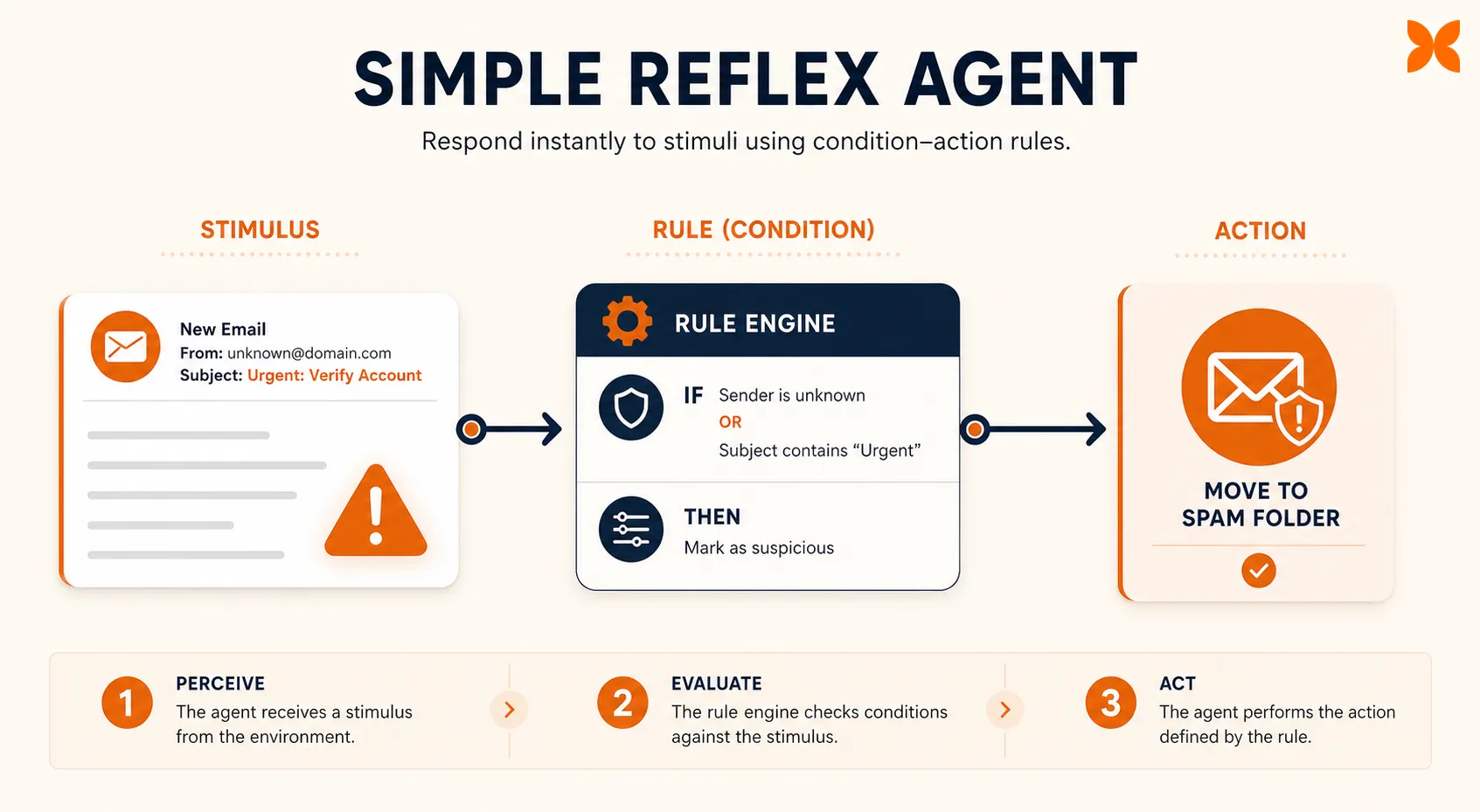
Where they work well: Fully observable environments with clear, repeatable patterns. When the rules are known and the inputs don’t require context, simple reflex agents are fast, cheap, and reliable.
Where they fall short: Partially observable or unpredictable environments. If the agent needs to remember what happened five steps ago to make a good decision now, simple reflex won’t cut it.
Model-Based Reflex Agents
A model-based reflex agent adds an internal model that tracks the state of the world over time. It still uses condition-action rules, but those rules can now factor in what the agent knows about past states, not just what it sees right now.
Consider the difference between a smoke detector (simple reflex: smoke detected, sound alarm) and a smart home system that knows the oven has been on for 30 minutes, the kitchen window is open, and a smoke pattern just started. The smart home system has context. It can distinguish between burnt toast and a real fire because it remembers what’s been happening.
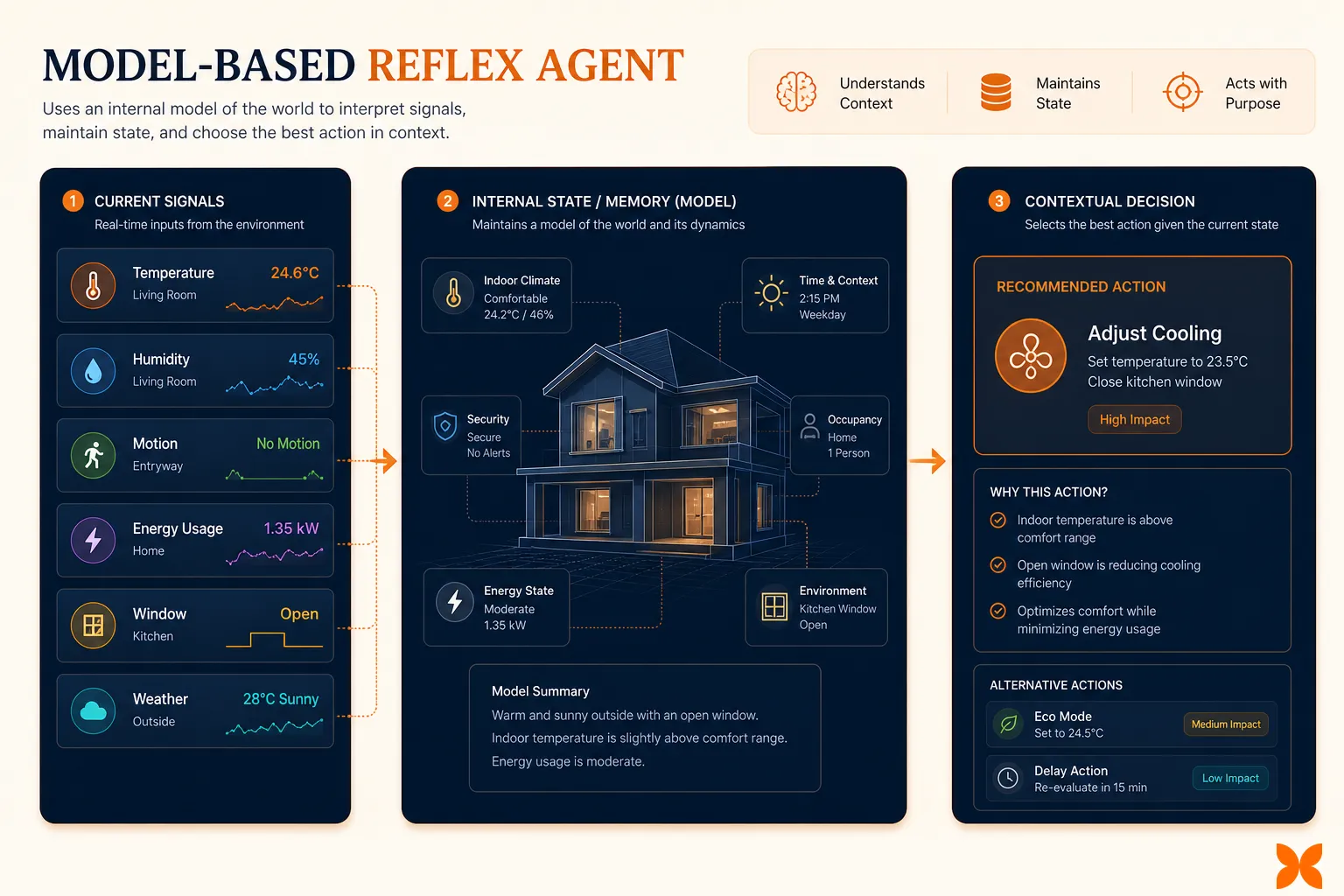
Where they work well: Partially observable environments where the agent can’t see everything at once. Warehouse robots that track inventory locations, monitoring systems that correlate events over time, and any scenario where history matters for the current decision.
Where they fall short: When the task requires planning toward a specific outcome, not just reacting with better context.
Goal-Based Agents
Goal-based agents take a meaningful step up from reacting to planning. Instead of responding to what’s happening now (even with memory), they work toward specific objectives. The agent considers possible actions, predicts their outcomes, and picks the sequence most likely to achieve its goal.
A navigation app is a familiar example. You give it a destination (the goal), and it evaluates possible routes, factors in traffic conditions, and plans a path. It’s not reacting to what’s in front of it. It’s planning ahead.
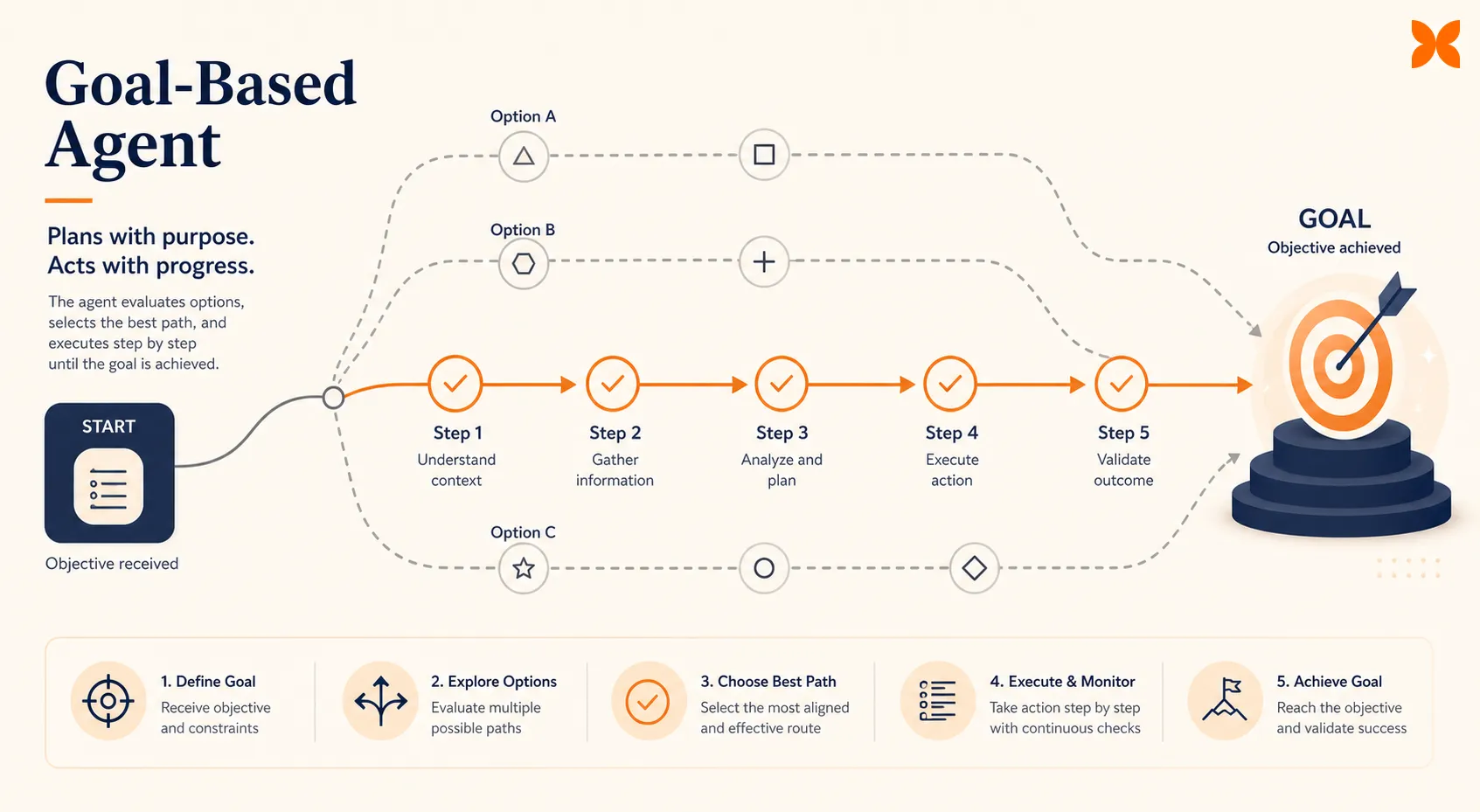
Where they work well: Tasks with defined objectives that require multi-step planning. Logistics routing, project scheduling, and research workflows where the agent needs to gather information from multiple sources in a deliberate sequence.
Where they fall short: When multiple valid goals compete and the agent needs to weigh which outcome is “better,” not just achievable. That’s where the next type comes in.
Utility-Based Agents
Utility-based agents don’t just ask “will this achieve my goal?” They ask “how well does this achieve my goal compared to the alternatives?” They use a utility function (essentially a scoring system) to evaluate outcomes and pick the one that maximizes overall benefit.
Consider a ride-sharing agent assigning drivers to riders. Multiple assignments could work (goal met), but the agent optimizes for the combination that minimizes wait times, balances driver workloads, and keeps costs reasonable. It’s weighing tradeoffs across competing priorities simultaneously.
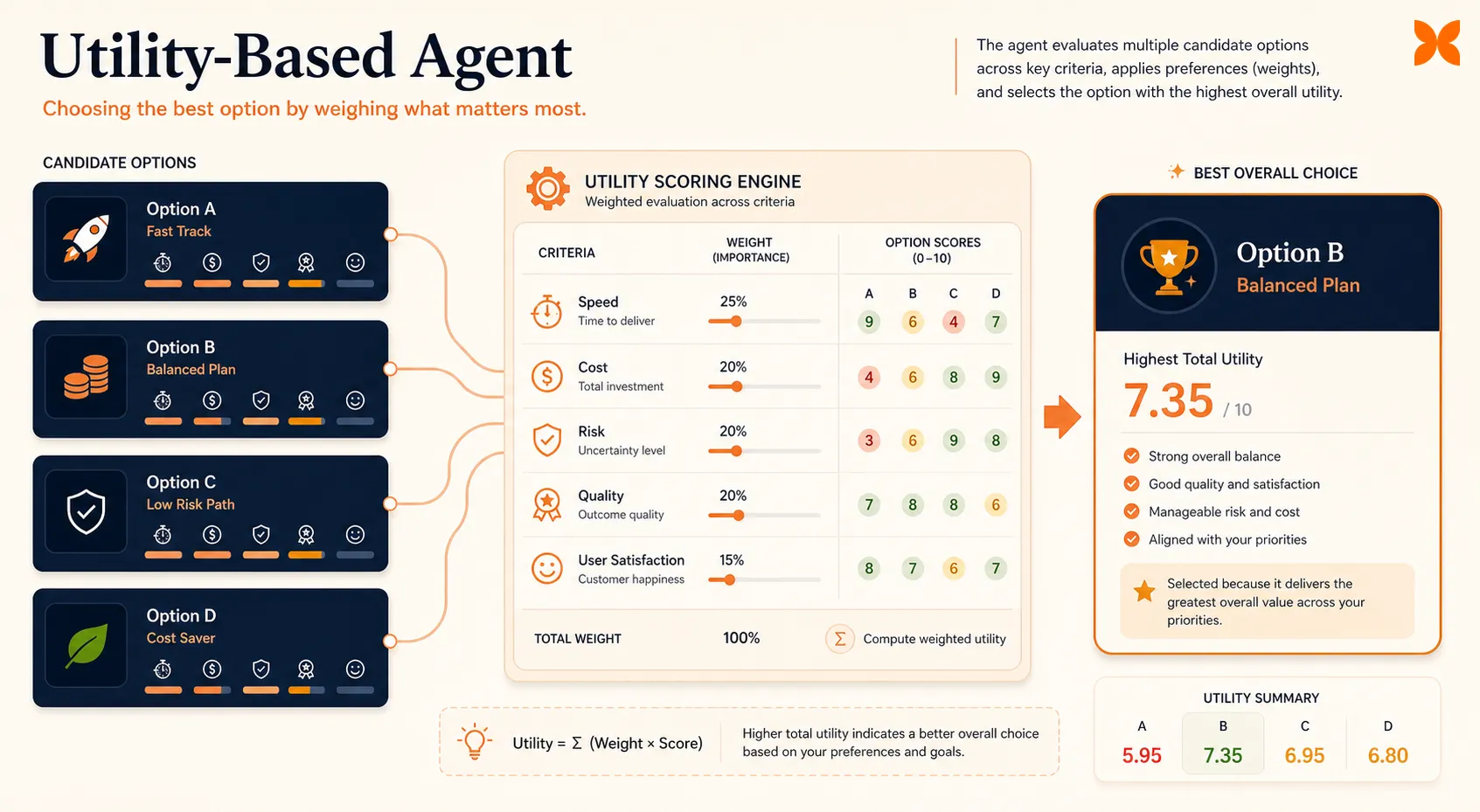
Where they work well: Complex environments with multiple competing objectives. Resource allocation, portfolio balancing, and any scenario where “good enough” isn’t specific enough and you need “best available given these constraints.”
Where they fall short: When the utility function is hard to define or the environment changes faster than the agent can evaluate options.
Learning Agents
Learning agents improve their performance over time through experience. They have four conceptual components: a learning element that updates the agent’s knowledge, a critic that evaluates performance, a performance element that selects actions, and a problem generator that suggests new experiences to learn from.
Recommendation engines are a familiar example. The more you interact with them, the better they predict what you’ll want next. They aren’t following fixed rules or optimizing a static function. They’re adapting based on feedback from every interaction.
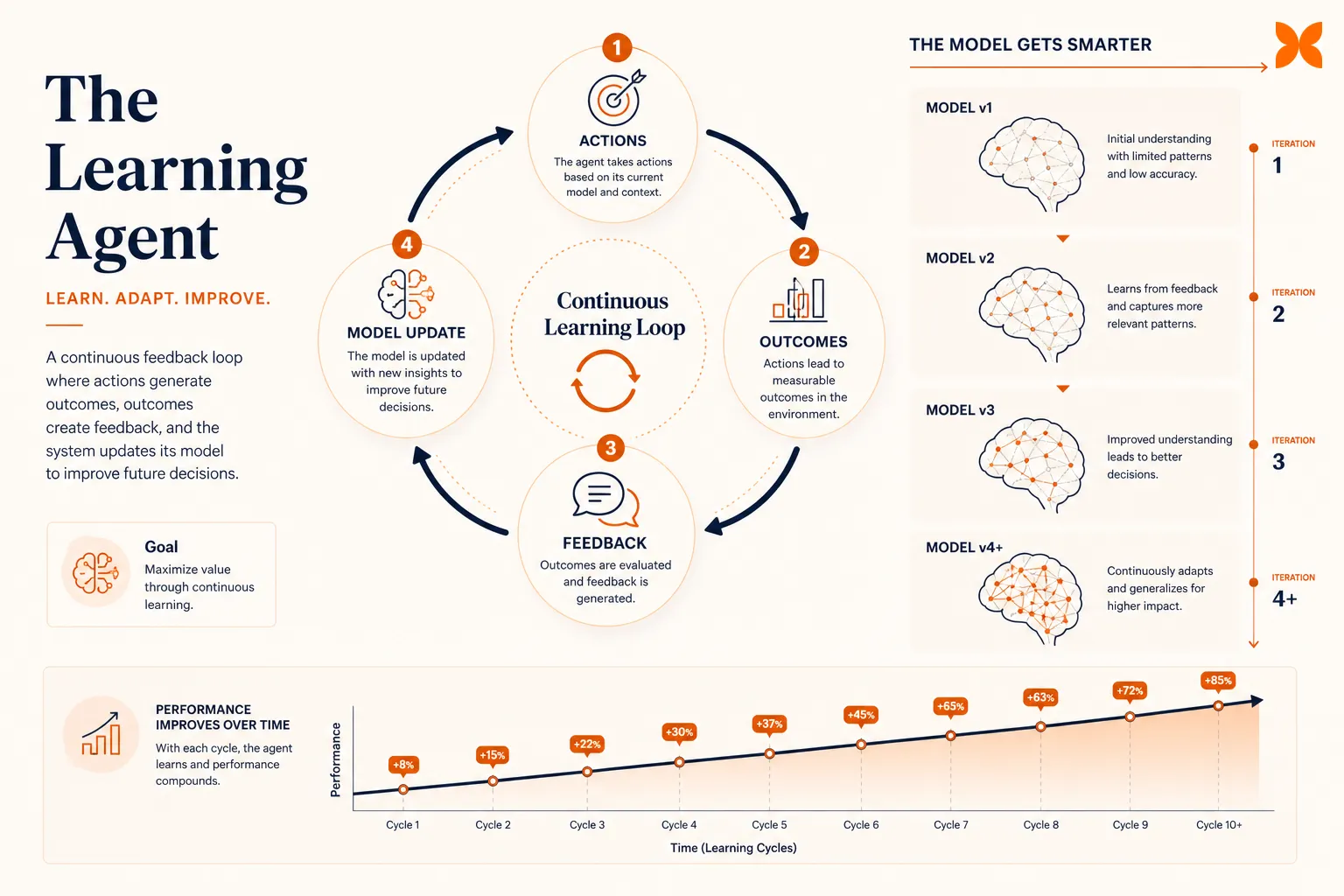
Where they work well: Dynamic environments where conditions change and past experience is valuable. Fraud detection systems that adapt to new attack patterns, content recommendation engines, and predictive maintenance systems that learn from equipment behavior over time.
Where they fall short: When training data is scarce, feedback loops are slow, or the stakes of a wrong prediction are too high for trial-and-error learning without strong guardrails.
How the Five Types Compare
| Type | How It Decides | Memory | Planning | Adaptability | Best For |
|---|---|---|---|---|---|
| Simple reflex | Fixed if-then rules | None | None | None | Predictable, rule-based tasks |
| Model-based reflex | Rules + internal state | Tracks past states | None | Limited | Tasks needing context from history |
| Goal-based | Plans to achieve objectives | Yes | Multi-step planning | Moderate | Tasks with clear objectives |
| Utility-based | Optimizes across criteria | Yes | Evaluates alternatives | Moderate | Multi-objective optimization |
| Learning | Adapts from feedback | Yes | Varies | High | Dynamic, evolving environments |
These five types give you a clear mental model, but production agents rarely fit neatly into a single category. Most real-world systems combine characteristics from multiple types, and that’s where modern agent patterns come in.
Beyond the Classics: Modern Agent Patterns
The five-type framework was designed to explain how individual agents process information and make decisions. Today’s enterprise AI increasingly relies on systems where multiple agents work together, each potentially a different type, coordinated by architectural patterns the original taxonomy doesn’t fully cover.
Multi-Agent Systems
A multi-agent system uses multiple specialized agents to handle a complex task that no single agent could manage well alone. Each agent has a defined role, its own tools, and often its own memory. An orchestrator coordinates who does what.
Picture a customer support operation: one agent triages incoming requests, another handles billing questions with access to payment systems, and a third handles technical troubleshooting with access to documentation and logs. Each agent is specialized. The orchestrator routes the right request to the right agent and combines their outputs when needed.
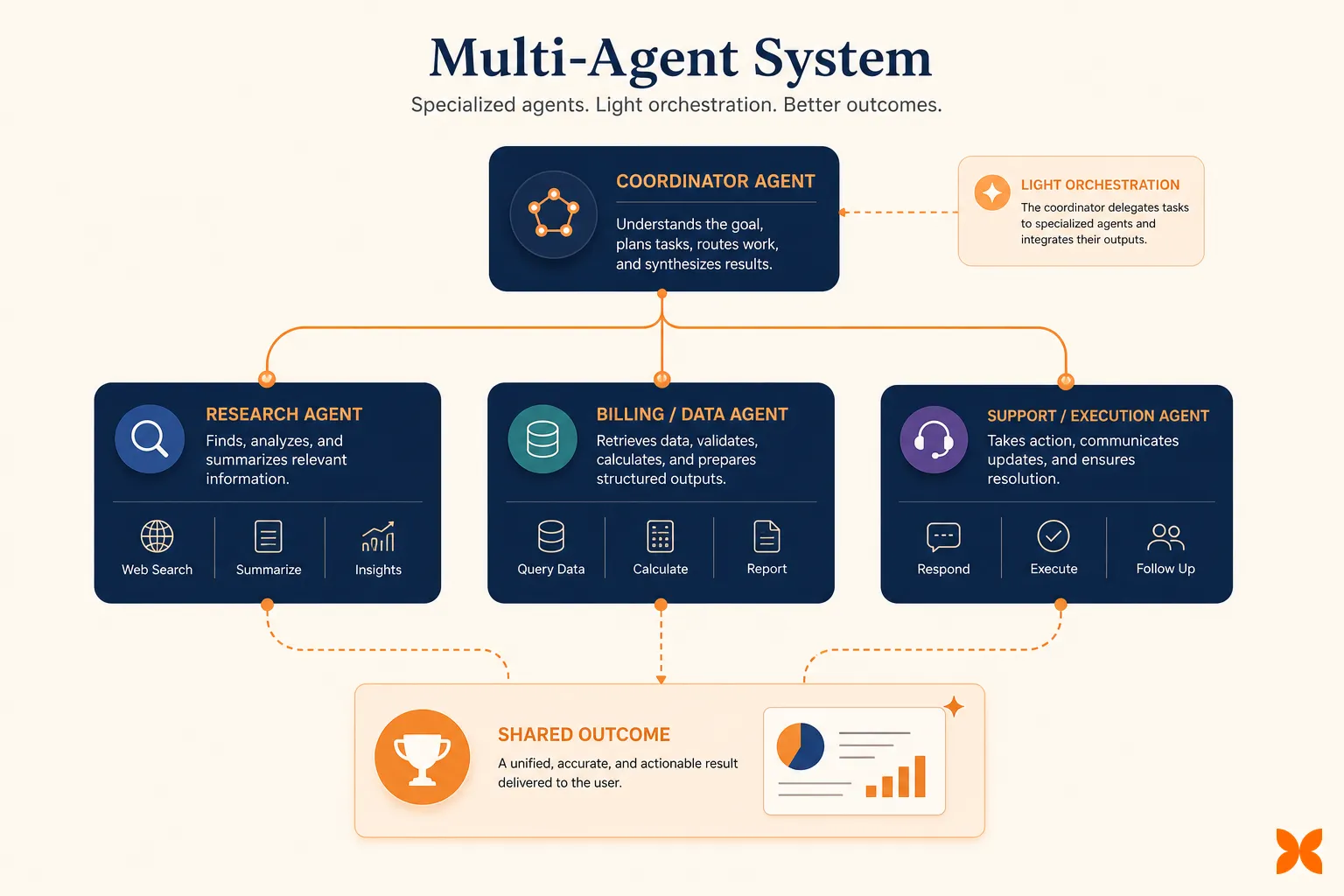
This pattern is growing fast. Gartner predicts that 40% of enterprise applications will feature task-specific AI agents by 2026, up from less than 5% in 2025. Much of that growth involves multi-agent architectures where task-specific agents coordinate rather than one general-purpose agent trying to do everything.
Hierarchical Agents
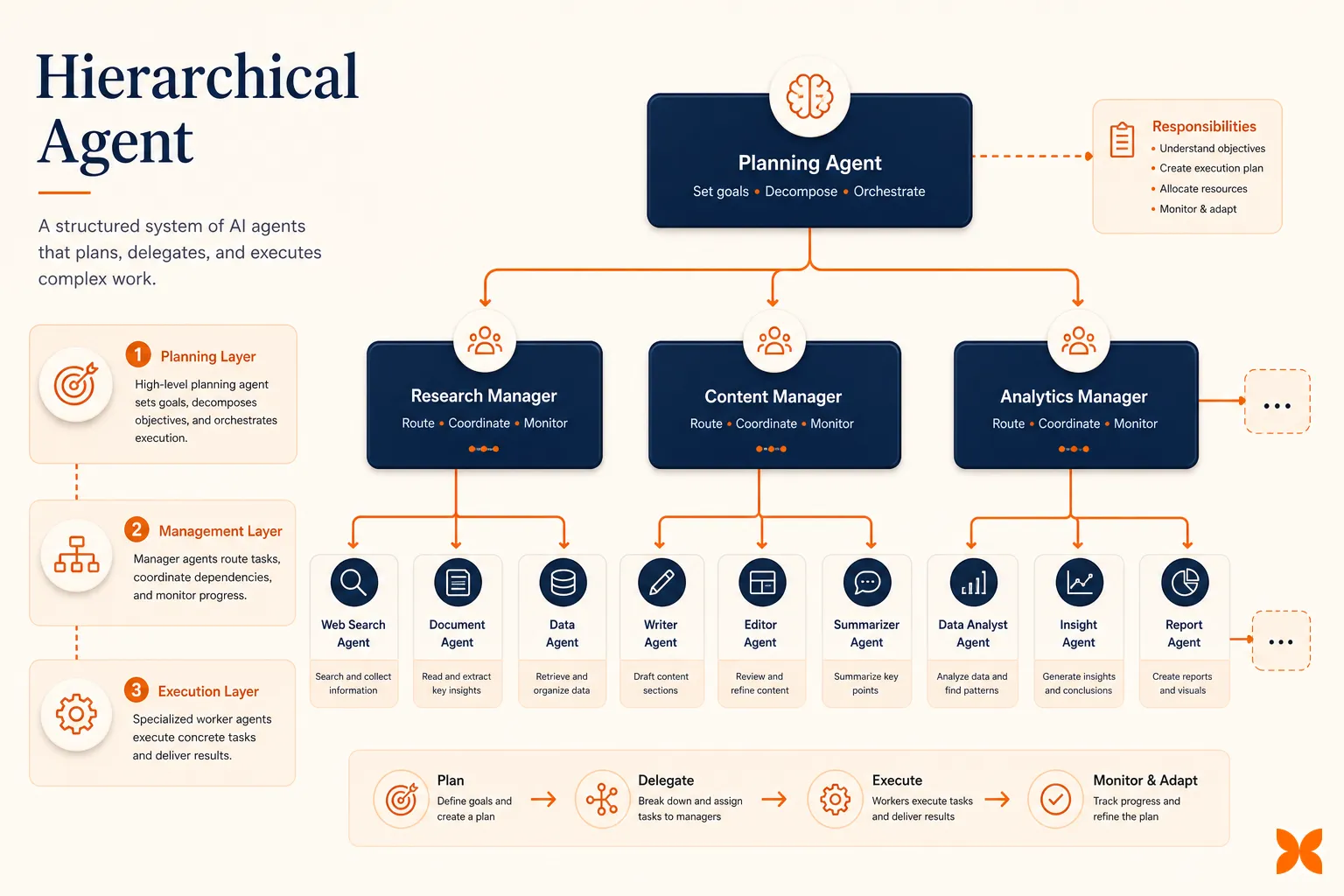
Hierarchical agents use a tiered structure. Higher-level agents handle planning and delegation. Lower-level agents execute specific tasks. The top-level agent might be a goal-based planner that breaks a project into sub-tasks, while each sub-task gets handled by a simpler, specialized agent.
This pattern scales well for enterprise workflows. A content production pipeline, for example, might have a planning agent that outlines the work, a research agent that gathers information, a writing agent, and a review agent, all coordinated by the planner at the top. If you want to dig deeper into how these layers connect structurally, the guide on AI agent architecture covers the implementation details.
Vertical AI Agents
Vertical AI agents are built for specific industries or domains: healthcare, legal, finance, HR, real estate. Unlike general-purpose agents, vertical agents come with specialized training data, domain-specific tool integrations, and compliance guardrails tailored to their industry.
A legal research agent, for instance, doesn’t just search the web. It searches case law databases, understands citation formats, and knows which jurisdictions matter for a given question. A healthcare agent might integrate with electronic health records while enforcing HIPAA-compliant data handling.
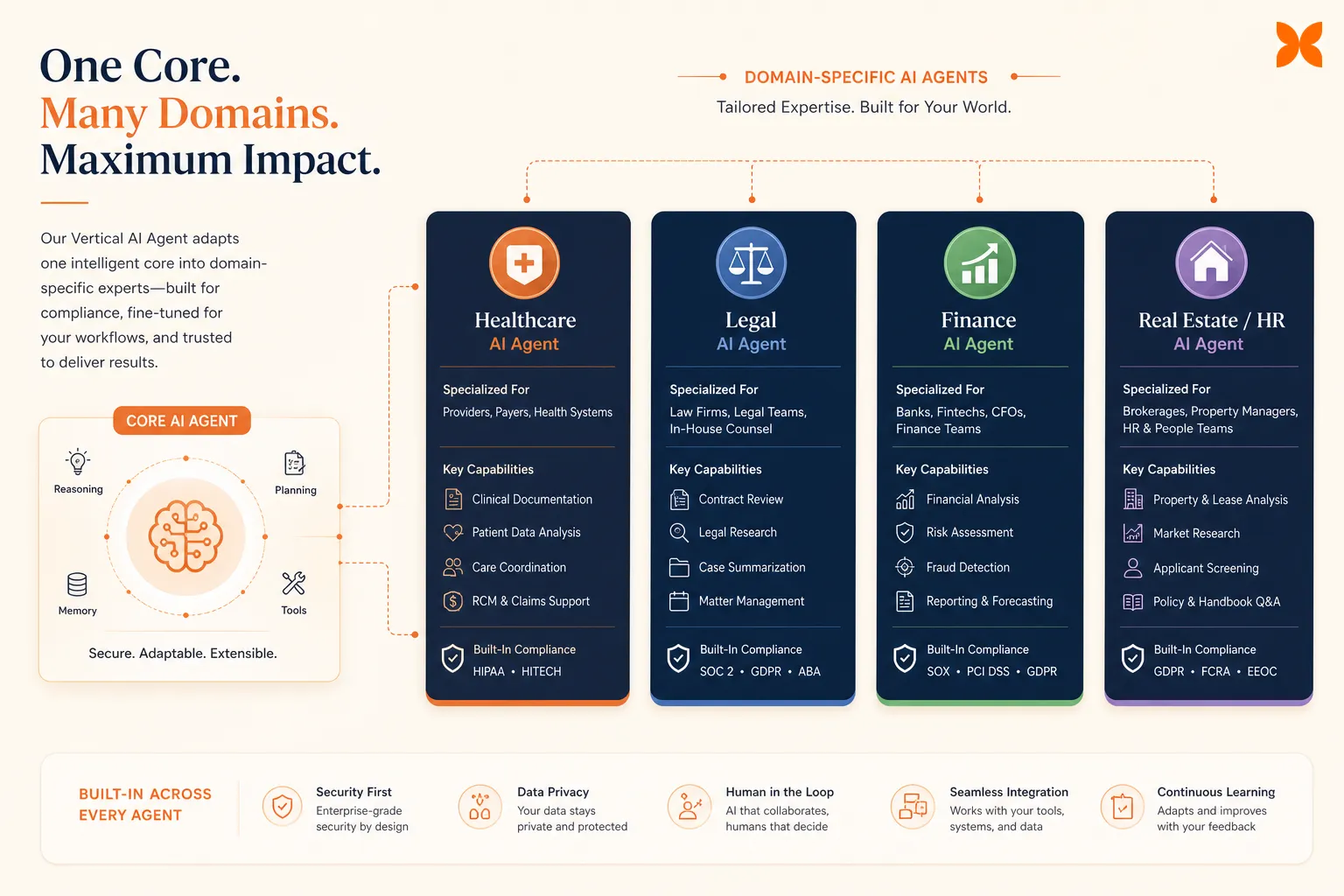
Vertical agents are growing rapidly as organizations move past the “let’s try a general AI assistant” phase and into building tools that actually understand their domain’s requirements and constraints.
The question isn’t whether to use a single classic type or a modern pattern. It’s about matching the right level of complexity to the problem you’re solving.
Which Agent Type Fits Your Use Case?
Here’s a practical way to think about selection. Start with the simplest type that could work and move up only when the task genuinely demands it.
Your task has clear rules and predictable inputs. A simple reflex agent handles it. Automated email sorting, basic data validation, and simple alert triggers don’t need planning or learning. Keep it simple.
Your task needs context from previous actions. Move to model-based. If the agent needs to remember what happened earlier in a conversation, session, or process to make a good decision now, it needs internal state tracking.
Your task has a specific goal with multiple steps to get there. Goal-based agents plan the path. Workflow orchestration, research tasks, and any multi-step process where the end objective is clear but the route isn’t predetermined.
Your task involves competing priorities and tradeoffs. Utility-based agents weigh options. Resource scheduling, budget allocation, and anything where you’re optimizing across multiple dimensions simultaneously.
Your task changes over time and the agent needs to get better. Learning agents adapt. Recommendation systems, fraud detection, quality prediction, and scenarios where historical patterns improve future decisions.
Your task is too complex for a single agent. Consider multi-agent systems or hierarchical orchestration. Break the problem into specialized roles. Platforms like Craze let you build agents that combine these capabilities, such as a goal-based workflow with learning components, without needing to code the architecture from scratch.
Keep in mind that most production agents blend types. A customer service agent might use model-based memory to track conversation context, goal-based planning to resolve the issue, and learning components to improve its responses over time. The five-type framework helps you understand which capabilities matter for your use case, even when the final system doesn’t fit a single label.
Final Thoughts
The five classic AI agent types (simple reflex, model-based reflex, goal-based, utility-based, and learning) give you a vocabulary for understanding how agents think and act. They form a spectrum from reactive to adaptive, and each step up adds capability that may or may not be worth the added complexity for your specific situation.
Modern production agents extend this foundation with multi-agent coordination, hierarchical orchestration, and industry-specific vertical agents. As enterprise adoption accelerates, understanding these types helps you ask better questions about the tools you’re evaluating and the workflows you’re building.
Start with the simplest type that solves your problem. Scale up when the task demands it.
FAQs
What are the 5 types of agents in AI?
The five types are simple reflex agents (act on current input using fixed rules), model-based reflex agents (track past states using an internal model), goal-based agents (plan actions toward specific objectives), utility-based agents (optimize outcomes across competing criteria), and learning agents (improve performance through experience and feedback). This classification comes from Russell and Norvig's Artificial Intelligence: A Modern Approach.
What are common AI agents?
Common examples span all five types: email spam filters (simple reflex), GPS navigation apps (goal-based), recommendation engines on streaming platforms (learning), ride-sharing dispatch systems (utility-based), and smart home systems that track device states (model-based).
What is the difference between goal-based and utility-based agents?
Goal-based agents ask whether an action helps reach an objective, essentially a binary question: achieve the goal or don't. Utility-based agents go further by asking how well an action achieves the objective compared to alternatives. They use a utility function to score and rank outcomes, which lets them handle tradeoffs when multiple goals compete or when several paths could work but one is measurably better.
Can an AI agent be more than one type?
Yes, and most production agents are. A customer support agent might use model-based memory (tracking conversation history), goal-based planning (resolving the ticket), and learning components (improving responses based on feedback). The five types are a framework for understanding capabilities, not rigid product categories.
What are the big 4 AI agents?
This question typically refers to AI agent platforms from major tech companies rather than the theoretical classification of agent types. The distinction matters: agent types (simple reflex, model-based, goal-based, utility-based, learning) describe how agents process information and decide, while big 4 usually refers to specific products or vendors.
More Articles
The 8 Best Lindy AI Alternatives in 2026 (Tested & Compared)

The 8 best Lindy AI alternatives for 2026, anchored to why people leave Lindy, with current pricing, third-party ratings, honest pros and cons, and the best pick for each reason to switch.
The 7 Best Make Alternatives in 2026 (Tested & Compared)
The 7 best Make.com alternatives for 2026, anchored to why people leave Make, with current pricing, third-party ratings, honest pros and cons, and the best pick for each reason to switch.
The 8 Best Zapier Alternatives in 2026 (Tested & Compared)
The 8 best Zapier alternatives for 2026, anchored to why people leave Zapier, with current pricing, third-party ratings, honest pros and cons, and the best pick for each reason to switch.