15+ AI Agent Examples That Are Actually Delivering Results
See real AI agent examples from companies like Uber, TELUS, and Intercom. Organized by function with actual business results, not just product names.

By: Deepit Patil
Co-Founder and CTO
Published
Updated
Edited by Craze Editorial Team · See our Editorial Process
Gartner predicts that 40% of enterprise apps will feature task-specific AI agents by 2026, up from less than 5% in 2025. That is not a slow rollout.
But “AI agent” has become one of those terms that gets slapped on everything from basic chatbots to fully autonomous systems. When every product claims to be an agent, it gets hard to know what is real and what is marketing.
This article cuts through that. You will find real examples of AI agents, organized by what they actually do, with the companies behind them and the business results they reported. Not a product directory. Not a taxonomy lecture. Just evidence of what is working in practice and what it looks like when AI agents deliver real outcomes.
Quick note on scope: an “AI agent” here means a system that can autonomously plan multi-step actions, use external tools, and execute tasks without someone directing each step. If it just answers questions when prompted, it is an assistant, not an agent.
TL;DR
- AI agents are deployed across every major business function: customer support, software development, sales, research, operations, and even physical environments like warehouses and delivery routes.
- Companies are reporting real, measurable results: TELUS saved 40 minutes per AI interaction across 57,000+ employees. Danfoss automated 80%+ of its B2B order processing. Suzano cut supply chain query time by 95%.
- The market is growing fast: The AI agents market hit $7.63 billion in 2025 and is growing at a 49.6% CAGR through 2033.
- Not everything called an “agent” actually is one. The article distinguishes genuine agents (autonomous, tool-using, multi-step) from chatbots and copilots.
- Includes an evaluation framework to help you figure out which examples are relevant to your team, not just impressive on paper.
What Makes Something an AI Agent (vs. a Chatbot or Copilot)
Before diving into examples, it helps to have a quick filter for what actually counts as an “agent.”
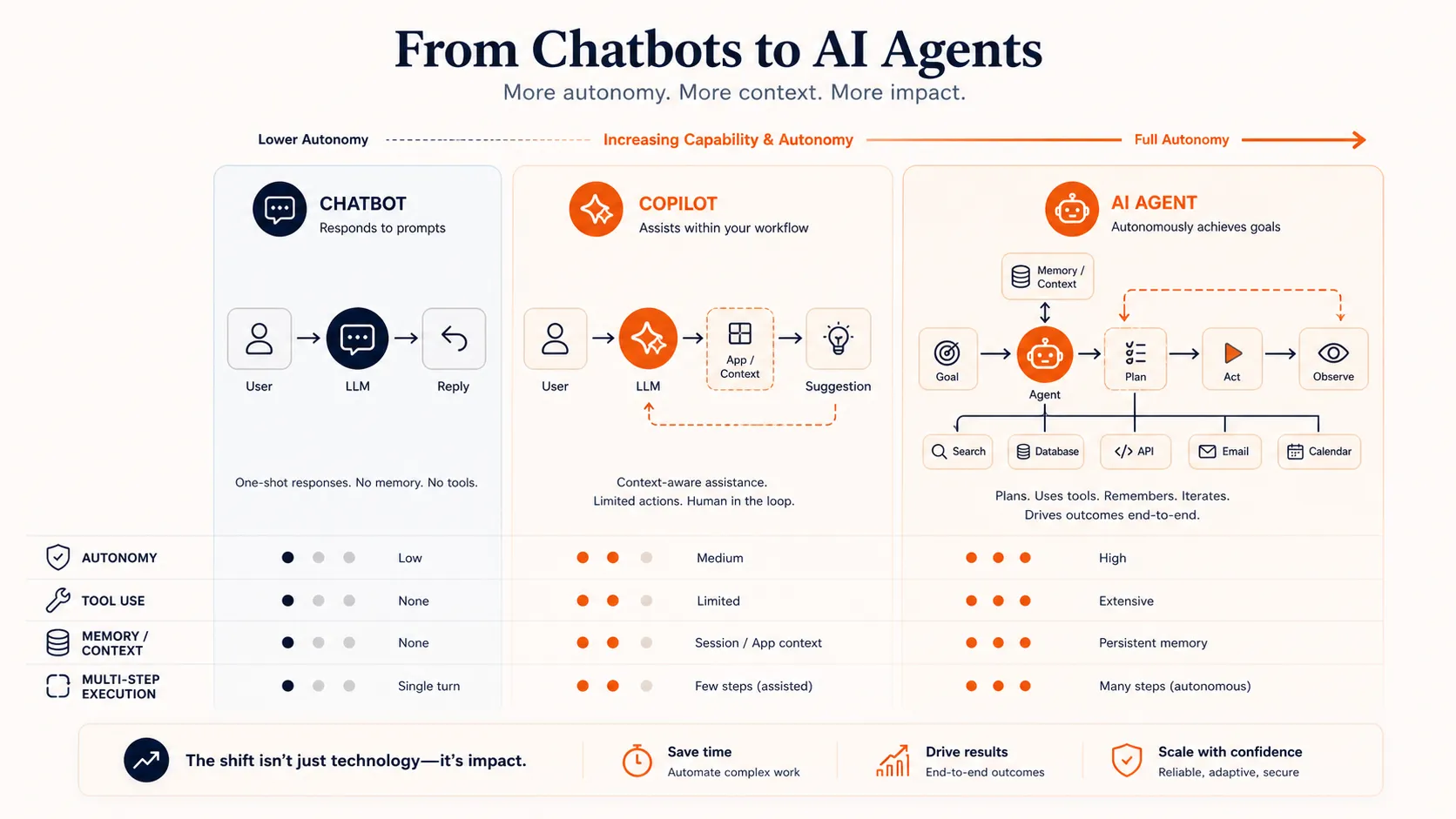
Think of it as a spectrum. A chatbot reacts to individual messages using scripts or pattern matching. It tells you your order status. An AI assistant or copilot uses AI to help you do tasks, but it waits for your direction at each step. It drafts the refund email for you to review. An AI agent pursues goals across multiple steps, uses external tools, and makes decisions on its own. It processes the return, updates inventory, issues the refund, and sends the confirmation without you touching anything.
The key characteristics that separate agents from everything else: they are autonomous (they act without constant prompting), goal-oriented (they work toward a defined outcome), tool-using (they connect to APIs, databases, and external systems), and iterative (they can self-correct when something goes wrong).
Our guide to AI agents covers the full types breakdown and how they work under the hood. Here, we are focused on what they look like in the real world.
AI Agent Examples by Business Function
The examples below are organized by what they do for your business, not by technical classification. Each one includes the company or product, what the agent handles, and the result it delivered.
Software Development and Coding Agents
Coding was one of the first domains where AI agents moved beyond simple autocomplete into genuine autonomy.
Devin AI (Cognition) is positioned as an autonomous software engineer. It does not just suggest code completions. It plans a solution, writes the code, debugs it, runs tests, and deploys changes across a full codebase. Early demos showed it handling end-to-end development tasks that would typically go to a junior developer: setting up environments, reading documentation, and iterating through errors until the code works.
A word of caution: Devin’s capabilities are impressive in controlled demos, but independent benchmarks on real-world performance are still limited. The concept is proven. The consistency at scale is still being validated.
GitHub Copilot Workspace takes the familiar Copilot experience a step further. Standard Copilot suggests code inline as you type, which is assistant-level behavior. Workspace plans and executes changes across entire repositories: analyzing issues, proposing multi-file edits, and letting you review the full plan before applying it. It edges into agent territory because it reasons about the problem, not just the current line of code.
Anthropic’s Claude Code and Cursor’s agent mode represent another pattern: coding agents embedded directly in development environments. They can navigate codebases, run terminal commands, create files, and iterate on solutions with minimal human guidance. The trend is clear: coding agents are moving from “suggest the next line” to “handle the entire task.”
Customer Support and Service Agents
Customer support is the most mature category for AI agents, and it is where the business impact data is strongest.
AI support agents are delivering measurable cost savings. Industry estimates put cost per interaction at $3-6 with a human agent versus $0.25-0.50 with an AI agent, an 85-90% cost reduction per interaction for queries an agent can handle.
Intercom Fin is one of the most visible examples. It works as both a chat and voice AI agent, handling customer conversations end to end. It does not just answer questions. It accesses customer data, processes actions (like issuing refunds or updating accounts), and decides when to escalate to a human. Intercom built their voice agent, Fin Voice, in roughly 100 days, integrating a full stack of transcription, LLM reasoning, text-to-speech, and telephony.
Decagon focuses on enterprise-level support complexity. Where simpler AI tools handle straightforward FAQ-style queries, Decagon targets multi-step support workflows that require pulling data from multiple systems, applying business logic, and coordinating across internal teams.
TELUS, a Canadian telecom with 57,000+ employees, deployed agentic AI across its operations using Google Cloud infrastructure. The result: 40 minutes saved per AI interaction across the workforce. For a company that size, the cumulative time savings are substantial.
Sales and Marketing Agents
Sales agents are moving beyond lead scoring into autonomous workflow execution.
Sales qualification and outreach agents now handle the repetitive parts of the sales cycle: qualifying inbound leads against ideal customer profiles, enriching contact records in the CRM, sending personalized follow-up emails, and booking meetings on sales reps’ calendars. The human rep steps in for the actual conversation. Everything before that, the agent handles.
Netguru built Omega, a multi-agent sales system that coordinates across Slack, CRMs, Apollo, and Google Drive. One agent prepares expert call agendas. Another summarizes sales conversations. A third generates proposal feature lists and tracks deal momentum. The system uses specialized agent roles: a SalesAgent analyzes requests, a PrimaryAgent executes tasks, and a CriticAgent reviews outcomes and provides feedback before they reach a human.
Social media monitoring agents represent the marketing side. These agents track brand mentions, analyze sentiment patterns, flag potential escalations, and can even draft responses for human approval. The shift is from reactive social media management (someone checks the mentions once a day) to continuous, automated monitoring with human review on the output.
Research and Data Analysis Agents
Research is where multi-agent orchestration is becoming visible in production systems.
Uber built Finch, a conversational AI agent embedded in Slack that gives finance teams instant access to data. Instead of writing SQL queries manually (which could take hours for complex analyses), team members ask questions in plain language. Finch’s multi-agent architecture routes each query through specialized sub-agents: a Supervisor Agent decides which tools to use, a SQL Writer Agent constructs the query, and results come back formatted directly in Slack. Uber published their engineering approach including how they test for accuracy using golden response sets and regression testing.
Harvey AI specializes in legal research and analysis. It handles document review, contract analysis, and legal research tasks that would typically take junior associates hours of manual work. Major law firms have adopted it for the volume work that is time-intensive but follows repeatable patterns.
Anthropic’s Claude Research is a multi-agent system where a lead agent plans the research scope and spawns parallel sub-agents to search, gather, and synthesize information from different sources. The lead agent then assembles the findings into a coherent answer. Anthropic published their architecture showing how they evaluate quality using an LLM judge that scores factual accuracy, citation accuracy, completeness, and source quality.
These research examples highlight a broader trend: single agents are giving way to multi-agent systems where specialized agents handle different parts of a complex task and an orchestration layer coordinates the workflow.
Operations and IT Automation Agents
Back-office operations is where some of the most concrete ROI numbers show up.
Danfoss, a global industrial manufacturer, deployed an agentic order management system on Google Cloud. It processes B2B orders that arrive by email, a workflow that used to require manual data entry, validation, and system updates. The result: more than 80% of transactional decisions are now handled by the AI agent. Humans review exceptions and edge cases. The routine volume runs autonomously.
Moveworks automates employee IT and HR support. When an employee needs software provisioned, a password reset, or an answer to a benefits question, the agent handles it without a support ticket ever reaching a human. It connects to internal systems (identity management, HR databases, knowledge bases) and resolves requests end to end.
Suzano, the world’s largest pulp manufacturer with 50,000 employees, built a Gemini Pro AI agent for supply chain data queries. Employees ask questions in plain language, and the agent translates them into SQL queries across their data infrastructure. The result: a 95% reduction in query time. What used to require a data analyst and hours of manual work now takes seconds.
Finance teams are deploying invoice processing agents that automatically receive invoices, extract key fields, match them against purchase orders, flag discrepancies, and route approvals. The pattern is the same: the agent handles the volume, humans handle the exceptions.
Voice AI Agents
Voice is one of the fastest-growing agent categories, driven by improvements in real-time transcription and text-to-speech.
Intercom Fin Voice (mentioned in customer support above) is a standout example of enterprise voice AI. It handles the full phone support flow: listens to the caller, understands intent, pulls relevant information, responds conversationally, and escalates when needed. The technical stack includes real-time transcription, LLM reasoning, retrieval-augmented generation for knowledge base access, text-to-speech, and telephony integration.
SMB voice agents are making 24/7 phone coverage accessible to businesses that cannot staff call centers. Restaurants, dental clinics, auto shops, and service businesses are deploying voice agents that handle appointment booking, answer common questions, take orders, and route callers to humans for anything complex. The cost is a fraction of a human receptionist, and the phone never goes unanswered.
The voice agent space is moving quickly. The latency and naturalness problems that made early voice AI feel robotic have largely been solved for structured conversations (booking, FAQs, order status). Unstructured, emotionally complex calls still go to humans, and that is the right call for now.
Physical and Robotic Agents
Not all AI agents live in software. Some operate in the physical world.
Autonomous delivery robots are navigating sidewalks in multiple cities, avoiding pedestrians and obstacles to deliver packages and food orders. They use computer vision, GPS, and real-time path planning to operate independently. The scope is limited (last-mile delivery in mapped environments), but the autonomy is real.
NASA’s Mars Rovers (Perseverance, Curiosity) are arguably the most autonomous AI agents in existence. They navigate terrain, conduct scientific experiments, and make navigational decisions with minimal real-time guidance from Earth. The communication delay between Earth and Mars makes human-directed control impractical, so the rovers operate with genuine autonomy for extended periods.
These physical examples are less directly relevant to most business readers, but they illustrate the full spectrum of what “AI agent” means: from software processing invoices to robots navigating another planet. The more practical question for most teams is how to decide which of these examples actually matters for their work.
How to Evaluate AI Agent Examples for Your Team
Seeing impressive examples is one thing. Knowing which ones matter for your situation is another. Before you get excited about any of the examples above, run them through these five questions.
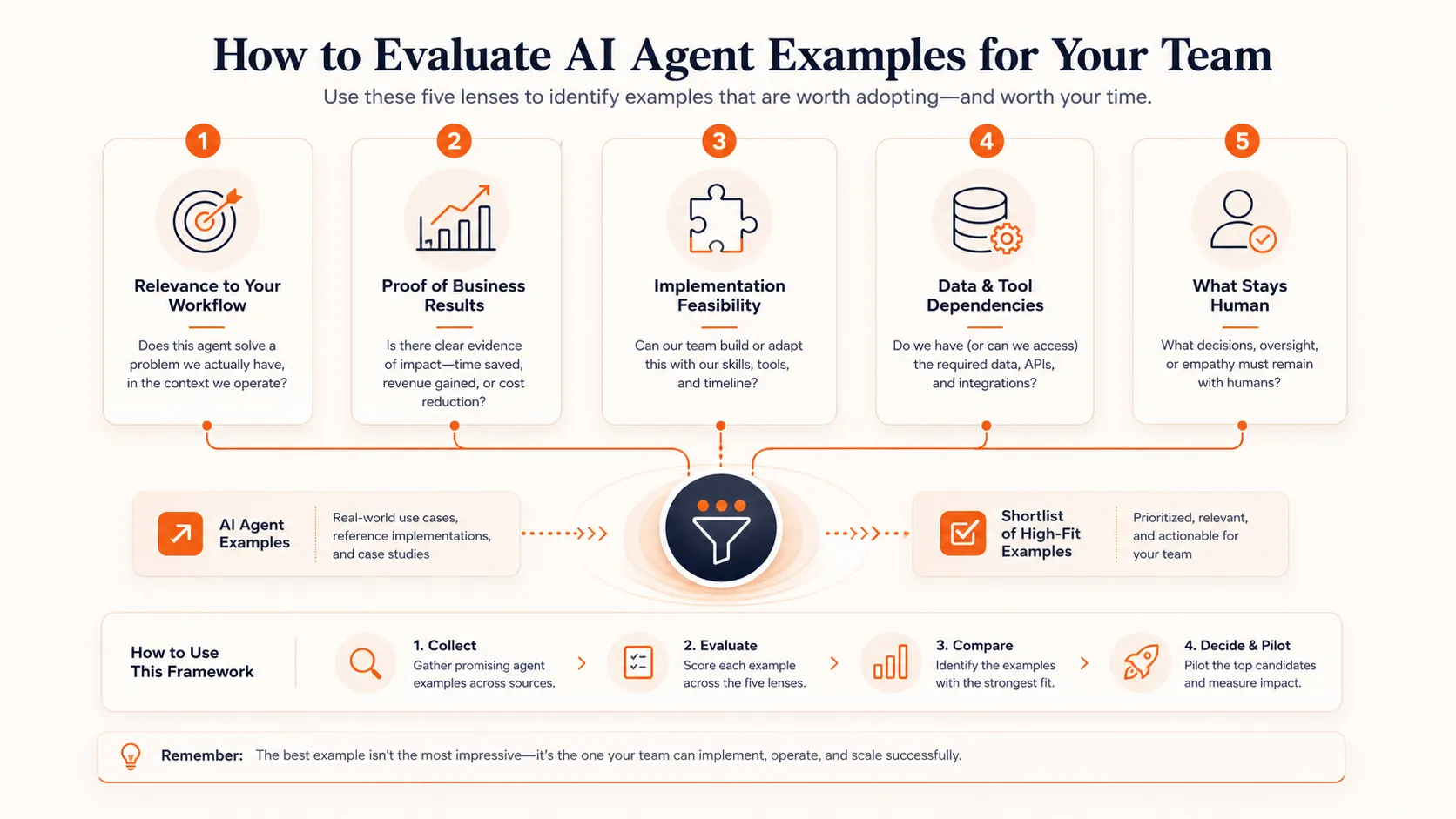
1. Does this agent solve a problem your team actually has? Match examples to your real workflows, not to what sounds cool. If your team does not spend hours writing SQL queries, Uber’s Finch is interesting but not relevant. If your support team is drowning in repetitive tickets, customer support agents are worth a closer look.
2. Is the result verified or just claimed? First-party metrics from engineering blogs (like Uber and Danfoss publishing their numbers) are stronger than marketing claims. Industry benchmarks give useful context but may not match your specific situation. When no hard numbers exist, that does not mean the agent does not work. It means you should pilot before committing.
3. Can your team implement something similar? Some examples require enterprise-scale infrastructure. Others are accessible to smaller teams through no-code platforms or off-the-shelf products. Voice agents for appointment booking, for instance, are available as ready-to-deploy services for small businesses. Building a multi-agent research system like Anthropic’s requires significant engineering resources.
4. What does the agent need to work? Every agent depends on data access, tool integrations, and permissions. A customer support agent needs access to your CRM, order history, and policy documents. A finance agent needs database access and secure query permissions. Map the dependencies before evaluating feasibility.
5. What stays human? The strongest agent deployments keep humans in the loop for judgment calls, edge cases, and anything customer-facing or financially significant. Danfoss handles 80%+ of orders with their agent, but humans still review the exceptions. That is the right pattern.
If you want to experiment with building AI agents without heavy engineering, Craze lets you build agents, create reusable workflows, and pick the right AI model for each task. Start with one workflow, measure the result, and expand from there. But where are agents headed from here?
What Is Next for AI Agents
The trajectory is clear. Agentic AI is moving from single-task tools to coordinated systems.
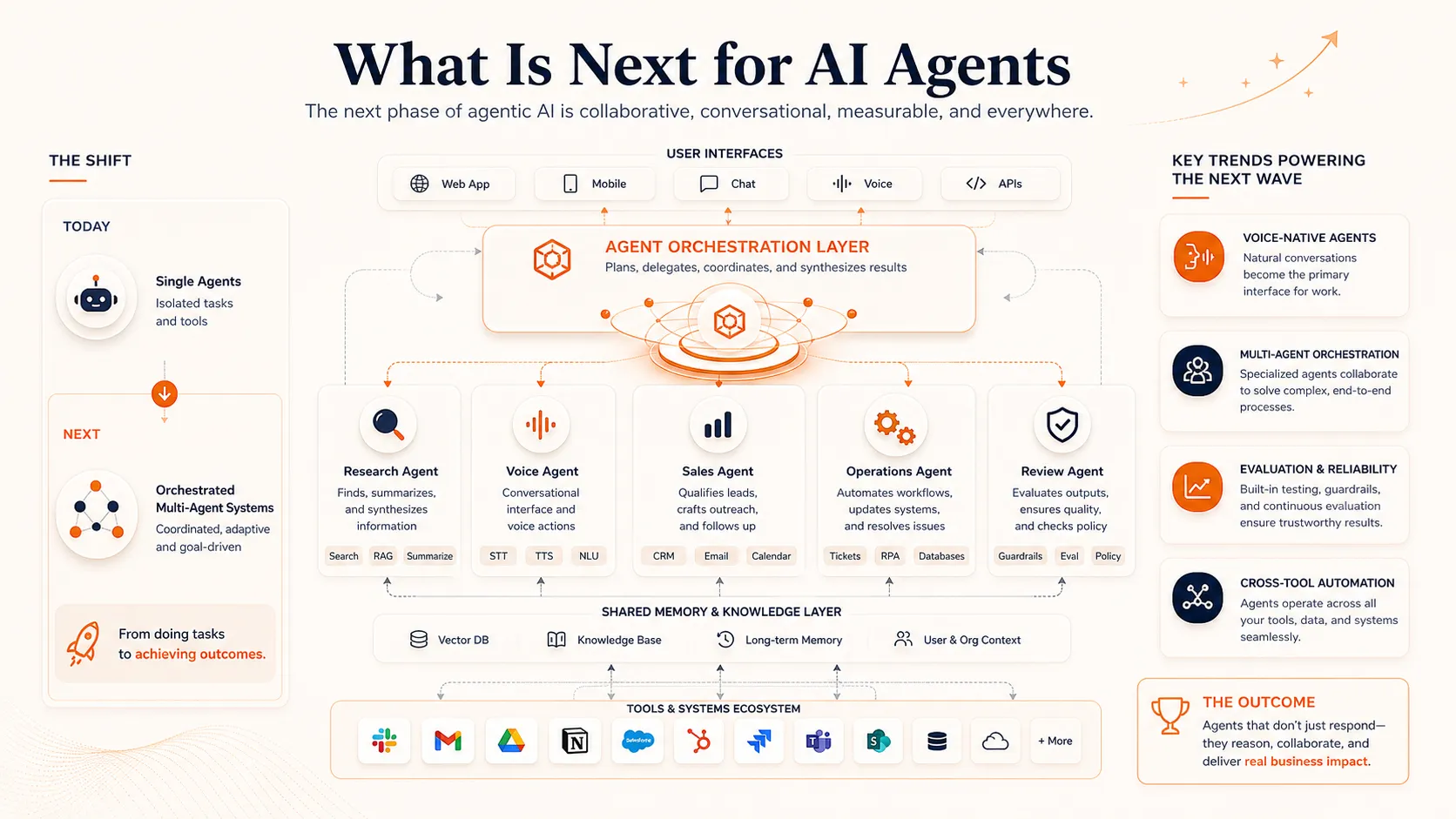
Multi-agent orchestration is becoming standard practice. Uber’s Finch uses a supervisor agent routing tasks to specialized sub-agents. Anthropic’s research system spawns parallel agents for different search tasks. Netguru’s Omega coordinates three agent roles in their sales workflow. The pattern is the same: complex work gets broken into specialized tasks, each handled by a purpose-built agent, with an orchestration layer managing the handoffs.
Voice AI agents are expanding rapidly beyond customer support into sales calls, appointment booking, and internal communications. The technology is mature enough for structured conversations and improving quickly for open-ended ones.
Agent evaluation and testing is emerging as its own category. As agents handle more critical workflows, organizations need ways to verify they are working correctly. Companies like Evidently AI are building testing frameworks specifically for agent reliability.
79% of organizations already say they have adopted AI agents to some extent, according to PwC. The question is no longer whether agents work. It is which workflows to target first and how to deploy them with enough discipline to capture real value.
Bottom Line
AI agents are delivering measurable results across customer support, operations, research, sales, and software development. The examples in this article are not lab demos or conference slides. They are production deployments from companies reporting real numbers: time saved, costs reduced, queries automated.
The smart move is not to deploy agents everywhere at once. Start with the workflow where the ROI is clearest, set guardrails, keep humans in the loop for edge cases, and expand based on what actually works.
FAQs
What are the most popular AI agents?
The most widely deployed AI agents fall into customer support (Intercom Fin, Zendesk AI), coding (GitHub Copilot, Devin AI), virtual assistants (Siri, Alexa), and enterprise automation (Moveworks, ServiceNow). Popular depends on context: consumer-facing agents like Siri have the most users, but enterprise agents like Intercom Fin and Moveworks handle the most business-critical workflows.
How are AI agents different from chatbots?
Chatbots react to individual messages using scripts or pattern matching. AI agents pursue goals across multiple steps, use external tools, access databases and APIs, and make decisions autonomously. A chatbot tells you your order status. An agent processes your return, updates inventory, issues the refund, and sends the confirmation without a human in the loop.
What industries use AI agents the most?
Telecom leads at 48% adoption of agentic AI, followed by retail and consumer goods at 47%. Financial services, legal, and logistics are also heavy adopters. Healthcare and government trail at 18% and 14% respectively. Customer support and IT operations are the most common starting points across all industries.
More Articles
The 8 Best Lindy AI Alternatives in 2026 (Tested & Compared)

The 8 best Lindy AI alternatives for 2026, anchored to why people leave Lindy, with current pricing, third-party ratings, honest pros and cons, and the best pick for each reason to switch.
The 7 Best Make Alternatives in 2026 (Tested & Compared)
The 7 best Make.com alternatives for 2026, anchored to why people leave Make, with current pricing, third-party ratings, honest pros and cons, and the best pick for each reason to switch.
The 8 Best Zapier Alternatives in 2026 (Tested & Compared)
The 8 best Zapier alternatives for 2026, anchored to why people leave Zapier, with current pricing, third-party ratings, honest pros and cons, and the best pick for each reason to switch.