AI Agents vs Agentic AI: Key Differences Explained
What separates AI agents from agentic AI? Learn the key differences, see how they work together, and find out which approach fits your team.

By: Deepit Patil
Co-Founder and CTO
Published
Updated
Edited by Craze Editorial Team · See our Editorial Process
If you’ve spent any time reading about AI automation, you’ve probably seen “AI agents” and “agentic AI” used as though they mean the same thing. They don’t. One describes a component. The other describes a system. Confusing them leads to real problems: teams buy agent platforms expecting end-to-end automation, or invest in agentic infrastructure when a single well-configured agent would have done the job.
The distinction matters now more than ever. Gartner projects that 40% of enterprise applications will include AI agents by 2026, up from less than 5% in 2025. But most organizations are still figuring out where agents end and agentic AI begins.
This article breaks down the difference, shows how the two relate, and gives you a practical framework for deciding which approach fits your team.
TL;DR
- AI agents are individual software components that handle specific tasks, like classifying support tickets or extracting invoice data.
- Agentic AI is the system that coordinates multiple agents, tools, and data sources to achieve broader, multi-step goals.
- You can run agents without agentic AI. You can’t run agentic AI without agents.
- 62% of organizations are experimenting with AI agents, but only 23% are scaling agentic systems.
- Start with agents for well-defined tasks. Consider agentic AI when you need cross-system, multi-step automation.
What Is an AI Agent?
An AI agent is a software component that takes in information, reasons about it, and acts to complete a specific task. Think of it as a focused worker with a defined job: it knows what inputs to expect, what rules to follow, and what output to deliver.
In practice, agents handle scoped, repeatable work. A support agent classifies incoming tickets and routes them to the right team. An extraction agent pulls key fields from invoices and enters them into your accounting system. A FAQ agent answers common customer questions using your knowledge base.
Agents range in complexity from simple if-then rules to language models that reason through ambiguous inputs and pick the best action. But regardless of sophistication, an agent’s scope is bounded. It handles one job, not an entire workflow. You can explore how AI agents work , the types you’ll encounter, and what makes them effective in more depth.
The real question comes when a single task isn’t enough. What happens when you need multiple agents working together toward a larger goal?
What Is Agentic AI?
Agentic AI is the system that plans, reasons, and coordinates multiple agents to achieve complex, multi-step outcomes. Where an agent handles a task, agentic AI handles a workflow.
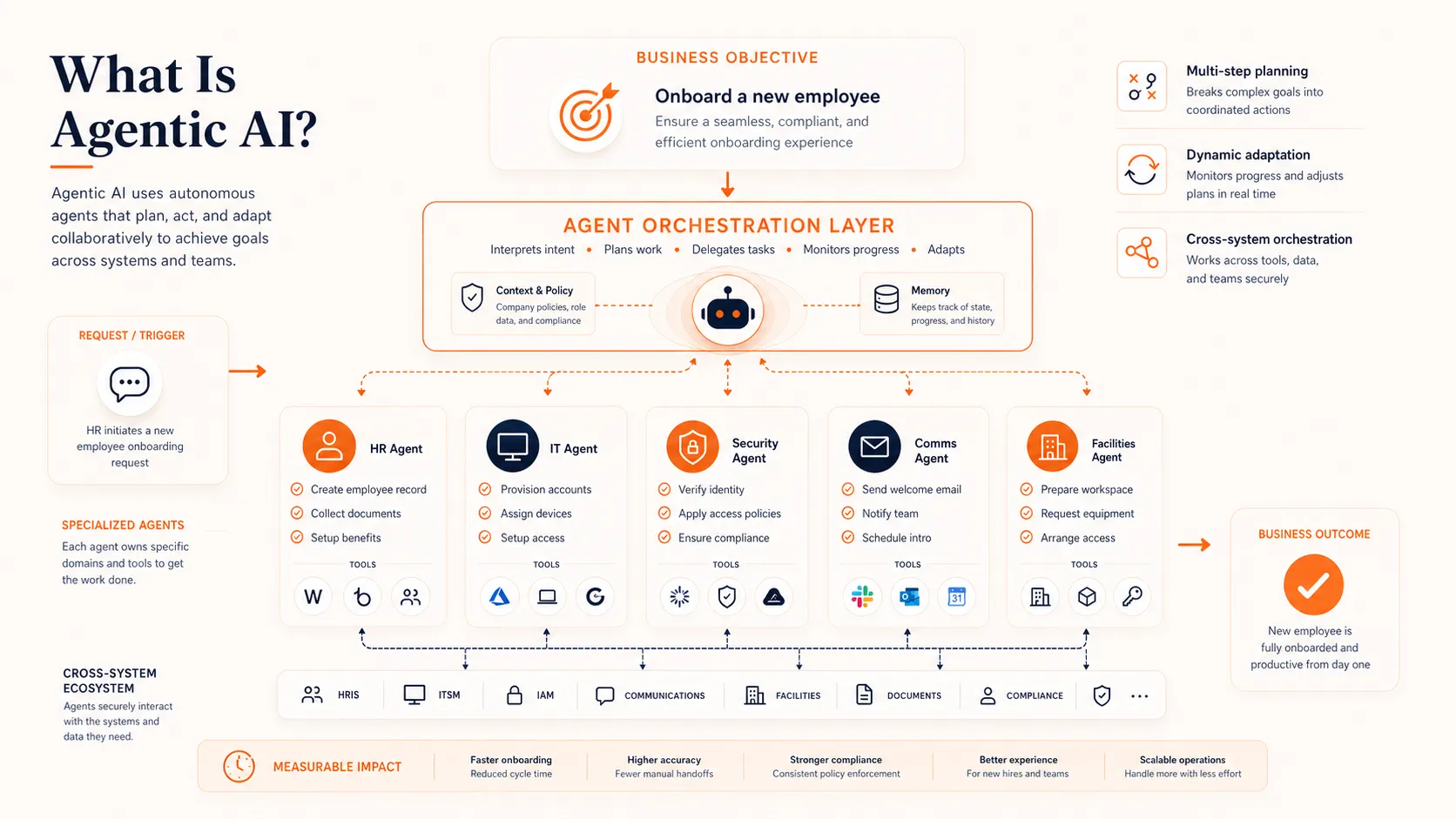
Four capabilities separate agentic AI from standalone agents:
- Goal-oriented reasoning. The system breaks a high-level objective (“onboard this new employee”) into the specific subtasks required to complete it.
- Multi-step planning. It determines the right sequence: which tasks depend on others, which can run in parallel, and what information each step needs.
- Dynamic adaptation. When something goes wrong or new information surfaces, the system adjusts its plan instead of failing or stopping.
- Cross-system orchestration. It coordinates agents that operate across different tools and data sources, not just within a single application.
There’s a useful distinction here worth calling out. An AI agent is an entity, a piece of software that does something. Agency is the capability for independent, goal-directed action. A traditional chatbot is technically an agent (it processes inputs and produces outputs), but it lacks agency because it doesn’t pursue goals, adapt to obstacles, or coordinate other systems. Agentic AI, by definition, has agency.
Consider employee onboarding. An agentic system takes the goal “onboard Sarah, starting Monday” and coordinates across HR (employment records, benefits enrollment), IT (laptop provisioning, account creation, security permissions), facilities (desk assignment, badge access), and communications (welcome email, team introductions, first-week schedule). Each of those might be handled by a specialized agent, but the agentic layer manages the sequence, handles dependencies, and adapts when the laptop shipment is delayed or an account creation fails.
If you’re curious how agentic AI compares to generative AI specifically, that’s a different comparison axis worth exploring separately.
With both concepts defined, the practical differences become clearer.
Key Differences Between AI Agents and Agentic AI
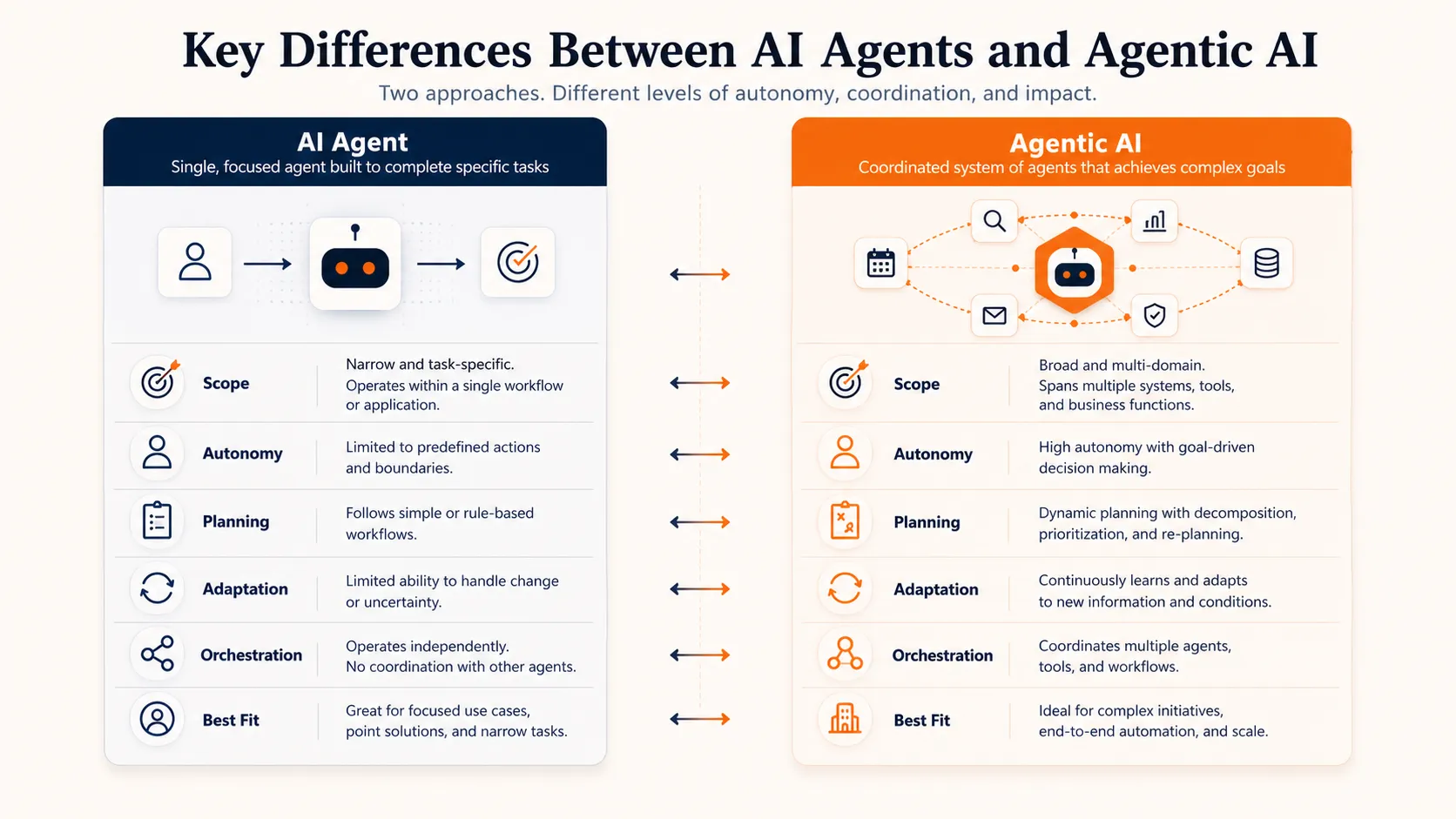
The differences come down to scope, coordination, and adaptability. Here’s a direct comparison:
| Dimension | AI Agents | Agentic AI |
|---|---|---|
| Scope | Single task or function | End-to-end outcomes across tasks |
| Autonomy | Operates within defined boundaries | Sets sub-goals and adjusts approach independently |
| Planning | Follows predefined logic or prompts | Decomposes goals into multi-step plans |
| Adaptation | Limited; escalates or fails on exceptions | Adjusts strategy when conditions change |
| Orchestration | Works alone or in isolation | Coordinates multiple agents and systems |
| Decision-making | Rule-based or single-model reasoning | Goal-driven reasoning across contexts |
| Best for | Defined, repeatable tasks in one system | Complex workflows spanning multiple systems |
Three of these differences matter most in practice.
Agents Handle Tasks; Agentic AI Handles Outcomes
An agent automates a step. Agentic AI automates the result. This is the most important distinction. When you deploy an agent, you’re saying “do this specific thing.” When you deploy agentic AI, you’re saying “achieve this goal, and figure out the steps.”
Agents Work Alone; Agentic AI Coordinates
Running five agents doesn’t give you agentic AI. Without an orchestration layer managing handoffs, dependencies, and shared context, you just have five independent agents that don’t know about each other. Agentic AI is what turns individual agents into a coordinated system.
Agents Follow Rules; Agentic AI Adjusts Strategy
When an agent hits an edge case outside its rules, it typically escalates to a human or returns an error. An agentic system can re-evaluate the situation, try an alternative approach, or reprioritize tasks based on new information.
Seeing the Difference: A Customer Refund Request
The distinction becomes concrete when you see the same problem handled both ways.
Agent-only approach: A customer requests a refund. The refund agent checks the return policy, verifies the purchase is within the eligible window, processes the refund, and sends a confirmation email. Done. One task, handled well.
Agentic approach: The same refund request comes in. The system first checks the customer’s history and identifies a pattern: this is the third complaint in two months, all about the same product line. Instead of jumping straight to the refund, it routes the request to a retention agent first, which offers a replacement and a discount on the next order. If the customer still wants a refund, the system processes it, flags the product issue for the product team, updates the CRM with the interaction history, and adjusts the customer’s risk profile. Multiple agents, coordinated toward a better outcome.
The agent-only path solved the immediate task. The agentic path solved the business problem.
So if agents are the building blocks and agentic AI is the system, how do they actually fit together?
How AI Agents and Agentic AI Work Together
Agents and agentic AI aren’t competing approaches. They exist in a building-block relationship: agents are the components, and agentic AI is the architecture that connects them.
You can absolutely run agents without agentic AI. A standalone chatbot answering support questions is a useful agent that doesn’t need an orchestration layer. A scheduling agent that books meetings based on calendar availability works fine on its own.
But agentic AI can’t exist without agents. The orchestration layer needs something to orchestrate. Without specialized agents handling individual tasks, there’s nothing to coordinate.
Here’s what catches people: deploying multiple agents doesn’t automatically make your setup “agentic.” If your support agent, billing agent, and CRM agent all run independently with no shared context or coordination, you have three agents, not an agentic system. The agentic layer is what provides the shared reasoning, the handoffs between agents, and the ability to adapt the overall workflow based on what each agent discovers.
It helps to think of this as a spectrum rather than a binary choice. Many tools you already use sit somewhere in the middle. A chat assistant with web browsing, code execution, and file access has agent-like capabilities. It can use tools and take multi-step actions. But it typically doesn’t set its own goals, coordinate other systems, or adapt its strategy across a complex workflow. It has some agentic features without being a full agentic system.
As Anthropic’s engineering team has noted, the right approach is to find the simplest solution that works and only add complexity when you genuinely need it. Sometimes that means a single agent. Sometimes it means a coordinated agentic system. Often it means starting with one and evolving toward the other.
Understanding where you are on that spectrum is what makes the next question practical: when should you choose one approach over the other?
When to Use AI Agents vs Agentic AI
Most teams don’t need to choose one or the other permanently. The right approach depends on what you’re trying to automate and how complex the workflow is.
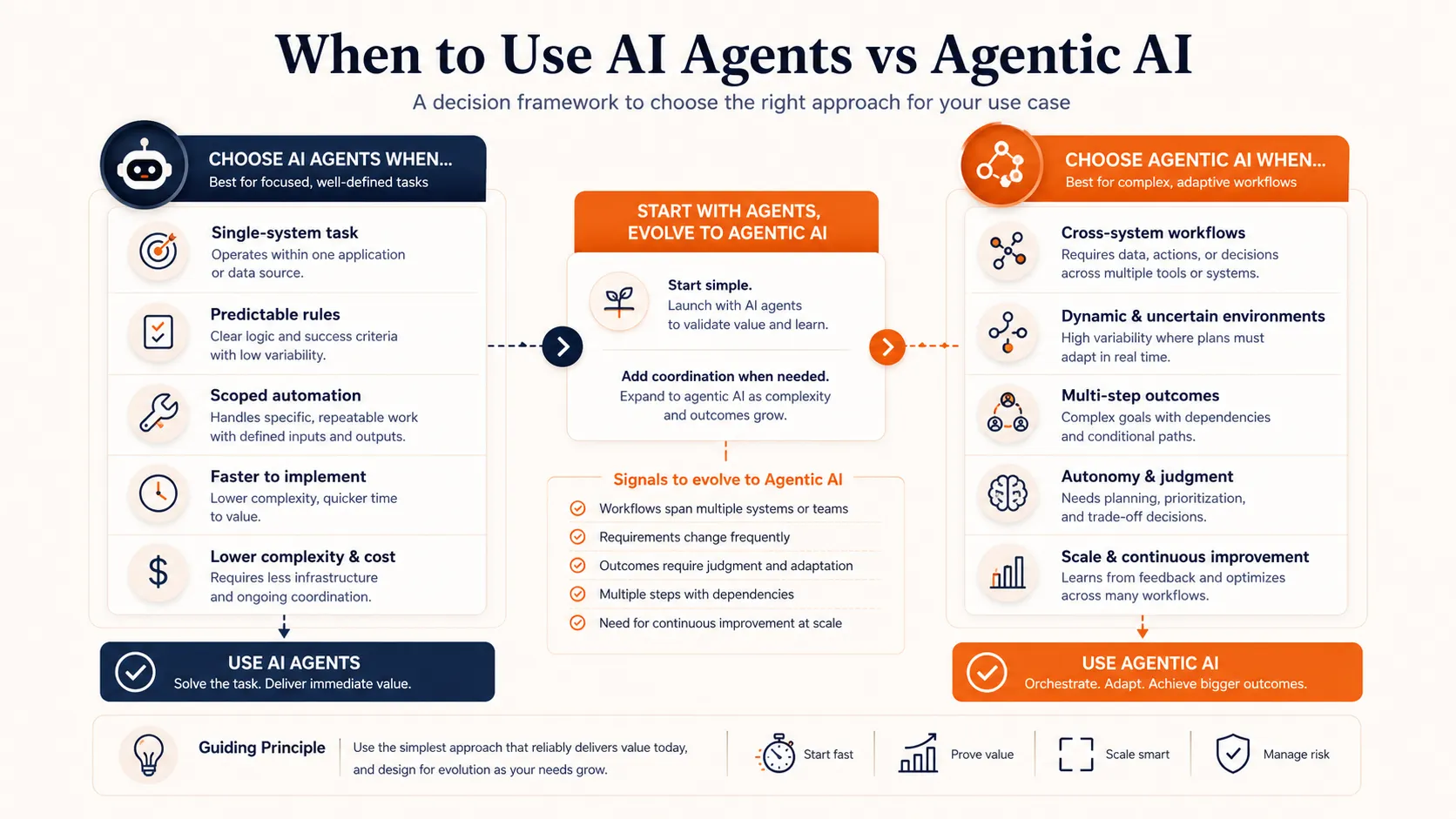
Choose Agents When
- The task is well-defined with clear inputs and outputs
- The work happens within a single system or data source
- Rules and logic are predictable (eligibility checks, data extraction, classification)
- You’re automating a single step in a larger process
Choose Agentic AI When
- The workflow spans multiple systems and tools
- Steps depend on each other and require reasoning about what to do next
- The process needs to adapt when conditions change
- You’re automating an outcome, not just a task
Start with Agents, Add Coordination When
- Multiple standalone agents are running in silos and need to share context
- Handoffs between systems are manual and error-prone
- You’re spending more time managing agent outputs than the agents save you
The adoption data supports a measured approach. While 79% of executives say their companies are adopting AI agents, the McKinsey State of AI report shows that in any given business function, no more than 10% of organizations are actually scaling them. Most teams are still in the experimentation phase.
That isn’t a reason to wait, but it’s a reason to start practical. Agentic AI requires strong system integrations, clear governance policies, and well-defined goals. Without those foundations, standalone agents almost always deliver more value faster.
Making the Right Choice
The difference between AI agents and agentic AI isn’t academic. It shapes how you plan your automation strategy, where you invest, and what results you can realistically expect.
Start with well-configured agents for defined, repeatable tasks. They’re faster to deploy, easier to evaluate, and deliver measurable value quickly. As your workflows grow more complex and you find yourself coordinating multiple agents manually, that’s when the orchestration layer of agentic AI starts earning its investment.
Craze lets you build and run AI agents across models, giving you a practical starting point for exploring what agents can do before you need full agentic infrastructure.
For concrete examples of agents in action, explore AI agent examples . If you’re ready to start building, how to build an AI agent walks through the process step by step.
FAQs
Is ChatGPT an AI agent or agentic AI?
ChatGPT is primarily a generative AI system built on a large language model. With features like browsing, code execution, and plugins, it has agent-like capabilities: it can use tools and take multi-step actions. But it doesn't autonomously set goals or coordinate multiple specialized agents across systems. It sits on a spectrum: a generative base with emerging agentic features, not a full agentic system.
Does agentic AI use AI agents?
Yes. AI agents are the building blocks of agentic AI. An agentic system coordinates multiple specialized agents, each handling its own task, while the orchestration layer manages the overall workflow, handles dependencies, and adapts the plan when conditions change.
What are the 5 types of AI agents?
The classic taxonomy includes five types: simple reflex agents (react to current inputs), model-based reflex agents (maintain an internal model of the world), goal-based agents (work toward defined objectives), utility-based agents (optimize for the best outcome), and learning agents (improve from experience). In practice, most enterprise agents blend elements from multiple categories.
Is ChatGPT generative or agentic AI?
Generative at its core. ChatGPT generates text, code, and images using a large language model. Recent additions like tool use, reasoning, and persistent memory add agentic behaviors, but the system is still primarily designed for generative tasks rather than autonomous multi-agent orchestration. It's evolving toward more agentic behavior with each update.
More Articles
The 8 Best Lindy AI Alternatives in 2026 (Tested & Compared)

The 8 best Lindy AI alternatives for 2026, anchored to why people leave Lindy, with current pricing, third-party ratings, honest pros and cons, and the best pick for each reason to switch.
The 7 Best Make Alternatives in 2026 (Tested & Compared)
The 7 best Make.com alternatives for 2026, anchored to why people leave Make, with current pricing, third-party ratings, honest pros and cons, and the best pick for each reason to switch.
The 8 Best Zapier Alternatives in 2026 (Tested & Compared)
The 8 best Zapier alternatives for 2026, anchored to why people leave Zapier, with current pricing, third-party ratings, honest pros and cons, and the best pick for each reason to switch.