The 7 Best Make Alternatives in 2026 (Tested & Compared)
The 7 best Make.com alternatives for 2026, anchored to why people leave Make, with current pricing, third-party ratings, honest pros and cons, and the best pick for each reason to switch.

By: Deepit Patil
Co-Founder and CTO
Published
Updated
Edited by Craze Editorial Team · See our Editorial Process
Most people do not start looking for a Make alternative because Make is bad. They look because they hit a wall. Either the learning curve got steep, with routers, iterators, and error handlers to wire up before a single scenario runs, or the credits crept up as those scenarios multiplied and started firing on every record.
To be clear, this guide is about Make.com, the visual workflow automation platform formerly called Integromat, not the Makefile build tool that compiles code. If you came here for a make replacement for builds, you want Taskfile, CMake, or Ninja instead.
Make earned its reputation, and it is worth saying so plainly. Its visual canvas handles deeper branching and logic than almost any other no-code tool, it bills by operation rather than by task so it is usually cheaper than Zapier, and it connects more than 2,000 apps. If you want serious workflow power and you do not mind the learning curve, staying put is a perfectly good decision.
But if you are here, something is pushing you to switch, and it is usually one of four things: Make is harder to learn than you want, the credits bill is climbing or confusing, you need to self-host and own your data, or you want AI actually doing the work instead of routing it through a chain of modules.
I compared more than 20 automation tools (the full list is at the end of this guide), narrowed them to the 7 I would actually recommend, and organized them around those four reasons. For each tool you get what it does better than Make, current pricing, third-party ratings, where it falls short, and who should pick it.
Top picks at a glance
If you only read this far, here is the short version:
- Zapier : the best overall Make alternative, with the easiest builder in the category and the widest app coverage.
- Craze : the best pick when you want AI agents doing the work, with chat, agents, and automation in one workspace (free to start).
- n8n : the best choice for developers who want open-source control and self-hosting.
- Gumloop : the best for AI-first automation over messy, unstructured data.
- Pabbly Connect : the best for a tight budget, with flat-rate pricing and no per-operation surprises.
- Relay.app : the best for beginners who want a simple builder with AI and human approval steps.
- Activepieces : the best open-source, AI-native option you can host yourself.
Why people leave Make
Make’s strength is its visual depth, and that is also the most common reason people leave it. Building a scenario means learning modules, routers, filters, iterators, and error handling, and for a non-technical user that is a real barrier compared with a simple trigger-action builder. “What is the modern alternative to Make?” is usually a quieter way of asking “what is the same kind of power without the same learning curve?”
The second reason is cost at scale. Make bills by operations, which it renamed credits in 2026, and every step inside a scenario counts. That model is cheaper than Zapier’s per-task billing for most workflows, but a complex scenario that fires on every record can burn through the allowance faster than people expect, and the credits math is not obvious until the bill arrives. If cost rather than complexity is what is pushing you off, the same tools show up in my roundup of the best Zapier alternatives , framed around price.
The other two reasons are about control and intelligence. Make is cloud-only and closed-source, so teams that need to self-host and own their data cannot, which sends them to n8n or Activepieces. And a growing group wants automation that is AI-native, where an agent reads a message, decides what to do, and acts, rather than a rigid module chain with an AI step bolted on, the same shift driving interest in standalone AI agents . Each alternative below answers one of these four reasons better than Make does.
How I compared these Make alternatives
I started with more than 20 automation tools and narrowed the list to the 7 here. The full set I looked at is in the table at the end. There are no sponsored placements and no affiliate links: a tool made the list because it earned a spot on the criteria below, and where Make still wins, I say so.
I scored each tool from 1 to 5 on five weighted criteria, chosen to match what a Make switcher actually weighs (weights add up to 100%):
- Ease of setup (25%): how fast a normal person gets a working automation running, since complexity is the top reason people leave Make.
- Price and value (20%): what you pay, and how predictable the bill is as usage grows.
- AI capability (20%): whether AI is genuinely native or bolted on.
- Workflow power (20%): how much logic, branching, and data manipulation you can build.
- Integration breadth (15%): how many of your apps it connects out of the box.
Pricing and third-party ratings reflect published figures as of June 2026 and change often, so confirm on the vendor’s page before you buy. A tool scoring lower on ease of setup (n8n, for example) is not being marked down unfairly; that is the tradeoff for the power and control it gives you.
Best Make alternatives: side-by-side comparison
| # | Tool | Best for | Pricing model | Integrations | Logic | AI-native | Self-host | Starting price | Score |
|---|---|---|---|---|---|---|---|---|---|
| 0 | Make (baseline) | Deep visual branching, low per-op cost | Per-operation (credits) | 2,000+ | Deep, visual | Add-on | No | Free; from $9/mo | n/a |
| 1 | Zapier | Easiest setup, widest app coverage | Per-task | 9,000+ | Moderate | Add-on | No | Free; Pro $19.99/mo | 4.7 |
| 2 | Craze | AI-native automation in one workspace | Subscription | 1,000+ and growing | Agent-driven | Native | No | Free ($0); Plus $20/mo | 4.6 |
| 3 | n8n | Developers, self-hosting, open-source | Per-execution / free self-host | 400+ nodes | Deep, code-friendly | Native nodes | Yes | Self-host free; Cloud $20/mo | 4.4 |
| 4 | Gumloop | AI-first, text-to-flow automation | Credits | Moderate | Visual + AI nodes | Native | No | Free; from $37/mo | 4.2 |
| 5 | Pabbly Connect | Budget, flat-rate, no per-op billing | Flat-rate tasks | 2,000+ | Moderate | Add-on | No | Free; from $19/mo | 4.1 |
| 6 | Relay.app | Beginner-friendly, AI + human steps | Steps + AI credits | 100+ | Moderate | Native | No | Free; Pro $19/mo | 4.3 |
| 7 | Activepieces | Open-source, AI-native, self-hostable | Per active flow / free self-host | 300+ pieces | Visual | Native | Yes | Open-source free; cloud $5/active flow/mo | 4.0 |
The 7 best Make alternatives in 2026
1. Zapier: best overall Make alternative
- Best for: People who want the simplest builder and the widest app coverage, without Make’s learning curve.
- Score: 4.7/5
- Pricing: Free; Pro $19.99/month; Team $69/month; with higher tiers for more tasks and users.
- Third-party ratings: G2 4.5/5 (thousands of reviews); Capterra 4.6/5.
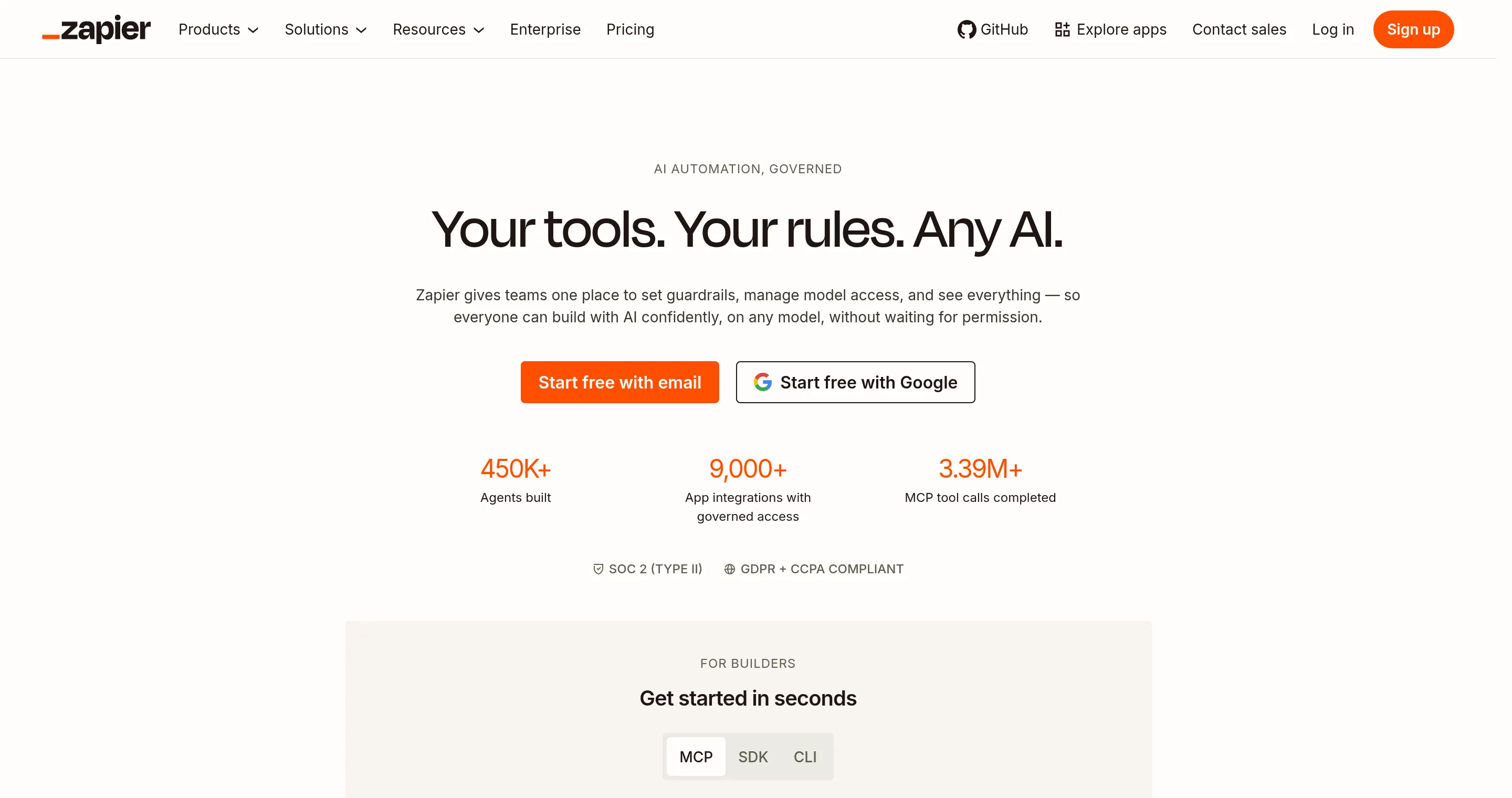
What it is: Zapier is the most widely used automation platform, built around a linear trigger-action model that is the easiest in the category to learn. Where Make gives you a canvas to wire together, Zapier walks you through one step at a time, which is exactly why people leaving Make on complexity land here first.
How I used it: I rebuilt a lead-routing flow that had grown into a tangle of Make modules. In Zapier it was a single Zap: new form entry, enrich the contact, add it to the CRM, and post to a Slack channel. It took minutes to set up and there was nothing to debug, which was the whole point of moving it off Make.
Key features:
- The simplest trigger-action builder in the category.
- 9,000+ app integrations, the largest library anywhere.
- Built-in AI steps, chatbots, and agents on higher tiers.
- Huge template gallery for common automations.
Pros:
- Easiest tool to get a working automation running.
- Unmatched app coverage, so almost anything connects.
- Reliable and well-documented.
Cons:
- Per-task billing gets expensive faster than Make’s per-operation model at volume.
- Less deep branching and logic than Make’s visual canvas.
- Advanced features sit behind higher-priced tiers.
Bottom line: Zapier is the best overall Make alternative for anyone who wants the same job done with far less setup and the widest app coverage available.
2. Craze: best for AI-native automation in one workspace
- Best for: Teams who want AI agents to do the work, not just route data, with chat, agents, and automation in one place.
- Score: 4.6/5
- Pricing: Free ($0); Plus $20/month.
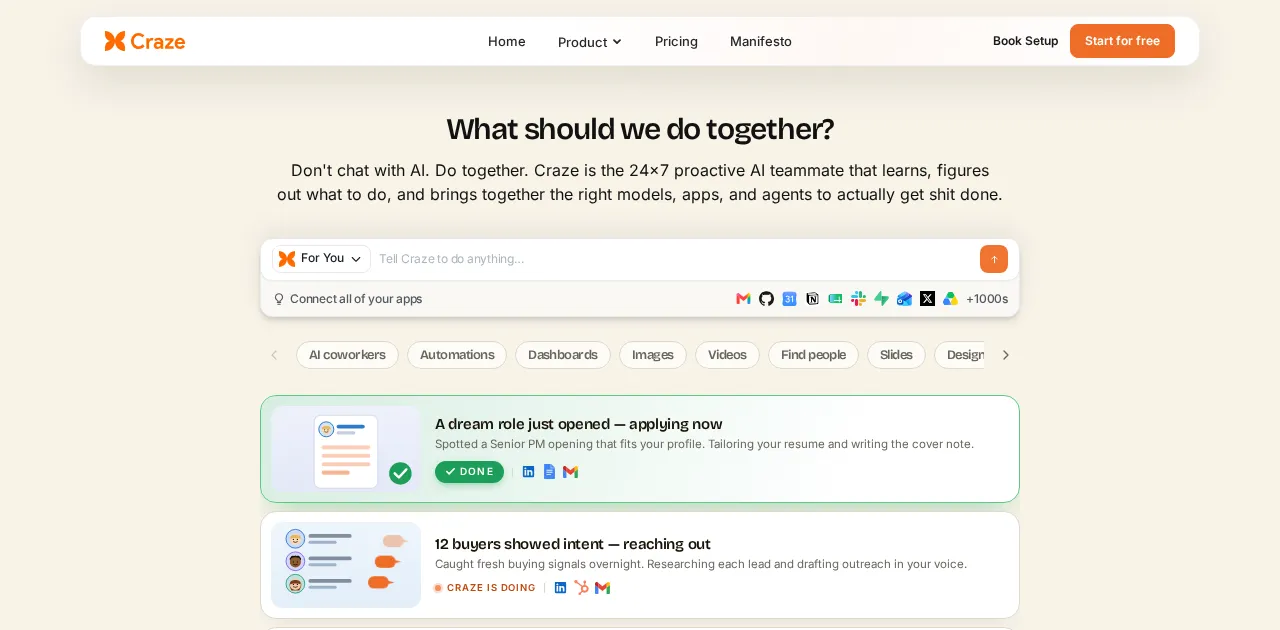
What it is: Craze is the AI workspace platform where chat across leading models, no-code AI agents, workflows, and scheduling live together. Instead of wiring a rigid module chain on a canvas, you can describe a job to an agent and have it carry out the multi-step work, then save it as something you run again. We built Craze for people who want AI to handle repeatable work without learning a complex builder or stitching together separate tools, and you can see where it lands among the best AI platforms .
How I used it: I rebuilt a weekly reporting routine that used to be a tangle of Make scenarios. I described a Craze agent that pulls the week’s numbers from a couple of sources, writes a short performance summary, and drops it in our team channel every Monday morning. Because the agent and its automations run in the cloud on a schedule, the summary is ready when I open my laptop, rather than depending on a scenario firing correctly or my machine being awake.
Key features:
- Chat across leading AI models in one workspace.
- No-code AI agents that run multi-step work.
- Workflows and scheduling to make that work repeatable.
- Agents and automations run in the cloud on a schedule, so work keeps going even when your computer is off.
- Free to use to start, with no API keys to manage.
Pros:
- Brings chat, agents, and automation together instead of a single-purpose canvas.
- Agent-driven automation handles judgment-based steps a rule-based scenario cannot.
- Free to use to start, with a gentler learning curve than Make.
Cons:
- Far fewer prebuilt connectors than Make’s 2,000+, so deep app-to-app coverage is narrower.
- Newer than the established automation platforms.
- It is an AI workspace, not a dedicated iPaaS, so it is not built for Make-level deep visual branching.
Bottom line: Craze is the best Make alternative when you want AI agents doing the work inside one workspace, and it is free to start. For raw integration breadth and deep branching, reach for Zapier or Make itself.
3. n8n: best for developers and self-hosting

- Best for: Technical teams that want open-source control and the option to self-host for free.
- Score: 4.4/5
- Pricing: Self-hosted Community Edition free (unlimited executions, you pay only for the server); Cloud Starter $20/month; Pro $50/month; Business $667/month.
- Third-party ratings: G2 4.5/5; Capterra 4.9/5 (figures vary by source).
What it is: n8n is a fair-code, node-based automation tool you can run on your own infrastructure or as a managed cloud service. Like Make it is visual and node-based, but it is open-source and lets you drop into code when a node does not exist, which is the trade Make cannot offer.
How I used it: I self-hosted n8n on a small VPS and moved a content pipeline off Make, where one AI step drafts, another runs an SEO pass, and it publishes on a schedule. Because it was self-hosted, none of those runs counted against an operations meter, which is the whole reason I moved it.
Key features:
- Self-hostable and open-source, with unlimited executions when self-hosted.
- 400+ nodes plus custom code steps for anything missing.
- Execution-based cloud pricing with unlimited active workflows and users.
- Strong fit for AI workflows and custom logic.
Pros:
- Free and unlimited if you self-host.
- Complete control over data and infrastructure, which Make cannot offer.
- Flexible enough for genuinely technical automations.
Cons:
- Self-hosting requires technical setup and maintenance.
- Steeper learning curve than Zapier, similar to Make’s.
- You bring your own LLM API keys rather than getting models bundled in.
Bottom line: n8n is the best Make alternative for developers and privacy-conscious teams who want self-hosting and open-source control.
4. Gumloop: best for AI-first, text-to-flow automation
- Best for: People automating unstructured-data tasks (research, scraping, summarizing) with AI at the center.
- Score: 4.2/5
- Pricing: Free (5,000 credits/month); Pro from $37/month (20,000+ credits); Enterprise custom.
- Third-party ratings: G2 4.8/5 (small sample, about 6 reviews).
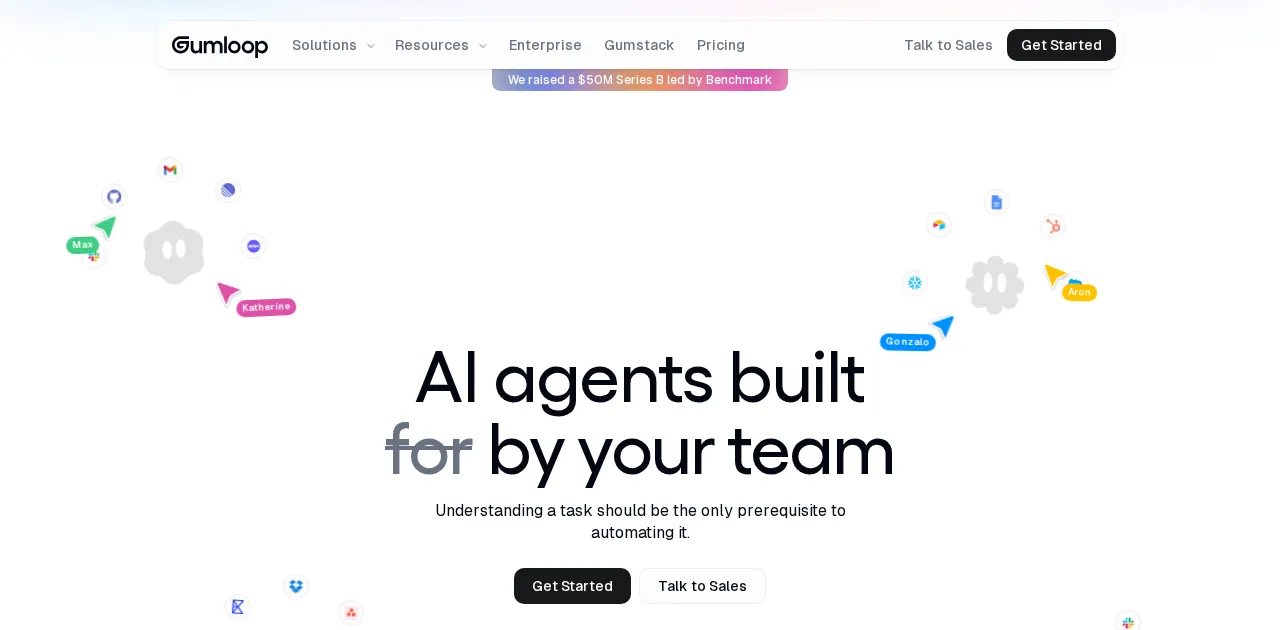
What it is: Gumloop is an AI-first automation platform with a visual builder where AI nodes do the heavy lifting. It looks a little like Make, but it is aimed at workflows that involve reading, extracting, and transforming messy data rather than tidy record-to-record syncs.
How I used it: I pointed Gumloop at a subreddit, had it pull the past week’s most-engaged posts, and summarize the recurring pain points into a short list of content ideas. That is the kind of unstructured-data job that is painful to wire up in Make, and Gumloop treated the AI step as a first-class node instead of an add-on module.
Key features:
- Visual builder with native AI nodes and a build assistant.
- Strong at web scraping and unstructured-data workflows.
- Credit-based pricing that covers premium LLM access.
- Interfaces feature to turn automations into shareable apps.
Pros:
- AI is genuinely native, not an add-on.
- Good fit for research and content workflows.
- Approachable visual interface.
Cons:
- Credits burn quickly on heavy AI calls.
- Fewer traditional app integrations than Make.
- Less suited to simple, high-volume record syncing.
Bottom line: Gumloop is the best Make alternative for AI-first workflows over messy, unstructured data.
5. Pabbly Connect: best for flat-rate, budget automation
- Best for: Budget-conscious users who want predictable, flat-rate pricing with no per-operation surprises.
- Score: 4.1/5
- Pricing: Free (100 tasks/month); paid plans from $19/month; lifetime access from $349 one-time.
- Third-party ratings: Capterra 4.5/5 (84+ reviews).
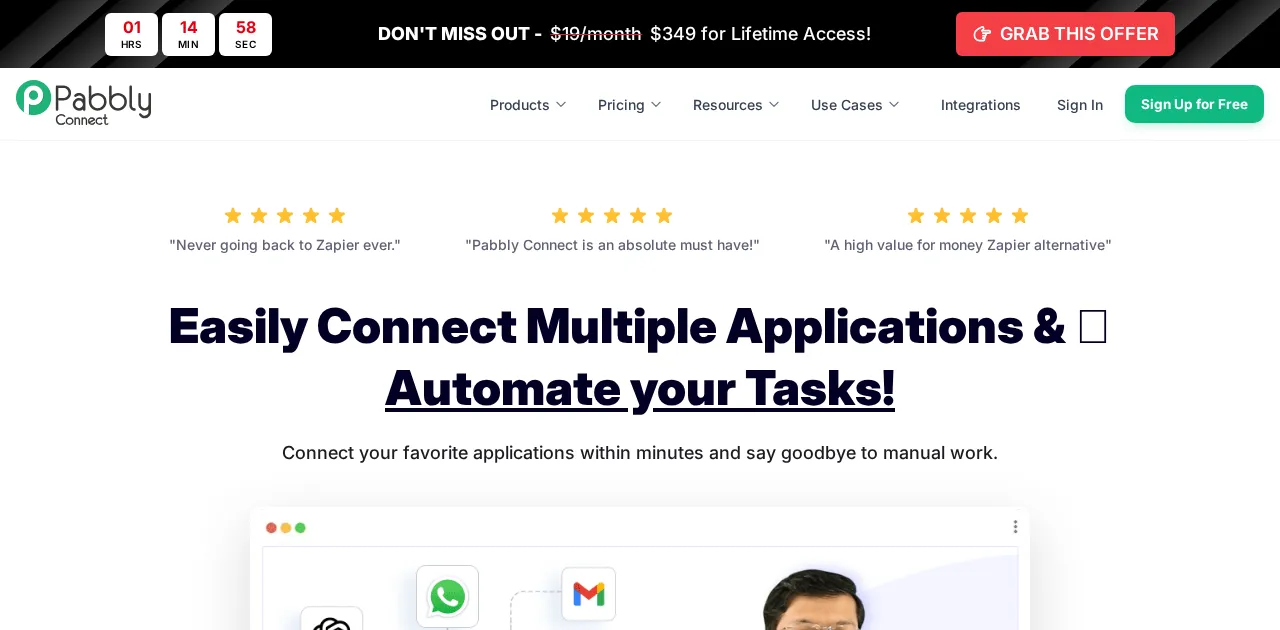
What it is: Pabbly Connect is a workflow automation tool built around flat-rate pricing. Internal steps do not burn your task count the way Make’s operations do, and every paid plan includes unlimited workflows.
How I used it: I moved my highest-volume automations off Make purely to escape the credits math. On Pabbly’s flat-rate plan, a busy month no longer spiked the bill, and the internal steps inside each workflow did not quietly eat my allowance the way operations did on Make.
Key features:
- Flat-rate task pricing with unlimited workflows on paid plans.
- One-time lifetime deals as an alternative to subscriptions.
- 2,000+ integrations.
- Internal multi-step actions that do not each count as a task.
Pros:
- Among the cheapest serious automation tools, especially via lifetime deals.
- Predictable pricing that does not punish complex workflows the way operations can.
- Low barrier to entry with a usable free tier.
Cons:
- Interface feels less polished than Make or Zapier.
- Smaller community and fewer templates.
- AI features are limited compared with the AI-native tools.
Bottom line: Pabbly Connect is the best Make alternative for anyone whose main complaint is the cost and the unpredictability of credits.
6. Relay.app: best for beginner-friendly automation
- Best for: Beginners who want a clean, simple builder with built-in AI and human approval steps.
- Score: 4.3/5
- Pricing: Free ($0, 200 automated steps + 500 AI credits/month); Professional $19/month (750 steps); Team $59/month (1,500 steps); Enterprise custom.
- Third-party ratings: G2 4.9/5 (70 reviews).
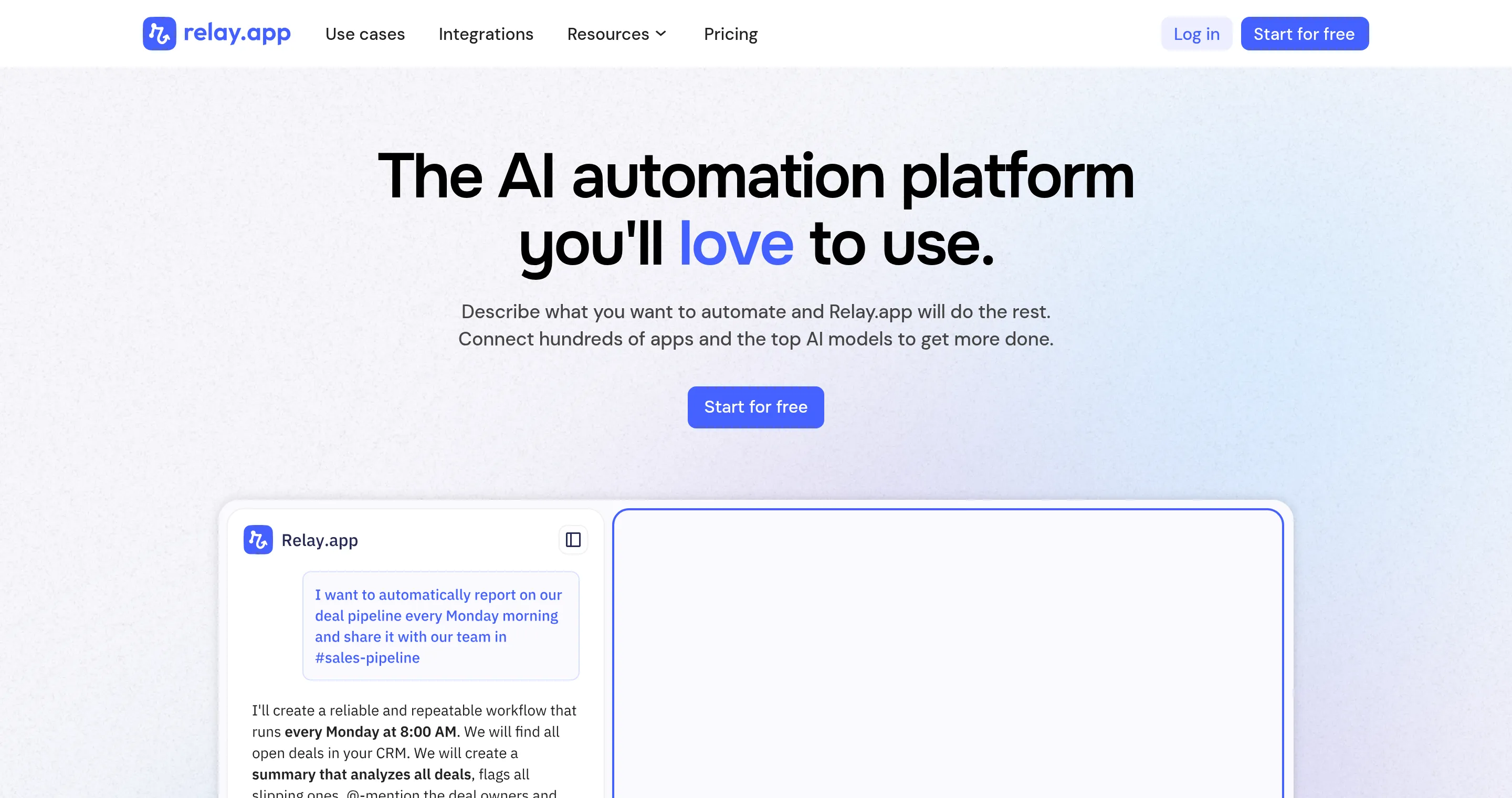
What it is: Relay.app is a newer automation platform built around being easy to use, with AI assistance and human-in-the-loop steps that pause a workflow for approval. It is the opposite of Make’s philosophy: fewer knobs, a cleaner interface, and AI woven in rather than bolted on.
How I used it: I rebuilt an approval flow that was overkill in Make. In Relay, a new request triggers an AI step that drafts a response, then pauses for me to approve before it sends. Setting up the human approval step took one click, where in Make it would have meant a webhook and a wait module.
Key features:
- Clean, beginner-friendly builder with built-in AI.
- Human-in-the-loop approval steps out of the box.
- Generous free tier with all integrations included.
- Fast, responsive support that reviewers consistently praise.
Pros:
- One of the easiest automation tools to learn.
- AI and approval steps are native, not workarounds.
- Strong free tier and predictable pricing.
Cons:
- Only 100+ integrations, far fewer than Make’s 2,000+.
- Less deep branching and logic than Make.
- Younger product with a smaller template library.
Bottom line: Relay.app is the best Make alternative for beginners who want a simple, AI-assisted builder and do not need a huge integration library.
7. Activepieces: best open-source AI alternative
- Best for: Teams who want an open-source, AI-native automation tool they can host themselves.
- Score: 4.0/5
- Pricing: Open-source and free to self-host (MIT-licensed); cloud Standard has a free tier (10 active flows, unlimited runs), then $5 per active flow per month; Ultimate is custom (annual).
- Third-party ratings: G2 4.8/5 (140+ reviews).
What it is: Activepieces is an open-source automation platform with a growing library of “pieces” (its term for integrations) and native AI steps. It combines the self-hosting freedom n8n offers with a friendlier, more no-code-leaning interface than Make.
How I used it: I spun up Activepieces on my own server to keep data in-house and rebuilt a simple flow that tags incoming form submissions with an AI step. Setup felt lighter than Make, and because the AI pieces are built in, I did not have to bolt on a separate service for the smart part.
Key features:
- Open-source with self-hosting, unlike cloud-only Make.
- 300+ pieces and native AI steps.
- More no-code-friendly than n8n.
- Active community contributing new pieces.
Pros:
- Free to self-host with full data control.
- AI-native and reasonably approachable.
- Transparent open-source codebase.
Cons:
- Smaller integration library than Make or Zapier.
- Self-hosting still requires some technical comfort.
- Younger ecosystem with fewer templates.
Bottom line: Activepieces is the best Make alternative for teams who want open-source self-hosting without n8n’s developer learning curve.
The verdict: which Make alternative should you pick?
- Best overall alternative: Zapier, for the easiest builder and the widest app coverage.
- Best for AI-native automation: Craze, free to start, when you want agents doing the work in one workspace.
- Best for developers and self-hosting: n8n.
- Best for AI over messy data: Gumloop.
- Best for a tight budget: Pabbly Connect, especially the lifetime deal.
- Best for beginners: Relay.app.
If your problem with Make is the learning curve, start with Zapier or Relay.app. If you want AI to actually do the work rather than route it, look at Craze or Gumloop. And if you need to own your data, self-host n8n or Activepieces. The honest catch: none of these matches Make’s depth of visual branching at its low per-operation cost, so if that power is exactly what you value and the learning curve does not bother you, the best move may be to stay on Make.
Every tool I evaluated
For transparency, here is the full set of automation tools I looked at before settling on the 7 above, and why each one did or did not make the shortlist.
| Tool | Category | Made the top 7? | Why or why not |
|---|---|---|---|
| Zapier | Visual automation | Yes (#1) | Easiest builder, widest app coverage |
| Craze | AI workspace | Yes (#2) | AI agents plus chat and workflows in one place |
| n8n | Open-source automation | Yes (#3) | Self-hosting and developer control |
| Gumloop | AI-first automation | Yes (#4) | Native AI over unstructured data |
| Pabbly Connect | Budget automation | Yes (#5) | Flat-rate pricing, no per-operation billing |
| Relay.app | Beginner automation | Yes (#6) | Simplest builder with native AI and approvals |
| Activepieces | Open-source AI | Yes (#7) | Open-source with friendlier setup than n8n |
| Power Automate | Enterprise / Microsoft | No | Great inside Microsoft 365, but an awkward fit outside it |
| Lindy | AI agents | No | Strong agent builder, but overlaps Craze and Gumloop on AI |
| IFTTT | Personal automation | No | Best for simple personal automations, not business work |
| Workato | Enterprise iPaaS | No | Enterprise-only, no self-serve, custom pricing |
| Tray.ai | Enterprise iPaaS | No | Expensive and complex for small teams |
| Integrately | SMB automation | No | Ecommerce-leaning with weaker AI features |
| OttoKit (SureTriggers) | WordPress automation | No | Built specifically for WordPress sites |
| Relevance AI | AI agents | No | Strong, but overlaps the AI-native picks |
| Stack AI | LLM app builder | No | Developer and RAG focus, not general automation |
| Retool | Internal tools | No | For building internal apps, not standalone automation |
| Dust | Internal AI agents | No | Internal knowledge agents, limited external SaaS automation |
| Flowise | LLM prototyping | No | Developer-focused LangChain tool, technical setup |
| Salesforce Agentforce | CRM agents | No | Salesforce-locked and costly |
| Tines | Security automation | No | Aimed at SecOps, not general business automation |
| Pipedream | Developer automation | No | Code-first, built for developers |
| Automatisch | Open-source automation | No | Open-source but less mature than n8n and Activepieces |
| Zoho Flow | Ecosystem automation | No | Best only inside the Zoho ecosystem |
FAQs
What is the modern alternative to Make?
It depends on what pushed you off Make. For an easier builder with the widest app coverage, Zapier is the modern go-to. For AI agents doing the work instead of routing data, Craze or Gumloop is better. For open-source self-hosting, n8n is the standard. For flat-rate budget pricing, Pabbly Connect is the pick. There is no single winner; the right alternative depends on whether your problem with Make is complexity, cost, control, or AI.
Is n8n better than Make?
For technical teams, often yes: n8n is open-source, can be self-hosted for free with unlimited executions, and gives full control over your data and code-level logic. For non-technical users, Make is usually the friendlier of the two, with a more polished visual canvas and a larger app library. n8n trades ease of setup for control, so the better tool depends on whether you have the technical comfort to run it.
Why is Make.com so expensive at scale?
Make bills by operations (renamed credits in 2026), and every step inside a scenario counts as one operation. That is cheap at low volume and cheaper than Zapier for most workflows, but complex multi-step scenarios that fire often can burn the allowance fast. Tools with flat-rate pricing (Pabbly) or self-hosting (n8n, Activepieces) are usually more predictable at high volume.
What is the best free Make alternative?
Self-hosted n8n and Activepieces are free aside from server costs and give you unlimited runs. Among managed tools, Zapier, Pabbly Connect, and Relay.app all have usable free tiers, and Craze has a free plan as well, though it is an AI workspace rather than a like-for-like Make replacement. For a genuinely free, unlimited option with full control, self-hosted n8n is the strongest pick.
Is there an easier alternative to Make?
Yes. Make's biggest drawback is its learning curve, and the easiest switches are Zapier, whose linear trigger-action builder is the simplest in the category, and Relay.app, which is built to be beginner-friendly with AI and human approval steps. If you want AI to handle the setup by describing the job in plain language, Craze and Lindy take a different, lower-effort approach to building automations.
More Articles
The 8 Best Lindy AI Alternatives in 2026 (Tested & Compared)

The 8 best Lindy AI alternatives for 2026, anchored to why people leave Lindy, with current pricing, third-party ratings, honest pros and cons, and the best pick for each reason to switch.
The 8 Best Zapier Alternatives in 2026 (Tested & Compared)
The 8 best Zapier alternatives for 2026, anchored to why people leave Zapier, with current pricing, third-party ratings, honest pros and cons, and the best pick for each reason to switch.
The 11 Best AI Chatbots in 2026 (Tested & Compared)
I compared the 11 best AI chatbots of 2026, from ChatGPT and Claude to Gemini and Perplexity, with current pricing, honest pros and cons, and the best pick for each need.