Horizontal vs Vertical AI Agents: How to Choose the Right Approach
A neutral guide comparing horizontal and vertical AI agents with a 5-question decision framework, real examples with sourced data, and the convergence trend reshaping both categories.

By: Kabir Nagral
Co-Founder and CEO
Published
Updated
Edited by Craze Editorial Team · See our Editorial Process
Most companies have already rolled out a general-purpose AI copilot. Drafting emails, summarizing meetings, pulling quick answers from internal docs: the basics are covered. But when teams try to push AI into more specialized work (clinical decisions, financial compliance, contract analysis), things stall. McKinsey calls it the “gen AI paradox”: organizations have horizontal AI tools humming across the org, yet roughly 90% of their more targeted vertical use cases never make it past pilot.
That gap between “AI works for general tasks” and “AI actually handles our domain-specific work” is where the horizontal vs vertical AI agent question lives. And if you’ve been searching for answers, you’ve probably noticed every comparison you find is written by a company selling one type or the other.
This guide breaks down what each type does, where each one wins, a practical framework for choosing, and the data that actually matters for your decision.
TL;DR
- Horizontal AI agents go wide, not deep. They handle drafting, summarizing, research, and data analysis across any department. Think ChatGPT, Microsoft Copilot, or Google Gemini.
- Vertical AI agents go deep, not wide. They’re purpose-built for one industry’s rules, terminology, and workflows. Think Harvey for legal, Abridge for healthcare, or Stripe’s fraud detection AI.
- Neither type is universally better. Your choice depends on compliance requirements, domain complexity, speed-to-value, and budget.
- Most organizations will use both. Horizontal for everyday productivity, vertical for high-stakes domain work.
- Use the 5-question framework below to decide. It covers specialization, compliance, speed, budget, and flexibility to help you pick a starting point.
What Is a Horizontal AI Agent?
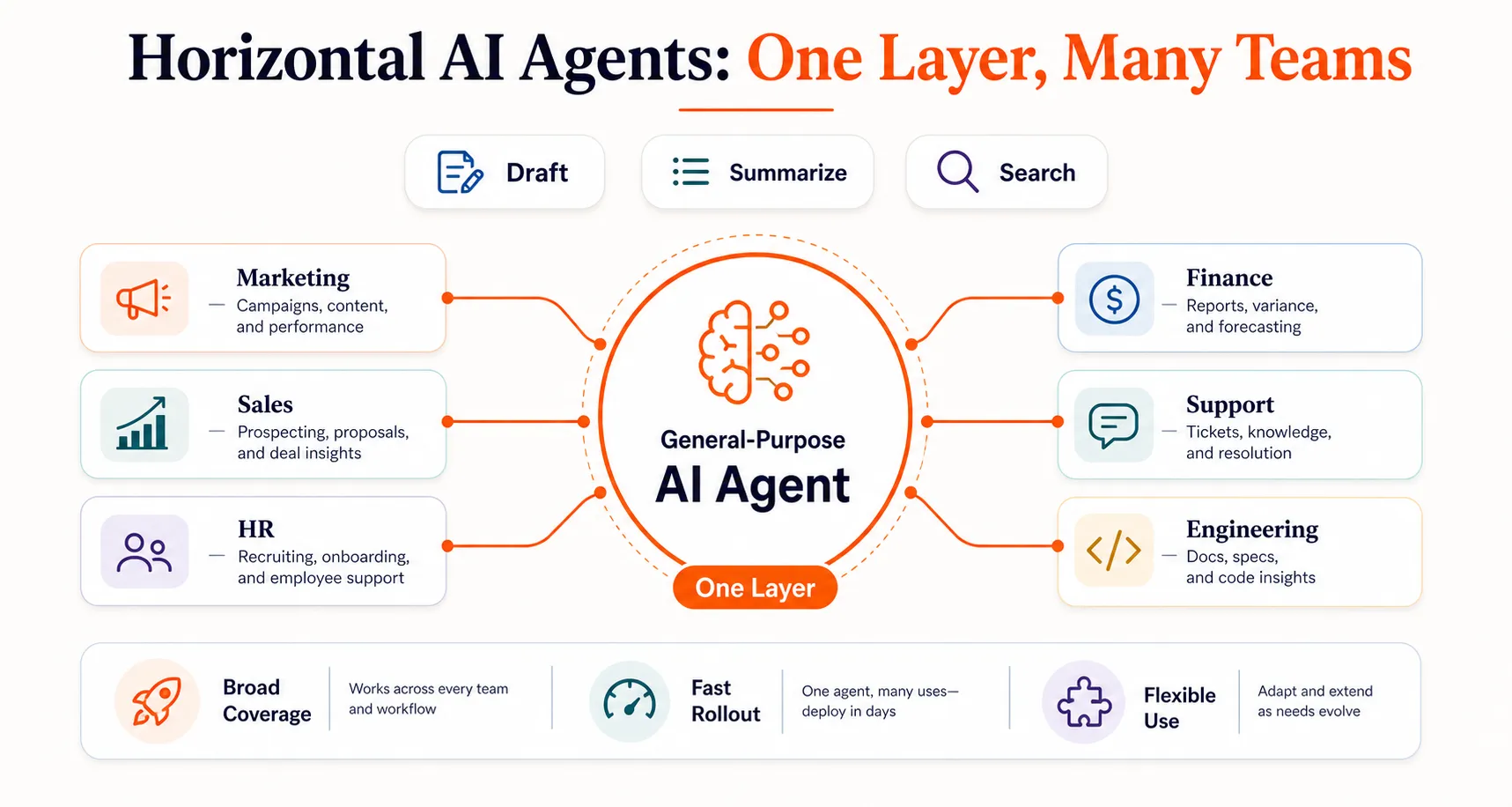
A horizontal AI agent is a general-purpose AI system that works across multiple departments and tasks without being built for any single domain. It’s trained on broad data, which gives it range: it can help with email drafting, meeting summaries, data lookups, brainstorming, research, and basic analysis for just about any team.
The most familiar horizontal AI agent examples include ChatGPT for general Q&A and content work, Microsoft Copilot for Office productivity, and Google Gemini in Workspace. Enterprise platforms like Glean handle cross-team search and knowledge management the same way: one tool, many functions.
What makes horizontal agents useful is their speed and flexibility. You can deploy one across your entire organization in days or weeks. Everyone from marketing to engineering to HR gets the same baseline AI capability without custom configuration.
The trade-off is depth. A horizontal agent can help a lawyer draft a general email, but it can’t review a contract for FINRA compliance without significant customization. It can summarize a medical study, but it doesn’t natively understand HIPAA rules around patient data. The broader the training, the thinner the domain expertise.
For everyday productivity tasks where speed and consistency matter more than specialized accuracy, horizontal agents deliver real value quickly. The question is what happens when the stakes get higher.
What Is a Vertical AI Agent?
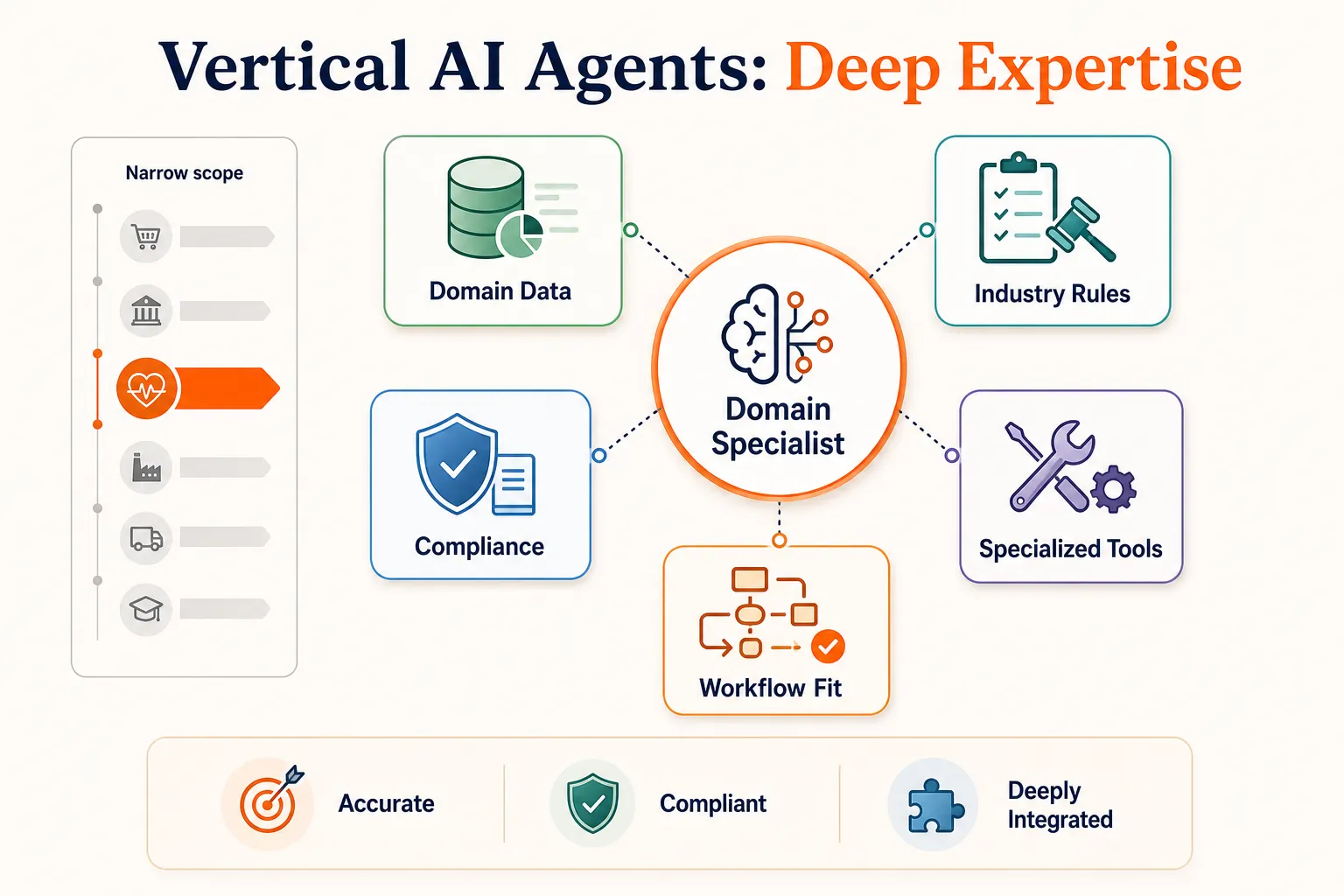
A vertical AI agent is purpose-built for a specific industry or function. Instead of knowing a little about everything, it knows a lot about one thing: the rules, terminology, data patterns, and workflows of its target domain.
What makes vertical agents different isn’t just that they’re “focused.” They’re built with domain-specific training data, compliance logic baked in from the start, and integrations designed for the tools their industry actually uses. A vertical AI agent for healthcare doesn’t just know medical terms; it understands HIPAA requirements, can navigate clinical workflows, and integrates with electronic health record systems.
The results, when vertical agents work well, can be significant:
- In healthcare, AI radiology systems have detected 20% more cancer cases than radiologists working alone.
- In finance, Stripe’s ML-based fraud detection reduced card testing attacks by 80% , according to Forbes reporting on Stripe data.
- In manufacturing, AI-driven predictive maintenance has reduced machine downtime by up to 50% .
But the trade-offs are real. Vertical agents are expensive to build or buy, require deep integration with domain-specific systems, and take months (not weeks) to configure and validate. Most critically, they struggle outside their niche. A vertical agent built for clinical trials can’t help your marketing team brainstorm campaign ideas.
And there’s a sobering reality check: McKinsey found that roughly 90% of vertical AI use cases never scale beyond pilot. The reasons vary (integration complexity, insufficient training data, underestimated compliance requirements), but the pattern is clear. Vertical agents deliver impressive results in controlled environments. Getting them to production scale is the hard part.
Key Differences at a Glance
| Dimension | Horizontal AI Agents | Vertical AI Agents |
|---|---|---|
| Scope | Broad: works across departments and functions | Narrow: built for one specific domain |
| Domain knowledge | General: needs prompting for industry context | Deep: natively understands industry rules and terminology |
| Setup and deployment | Fast: works out of the box for general tasks | Slower: requires domain data, custom integrations, compliance configuration |
| Accuracy in specialized tasks | Moderate: reliable for general work, weaker for regulated or complex tasks | High: purpose-built for precision in its domain |
| Integration depth | Shallow to moderate: connects with common productivity tools | Deep: requires tight integration with domain-specific systems, APIs, and data pipelines |
| Flexibility | High: handles many types of tasks across the organization | Low: struggles outside its specialty |
| Scalability | Scales easily across teams with a single deployment | Scales depth within its domain, but adding new domains means new agents |
| Cost to start | Lower: subscription-based, typically $20-50/user/month at enterprise tier | Higher: custom pricing, often $5K-50K+/month depending on domain and integration depth |
| Compliance handling | Limited: needs significant customization for regulated workflows | Strong: compliance logic built in (HIPAA, FINRA, FDA, SOX) |
| Best for | General productivity, cross-team consistency, everyday automation | High-stakes decisions, regulated industries, domain-specific workflows |
Cost ranges are approximate and based on current market data for enterprise-tier products. Actual pricing varies by vendor and deployment model.
This table gives you the structural comparison. But choosing between horizontal and vertical isn’t just about features; it’s about your specific situation.
How to Choose: A 5-Question Decision Framework
Most comparison guides tell you “it depends on your needs” and leave it there. Here are five specific questions that can actually point you toward the right starting point.
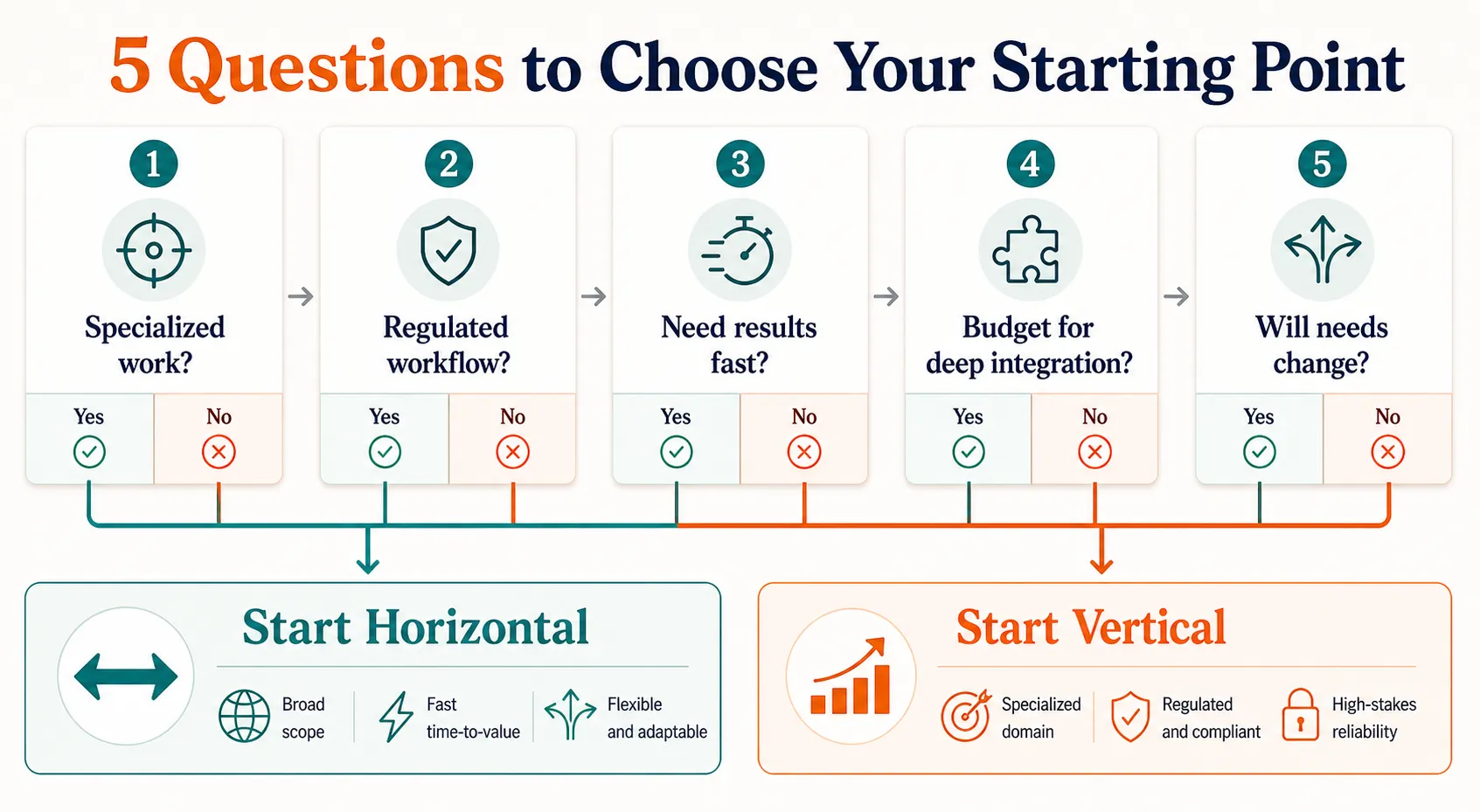
1. How Specialized Is Your Use Case?
If the work your team needs automated is general (email drafting, meeting notes, internal search, data summarization), a horizontal agent handles it well. These are tasks where a smart generalist with broad knowledge adds real value.
If the work requires deep domain knowledge (clinical decision support, financial risk assessment, legal compliance review, regulatory submissions), you’re likely looking at a vertical agent. A useful rule of thumb: if a new hire would need six or more months of domain training to do the task competently, a horizontal agent probably can’t handle it either.
2. What Are Your Compliance Requirements?
This is often the deciding factor. If your workflows are governed by HIPAA, FINRA, FDA, SOX, or similar regulations, horizontal agents are risky without heavy customization. They weren’t built to understand the nuances of regulated data handling, audit trails, or industry-specific disclosure rules.
Vertical agents built for regulated industries embed compliance logic from the ground up. They’re designed to handle protected health information, financial trading constraints, or clinical trial documentation requirements natively.
One reason so many vertical AI pilots fail to scale is that teams underestimate compliance requirements upfront. If compliance is a factor, budget time and resources for it early.
3. How Fast Do You Need Results?
Horizontal agents can be deployed in days or weeks for general use cases. You sign up, connect it to your productivity stack, and your team starts getting value almost immediately.
Vertical agents typically take months. You need to source domain-specific training data, configure compliance rules, integrate with specialized systems, validate accuracy, and often go through internal security review. The payoff is deeper, but the timeline is longer.
The trade-off is straightforward: horizontal gives you quick wins across the org, vertical gives you deeper wins in one function but takes longer to prove value. If your team needs AI productivity gains this quarter, start horizontal. If you’re planning a 6-12 month initiative in a specific domain, vertical may be worth the investment.
4. What Is Your Budget and Scale?
Horizontal agents typically cost $20-50 per user per month at enterprise tiers (think Copilot, Gemini-tier products). They scale easily: one tool across many teams.
Vertical agents come with custom pricing that often runs $5K-50K+ per month, depending on the domain, data requirements, and integration depth. The ROI case can be strong (fraud prevention, diagnostic accuracy, regulatory risk reduction), but it takes longer to prove.
Budget is also a scale question. Horizontal serves many teams with one tool at a predictable cost. Vertical serves one function deeply at a higher cost but with potentially higher value per use case.
5. Will Your Needs Change?
If your team’s AI needs are evolving fast and you’re still figuring out where AI adds the most value, horizontal platforms offer more flexibility. You can experiment across departments, find what sticks, and specialize later.
If you have a well-defined, stable workflow in a regulated domain (say, clinical trial management or financial compliance reporting), vertical specialization pays off because the use case isn’t going to change.
There’s also a convergence factor worth considering. Major horizontal platforms like Microsoft, Google, and Salesforce are rapidly adding vertical capabilities (Copilot for Finance, Copilot for Healthcare, industry-specific Gemini features). A horizontal-first strategy may gain vertical features over time without a separate investment.
Real-World Examples: Where Each Type Wins
Where Horizontal Agents Win
Enterprise-wide knowledge management is one of the clearest wins for horizontal AI. A single AI assistant that can answer questions across IT, HR, operations, and finance (“What’s our vacation policy?” and “How do I reset my VPN?” from the same tool) removes a common daily friction.
Cross-functional research and content work is another strong case. Drafting reports, summarizing documents, brainstorming ideas, analyzing data: these tasks happen in every department, and a horizontal agent handles them without domain-specific configuration.
Quick-start automation is where horizontal shines for teams that need results fast. When the goal is “get AI productivity gains in weeks, not months,” deploying a general-purpose agent across the organization is the most practical path.
Where Vertical Agents Win
Healthcare diagnostics showcase the depth advantage. AI radiology systems detecting 20% more cancer cases than radiologists alone isn’t something a general-purpose agent can replicate. The accuracy comes from domain-specific training on medical imaging data.
Financial fraud detection is another clear vertical win. Stripe’s ML models reducing card testing fraud by 80% required purpose-built models trained on financial transaction patterns, not a general LLM.
Manufacturing operations benefit from vertical AI’s ability to learn equipment-specific patterns. Predictive maintenance reducing machine downtime by up to 50% depends on models trained on sensor data from specific equipment types, something a horizontal agent has no framework for.
Where Both Work Together
In practice, most mature AI strategies use both types in parallel. The horizontal layer handles everyday productivity (email, meetings, search, general analysis) while vertical agents handle high-stakes domain work (clinical decisions, compliance, risk assessment).
A financial services company might deploy Microsoft Copilot for general employee productivity across the firm while running a specialized fraud detection agent for transaction monitoring and a separate compliance agent for regulatory reporting. The two layers serve different needs at different risk levels.
McKinsey’s recommendation for breaking the “gen AI paradox” points in the same direction: agentic AI platforms that can coordinate both horizontal and vertical capabilities, rather than forcing organizations to choose one or the other.
The Convergence Trend: Why the Line Is Blurring
The horizontal-vs-vertical distinction, while useful for making decisions today, is becoming less binary over time.
Microsoft is adding industry-specific Copilots for finance, healthcare, and security. Google and Salesforce are building vertical capabilities into their horizontal platforms. On the other side, vertical AI startups that started with a single domain are broadening their platforms to handle adjacent use cases.
The emerging layer is agent orchestration: systems where multiple specialized agents (both horizontal and vertical) work together, coordinated by an overarching platform. McKinsey’s research on enterprise agentic platform architecture describes this as the likely direction for most large organizations.
What this means for your planning: if you start with a horizontal platform today, you may gain vertical capabilities as the platform evolves. If you start with a vertical agent, you’ll likely need a horizontal layer eventually for everything outside your domain. Either way, the long-term destination for most organizations is a layered approach.
Which One Should You Start With?
The short answer: start with whichever type solves your most pressing problem.
If your team needs broad AI productivity gains across the organization, start horizontal. Deploy a general-purpose agent, let teams adopt it for everyday tasks, and identify the high-value domain-specific use cases as you go.
If you have a clear, high-stakes, regulated use case where accuracy and compliance are non-negotiable, start vertical. But go in with realistic expectations about timeline and cost, and start with a single well-defined workflow rather than trying to cover an entire domain at once.
If you’re unsure, start horizontal and add vertical as you find the use cases that justify the investment. That’s the path most organizations are taking, and it works because horizontal gives you quick wins while you figure out where vertical specialization actually matters.
AI platforms like Craze let you build and run agents across different workflows from a single workspace, which can be a practical starting point for teams exploring both approaches. Other platforms like ChatGPT, Claude, and Microsoft Copilot each handle parts of this equation as well. The right tool depends on your specific use case, compliance needs, and how much customization you need.
The best AI agent strategy is the one you can actually deploy, measure results from, and iterate on. Pick a starting point, track what works, and expand from there.
FAQs
What is a vertical AI agent?
A vertical AI agent is an AI system built for a specific industry or function. It's trained on domain-specific data and understands the rules, terminology, and workflows of its target area, such as healthcare, finance, or legal. This specialization gives it higher accuracy for complex domain tasks but limits its flexibility outside that domain.
What is the main difference between horizontal and vertical AI agents?
The core difference is scope vs depth. Horizontal agents are general-purpose, working across many departments and tasks with broad but shallow knowledge. Vertical agents are specialists, built for one domain with deep expertise but limited flexibility outside it. Horizontal agents deploy faster and cost less upfront, while vertical agents deliver higher accuracy in their niche but take longer to build and cost more.
Can you use horizontal and vertical AI agents together?
Yes, and most enterprise AI strategies are heading in that direction. The typical approach is to deploy horizontal agents for general productivity across the organization while using vertical agents for high-stakes domain work where accuracy and regulatory compliance matter most. The horizontal layer handles everyday tasks; the vertical layer handles specialized workflows.
Why do most vertical AI projects fail to scale?
McKinsey found that roughly 90% of vertical AI use cases remain stuck in pilot mode. The main barriers are technical complexity integrating with legacy systems, organizational resistance, insufficient domain-specific training data, and underestimating compliance requirements. Successful vertical deployments typically start with a single, well-defined workflow and expand from there.
What are some examples of horizontal AI agents?
Common examples include ChatGPT and Claude for general Q&A and content work, Microsoft Copilot for Office productivity, Google Gemini in Workspace, and enterprise AI platforms like Craze for cross-team agent building, workflows, and automation. These agents handle varied tasks across departments without requiring industry-specific customization.
More Articles
The 8 Best Lindy AI Alternatives in 2026 (Tested & Compared)

The 8 best Lindy AI alternatives for 2026, anchored to why people leave Lindy, with current pricing, third-party ratings, honest pros and cons, and the best pick for each reason to switch.
The 7 Best Make Alternatives in 2026 (Tested & Compared)
The 7 best Make.com alternatives for 2026, anchored to why people leave Make, with current pricing, third-party ratings, honest pros and cons, and the best pick for each reason to switch.
The 8 Best Zapier Alternatives in 2026 (Tested & Compared)
The 8 best Zapier alternatives for 2026, anchored to why people leave Zapier, with current pricing, third-party ratings, honest pros and cons, and the best pick for each reason to switch.