AI Agents in Healthcare: Use Cases, Benefits, and Top Platforms
A comprehensive guide to AI agents in healthcare. Covers use cases, benefits, top platforms (Hippocratic AI, Epic, Sully.ai, Notable Health), HIPAA compliance, hallucination management, and real-world deployment results.

By: Deepit Patil
Co-Founder and CTO
Published
Updated
Edited by Craze Editorial Team · See our Editorial Process
Healthcare is one of the most information-intensive industries, yet getting the right data to the right person at the right time is still surprisingly hard. For every hour of patient care, physicians spend approximately 2 additional hours on administrative and EHR work. 62% of physicians reported burnout in 2025, with bureaucratic tasks and documentation topping the list of contributors.
AI agents are starting to change this picture. Not the chatbots that ask you to “press 1 for billing,” but actual AI agents that can read patient records, reason about clinical data, and take action within healthcare workflows. The agentic AI healthcare market hit $0.79 billion in 2025 and is projected to reach $33.66 billion by 2035, a 45.6% compound annual growth rate. Health systems, insurers, and specialized vendors are already deploying these agents in production.
This guide covers what healthcare AI agents are, how they’re being used, the benefits they deliver, which platforms lead the space, what HIPAA compliance requires, and how to build your own if you choose to.
TL;DR
- Five core use cases are driving adoption. Healthcare AI agents handle clinical assistance, administrative automation, patient engagement, drug discovery, and revenue cycle management, with administrative tasks as the most common starting point.
- The ROI is already measurable. Notable Health cut check-in time by 90%, Sully.ai saves clinicians 3 hours per day, and McKinsey estimates 30-60% revenue cycle cost savings from AI-enabled automation.
- Ten platforms lead the space. Hippocratic AI for patient voice, Epic for EHR-native agents, Sully.ai for clinical workflow, Notable Health for registration, and Cognigy for multilingual communication are the top picks depending on your use case.
- HIPAA compliance starts on day one, not after launch. Signed BAA with every vendor, end-to-end encryption, and comprehensive audit logging are non-negotiable before any agent touches patient data.
- Hallucinations are manageable but not ignorable. Structured mitigation (RAG, validation layers, confidence scoring, human-in-the-loop review) reduced hallucination rates from 31% to 0.3% in one clinical trial study.
What Is an AI Agent in Healthcare?
An AI agent in healthcare is an autonomous software system that uses artificial intelligence to perceive information from clinical or administrative sources, reason about it, and take actions within healthcare workflows, often with minimal human prompting.
That’s different from a standard chatbot or a simple AI assistant. A chatbot follows scripted conversation flows. An AI agent integrates with real systems (like electronic health records), pulls real patient data, reasons across multiple data points, and executes multi-step tasks. Think of the difference between an automated phone tree and an experienced medical assistant who can look up your records, check your insurance, schedule your follow-up, and flag a potential drug interaction, all in one interaction.
Healthcare AI agents work through a perceive-reason-act cycle. They perceive data from EHR systems, lab results, insurance records, or patient messages. They reason using large language models, clinical knowledge bases, and rule engines. Then they act by updating records, sending communications, scheduling appointments, or surfacing recommendations for clinicians to review.
Most healthcare deployments start on the assistive end of this spectrum, where the agent suggests next steps for a human to approve, and expand toward more autonomous handling as trust and validation grow.
What Healthcare AI Agents Actually Do
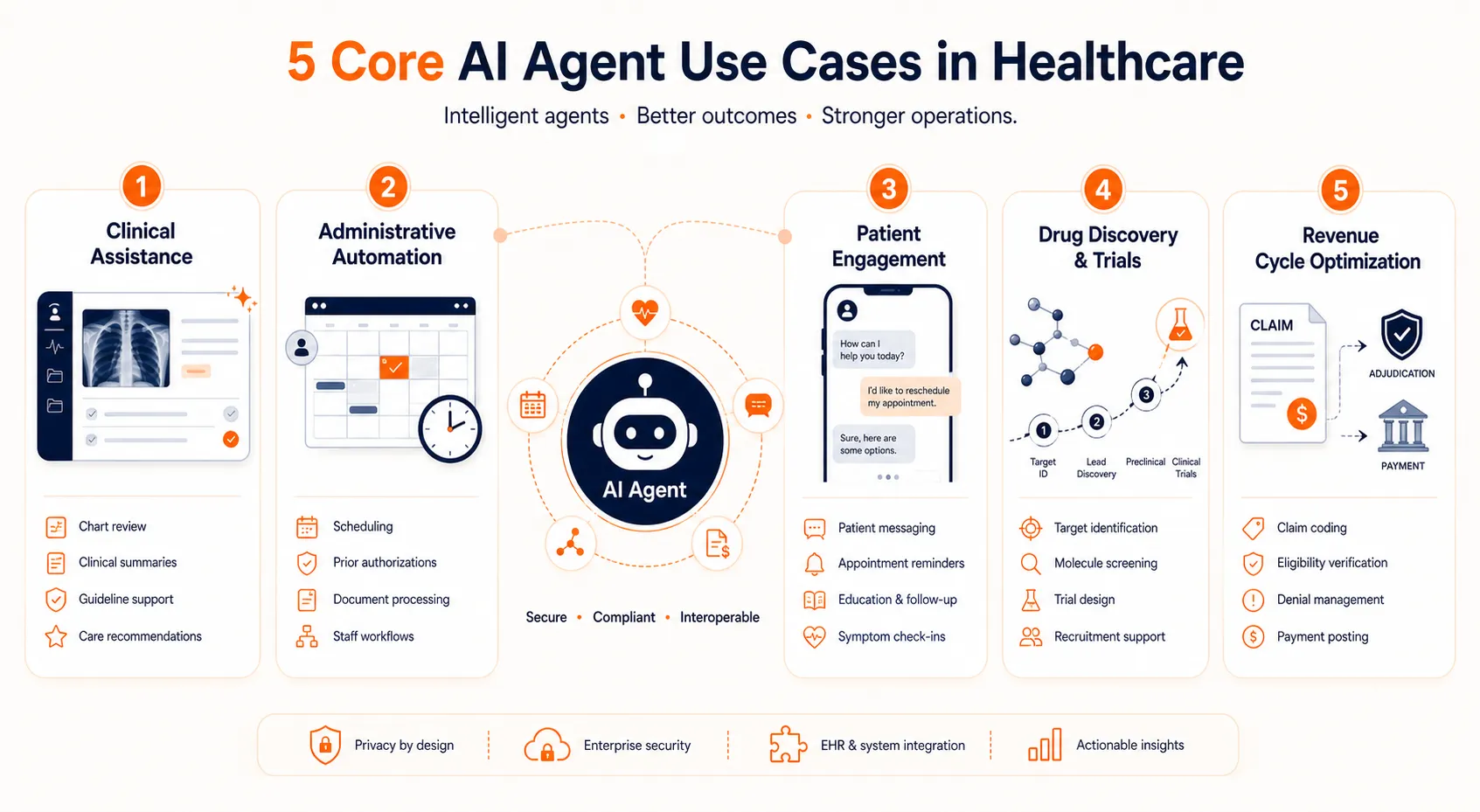
Healthcare AI agents generally fall into five categories, each targeting a different part of the healthcare workflow.
Clinical Assistance
Clinical assistance agents help doctors and nurses make faster, better-informed decisions. They pull relevant patient history from EHR systems, flag potential drug interactions, surface clinical evidence at the point of care, and assist with documentation. They don’t make diagnoses on their own. They give clinicians the information they need, organized and ready.
The Atropos Evidence Agent is a good example. It answers clinical questions within a physician’s existing workflow, drawing from patient-level data to surface real-world evidence without the physician needing to search for it.
Administrative Automation
Administrative automation agents handle the operational work that bogs down healthcare systems: appointment scheduling, insurance verification, prior authorization processing, medical coding, and billing workflows. These tasks are high-volume, rules-based, and well-suited for AI handling.
Healthcare agents such as Hippocratic AI are pushing into voice-first territory, handling patient engagement calls in both English and Spanish. Search interest in AI voice agents for healthcare has been growing steadily as more health systems explore these capabilities.
Patient Engagement
Patient engagement agents sit on the patient-facing side. They handle triage questions, schedule appointments, send follow-up reminders, manage prescription refill requests, and guide patients through pre-visit preparation. Early adopters report significant drops in missed calls and response times once these agents go live.
Beyond individual interactions, population health agents monitor patient groups to identify at-risk individuals and trigger proactive outreach. Mental health support agents are also gaining traction, providing initial screening, mood tracking, and connection to human therapists when needed.
Drug Discovery and Clinical Trials
AI agents are accelerating the earliest stages of drug development. Exscientia developed an AI-designed drug candidate (DSP-1181) for OCD that entered clinical trials in under 12 months, a process that traditionally takes 4-5 years. Insilico Medicine identified a novel target for idiopathic pulmonary fibrosis and developed a drug candidate in 18 months at roughly $150,000, a fraction of typical costs.
AI agents in clinical trials manage patient recruitment, monitor adverse events, and coordinate data collection across sites. These are still early-stage applications, but the speed and cost advantages are attracting significant investment.
Revenue Cycle Management
Revenue cycle is where many health systems see the fastest ROI from AI agents. U.S. healthcare organizations lose an estimated $262 billion annually to revenue cycle inefficiencies. Provider denial rates above 10% surged from 30% in 2022 to 41% in 2025.
AI agents in revenue cycle handle claims submission, coding validation, denial management, and appeals. McKinsey estimates that AI-enabled revenue cycle management could cut cost to collect by 30-60% . Epic’s Penny agent already handles billing and authorization workflows natively within Epic’s EHR platform.
With these five categories covering a wide range of healthcare operations, the practical benefits are becoming measurable.
Quick check
Which healthcare AI agent use case is the most common starting point for new deployments?
Benefits of AI Agents in Healthcare
The use cases above paint a picture of what healthcare AI agents do. Here’s what they deliver in practice.
Reduced Clinician Burnout
62% of physicians reported burnout in 2025, with bureaucratic work and EHR documentation as the top contributors. AI agents that handle documentation, prior authorizations, and routine communications give clinicians time back for patient care. A Salesforce survey found that U.S. healthcare workers estimated AI agents could reduce their administrative burden by 30% .
Lower Operational Costs
Revenue cycle automation alone could cut collection costs by 30-60%. Administrative agents that handle scheduling, verification, and coding reduce the labor hours needed for high-volume operational tasks. The healthcare RCM outsourcing market sits at $34 billion in 2025, and AI agents are positioned to absorb a significant share of that work.
Faster Patient Access
Notable Health’s deployment at North Kansas City Hospital cut patient check-in time from 4 minutes to 10 seconds , a 90% reduction. Pre-registration rates jumped from 40% to 80%. These are measured results from live deployments, not projections.
Improved Diagnostic Support
Clinical assistance agents don’t make diagnoses, but they surface relevant information faster than manual chart review. Drug interaction checks, clinical evidence retrieval, and pattern recognition across patient histories help clinicians make better-informed decisions with less effort.
Better Patient Communication
Patients expect responsiveness. AI agents that handle triage questions, appointment scheduling, and follow-up reminders improve the patient experience without adding staff. Practices that have deployed patient-facing agents report significant drops in response times and missed calls, even without hiring additional front-desk staff.
Around-the-Clock Availability
AI agents don’t have shifts. Patient-facing agents can handle appointment requests, prescription refill inquiries, and triage questions at 2 AM just as effectively as at 2 PM. For health systems with high call volumes, this reduces missed calls and improves access for patients who can’t call during business hours.
Accelerated Drug Development
Traditional drug discovery takes 10-15 years and billions of dollars. AI agents are compressing timelines dramatically: Exscientia’s AI-designed drug candidate reached clinical trials in under 12 months, and Insilico Medicine’s approach cost roughly $150,000 for target identification and candidate development.
These benefits are already being demonstrated in production deployments, which leads to a natural question: who’s building these agents, and which platforms are leading?
Real-World Healthcare AI Agent Examples
Healthcare AI agents aren’t theoretical anymore. Here are deployments handling real patient data in production environments.
Microsoft Healthcare Agent Orchestrator
Microsoft’s Healthcare Agent Orchestrator powers AI agents at Oxford University Hospitals NHS Trust. The system summarizes patient charts, determines cancer staging, and drafts treatment plans for tumor board meetings. Work that previously took hours of manual preparation now happens in a fraction of the time.
Epic’s Agent Ecosystem
Epic’s agent ecosystem includes CoMET for clinician support, Emmie for patient-facing interactions, and Penny for billing and authorization workflows. These agents operate within Epic’s EHR platform, giving them native access to patient data without separate integration work.
Notable Health
Notable Health’s deployment at North Kansas City Hospital reduced check-in time from 4 minutes to 10 seconds and pushed pre-registration from 40% to 80%. The system handles patient registration, scheduling, and referral management.
Sully.ai
Sully.ai’s deployment at CityHealth saves clinicians approximately 3 hours per day and cut operations per patient by 50%. The platform covers intake, coding, billing, and triage across 19 languages.
Other deployments show similar patterns. The Atropos Evidence Agent answers clinical questions within a physician’s existing workflow, drawing from patient-level data to surface real-world evidence at the point of care. And a diagnostic network in Mumbai documented that AI assistants reduced workflow errors by 40% and improved patient satisfaction scores, showing that the impact extends beyond US health systems.
The common thread across these deployments is that they started with a well-defined use case and expanded from there.
Top Healthcare AI Agent Platforms
The healthcare AI agent landscape includes both specialized vendors and broader platforms offering healthcare solutions. Here’s how the leading options compare.
| Platform | Focus Area | Key Capability | Notable Deployment |
|---|---|---|---|
| Hippocratic AI | Patient-facing voice agents | Safety-first conversational AI, non-diagnostic | WellSpan Health (English + Spanish outreach) |
| Epic (CoMET, Emmie, Penny) | EHR-native clinical + admin | Native EHR integration, no separate connectors | Thousands of Epic health systems |
| Microsoft Healthcare Agent | Clinical workflow orchestration | Azure-based, integrates with existing infrastructure | Oxford University Hospitals NHS Trust |
| Oracle Clinical AI Agent | Documentation + billing | EHR-integrated, clinical suite | Oracle Health customers |
| Sully.ai | Full clinical workflow | Intake, coding, billing, triage; 19 languages | CityHealth (3 hrs/day saved per clinician) |
| Notable Health | Registration + scheduling | Patient access, referrals, coding automation | North Kansas City Hospital (90% check-in reduction) |
| Beam AI | Multi-agent patient management | Multilingual, multi-agent system | Avi Medical |
| Cognigy | Conversational patient support | 30+ communication channels | Healthcare contact centers |
| Innovaccer | Value-based care | AI agents for coding, intake, care coordination | Value-based care organizations |
| Atropos Health | Clinical evidence | Real-world evidence at point of care | Health systems using evidence-based workflows |
The right platform depends on your starting use case. For patient-facing voice automation, Hippocratic AI and Cognigy lead. For clinical workflow support, Sully.ai and Epic’s agent ecosystem are strong choices. For billing and revenue cycle, Notable Health and Oracle offer focused solutions.
Hippocratic AI has raised $141 million in its Series B at a $1.64 billion valuation, making it one of the most well-funded pure-play healthcare AI agent companies.
None of these tools are general-purpose AI platforms. They’re built specifically for healthcare workflows with healthcare-specific compliance, integrations, and clinical validation. For a broader look at agent capabilities across industries, see our overview of AI agent examples and vertical AI agents .
With the platform landscape mapped, the next critical consideration is compliance. No matter which platform you choose, HIPAA requirements apply.
HIPAA Compliance and Regulatory Considerations
HIPAA isn’t something you bolt on after deploying an AI agent. It needs to be part of the architecture from day one. HIPAA civil penalties can reach up to $2,190,294 per violation, making early compliance architecture essential rather than optional.
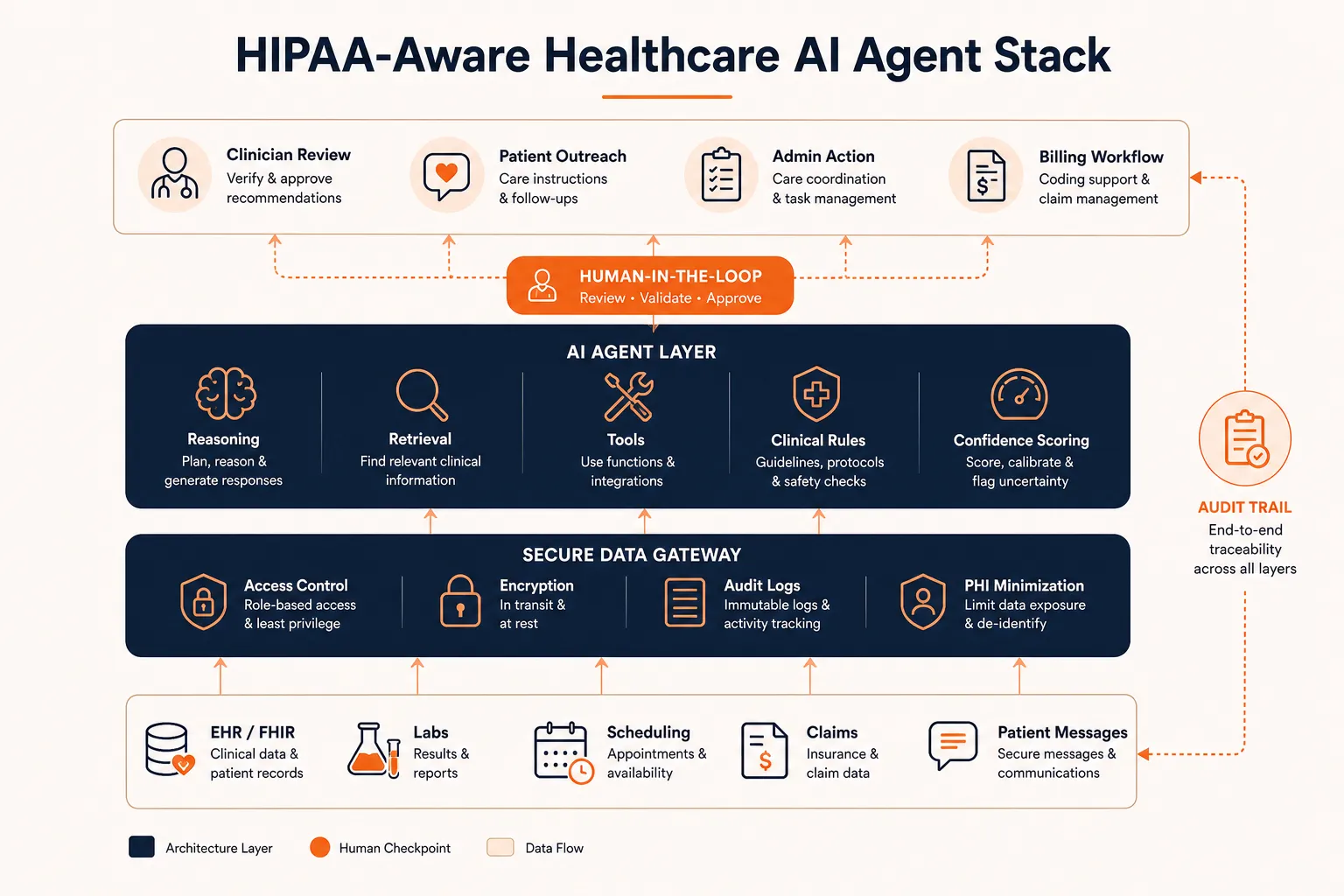
Here are the non-negotiable compliance requirements:
Business Associate Agreement (BAA)
Every AI vendor, cloud provider, and third-party service that touches Protected Health Information (PHI) must sign a BAA with your organization. Using an AI agent to handle conversations containing PHI without a signed BAA is a compliance violation, full stop.
End-to-End Encryption
A 2025 HHS proposed rule (published January 2025, expected finalization in 2026) would eliminate the “addressable” designation for encryption. If finalized, every data path your AI agent touches, including temporary storage and inference pipelines, will require validated cryptographic encryption (with only narrow, specifically defined exceptions). Even under current rules, encryption is the practical standard for any AI system handling ePHI.
The Five Technical Safeguards
HIPAA requires Access Control, Audit Controls, Integrity, Person Authentication, and Transmission Security. Your AI agent’s infrastructure needs to meet all five:
- Access Control: Role-based access following the Minimum Necessary standard. Your agent should only access the specific PHI it needs for its task.
- Audit Controls: Comprehensive logging of every data access, agent action, and decision. LangSmith or equivalent observability tools make this manageable.
- Integrity: Mechanisms to verify that PHI hasn’t been altered or destroyed improperly.
- Person Authentication: Verify that users (and systems) are who they claim to be before granting access.
- Transmission Security: Encrypt PHI in transit. TLS 1.2 or higher for all communications.
Risk Analysis
The updated HIPAA regulations require covered entities to explicitly inventory AI software that touches ePHI and apply heightened risk analysis. A risk analysis that doesn’t mention your AI agents won’t satisfy the updated standard.
The proposed 2026 rule also introduces requirements for multi-factor authentication, biannual vulnerability scans, and annual penetration testing. Healthcare organizations deploying AI agents should plan for these requirements now rather than retrofitting later.
Compliance covers the regulatory side, but there’s another risk that’s unique to AI: hallucinations.
Quick check
Under the 2025 HHS proposed rule, what happens to the 'addressable' designation for HIPAA encryption requirements?
The Hallucination Problem and How to Manage It
AI hallucinations, where the model generates confident but factually wrong information, are a nuisance in customer support. In healthcare, they’re dangerous.
The numbers paint a sobering picture. AI hallucination rates in healthcare range from roughly 10% for diagnostic tasks to 15-20% for drug interaction queries. One academic study found a 64.1% hallucination rate in medical case summaries when no mitigation prompts were used. And clinicians are noticing: 90% of those surveyed have encountered medical hallucinations from AI, with approximately 85% considering them capable of causing patient harm.
The good news is that structured mitigation works. A verification system called CHECK reduced hallucination rates from 31% to 0.3% on 1,500 clinical trial questions, showing that layered validation can dramatically reduce risk.
You can’t eliminate hallucinations entirely, but you can manage them with the right safeguards.
Ground Responses in Verified Medical Sources
Use retrieval-augmented generation (RAG) with curated, up-to-date medical knowledge bases. Don’t rely on the LLM’s training data for medical facts. Pull from structured sources like clinical guidelines, drug databases, and your organization’s approved protocols.
Add Validation Layers
Build rule-based checks that catch obvious errors before they reach users. A drug interaction checker, for example, can verify that the agent’s medication-related suggestions don’t conflict with the patient’s current prescriptions.
Implement Confidence Scoring
Have the agent assess its own confidence and flag low-confidence outputs for human review. This doesn’t catch every hallucination, but it catches the ones where the model is most likely to be wrong.
Require Human Review for Clinical Outputs
Any agent output that influences clinical decisions should go through a qualified reviewer. This is the most reliable safeguard and the one that regulatory bodies care about most.
Monitor and Audit Continuously
Track the accuracy of your agent’s outputs over time. Log every response, review samples regularly, and retrain or adjust when you spot patterns of errors.
With hallucination risks understood and mitigation strategies in place, some organizations decide to build their own healthcare AI agents rather than relying entirely on vendor platforms.
How to Build Your Own Healthcare AI Agent
If you decide to build rather than buy, the process follows the same general principles as building any AI agent , but with additional constraints around compliance, safety, and integration.
Start with a Narrow Use Case
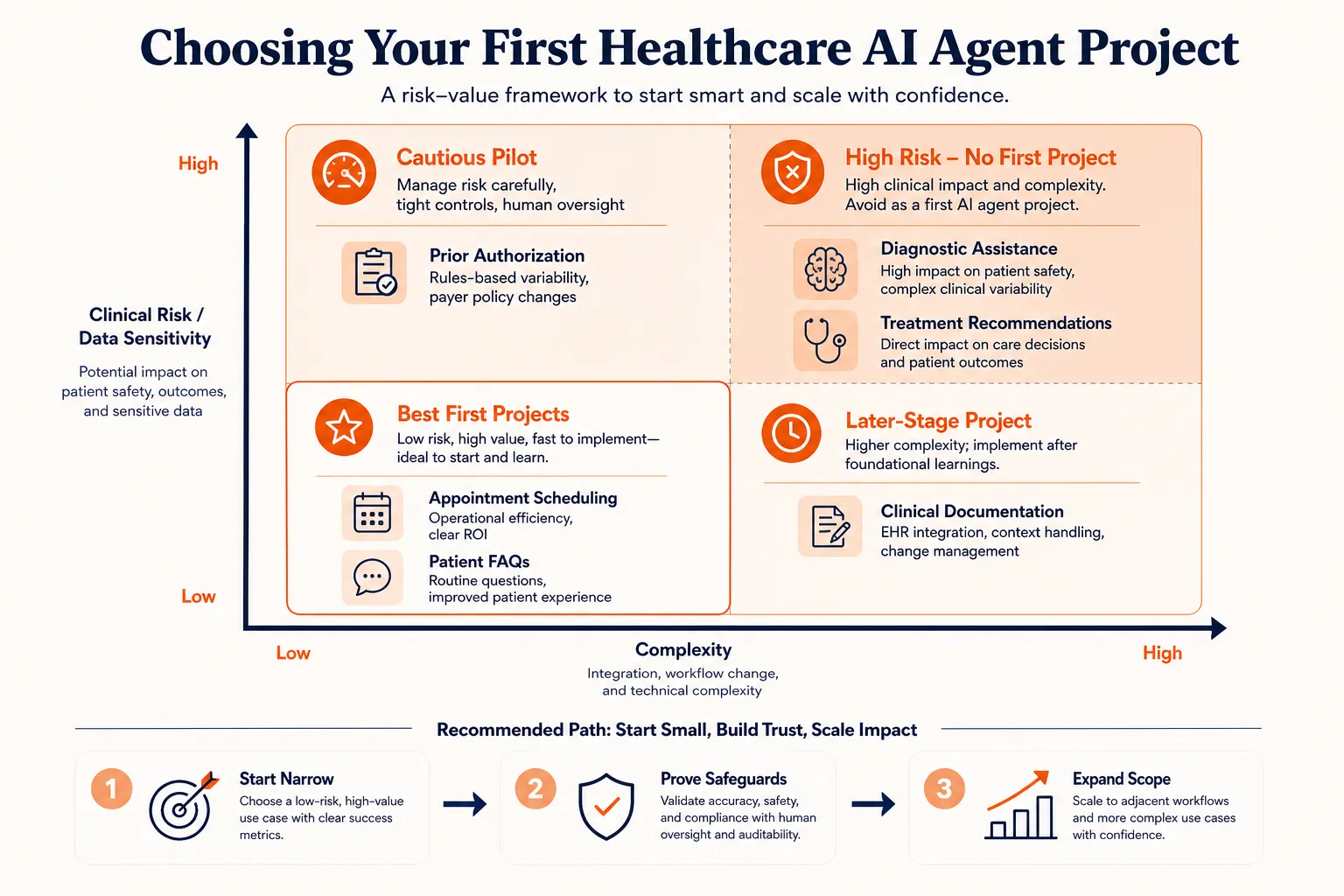
The single most common mistake is trying to build an agent that “handles everything.” Pick one well-defined workflow first.
| Use Case | Complexity | Data Sensitivity | Good First Project? |
|---|---|---|---|
| Appointment scheduling | Low | Low | Yes |
| Patient FAQ and triage | Low-Medium | Medium | Yes |
| Prior authorization | Medium | High | Maybe |
| Clinical documentation | Medium-High | High | No (start here later) |
| Diagnostic assistance | High | Very High | No |
| Treatment recommendations | Very High | Very High | No |
Administrative tasks are safer starting points because the consequences of errors are lower and the workflows are more predictable.
Choose a Framework
The framework shapes how you build agent logic, manage state, and integrate with healthcare systems.
| Framework | Best For | HIPAA Logging | EHR/FHIR Support | Multi-Agent |
|---|---|---|---|---|
| LangChain + LangGraph | Most healthcare projects | LangSmith (self-hostable, BAA available) | Community FHIR tools, custom build needed | Yes (via LangGraph) |
| Microsoft AutoGen | Complex multi-agent clinical workflows | Azure audit infrastructure | Azure Health Data Services integration | Strong |
| CrewAI | Role-based agent teams | Custom implementation needed | Custom build needed | Yes (role-based) |
| Custom build | Highly specialized requirements | Full control | Full control | Custom |
For a broader comparison, our guide to agentic AI frameworks covers the full landscape. No framework ships with production-ready FHIR integrations out of the box, so plan to build your own SMART on FHIR client regardless of which option you pick.
Connect to EHR Systems via FHIR
FHIR R4 (Fast Healthcare Interoperability Resources) is the standard API format for exchanging healthcare data, supported by major EHR platforms including Epic, Cerner, and athenahealth. A typical integration flow authenticates via SMART on FHIR (OAuth 2.0), requests patient data through FHIR R4 endpoints, processes that data within your agent’s logic, and writes back through the same API when needed.
The critical thing to understand is that data quality and completeness vary significantly across health systems. Your agent needs to handle missing fields, inconsistent coding, and partial records gracefully. Understanding AI agent architecture patterns helps here, as healthcare agents typically use a tool-calling architecture where the LLM orchestrates calls to FHIR endpoints, medical knowledge bases, and clinical rule engines. The orchestration layer manages the sequence and dependencies between these tools.
Build Human-in-the-Loop Safeguards
In healthcare, human oversight isn’t a nice-to-have. It’s a requirement. Every clinical decision that your agent supports needs a checkpoint where a qualified human reviews and approves the output.
Design your agent with explicit escalation paths: confidence thresholds that escalate low-confidence outputs to human reviewers, clinical decision gates that require human approval for anything affecting diagnosis or treatment, exception handling that hands off instead of guessing when the agent encounters unfamiliar scenarios, and comprehensive audit trails logging every action with timestamps and context.
The Atropos Evidence Agent is a good model here. It surfaces evidence for physicians but doesn’t make clinical decisions on its own. The human clinician always holds the final say. Memory management matters too: healthcare workflows span multiple visits and providers, and your agent needs to track context across interactions without losing critical information or relying on stale data.
Building a healthcare AI agent is technically achievable, but even well-architected projects run into avoidable pitfalls.
Quick check
You're building a healthcare AI agent. Which use case should you start with?
Common Mistakes and How to Avoid Them
After reviewing how healthcare teams approach AI agent deployments, these patterns cause the most problems.
Trying to Automate Too Much, Too Fast
Start with one workflow. Get it working reliably, measure the outcomes, and then expand. The same principle applies to any AI agent use case : narrow focus first, broader scope later.
Skipping Compliance Fundamentals
Using an AI tool to process patient data without a Business Associate Agreement is a HIPAA violation. Get the BAA signed before the agent touches any real patient data. And don’t treat compliance as a one-time checkbox: regulations evolve, your agent’s behavior changes as you update it, and new risks emerge. Build compliance reviews into your regular workflow.
Ignoring Audit Trails
HIPAA requires comprehensive logging, but beyond compliance, audit trails are how you debug problems, track agent behavior, and demonstrate accountability. If you can’t trace exactly what your agent did and why, you have a problem.
Skipping Escalation Paths
An AI agent that can’t hand off to a human is a liability. Every healthcare AI agent needs clear, well-tested escalation paths for situations it can’t handle or shouldn’t handle on its own.
Using Real Patient Data in Development
Never use real patient data in development or testing environments without proper de-identification. Synthetic data and de-identified datasets exist for this purpose. The compliance cost of a data breach during development is the same as in production.
Avoiding these mistakes gets your agent into production. The next question is where the space goes from here.
Where Healthcare AI Agents Are Headed
The healthcare AI agent space is moving quickly. Here’s what the near-term trajectory looks like.
Multi-Agent Systems
Instead of one agent trying to handle an entire workflow, teams are building systems where specialized agents collaborate: one handles intake, another manages scheduling, a third pulls clinical records, and an orchestration layer coordinates them. This multi-agent pattern is becoming the standard architecture for complex healthcare deployments. Understanding how agentic workflows operate gives you a foundation for thinking about these architectures.
Multimodal Capabilities
Agents that can process medical images, lab reports (as PDFs or scans), and voice conversations alongside text data will handle a much wider range of healthcare workflows. Early implementations are already combining radiology image analysis with patient history summarization in a single agent interaction.
Regulatory Evolution
The 2025 HHS proposed rule is just the beginning. Expect clearer guidelines specifically addressing AI agents in clinical settings, including requirements around explainability and accountability. Gartner predicts that by 2028, 33% of enterprise software will include agentic AI, up from less than 1% in 2024.
The Build vs. Buy Decision
Most health systems face a fundamental choice: build custom agents on general-purpose AI platforms like Craze using open frameworks, or buy purpose-built solutions from healthcare-specific vendors. Building gives more control and customization, while buying gives faster deployment and domain expertise. Many organizations start by buying for well-defined use cases (scheduling, patient outreach) and build for workflows unique to their operations. For teams exploring the build path, AI agent builders offer a range of starting points.
These trends point in one direction: healthcare AI agents are becoming more specialized, more regulated, and more deeply integrated into clinical workflows.
Getting Started
Healthcare AI agents are no longer experimental. They’re handling real patient data, saving clinicians hours per day, cutting check-in times by 90%, and automating the bulk of patient inquiries at practices that have adopted them.
The path forward depends on where you are. If you’re evaluating platforms, start with the vendor comparison above and match your highest-priority use case to a platform that specializes in it. If you’re considering building, start with an administrative workflow, get compliance right from day one, and expand from there.
The teams that move now, with narrow scope and proper safeguards, will have the experience and infrastructure to scale as the technology and regulations mature.
FAQs
What is an AI agent for healthcare?
A healthcare AI agent is an autonomous software system that perceives clinical or administrative data, reasons about it, and takes actions within healthcare workflows. Unlike chatbots that follow scripted responses, AI agents integrate with EHR systems, apply medical reasoning, and handle multi-step tasks like scheduling, triage, documentation, and clinical decision support.
How are AI agents used in healthcare?
AI agents in healthcare handle five main areas: clinical assistance (documentation, decision support, drug interaction checks), administrative automation (scheduling, coding, prior authorization), patient engagement (triage, outreach, appointment reminders), drug discovery (compound identification, clinical trial management), and revenue cycle management (claims processing, denial management, billing). Most deployments start with administrative tasks and expand from there.
Which AI agent is best for healthcare?
It depends on the use case. For patient-facing voice interactions, Hippocratic AI leads. For EHR-native clinical support, Epic's agent ecosystem (CoMET, Emmie, Penny) is strong. For full clinical workflow automation, Sully.ai covers intake through billing. For patient registration and scheduling, Notable Health is a proven choice. For multilingual patient communication, Cognigy stands out with support for 30+ channels.
Is it possible to build a HIPAA-compliant AI healthcare agent?
Yes, but it requires careful architecture from the start. You need a signed Business Associate Agreement with every AI vendor that touches PHI, end-to-end encryption for all data paths, role-based access controls following the Minimum Necessary standard, comprehensive audit logging, and regular risk assessments that explicitly include AI systems. A 2025 HHS proposed rule (expected finalization in 2026) would eliminate the 'addressable' designation for encryption, making it mandatory for all ePHI.
What frameworks are best for building healthcare AI agents?
LangChain with LangGraph is the most widely used combination, offering the largest ecosystem of integrations and LangSmith for HIPAA audit logging. Microsoft AutoGen is strong for multi-agent orchestration in complex clinical workflows. CrewAI works well for role-based agent teams. For EHR integration, you will almost always need to build a custom SMART on FHIR client regardless of which framework you choose.
Can AI agents replace doctors or nurses?
No. Healthcare AI agents are designed to assist clinical staff, not replace them. They handle administrative burden (scheduling, documentation, prior authorizations), surface relevant information faster (drug interactions, clinical evidence), and manage routine patient communications (appointment reminders, screening outreach). Clinical decisions still require human judgment, empathy, and accountability. The most effective deployments keep humans in the loop for any decision that affects patient care.
How much does it cost to build a healthcare AI agent?
Costs vary widely based on scope. A focused administrative agent (appointment scheduling, FAQ handling) might cost $20K to $75K to build and deploy. A clinical decision support agent with EHR integration typically runs $100K to $500K or more, including compliance infrastructure. Ongoing costs include API usage ($200 to $2,000+ per month depending on volume), compliance audits, and the engineering time to maintain integrations and update medical knowledge bases.
More Articles
The 8 Best Lindy AI Alternatives in 2026 (Tested & Compared)
The 8 best Lindy AI alternatives for 2026, anchored to why people leave Lindy, with current pricing, third-party ratings, honest pros and cons, and the best pick for each reason to switch.
The 7 Best Make Alternatives in 2026 (Tested & Compared)
The 7 best Make.com alternatives for 2026, anchored to why people leave Make, with current pricing, third-party ratings, honest pros and cons, and the best pick for each reason to switch.
The 8 Best Zapier Alternatives in 2026 (Tested & Compared)
The 8 best Zapier alternatives for 2026, anchored to why people leave Zapier, with current pricing, third-party ratings, honest pros and cons, and the best pick for each reason to switch.