Finance AI Agent: A Practical Guide for Finance Leaders
A practical guide to AI agents in finance. Covers use cases, benefits, regulatory challenges, hallucination risks, cost considerations, and how finance teams can get started.

By: Deepit Patil
Co-Founder and CTO
Published
Updated
Edited by Craze Editorial Team · See our Editorial Process
The demand on finance teams keeps growing. More reports, faster closes, tighter compliance, better forecasts. But most of that capacity is still consumed by manual work: reconciliations, data gathering, compliance screening, report formatting.
87% of CFOs say AI will be critical to finance operations in 2026, according to Deloitte’s Q4 2025 CFO Signals survey. Yet only 14% have fully integrated AI agents into their finance function.
That gap is where the opportunity sits. Finance AI agents aren’t chatbots that answer balance inquiries. They’re systems that connect to your ERP, your compliance databases, and your market data feeds, then execute multi-step workflows with rules you define and oversight you control.
But they’re also not magic. Finance is one of the hardest verticals for AI. The numbers have to be exact, the regulations are strict, and a hallucination in a financial report isn’t just embarrassing. It can trigger audit failures, regulatory fines, or worse.
This guide covers what finance AI agents actually do, where they create value, what the real benefits and risks are, and how to get started.
TL;DR
- A finance AI agent executes complete workflows (reconciliation, KYC screening, fraud monitoring, reporting) by connecting to ERPs, market data feeds, and compliance systems
- PwC analysis shows AI agents can deliver up to 90% time savings in key finance processes and up to 40% improvement in forecasting accuracy
- The adoption-value gap is real: 87% of CFOs call AI critical, but only 21% of active users report measurable value delivered
- Hallucinations aren’t just a quality issue; FINRA and the CFPB treat AI-generated misinformation as a compliance liability
- Start with a single, high-volume workflow like accounts payable or transaction monitoring, not your entire finance stack
- Human-in-the-loop is non-negotiable for any action that moves money, changes account status, or produces regulatory filings
What a Finance AI Agent Actually Does
An AI agent is software that takes a goal, breaks it into steps, uses tools to complete those steps, and makes decisions along the way. In finance, that means a system connected to your general ledger, your ERP, your market data providers, and your compliance tools, executing tasks that follow a defined workflow.
This is different from a chatbot that answers “What’s my account balance?” in a conversation window. It’s also different from a rules-based automation that moves data between two systems when a trigger fires. A finance AI agent sits between those two: it can reason about what to do next, pull information from multiple sources, and take different actions depending on what it finds.
Here’s a concrete example. When a month-end close starts, a finance AI agent can pull trial balance data from the ERP, compare it against sub-ledger entries, flag mismatches that exceed a threshold, draft journal entry adjustments for review, compile the reconciliation report, and route it to the controller for approval. That entire chain happens without someone manually pulling data from five different screens.
Anthropic released ten finance-specific agent templates in May 2026, covering tasks like general ledger reconciliation, month-end closing, KYC screening, earnings review, and pitchbook building. These templates show how the industry is moving from general-purpose agents to purpose-built finance workflows.
Finance Use Cases Worth Automating with AI Agents
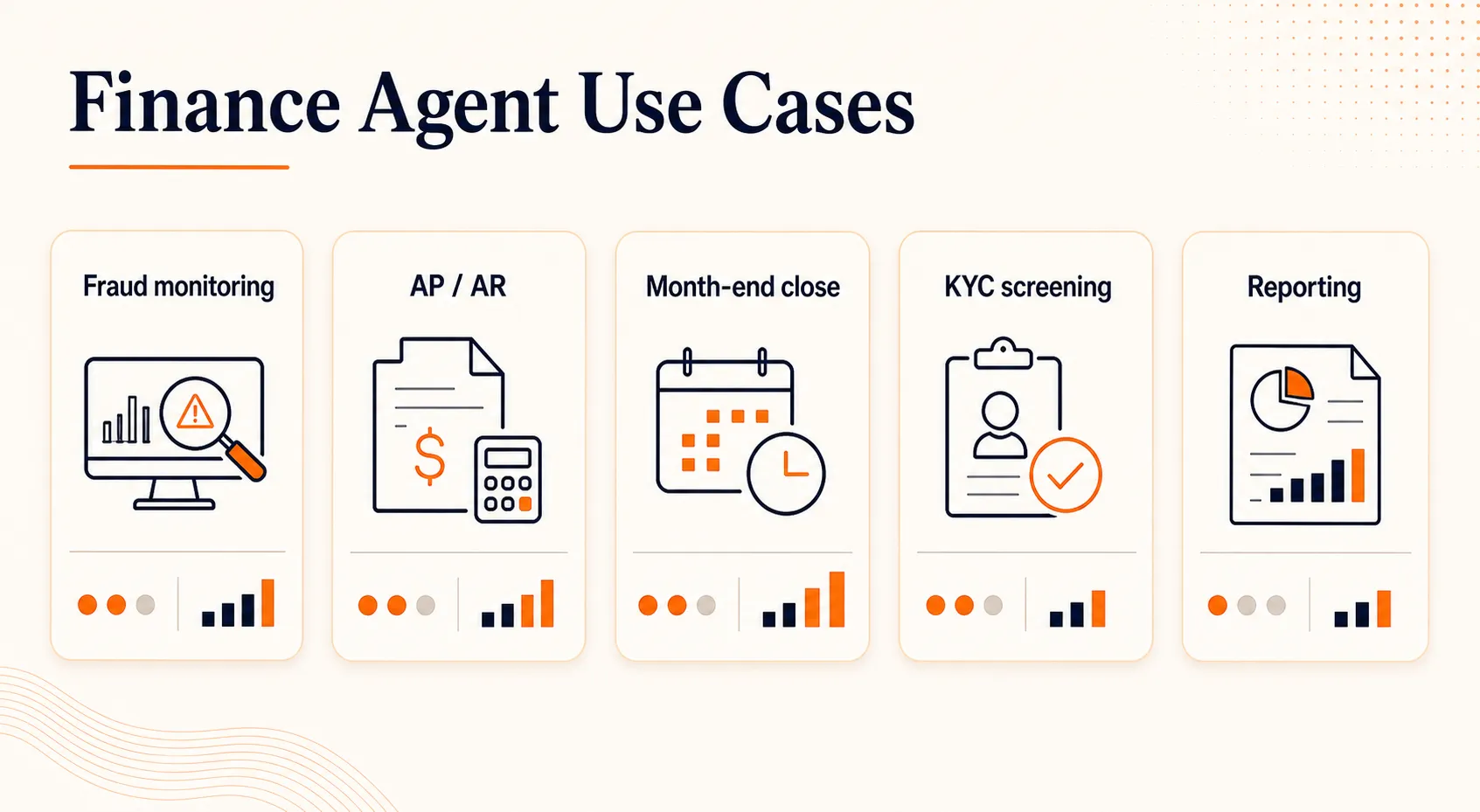
Not every finance task benefits from an agent. The best candidates share traits common to high-value AI agent use cases across industries: high frequency, rule-heavy logic, and significant time cost. Here’s where they deliver the most value in finance.
Fraud Detection and Transaction Monitoring
This is the most mature finance AI agent use case. Agents monitor transactions in real time, analyzing patterns, behavioral data, and anomaly signals simultaneously. When something looks suspicious, the agent investigates automatically: pulling transaction history, checking against known fraud patterns, and either flagging it for review or triggering an automated hold.
The numbers back this up. About 87% of global financial institutions had AI-powered fraud detection in place by 2025. FIS partnered with Anthropic to build a Financial Crimes AI Agent that compresses anti-money-laundering investigations from hours to minutes.
Accounts Payable and Receivable
AP automation is one of the fastest paths to ROI. An agent can ingest invoices (PDF, email, EDI), extract key fields, match them against purchase orders, flag discrepancies, route approvals based on amount thresholds, and post to the general ledger. Teams processing 500+ invoices per month typically see payback in 60 to 90 days.
Month-End Close and Reconciliation
The monthly close is a predictable, high-effort process that follows the same steps every cycle. An agent can automate sub-ledger to GL reconciliation, intercompany elimination entries, accrual calculations, and variance analysis. The controller reviews exceptions rather than building everything from scratch.
KYC and Compliance Screening
Know Your Customer checks involve pulling data from multiple sources, verifying identity documents, screening against sanctions lists, and documenting the results. An agent can handle the data gathering and initial screening, flagging cases that need human review. This is especially valuable for banks and financial institutions that process thousands of new accounts monthly.
Financial Reporting and Analysis
Agents can compile data from multiple sources, generate draft reports in standard formats, calculate key metrics, create a pie chart to visualize financial data, and highlight trends or anomalies. The analyst reviews and adds context rather than spending hours pulling numbers into spreadsheets.
| Use Case | Autonomy Level | Risk Level | Typical Payback |
|---|---|---|---|
| Fraud detection | Semi-autonomous | High (needs review gates) | 4-6 months |
| AP/AR automation | Semi-autonomous | Medium | 60-90 days |
| Month-end close | Assistive | Medium | 4-6 months |
| KYC screening | Semi-autonomous | High (regulatory) | 3-6 months |
| Financial reporting | Assistive | Medium | 2-4 months |
| Portfolio rebalancing | Human-in-the-loop | Very high | 6-12 months |
Quick check
Which finance AI agent use case typically has the fastest payback period?
Benefits of AI Agents in Finance
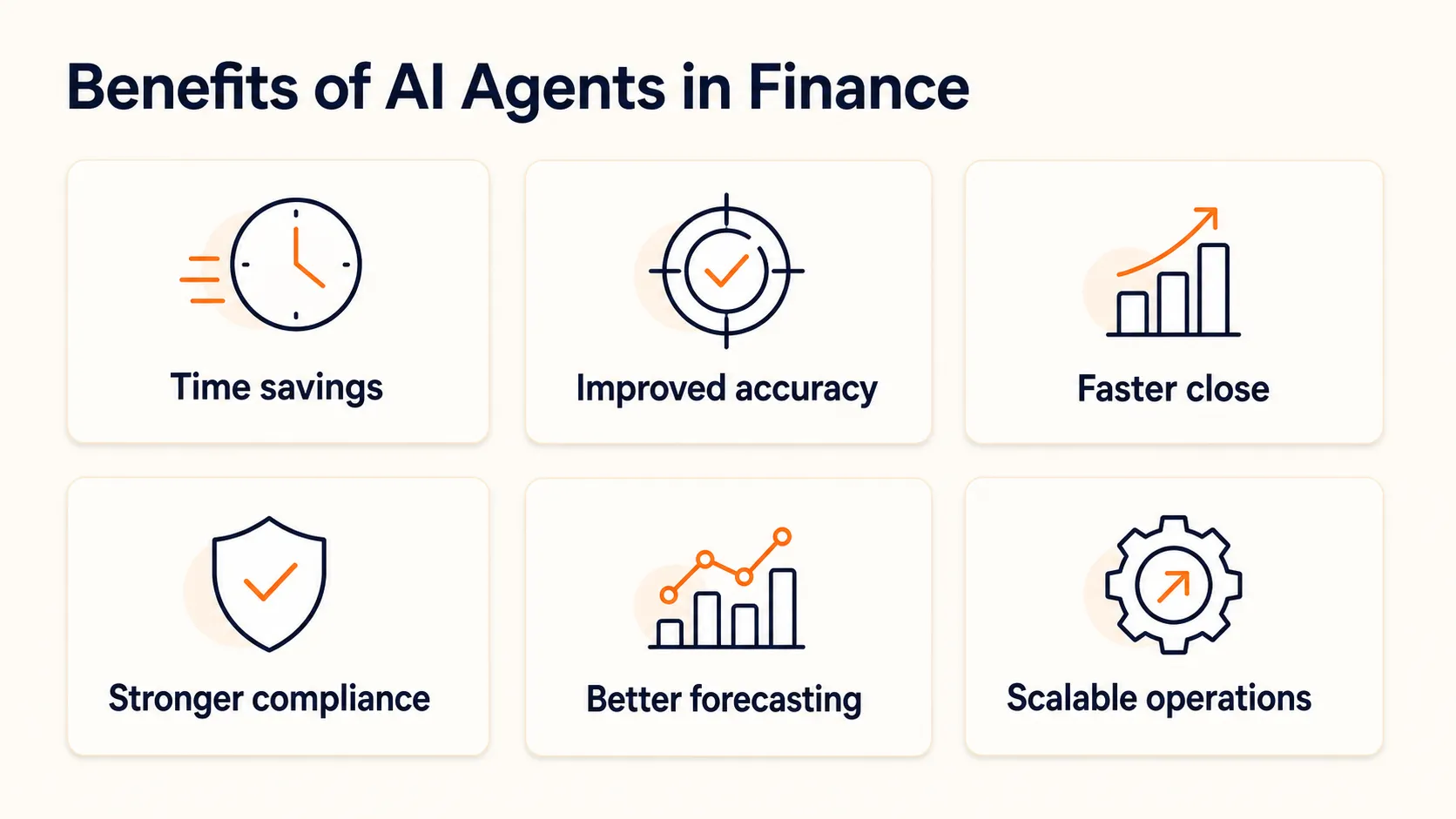
The use cases above show where AI agents fit. The next question is what they actually deliver. Here’s what the data shows across the benefits that matter most to finance teams.
Greater Efficiency and Time Savings
This is the most immediate benefit. PwC’s analysis found AI agents can deliver up to 90% time savings in key finance processes like purchase order processing, freeing up to 60% of team capacity for higher-value work like analysis, planning, and stakeholder communication. The savings compound: when agents handle data gathering and report formatting, analysts spend their time interpreting results instead of assembling them.
Improved Accuracy
Finance AI agents use deterministic tools for calculations, not probabilistic LLM outputs. That means the math is exact every time. Beyond calculation accuracy, agents running continuous validation catch anomalies and discrepancies earlier in the process than periodic manual reviews. Errors that might surface during a quarterly close get flagged in real time.
Faster Financial Close
The monthly close is one of the most labor-intensive cycles in finance. Gartner predicts that cloud ERP with embedded AI will drive 30% faster financial close cycles by 2028. IBM’s internal deployment showed a 90% cycle time reduction in their financial close process, saving approximately $600K annually through automated journal entry processing alone.
Stronger Compliance Posture
Instead of periodic compliance reviews that check a sample of transactions after the fact, AI agents monitor continuously. Every transaction gets screened. Every exception gets logged.
Automated audit trails capture the full decision chain: what data the agent accessed, what rules it applied, what it escalated, and who approved the final action. This is the kind of documentation FINRA and SEC examiners expect.
Better Forecasting
Finance teams that deploy AI agents for forecasting see up to 40% improvement in forecasting accuracy and speed, according to PwC. Agents can pull from more data sources, run more scenarios, and update projections more frequently than manual processes allow. The result is forecasts that reflect current conditions rather than last month’s assumptions.
Cost Reduction
The ROI shows up across the board. Fraud detection agents at HSBC reduced false positives by 60% while improving suspicious activity detection by 2 to 4 times across 900 million monthly transactions. Each of those false-positive reductions frees an investigator to focus on real threats.
Scalability Without Proportional Headcount
As transaction volumes grow, AI agents handle the increase without proportional headcount additions. An AP agent processing 500 invoices per month scales to 5,000 with the same infrastructure. This is especially relevant for growing companies or finance teams supporting multiple entities.
Challenges and Risks of AI Agents in Finance
The benefits are real, but so are the risks. Finance leaders evaluating AI agents need to understand what can go wrong and what governance to put in place before deployment.
Hallucinations Are a Compliance Liability
When an LLM generates plausible but incorrect information, that’s a hallucination. In finance, this isn’t just a quality issue. The CFPB has determined that providing customers with incorrect AI-generated information can constitute a UDAAP (Unfair, Deceptive, or Abusive Acts or Practices) violation.
FINRA’s 2026 oversight report explicitly requires firms to establish governance frameworks that address hallucinations, bias, and human monitoring of AI outputs. A compliance chatbot that cites a non-existent regulation or a reporting agent that fabricates a data point creates regulatory exposure, not just embarrassment.
The Explainability Problem
Regulators and auditors need to understand how AI systems reach their conclusions. “The model decided” is not an acceptable answer when examiners ask why a credit application was declined or why a transaction was flagged. Finance AI agents need transparent reasoning chains, and that means choosing architectures where you can trace every step from input to output to decision. Black-box models undermine both regulatory compliance and internal trust.
Regulatory Landscape Is Still Forming
FINRA, the SEC, the CFPB, and the EU AI Act are all moving from broad principles to enforceable rules for AI in financial services. The SEC has made AI a top examination priority, focusing on fairness of representations and consistency with disclosures. The EU AI Act classifies financial AI systems as high-risk, requiring complete traceability and documented testing.
Different jurisdictions have different requirements, and the rules are still evolving. Firms face genuine uncertainty about what compliance will look like in 18 months.
Bias in Credit and Lending Decisions
AI agents trained on historical data can inherit and amplify the biases in that data. In credit and lending, this means unfairly disadvantaging certain groups in ways that violate fair lending laws. The Federal Reserve, OCC, and CFPB are all conducting reviews of AI in credit decisions. Any finance team deploying agents that touch lending, credit scoring, or customer-facing financial advice needs bias testing and monitoring built into the system from the start.
The ROI Reality Gap
The hype is ahead of the results. Gartner predicts over 40% of agentic AI projects will be canceled by the end of 2027. Deloitte found that only 21% of active AI users in finance report clear, measurable value delivered.
The pattern is consistent: teams that scope narrowly and redesign workflows around the agent succeed. Teams that bolt an agent onto existing processes without changing how work flows typically don’t. McKinsey’s guidance is to invest 3x more in process redesign than in software.
Workforce Impact and Change Management
AI agents don’t replace finance professionals, but they do change what those professionals do day to day. Analysts shift from data gathering to analysis and judgment. Controllers shift from building reports to reviewing agent outputs and handling exceptions.
This role evolution requires intentional change management: retraining, updated job descriptions, and honest communication about how roles will change. In practice, change management is often a bigger barrier to successful AI agent deployment than the technology itself.
Quick check
When an AI agent hallucinates incorrect financial information, the CFPB can treat it as which type of violation?
Why Finance Is Different: Compliance, Accuracy, and Trust
The challenges above apply broadly to AI agents in any regulated industry. Finance adds a layer of constraints that make agent deployment uniquely demanding. Three requirements set it apart.
Numbers Must Be Exact
In most AI agent use cases, being 95% right is good enough. In finance, it isn’t. A reconciliation that’s off by a penny needs to be investigated. A tax calculation that rounds incorrectly creates compliance risk.
This means your finance AI agent needs deterministic tools for any calculation. Never let the LLM do math directly. Instead, the LLM reasons about what calculation to perform, then calls a dedicated function (Python, a spreadsheet engine, or a database query) to get the exact number. The LLM interprets and presents the result, but the math happens in code.
Regulatory Requirements Are Non-Negotiable
Finance operates under layers of regulation. SOX (Sarbanes-Oxley) requires internal controls and audit trails for financial reporting. SEC rules govern disclosures and filings.
FINRA oversees broker-dealer compliance. AML/KYC regulations require documented due diligence on customers.
The FINRA oversight report referenced earlier goes further here: firms must assess compliance obligations before deploying GenAI and establish governance frameworks covering cybersecurity risks and human monitoring on top of hallucinations and bias. This isn’t optional guidance; it’s what examiners will check.
For your agent, this means:
- Every action must be logged with a complete audit trail
- Financial outputs need version control and approval workflows
- Sensitive data must be encrypted and access-controlled
- The agent should never have unsupervised authority over regulated processes
Hallucination Mitigation Is Non-Optional
The compliance risks of hallucinations were covered above. In practice, three controls work together to contain them:
- Use RAG (Retrieval-Augmented Generation) to ground the agent’s responses in actual financial documents and data
- Keep all math in code, as described in the accuracy requirements above
- Require human review for any output that goes to regulators, clients, or public filings
Getting Started with Finance AI Agents
Understanding the benefits, risks, and constraints is the first step. The next is deciding where to begin. The most important decision isn’t which tool to use. It’s which workflow to automate first.
Choose the Right Use Case
Pick one specific, high-volume workflow where the current process is well-documented, repetitive, and time-consuming. AP automation, transaction monitoring, and month-end reconciliation are the most common starting points because they’re predictable, rule-heavy, and produce measurable time savings.
Avoid starting with high-stakes, judgment-heavy workflows like strategic planning or complex credit decisions. Those require more human oversight and are harder to validate.
Understand the Autonomy Spectrum
Not every finance AI agent needs the same level of independence. Three levels apply:
- Assistive: The agent gathers data and drafts outputs, but a human makes every decision. Best for financial reporting and analysis.
- Semi-autonomous: The agent handles routine cases independently and escalates exceptions. Best for transaction monitoring and AP processing.
- Fully autonomous: The agent runs end-to-end without human intervention. Only appropriate for very low-risk, well-defined tasks like data enrichment.
Most finance teams should start at the assistive level and move toward semi-autonomous only after the agent has proven its accuracy over multiple cycles.
Build Governance from Day One
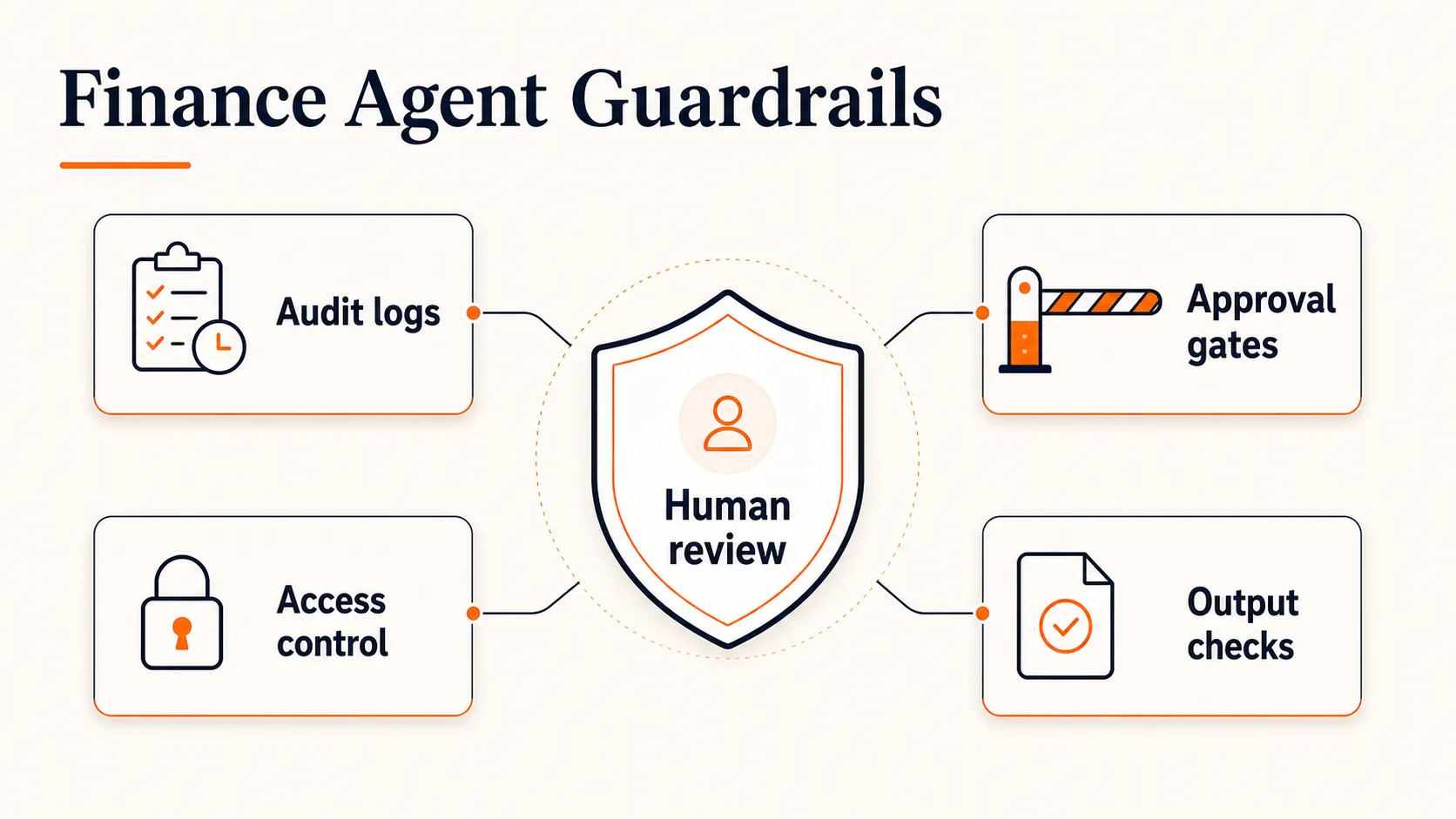
Compliance guardrails aren’t something you add after launch. They need to be part of the initial design:
- Audit logging: Every agent action, data access, and decision gets logged with timestamps and reasoning
- Approval workflows: Transactions above defined thresholds go to human reviewers automatically
- Data access controls: The agent only accesses data it needs for the specific task
- Output validation: Automated checks catch common errors before outputs reach reviewers
For teams that want the full technical implementation walkthrough, including data source connections, processing logic design, and deployment strategy, see this guide to building an AI agent .
Quick check
What autonomy level should most finance teams start with when deploying their first AI agent?
Evaluating AI Agent Platforms
Once you’ve chosen a use case and defined your governance requirements, the next step is choosing the right approach for your team.
No-code platforms are the fastest path for finance teams without dedicated engineering resources. Craze lets you build agents that connect to financial tools and data sources without writing code, which works well for straightforward workflows like report generation, data enrichment, and basic automation. You get flexibility without managing infrastructure.
Pre-built templates and SDKs offer a middle ground between speed and customization. Anthropic’s Claude Agent SDK, combined with their finance agent templates , provides pre-configured workflows for common finance tasks like reconciliation, KYC screening, and earnings review. Each template packages domain instructions, data connectors, and specialized sub-agents. This is the fastest path to a production-grade finance agent if your team has some technical capability.
Multi-agent frameworks let you define specialized agents that collaborate on complex workflows. One agent handles data extraction, another handles analysis, a third handles compliance checking. This works well for processes like month-end close where different phases require different reasoning and benefit from structured agent orchestration .
Custom engineering using Python and specialized libraries gives you maximum control over every decision point, API call, and integration. This is the right choice when you need tight connections to proprietary ERP systems or custom compliance logic, but it requires significant engineering investment and ongoing maintenance.
| Approach | Best For | Team Required | Flexibility | Finance Fit |
|---|---|---|---|---|
| No-code (Craze) | Non-technical teams, simple workflows | Business users | Moderate | Good for reporting, data tasks |
| Templates + SDK (Anthropic) | Standard finance workflows | Some technical ability | High | Strong for reconciliation, KYC |
| Multi-agent (CrewAI, LangGraph) | Complex multi-step workflows | Engineering team | High | Good for close cycles, audit |
| Custom (Python, LangChain) | Proprietary systems, regulated environments | Dedicated engineers | Maximum | Best for custom compliance |
Cost, ROI, and Getting Budget Approval
Finance leaders want numbers, so here they are.
What It Costs
Initial build costs vary by scope:
- Single-workflow agent (AP automation, report generation): $50K to $150K
- Multi-workflow agent (reconciliation + compliance + reporting): $200K to $500K
- Enterprise deployment (custom hosting, full compliance infrastructure): $300K to $1.2M+
Ongoing costs include:
- LLM API calls: $500 to $5,000+ per month depending on transaction volume
- Cloud infrastructure: $1,000 to $10,000+ per month
- Maintenance and updates: 15-20% of initial build cost annually
- Compliance audits that include AI systems: varies by firm size
What You Get Back
McKinsey’s 2025 analysis found a median ROI of 210% over three years for AI in financial services, with a 16-month median payback. More specifically:
- AP automation typically breaks even in 60 to 90 days for high-volume teams
- Month-end close automation saves 4 to 6 days per cycle
- Fraud detection agents can reduce losses by up to 78%
- Compliance screening agents cut KYC processing time by 60-80%
Making the Business Case
When building a budget proposal, include four value categories:
- Labor savings: Hours automated per month times fully loaded hourly cost
- Error reduction: Cost of manual errors (restatements, late fees, audit findings) times reduction rate
- Cycle time compression: Value of faster close, faster collections, faster compliance response
- Risk reduction: Cost of compliance failures, fraud losses, and audit penalties times the reduction you can demonstrate in testing
Most finance teams undercount the last two categories, which are often the largest contributors to long-term ROI. Getting the budget approved is one thing; spending it wisely is another. Here are the deployment mistakes that derail the most finance AI projects.
Common Mistakes When Deploying Finance AI Agents
Letting the LLM Do Math
This is the most common and most dangerous mistake. As covered in the accuracy section above, LLMs approximate rather than calculate. Every number in a financial workflow should come from a deterministic tool, never from the model itself.
Skipping the Audit Trail
In finance, if it isn’t logged, it didn’t happen. Every agent action needs a timestamped record of what data was accessed, what decisions were made, what outputs were produced, and who approved them. Build this from day one, not after your first audit finding.
Automating Too Many Workflows at Once
Start with one workflow. Get it working reliably. Then add the next one.
A finance agent that handles AP, AR, reconciliation, and compliance from day one will take months to build and will be brittle. The teams that see the fastest ROI pick one high-volume workflow and get it right first.
Ignoring Data Quality
A reconciliation agent is only as good as the data in your GL and sub-ledgers. If your chart of accounts has inconsistencies, your vendor master has duplicates, or your transaction coding is unreliable, the agent will amplify those problems. Clean your data first, or build data quality checks into the agent’s workflow.
Treating Compliance as an Afterthought
SOX controls, FINRA requirements, and SEC rules need to be baked into the agent’s architecture from the start. Bolting on compliance after you’ve built the workflow means rebuilding half of it. Define your control points, approval thresholds, and audit requirements before you write the first line of agent logic.
Skipping Human-in-the-Loop for High-Stakes Actions
Any agent action that moves money, changes an account status, produces a regulatory filing, or communicates with external parties needs human review. Start with review on everything, then selectively remove it for low-risk, well-tested scenarios.
Avoiding these mistakes puts you in a stronger position than most teams attempting finance AI agents today. Here’s what that adds up to.
Where Finance AI Agents Go from Here
AI agents in finance are delivering real results for teams that deploy them well. The efficiency gains, accuracy improvements, and compliance benefits are backed by data from PwC, Deloitte, McKinsey, and early adopters like HSBC and IBM. But the gap between adoption and value realization is wide. Most of the teams that struggle started too broad, skipped governance, or expected the technology to fix broken processes on its own.
The practical path forward is straightforward: pick one high-volume workflow, build governance from day one, start at the assistive level, and expand only after you’ve proven accuracy. The teams that treat AI agents as a process improvement initiative, not just a technology purchase, are the ones seeing payback within quarters, not years.
FAQs
What is a finance AI agent?
A finance AI agent is an AI system that connects to financial data sources, reasons about financial information, and takes actions within finance workflows. Unlike basic chatbots or simple automations, a finance AI agent can handle multi-step tasks like reconciling general ledger entries, screening KYC files, monitoring transactions for fraud, or preparing financial reports. It pulls data from ERPs, market feeds, and compliance databases, makes decisions based on predefined rules and AI reasoning, and routes high-stakes actions to human reviewers.
Is it safe to use AI agents for financial transactions?
Yes, but only with proper guardrails. Finance AI agents should never have unsupervised authority over transactions. The standard approach is human-in-the-loop for any action that moves money, changes account status, or produces regulatory filings. For lower-risk tasks like data enrichment, report drafting, and anomaly flagging, agents can operate more autonomously. FINRA's 2026 oversight report explicitly requires firms to establish governance frameworks that address hallucinations, bias, and human monitoring of AI outputs.
What approaches are available for implementing finance AI agents?
Several approaches exist depending on your team's capabilities and requirements. No-code platforms like Craze are the fastest path for teams without engineering resources, letting you connect agents to financial tools without writing code. Pre-built finance templates offer a middle ground for tasks like reconciliation and KYC screening. Multi-agent frameworks work well when different agents handle different phases. Custom solutions give maximum control but require significant engineering investment. The right choice depends on technical depth, compliance requirements, and system complexity.
How much does it cost to build a finance AI agent?
Costs vary by scope. A focused agent for a single workflow like accounts payable automation might cost $50K to $150K to build and deploy. Enterprise-grade agents with custom model hosting, compliance guardrails, and multi-system integration typically run $300K to $1.2M in initial investment, plus $100K to $350K per year for licensing and operations. API costs for LLM calls add $500 to $5,000+ per month depending on volume. Most finance teams see payback within two to four quarters when they scope the agent to a specific, high-volume workflow.
Can AI agents replace financial analysts?
No. Finance AI agents are best at handling the high-volume, repetitive parts of financial work: data gathering, reconciliation, report formatting, anomaly detection, and compliance screening. Analysts still bring judgment, context, relationship knowledge, and strategic thinking that AI can't replicate. The most effective deployments treat agents as tools that free analysts from grunt work so they can spend more time on analysis, decision-making, and client relationships.
What are the biggest risks of using AI agents in finance?
The three biggest risks are hallucination-as-compliance-liability, regulatory uncertainty, and the ROI reality gap. Incorrect AI-generated financial information can create real exposure: the CFPB has treated AI misinformation as a potential UDAAP issue, and FINRA requires governance for hallucinations, bias, and human monitoring. Rules are still forming across FINRA, SEC, CFPB, and the EU AI Act, while many agentic AI projects fail to show clear value. Starting with one high-volume workflow and governance from day one helps manage all three risks.
More Articles
The 8 Best Lindy AI Alternatives in 2026 (Tested & Compared)

The 8 best Lindy AI alternatives for 2026, anchored to why people leave Lindy, with current pricing, third-party ratings, honest pros and cons, and the best pick for each reason to switch.
The 7 Best Make Alternatives in 2026 (Tested & Compared)
The 7 best Make.com alternatives for 2026, anchored to why people leave Make, with current pricing, third-party ratings, honest pros and cons, and the best pick for each reason to switch.
The 8 Best Zapier Alternatives in 2026 (Tested & Compared)
The 8 best Zapier alternatives for 2026, anchored to why people leave Zapier, with current pricing, third-party ratings, honest pros and cons, and the best pick for each reason to switch.