AI Agent for Marketing: What It Does, How to Build One, and Where It Helps
Learn how AI agents handle marketing tasks like SEO, email, social, and content. Covers use cases, how to build your first marketing agent, quality control, and ROI.

By: Praman Menaria
Organic Growth/SEO Consultant
Published
Updated
Edited by Craze Editorial Team · See our Editorial Process
Marketing teams have more channels, more content formats, and more data than ever, but headcount rarely keeps up. You’ve probably used ChatGPT to draft a few social posts or brainstorm subject lines. That helps, but it’s still you doing the work one prompt at a time. An AI agent for marketing is something different: a system that handles repeatable marketing tasks on its own, connected to your tools, following your rules, and checking in with you before anything goes live.
This guide covers where marketing agents actually deliver results, how to build your first one, how to keep quality high on AI-generated marketing content, and how to measure whether the investment is paying off.
TL;DR
- These are not one-off prompts. AI marketing agents handle repeatable tasks across content, SEO, email, social media, and analytics as complete workflows.
- Not every marketing task benefits from an agent. Match the agent type to the function and start with high-frequency, lower-risk work.
- Quality gates are non-negotiable. Brand voice rules and human review must be in place before publishing any AI-generated marketing content.
- Measure outcomes, not just speed. Track downstream results (conversions, engagement, revenue) rather than time saved alone.
- Start with one workflow, prove it works, then expand to multi-agent setups.
What an AI Marketing Agent Actually Does
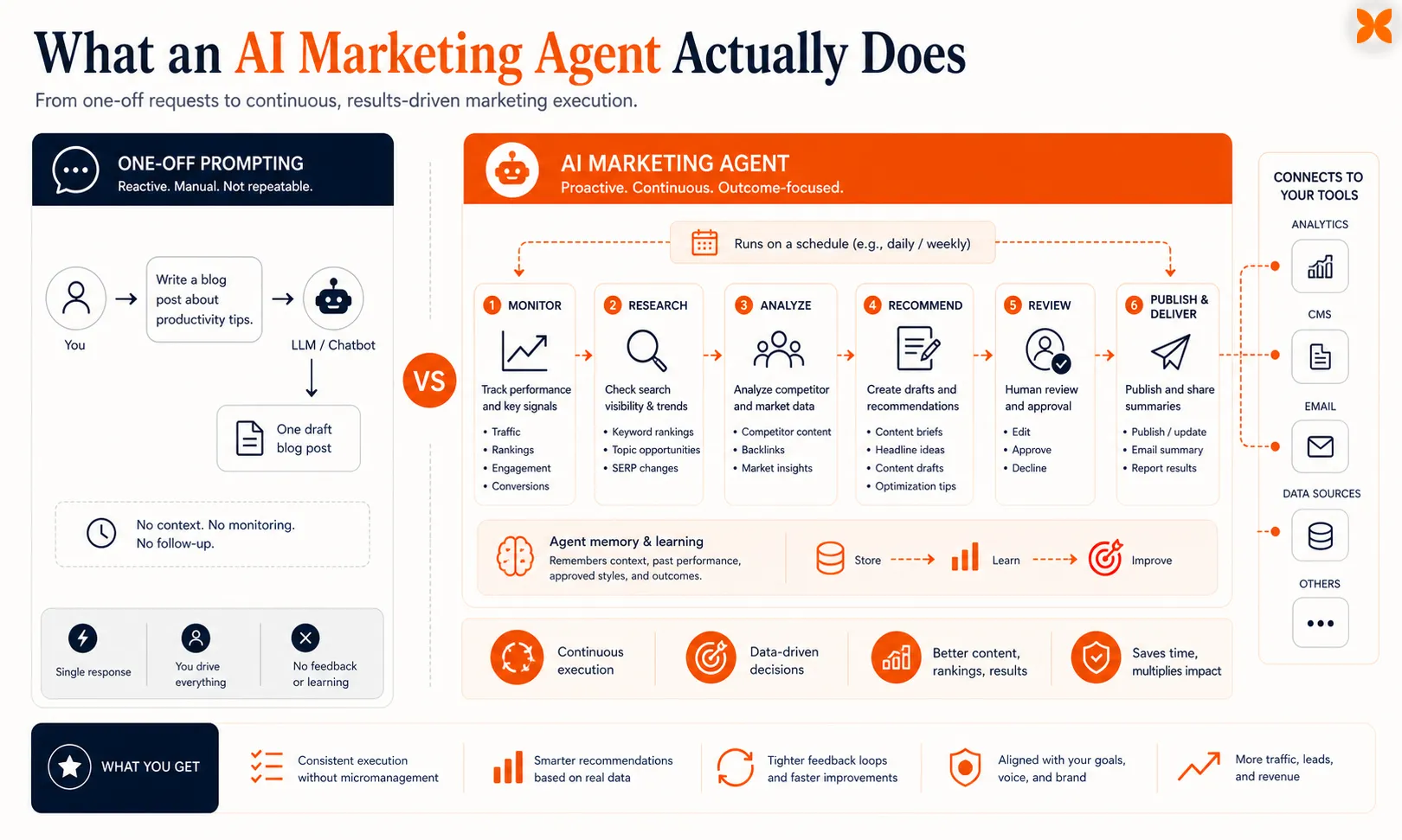
An AI agent is software that takes a goal, breaks it into steps, uses tools to complete those steps, and makes decisions along the way. In marketing, that means an agent connected to your analytics platform, your CMS, your email tool, or your social accounts, executing tasks that would otherwise eat hours of your week.
The difference between asking ChatGPT to “write me a blog intro” and running a marketing agent is the difference between a single question and a complete workflow. A marketing agent might monitor your search rankings every Monday, identify pages losing traffic, pull competitor data for those keywords, draft optimization recommendations, and send you a summary to review. You set it up once. It runs on schedule.
About 90% of marketing organizations now use AI agents in some capacity, according to recent industry surveys. But “using AI” and “getting consistent value from AI” are two different things. The gap usually comes down to picking the right tasks, building the right guardrails, and measuring the right outcomes. For a closer look at where agents deliver across industries, see this overview of AI agent use cases .
Marketing Use Cases Where AI Agents Deliver Results
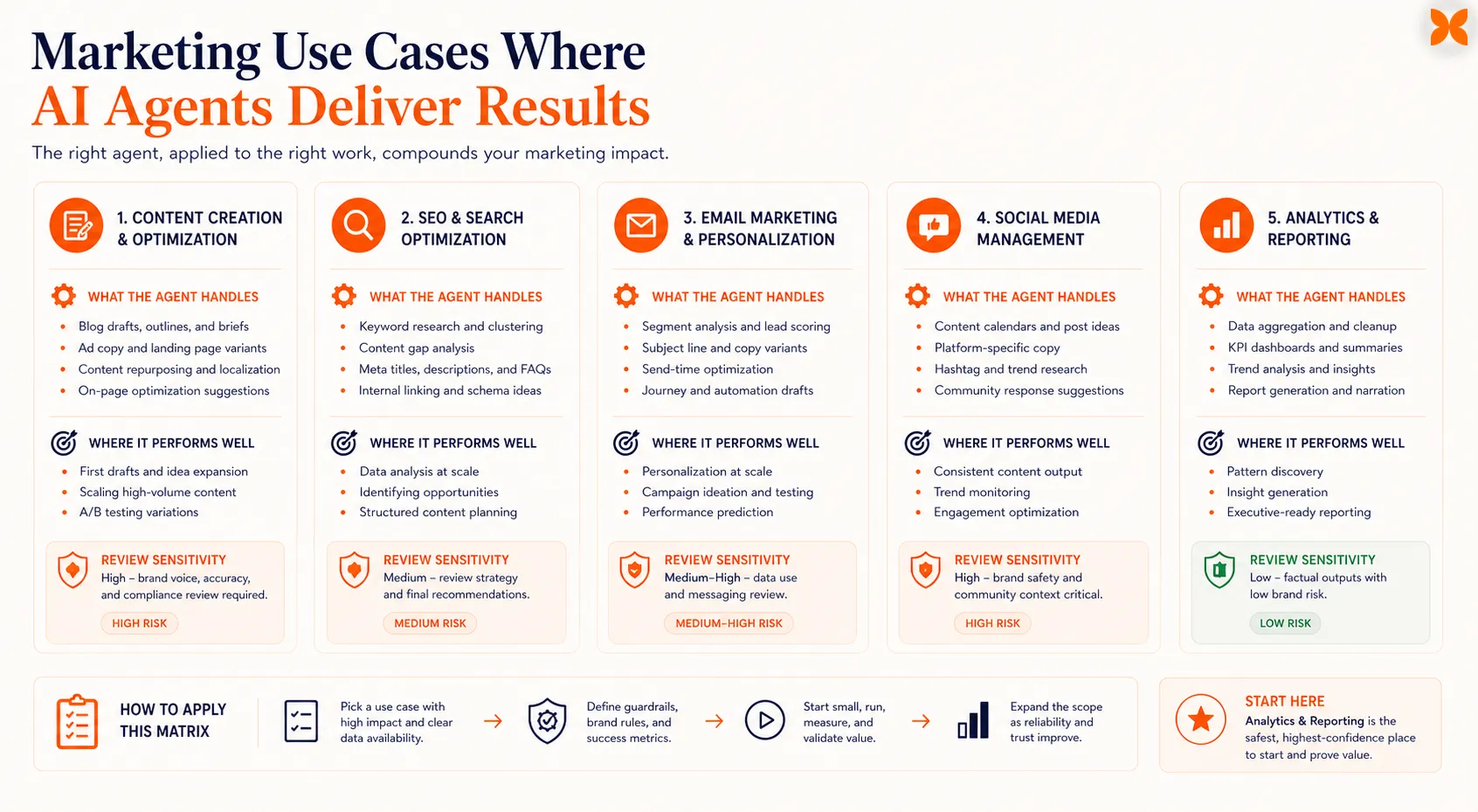
Marketing covers a wide range of activities, and agents don’t suit all of them equally. Here’s where they work well, with realistic expectations for each.
Content Creation and Optimization
Content agents can research topics, generate first drafts, optimize existing posts for search, and repurpose long-form content into social snippets, email summaries, or ad copy.
A typical workflow looks like this:
- The agent scans your content calendar and identifies upcoming topics
- It pulls search data, competitor content angles, and audience questions
- It generates a structured outline and first draft
- A human editor reviews for accuracy, brand voice, and originality
- The final piece publishes through your CMS
Where agents struggle with content: original thought leadership, nuanced brand humor, and topics where your company’s unique perspective is the whole point. Agents draft well. They don’t think originally.
SEO and Search Optimization
SEO involves large amounts of recurring, data-heavy work, which makes it a strong fit for agents. An SEO agent can track keyword rankings, flag pages losing positions, identify content gaps, audit technical issues, and draft optimization recommendations.
Marketing leaders expect AI automation in their workflows to grow from 16% to 36% by 2028, according to Gartner. SEO is one of the first functions where that shift is visible. The work is structured, measurable, and repetitive enough that agents can handle the monitoring and analysis while humans focus on strategy.
Email Marketing and Personalization
Email agents handle audience segmentation, subject line generation, body personalization, A/B test setup, and send-time optimization. They’re especially useful for teams managing multiple customer segments with different messaging needs.
A practical example: the agent analyzes past campaign performance by segment, generates personalized subject lines and body variants for each group, sets up the A/B test, and queues the campaign for your review before sending. You check the output, approve or adjust, and it goes out.
The key constraint: email agents need clean data. If your CRM segments are messy or your subscriber lists are outdated, the agent will personalize confidently based on bad information.
Social Media Management
Social agents can draft posts, schedule content across platforms, monitor engagement, detect trending topics in your niche, and draft responses to common questions.
This is the function where brand voice precision matters most. A slightly off-tone tweet can go viral for the wrong reasons. Social agents need tight guardrails: approved tone examples, topics to avoid, escalation rules for sensitive subjects, and mandatory human review for anything beyond routine scheduling.
Analytics and Reporting
If you’re looking for the safest place to start with a marketing agent, this is it. Analytics agents pull data from multiple sources (Google Analytics, ad platforms, email tools, social dashboards), generate weekly or monthly performance reports, flag anomalies, and draft executive summaries.
The risk is low because the output is internal. The value is high because manual reporting eats hours every week and adds minimal strategic value. An analytics agent gives your team back that time to actually act on the data instead of just compiling it.
Quick check
Which marketing function is the safest starting point for your first AI agent?
Each of these functions has different examples of how agents work in practice . The important thing is picking the right starting point for your team.
How to Build Your First Marketing AI Agent
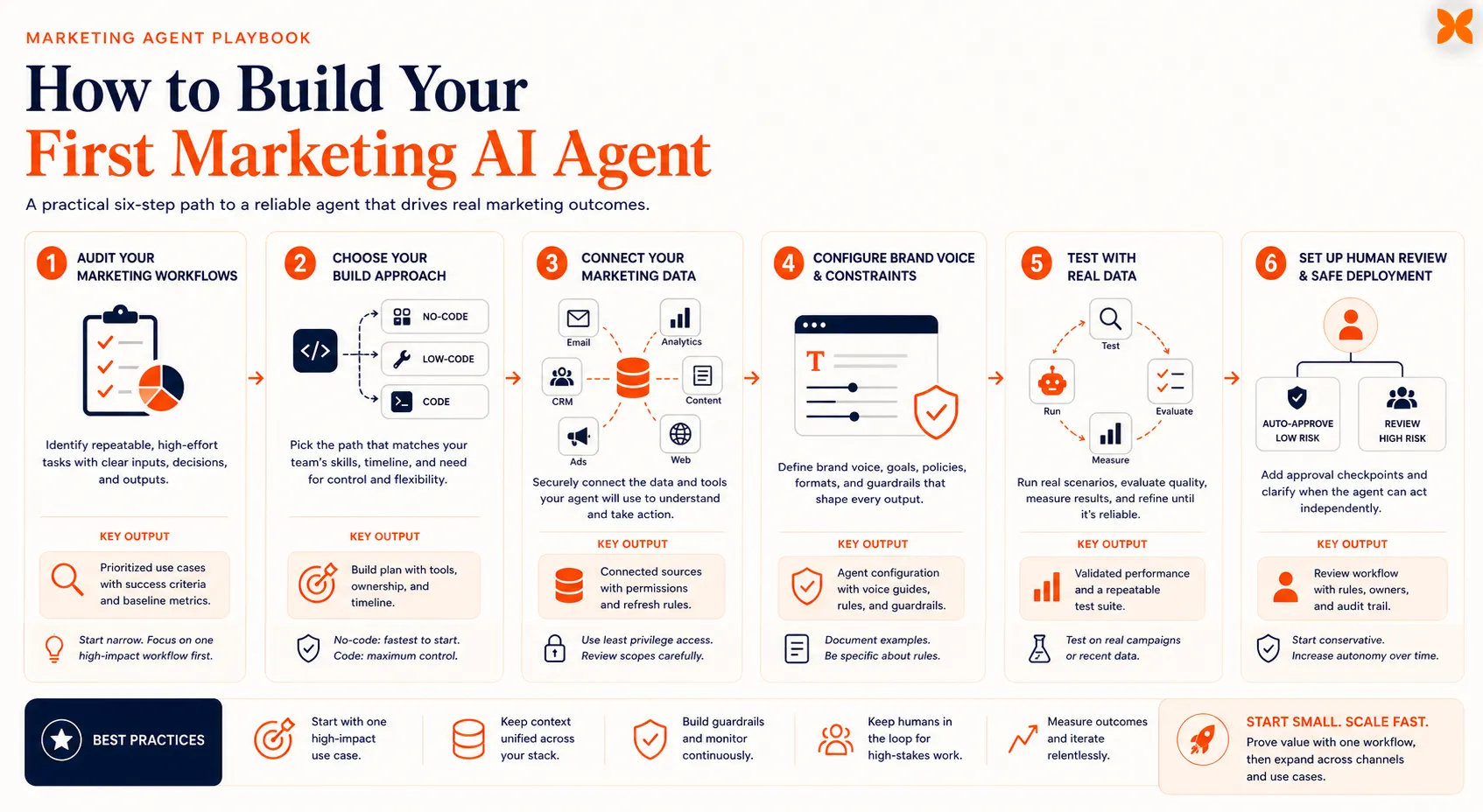
You don’t need to build all five agent types at once. Start with one workflow and expand from there. Here’s a practical framework.
Step 1: Audit Your Marketing Workflows
Map every recurring marketing task by three dimensions:
- Frequency: How often does this task happen? (Daily, weekly, monthly)
- Time per instance: How long does it take a person to complete?
- Quality sensitivity: How much damage does a mistake cause?
Tasks that are high-frequency, time-consuming, and lower-risk (like weekly performance reports or content repurposing) are your best starting candidates.
Step 2: Choose Your Build Approach
You have three main paths, depending on your team’s technical comfort:
- No-code platforms: Visual builders where you connect tools and define workflows without writing code. Good for marketing teams without engineering support.
- Frameworks: Tools like CrewAI or LangChain for teams with some technical capability. More flexible, more complex. See the full breakdown of agentic AI frameworks .
- AI platforms: Tools like Craze let you build agents with any AI model, connect them to your workflows, and run them on a schedule without managing infrastructure.
For a deeper walkthrough of the build process, the guide to building an AI agent covers scoping, tool selection, and common mistakes in detail. If you want to explore dedicated builder tools, see this roundup of AI agent builders .
Step 3: Connect Your Marketing Data
Your agent needs access to the tools where your marketing data lives: analytics platforms, CRM, email tools, social media accounts, and your CMS. The more context the agent has, the better its output. But start narrow. Connect one or two data sources for your first agent and expand access as you validate the workflow.
Step 4: Configure Brand Voice and Constraints
This step is where most marketing agents succeed or fail. Before your agent generates any customer-facing content, provide it with:
- Your brand style guide or voice documentation
- Examples of approved content (good and bad)
- Explicit rules about tone, topics to avoid, and compliance requirements
- Output format templates
Step 5: Test With Real Data
Don’t test your marketing agent with demo scenarios. Use actual campaign data, real content topics, and genuine customer segments. The only way to know if the agent works is to see how it handles your specific context.
Step 6: Set Up Human Review
No marketing agent should publish directly to customers without human review, at least not initially. Build the review step into the workflow: the agent drafts, a human approves or edits, and only then does content go live. Over time, you might loosen the review requirement for lower-risk outputs like internal reports, but keep it tight for anything customer-facing.
Understanding different types of AI agents can help you decide how much autonomy to give your marketing agent at each stage.
Quality Control for AI Marketing Content
Speed means nothing if your AI-generated content damages your brand. Marketing content is customer-facing, which makes quality control more important here than in almost any other agent use case.
Brand Voice Consistency
The most common complaint about AI marketing content is that it sounds generic. Every brand has a voice, and that voice is what makes your content recognizable. Without explicit voice training, agents default to a bland, corporate tone that could belong to any company.
Fix this by feeding the agent specific examples of your best content, not just a style guide document. Show it what good looks like. Include examples of what to avoid. Test the output against your brand standards before expanding the agent’s responsibilities.
The Review Workflow
A reliable review process looks like this:
- Agent drafts: The agent generates content based on its instructions, data, and brand guidelines
- Human reviews: A team member checks for accuracy, brand voice, factual claims, and anything that feels off
- Revise or approve: The human edits where needed or sends it back for regeneration with updated instructions
- Publish: Only after human approval does content go live
This isn’t optional for customer-facing marketing content. Even the best agents make mistakes: they hallucinate product features, misquote statistics, or produce tone-deaf copy for sensitive topics.
Compliance Considerations
Marketing agents need to operate within regulatory boundaries:
- FTC guidelines: Disclose AI-generated content where required. Rules are evolving, but transparency protects your brand.
- Email regulations: CAN-SPAM and similar laws apply to agent-sent emails just as they do to manually sent ones. Unsubscribe links, sender identification, and consent rules still apply.
- Platform terms of service: Social media platforms have their own rules about automated posting and bot behavior. Make sure your agent operates within them.
When your agents grow more complex, understanding AI agent architecture helps you design better quality checkpoints into the system.
Quick check
Why should no marketing agent publish customer-facing content without human review?
Measuring Marketing Agent ROI
“We saved 10 hours a week” sounds great in a meeting. But if those 10 hours of agent-produced content generated lower engagement, fewer conversions, or customer complaints, you haven’t saved anything. You’ve created a new problem.
Three Layers of Measurement
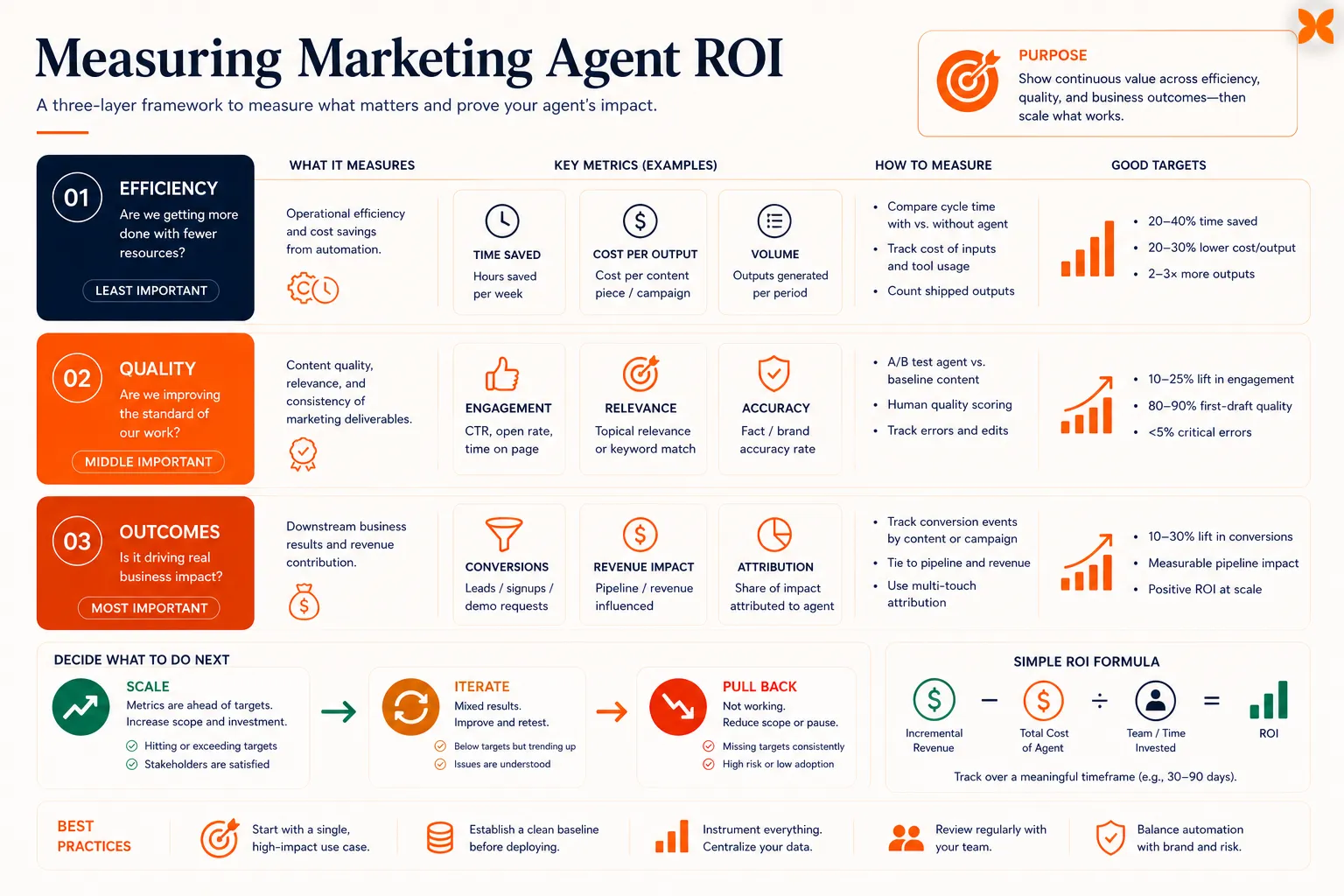
Layer 1: Efficiency. Track the basics: time saved per task, cost per output, volume of work produced. This is the most visible metric but the least important on its own.
Layer 2: Quality. Compare agent output against your benchmarks: engagement rates, accuracy scores, brand voice consistency ratings, and error rates. If quality dips, efficiency gains are meaningless.
Layer 3: Outcomes. This is what matters most. Are the agent’s outputs driving the results you need? Track conversion rates, revenue attributed to agent-produced content, customer satisfaction scores, and campaign performance relative to manually produced work.
Research suggests AI content drafting delivers roughly 3.2x ROI on average, according to McKinsey. But that number varies widely depending on how well the agent is configured and how rigorously quality is maintained.
When to Scale vs. When to Pull Back
Scale your marketing agent when:
- Quality metrics match or exceed your manual baseline
- Downstream outcomes (conversions, engagement) are stable or improving
- Your team trusts the output enough to reduce review friction
Pull back when:
- Quality scores are declining despite configuration adjustments
- Customer feedback signals something is off
- The agent is producing volume but outcomes are flat or dropping
For teams running multiple agents, AI agent orchestration becomes important to coordinate workflows and maintain quality across the system.
Quick check
Which measurement layer matters MOST when evaluating marketing agent ROI?
Getting Started
AI agents for marketing aren’t about replacing your marketing team. They’re about giving that team capacity to focus on strategy, creativity, and judgment while agents handle the repeatable, data-heavy work.
Start with one workflow. Pick something high-frequency and lower-risk, like weekly reporting or content repurposing. Build quality gates before you build scale. Measure downstream outcomes, not just speed. And expand only when the results justify it.
The marketing teams getting the most from AI agents aren’t the ones deploying the most tools. They’re the ones who chose the right task, built the right guardrails, and measured the right things.
FAQs
How can AI agents be used in marketing?
AI agents handle repeatable marketing tasks across several functions: content creation and optimization, SEO monitoring and keyword research, email personalization and A/B testing, social media scheduling and engagement tracking, and analytics reporting. They work best for high-volume, structured tasks where the workflow follows a predictable pattern. Creative strategy, original thought leadership, and sensitive brand decisions still need human judgment.
How to create an AI agent for marketing?
Start by auditing your marketing workflows and identifying a high-frequency, lower-risk task like weekly reporting or content repurposing. Choose a build approach that matches your team's technical ability: no-code platforms for non-technical teams, frameworks like CrewAI for teams with some engineering support, or AI platforms like Craze for building agents without managing infrastructure. Connect your marketing data sources, configure brand voice rules and output constraints, test with real data, and set up human review before going live.
What is the 10-20-70 rule for AI?
The 10-20-70 rule says that 10% of AI project success comes from the technology itself, 20% from data quality, and 70% from people, processes, and change management. For marketing agents, this means the AI model and tools you choose matter far less than how well you scope the right task, train your team to work alongside the agent, and adjust your marketing workflows to include quality review steps.
Which AI agent is best for marketing?
There is no single best agent for all marketing functions. The right choice depends on what you are automating. For content creation, you need an agent connected to your CMS and trained on your brand voice. For SEO, you want one integrated with your analytics and rank-tracking tools. For email, look for tight integration with your email platform and CRM. Craze lets you build marketing agents with any AI model and connect them to your existing tools, which is useful if you want flexibility across multiple marketing functions.
More Articles
The 8 Best Lindy AI Alternatives in 2026 (Tested & Compared)

The 8 best Lindy AI alternatives for 2026, anchored to why people leave Lindy, with current pricing, third-party ratings, honest pros and cons, and the best pick for each reason to switch.
The 7 Best Make Alternatives in 2026 (Tested & Compared)
The 7 best Make.com alternatives for 2026, anchored to why people leave Make, with current pricing, third-party ratings, honest pros and cons, and the best pick for each reason to switch.
The 8 Best Zapier Alternatives in 2026 (Tested & Compared)
The 8 best Zapier alternatives for 2026, anchored to why people leave Zapier, with current pricing, third-party ratings, honest pros and cons, and the best pick for each reason to switch.