Multi-Agent vs Single-Agent AI: When to Use Each
Single-agent AI handles most workflows cheaper and faster. Multi-agent shines when tasks need parallel processing, security boundaries, or specialized roles. Here's how to decide.

By: Deepit Patil
Co-Founder and CTO
Published
Updated
Edited by Craze Editorial Team · See our Editorial Process
The question comes up early in every AI project: should you build one agent that handles everything, or split the work across multiple specialized agents?
It sounds like a simple architecture decision. In practice, it is one of the highest-impact choices you will make. Pick single-agent when multi-agent would have been better, and your system hits a ceiling it can’t grow past. Pick multi-agent too early, and you are paying 2 to 5 times more per task for complexity that slows you down instead of helping.
This guide breaks down exactly when each approach works, where each one fails, and how to make the right call for your project.
TL;DR
- Single-agent handles most workloads. One AI agent with good tools covers roughly 80% of enterprise use cases at lower cost and latency.
- Multi-agent is for specific situations. You need it when tasks span multiple domains, require parallel processing, or involve hard security boundaries.
- Don’t start with multi-agent. A 2026 Stanford study shows single agents match or outperform multi-agent systems on reasoning tasks when compute budgets are equal.
- Multi-agent costs 2 to 5x more per task. Multiple LLM calls, redundant context, and coordination overhead add up fast.
- Reliability compounds downward. Five agents at 95% individual reliability = 77% system reliability. More agents, more failure points.
- Start single, split when proven necessary. Build a single-agent baseline first. Move to multi-agent only when you can measure the gap it fills.
What Single-Agent and Multi-Agent AI Actually Mean
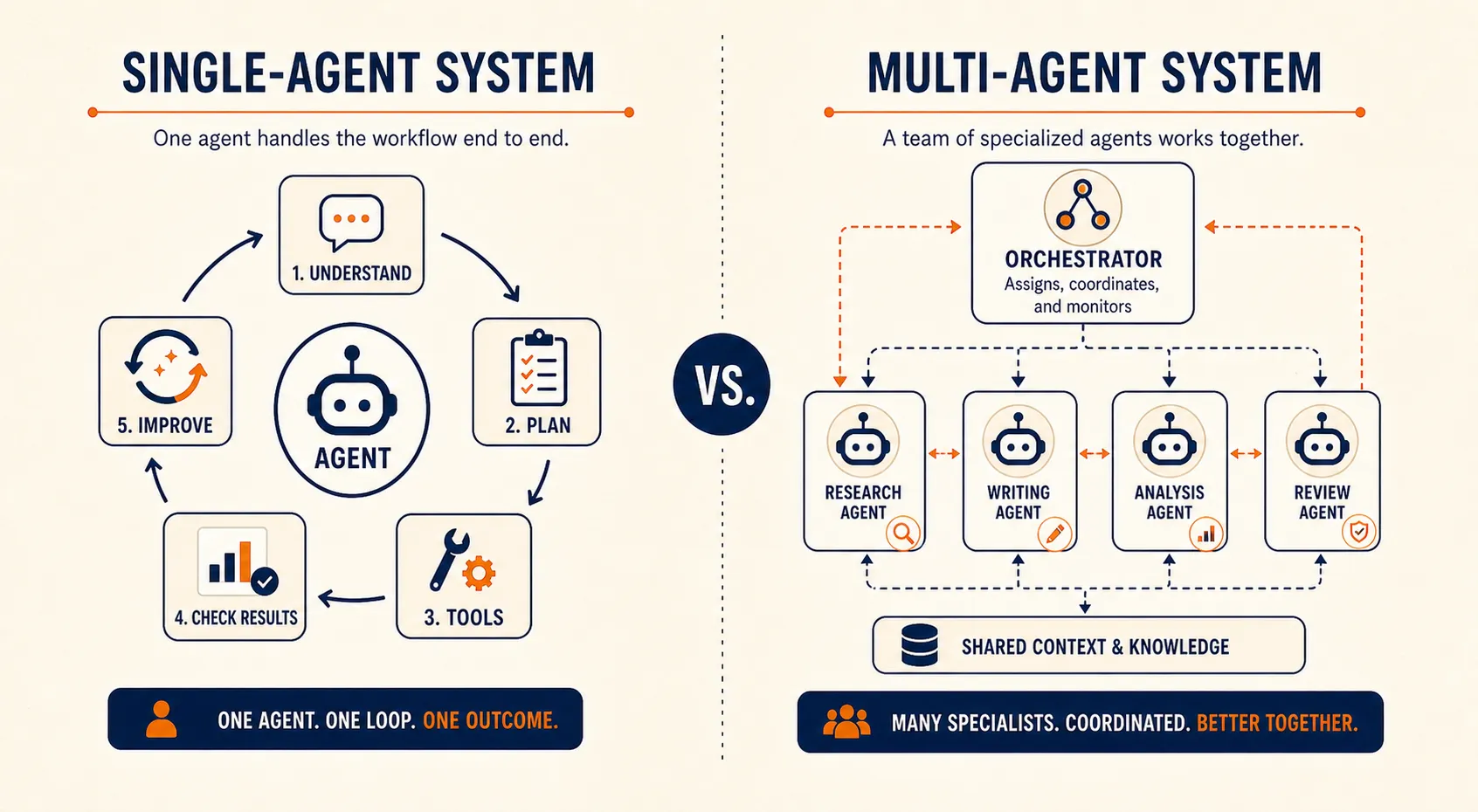
Before comparing the two approaches, it helps to define them clearly. The terms get used loosely, and that leads to bad architecture decisions.
Single-Agent Systems
A single-agent system uses one AI model instance with one thread of reasoning, one memory context, and access to a set of tools. The agent receives a goal, plans its approach, executes steps sequentially (or with tool calls), and returns a result. All decision-making happens in one place.
Think of it as one skilled employee with a good toolkit. They read the brief, pull the data, draft the report, and send it off. One brain, one workflow, one thread of accountability.
The architecture of a single agent typically includes a language model for reasoning, a memory system for tracking context, tool integrations for taking actions, and a planning module for breaking goals into steps. Everything runs through a single execution loop.
Multi-Agent Systems
A multi-agent system uses multiple distinct AI agents, each with its own role, instructions, tools, and sometimes its own model. A coordination layer (an orchestrator, router, or peer protocol) manages how agents communicate, share context, and hand off work.
Think of it as a team of specialists with a project manager. The project manager assigns tasks, the researcher digs into data, the writer drafts content, and the reviewer checks quality. Each specialist is focused and good at their job, but the coordination between them is a real cost.
Multi-agent AI systems need additional infrastructure: agent registries, routing logic, shared state management, and monitoring for each agent in the pipeline. That infrastructure is where most of the complexity lives.
The difference is not just “more agents.” It is a fundamentally different coordination model that introduces communication overhead, failure propagation paths, and debugging challenges that single-agent systems don’t have.
Understanding what each approach is built for helps you evaluate where each one actually shines.
Single-Agent AI: What It Does Well
Single-agent systems are underrated. The industry hype around multi-agent architectures makes it easy to overlook how capable a well-built single agent can be.
Cost Efficiency
A single agent makes one LLM call per reasoning step. No coordination overhead, no redundant context processing, no inter-agent communication tokens. For high-volume operations with thin margins, the 2 to 5x token savings over multi-agent is significant.
Lower Latency
No handoffs between agents means no handoff latency. For synchronous, customer-facing applications where sub-5-second responses matter, single-agent wins by default. Every agent boundary adds processing time.
Simpler Debugging
When something goes wrong with a single agent, you read one prompt, examine one output, and identify one gap. The debugging path is linear and takes minutes. With multi-agent systems, you are tracing errors across multiple agents, figuring out which handoff corrupted the context.
Strong Reasoning Performance
This is the big one. A Stanford University study from 2026 found that single-agent systems match or outperform multi-agent architectures on complex reasoning tasks when both get the same compute budget. If you give a single agent the same total tokens that a multi-agent system would use, the single agent is more information-efficient.
Reliability
A single agent at 95% reliability gives you 95% system reliability. That number doesn’t compound downward the way it does with multiple agents in a chain.
Real-World Examples
A customer support agent that reads a ticket, looks up the account, drafts a response, and sends it works perfectly as a single agent. Same for a sales research agent that pulls company data, enriches a lead profile, and writes a summary. These are sequential tasks in one domain, and splitting them across multiple agents would add cost and latency for zero improvement.
Single agents work best for well-defined sequential tasks, single-domain workflows, latency-sensitive applications, and any situation where debuggability and cost control are priorities.
But not every workflow fits neatly into a single agent’s strengths. Some tasks genuinely need more than one brain.
Quick check
A 2026 Stanford study found that single-agent systems perform how compared to multi-agent systems on reasoning tasks with equal compute budgets?
Multi-Agent AI: What It Does Well
Multi-agent systems earn their complexity in specific situations where single agents genuinely struggle.
Parallel Processing
When three research queries, five data checks, or ten API calls can run simultaneously, multi-agent systems complete the work in the time of the longest subtask instead of the sum of all subtasks. For batch processing and data pipelines, this speed advantage is real and measurable.
Deep Specialization
Each agent gets a narrow scope, specific instructions, and purpose-built tools. A research agent does not need writing tools. A code review agent does not need customer service prompts. Narrower scope means better performance on each individual task.
Generator-Critic Patterns
One agent produces output. A separate agent evaluates it. Early research suggests this pattern catches significantly more factual errors than self-reflection within the same agent. For high-stakes outputs (medical summaries, legal documents, financial reports), that error-catching improvement can justify the extra cost.
Security and Compliance Boundaries
When different parts of a workflow need different access levels (one agent reads sensitive customer data, another handles public-facing communication), separate agents with separate permissions make compliance simpler and more auditable.
Fault Isolation
If one agent in a multi-agent system fails, the others can continue. An orchestration layer can retry the failed agent, route around it, or degrade gracefully. With a single agent, one failure stops everything.
Real-World Examples
A due diligence workflow for a finance AI agent that needs to pull financial statements, check regulatory filings, analyze market trends, and produce a risk assessment benefits from multi-agent. Each step requires different data sources, different tools, and different evaluation criteria. Similarly, a content pipeline where one agent researches, another writes, and a third fact-checks produces higher-quality output than a single agent trying to do all three.
Multi-agent systems make sense when workflows span three or more distinct domains, when sub-tasks genuinely benefit from running in parallel, when quality requires separate review, or when compliance demands functional separation.
With the strengths of both approaches clear, here is how they stack up head-to-head across the dimensions that matter most.
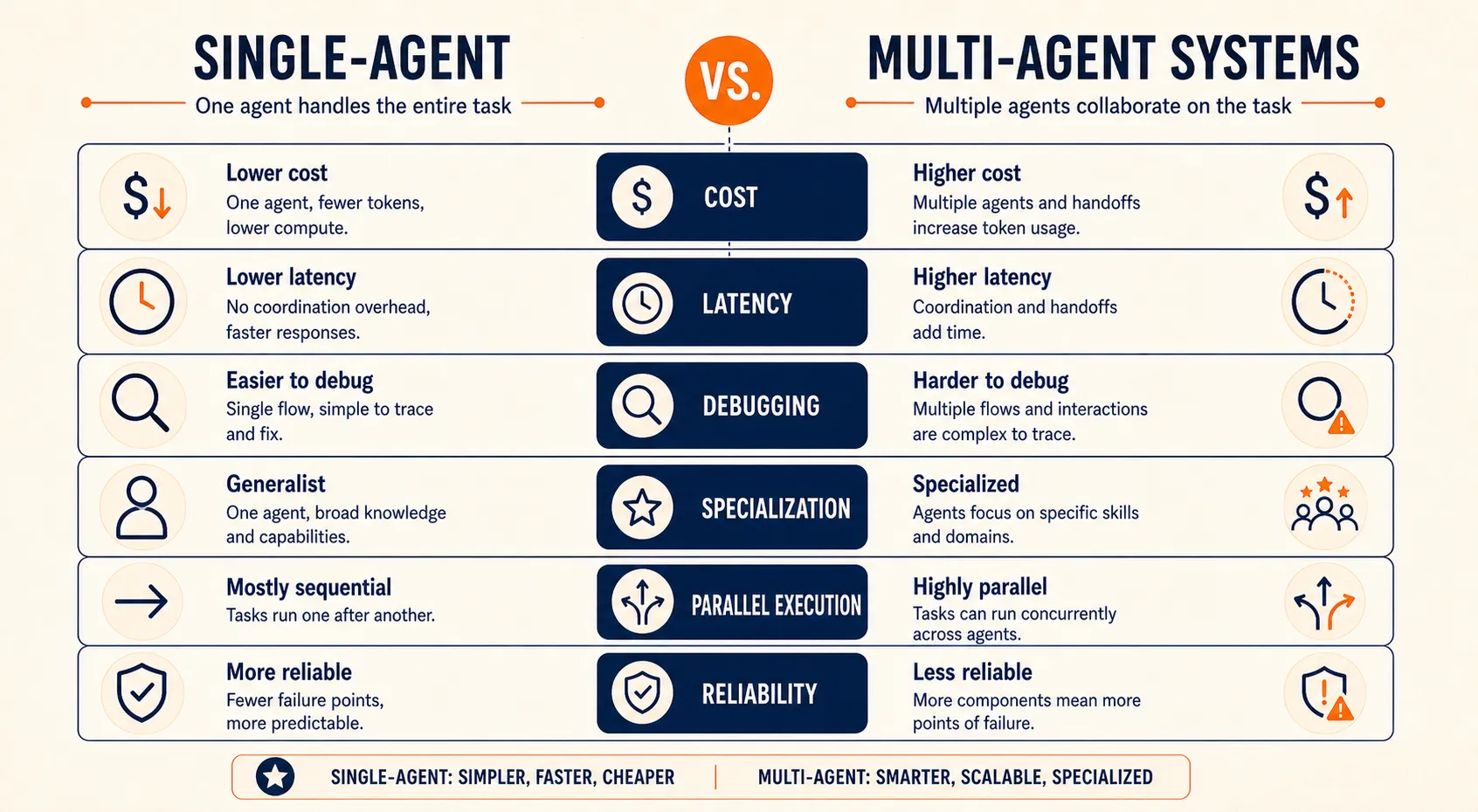
Single-Agent vs Multi-Agent: Side-by-Side Comparison
Here is how the two approaches compare across the dimensions that matter most for architecture decisions.
| Factor | Single-Agent | Multi-Agent |
|---|---|---|
| Setup complexity | Low. One agent, one config, one set of tools. | High. Multiple agents, orchestration layer, shared state management. |
| Cost per task | Lower. One LLM call per step, no coordination tokens. | 2 to 5x higher. Multiple LLM calls plus inter-agent communication overhead. |
| Latency | Lower. No handoff delays. Best for sub-5-second responses. | Higher per sequential step. But parallel execution can reduce total time for multi-step tasks. |
| Debugging | Simple. Linear trace through one agent’s reasoning. | Complex. Errors propagate across agents. Requires distributed tracing. |
| Task specialization | Limited. One agent does everything, quality can degrade on diverse tasks. | High. Each agent is purpose-built for its role. |
| Reliability (5-step task) | 95% agent reliability = 95% system reliability. | 95% per agent = 77% system reliability (compounding). |
| Parallel execution | No. Steps run sequentially. | Yes. Independent subtasks run simultaneously. |
| Fault tolerance | Low. Single point of failure stops the workflow. | Higher. Failed agents can be retried or routed around. |
| Security boundaries | One permission set for all tasks. | Separate permissions per agent. Better for compliance. |
| Reasoning performance | Matches or beats multi-agent on sequential reasoning (Stanford 2026). | Degrades 39 to 70% on strict sequential reasoning (Google Research). |
| Best for | Linear workflows, single-domain tasks, latency-sensitive apps, budget-conscious operations. | Cross-domain workflows, parallel tasks, quality-critical outputs, compliance-heavy processes. |
The comparison makes one thing clear: multi-agent is not an upgrade from single-agent. It is a trade-off. You gain specialization and parallelism. You pay in cost, complexity, and compounding reliability risk.
Quick check
If each agent in a five-agent chain has 95% individual reliability, what is the system-level reliability?
When to Use Each Approach: A Decision Framework
Instead of guessing, use these concrete signals to choose the right architecture.
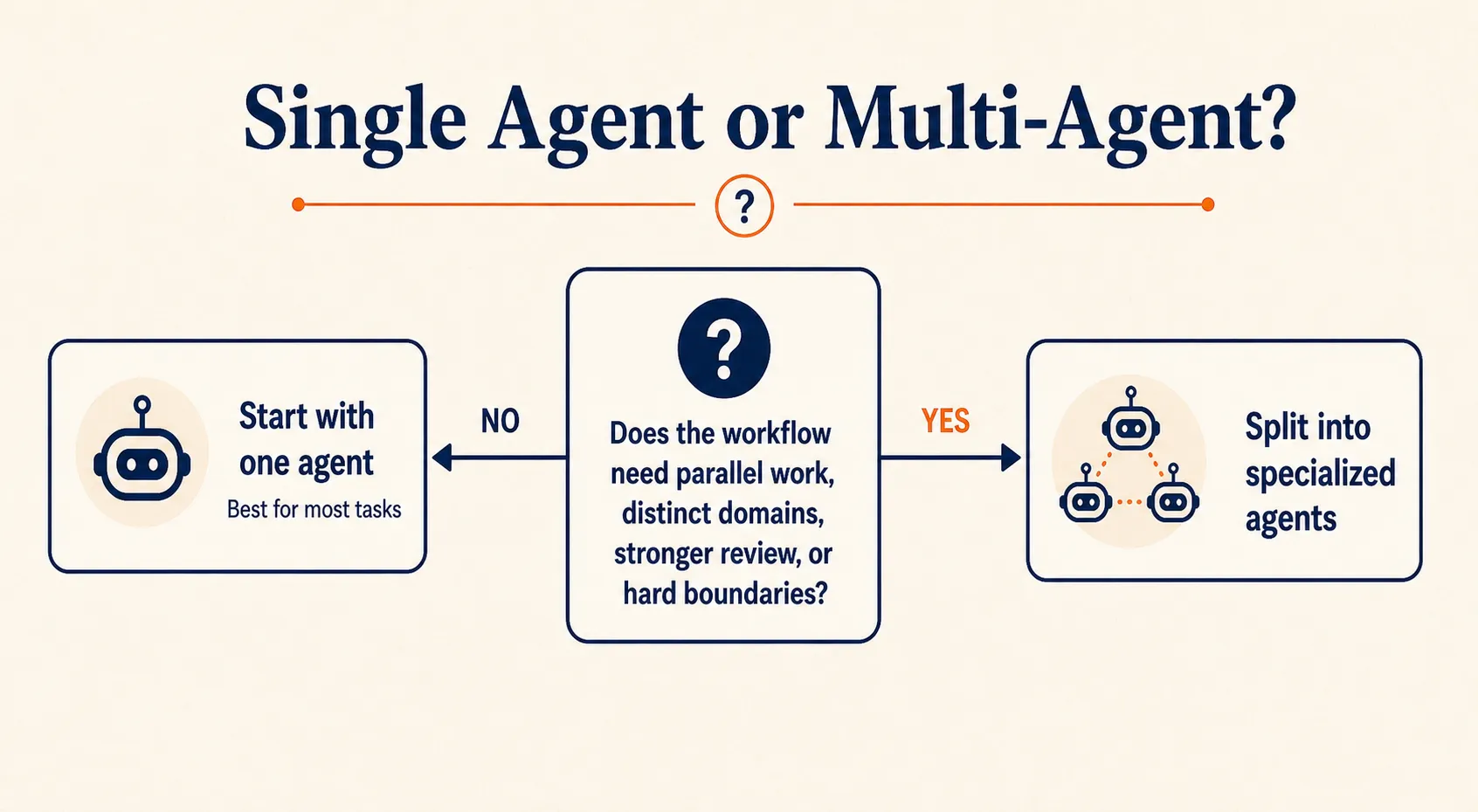
Choose Single-Agent When:
- The workflow is linear. If tasks follow a predictable sequence (receive input, process, validate, output), a single agent handles it faster and cheaper.
- You need fast responses. Customer-facing chat, booking systems, and support triage need sub-5-second latency. Multi-agent handoffs add delays you can’t afford.
- The task stays in one domain. Summarizing documents, classifying tickets, generating reports from one data source: these are single-agent territory.
- Budget is constrained. If cost per task matters (high-volume, thin-margin operations), the 2 to 5x overhead of multi-agent is hard to justify.
- You are just getting started. Even if you think you will need multi-agent later, start with a single agent to establish a performance baseline. You need that baseline to measure whether multi-agent actually improves things.
Choose Multi-Agent When:
- Tasks span three or more distinct domains. When a workflow touches research, code generation, and quality review, dedicated agents for each domain outperform one generalist.
- Sub-tasks can run in parallel. If three research queries, five compliance checks, or ten data extractions are independent, running them simultaneously saves real time.
- Quality requires separate review. If errors in the output carry high consequences, a generator-critic pattern with separate agents catches more mistakes than self-review within a single agent.
- Security boundaries are non-negotiable. When different workflow steps need different access levels, separate agents with separate permissions simplify compliance.
- You have measured a gap. You ran a single agent, identified specific steps where it consistently fails, and have data showing multi-agent would close that gap.
The “Start Single, Split When Proven” Approach
Here is the practical path most successful teams follow:
- Build a single agent with the right tools for your workflow.
- Measure where it fails or underperforms.
- Split only the failing steps into a specialized agent.
- Connect the original agent and new specialist through an orchestrator.
- Measure whether the split actually improved results.
- Repeat only when data supports it.
This incremental approach avoids the most common mistake: building a multi-agent system on day one for a problem that a single agent could have solved.
To see this in action, consider a company building an AI agent for marketing campaign management . They start with a single agent that generates ad copy, schedules posts, and tracks performance. It works fine for the first two tasks but consistently produces poor analytics summaries.
So they split analytics into a dedicated reporting agent while keeping the rest single-agent. That targeted split is much cheaper and more maintainable than designing a five-agent system from scratch.
Once you’ve decided multi-agent is the right call, the next question is how to coordinate those agents.
Common Multi-Agent Orchestration Patterns
If you have decided multi-agent is the right call, you need to pick an orchestration pattern. The four production-proven patterns each suit different situations.
Orchestrator-Worker
One central agent receives tasks, breaks them into subtasks, delegates each to a specialized worker, and reassembles results. This is the most deployed pattern in production because it is the easiest to understand, debug, and monitor.
Best for: Structured workflows with clear task decomposition. Customer support routing, content generation pipelines, data processing.
Router (Handoff)
A routing agent classifies incoming requests and sends each one to the best-suited specialist. Unlike orchestrator-worker, the router does not decompose tasks. It sends the whole task to one agent.
Best for: Scenarios where the right agent depends on the request type. Help desk triage, intent-based chatbots, document classification.
Pipeline (Sequential)
Agents pass work in a fixed order, like an assembly line. Agent A’s output becomes Agent B’s input, which becomes Agent C’s input. No central orchestrator needed.
Best for: Workflows with a natural sequence. Content creation (research, draft, edit, review), ETL pipelines, approval chains.
Swarm (Peer-to-Peer)
Agents negotiate directly with each other without a central coordinator. Each agent decides when to hand off and to whom based on the current state.
Best for: Exploratory tasks without a predictable structure. Collaborative brainstorming, market research, multi-perspective analysis.
Frameworks like LangGraph, CrewAI, and AutoGen provide the primitives for these patterns so you don’t build coordination logic from scratch. LangGraph excels at stateful orchestrator-worker setups with checkpointing. CrewAI makes role-based teams intuitive, and AutoGen suits conversational agent collaboration. Check out our agentic AI frameworks comparison for details on each.
Picking the right pattern is important, but so is understanding where multi-agent systems commonly break down.
Quick check
A help desk system needs to route incoming tickets to the right specialist agent based on the request type. Which orchestration pattern fits best?
Where Multi-Agent Systems Go Wrong
Multi-agent systems fail at higher rates than most teams expect. Understanding the failure modes helps you avoid them or decide they are not worth the risk.
Compounding Reliability
This is the math that kills most multi-agent pilots. If each agent in a chain has 95% reliability, two agents give you 90.25%, three give you 85.7%, and five give you 77.4%. Gartner projects that over 40% of agentic AI projects will be canceled by the end of 2027, citing escalating costs, unclear business value, and inadequate risk controls.
Hallucination Propagation
When one agent hallucinates, its bad output becomes trusted input for every downstream agent. No mainstream framework validates message correctness between agents automatically. Research shows unstructured multi-agent networks can amplify errors up to 17.2 times compared to single-agent baselines.
Cost Explosion
Each agent processes its own context, often including redundant information. Inter-agent communication adds tokens. Retry logic adds more. Teams regularly report 3 to 5x cost increases after moving from single-agent to multi-agent, with some seeing 10 times or higher when coordination is poorly designed.
Debugging Complexity
Single-agent failures are linear: read the prompt, check the output, find the gap. Multi-agent failures cascade across agents in ways that are hard to reproduce. You need distributed tracing, per-agent logging, and often manual replay to figure out what went wrong.
The takeaway is not that multi-agent systems are bad. It is that they require significantly more engineering rigor, monitoring, and investment than single-agent systems. If your team is not ready for that level of operational maturity, single-agent is the safer and often better choice.
Making the Right Call for Your Project
The single-agent vs multi-agent decision is not about which is “better.” It is about which fits your specific constraints.
If you are building AI agent workflows , start with the simplest thing that could work. A single agent with well-chosen tools and clear instructions will surprise you with how much it can handle. Measure its performance, identify where it genuinely falls short, and only then introduce a second agent for the specific task where the single agent struggles.
The best multi-agent systems in production today did not start as multi-agent systems. They started as single agents that grew into teams as complexity demanded it.
At Craze , we see this pattern across our users building agents and workflows. The teams that start simple and add complexity based on data consistently outperform the ones that architect for scale on day one.
Your first agent does not need a team. It needs good tools, clear instructions, and room to prove what it can do.
FAQs
Can a single AI agent handle complex workflows?
Yes, in most cases. A single agent with the right tools and context handles roughly 80% of enterprise workflows at lower cost and latency. A 2026 Stanford study found that single agents match or outperform multi-agent systems on reasoning tasks when given the same compute budget. You only need multiple agents when tasks span distinct domains, require parallel processing, or involve hard security boundaries.
How much more does a multi-agent system cost compared to a single agent?
Multi-agent systems typically cost 2 to 5 times more per task than single-agent setups. The extra cost comes from multiple LLM calls, redundant context processing across agents, and coordination overhead. This cost is justified when multi-agent quality or speed improvements outweigh the increase, but for straightforward workflows, it is wasted spend.
What is the simplest multi-agent pattern to start with?
The orchestrator-worker pattern is the most common and easiest to debug. One central agent receives the task, breaks it into subtasks, delegates each to a specialized worker agent, and reassembles the results. Start with one orchestrator and two worker agents. Add more workers only when you have evidence that existing ones cannot handle the scope.
Do multi-agent systems always outperform single agents?
No. Google Research found that on tasks requiring strict sequential reasoning, multi-agent performance degrades by 39 to 70% compared to a single agent. Multi-agent systems also suffer from compounding reliability issues: five agents at 95% individual reliability produce only 77% system-level reliability. Multi-agent outperforms only when tasks genuinely benefit from specialization or parallel execution.
Which frameworks support building multi-agent AI systems?
The three most widely used frameworks are LangGraph (best for stateful, graph-based workflows with checkpointing), CrewAI (best for intuitive role-based agent teams), and AutoGen (best for conversational multi-agent patterns). LangGraph reached v1.0 in late 2025 and leads in enterprise adoption. CrewAI is popular for prototyping. AutoGen suits collaborative chat-style coordination.
More Articles
The 8 Best Lindy AI Alternatives in 2026 (Tested & Compared)

The 8 best Lindy AI alternatives for 2026, anchored to why people leave Lindy, with current pricing, third-party ratings, honest pros and cons, and the best pick for each reason to switch.
The 7 Best Make Alternatives in 2026 (Tested & Compared)
The 7 best Make.com alternatives for 2026, anchored to why people leave Make, with current pricing, third-party ratings, honest pros and cons, and the best pick for each reason to switch.
The 8 Best Zapier Alternatives in 2026 (Tested & Compared)
The 8 best Zapier alternatives for 2026, anchored to why people leave Zapier, with current pricing, third-party ratings, honest pros and cons, and the best pick for each reason to switch.