RAG AI Agents: What They Are, How They Work, and When You Need One
RAG AI agents combine large language models with real-time knowledge retrieval to deliver accurate, grounded answers. Learn how they work, where they're deployed, and what to watch out for.

By: Deepit Patil
Co-Founder and CTO
Published
Updated
Edited by Craze Editorial Team · See our Editorial Process
Large language models are impressive, but they have a fundamental problem: they can only work with what they learned during training. Ask a model about your company’s internal policies, yesterday’s financial data, or a product spec sheet that was published last week, and it either guesses or admits it doesn’t know. Neither response is useful.
Retrieval-Augmented Generation (RAG) solves this by giving the model a way to look things up before it answers. A RAG AI agent takes this further by adding autonomous decision-making to the retrieval process. Instead of following a fixed lookup-then-answer pipeline, the agent decides what to search for, evaluates whether the results are good enough, and refines its approach until it has the information it needs.
This article explains what a RAG AI agent actually is, how it differs from standalone RAG or a standalone AI agent, where these systems are deployed, and what to watch out for when building one.
TL;DR
- RAG grounds LLM responses in real data. Instead of relying on training knowledge alone, the model retrieves relevant documents from external sources before generating an answer, cutting hallucination rates from 20-40% to under 5% in well-implemented systems.
- Agentic RAG adds autonomous reasoning to the pipeline. The agent doesn’t just retrieve and answer; it evaluates, re-queries, and uses tools, outperforming traditional RAG by 26% on accuracy benchmarks while using 90% fewer tokens.
- Vector databases are the backbone. They store document embeddings and enable fast similarity search. Pinecone, Weaviate, and Chroma each serve different team shapes and scale requirements.
- Enterprise adoption is accelerating fast. The RAG market hit $1.94 billion in 2025 and is projected to reach $9.86 billion by 2030, with financial services and healthcare leading deployment.
- Retrieval quality is the bottleneck, not generation. When RAG systems fail, 73% of the time it’s the retrieval step that breaks down, not the language model. Getting your data pipeline right matters more than picking the fanciest LLM.
What Is a RAG AI Agent?
A RAG AI agent is an AI system that combines a large language model (LLM) with a retrieval component, typically a vector database, so it can look up relevant information from external knowledge bases before generating a response. The “agent” part means it doesn’t just follow a fixed retrieve-then-answer pipeline. It autonomously decides what to search for, evaluates whether the results are sufficient, and refines its strategy until it has what it needs.
The concept builds on two foundations: Retrieval-Augmented Generation (RAG) as a technique, and AI agents as autonomous systems. Understanding both helps clarify what a RAG AI agent actually does and when you’d use one over the alternatives.
RAG vs. AI Agents: How They Relate
People searching for “RAG AI agent” often mean one of two things: they want to understand what a RAG-powered agent is, or they want to know how RAG and AI agents differ. Here’s the distinction:
RAG as a technique
RAG is a technique, not a system. It connects an LLM to external data sources so the model can retrieve relevant documents before generating a response. On its own, RAG follows a fixed pipeline: receive query, search knowledge base, return context to LLM, generate answer. It doesn’t make decisions, use tools, or adapt its approach.
AI agents as autonomous systems
AI agents are autonomous systems that can reason, plan, and take actions. An agent can call APIs, execute code, send messages, or trigger workflows. But without access to domain-specific knowledge, an agent’s actions are only as good as the LLM’s training data, which goes stale and lacks your organization’s proprietary information.
How RAG AI agents combine both
A RAG AI agent merges the retrieval capability of RAG with the autonomy of an agent. It can decide which knowledge bases to search, evaluate whether retrieved results are adequate, reformulate queries when they aren’t, and use tools alongside retrieval to complete complex tasks. This is what the industry increasingly calls “agentic RAG.”
The practical implication: if you only need answers from a static knowledge base, basic RAG is sufficient. If you need the system to reason across multiple sources, take actions, and adapt its strategy, you need a RAG AI agent.
What Is Retrieval-Augmented Generation (RAG)?
RAG is a technique that connects a large language model to external knowledge sources so the model can retrieve relevant information before generating a response. The term was coined in a 2020 research paper by Facebook AI Research (now Meta AI) , and it’s since become the default pattern for building LLM applications that need accurate, up-to-date answers.
Think of it like the difference between a student taking a closed-book exam versus an open-book exam. Without RAG, the LLM answers purely from memory (its training data). With RAG, it can look up relevant documents, verify facts, and cite sources before responding.
Here’s why that matters:
- Training data goes stale. Models are trained on snapshots of data. A model trained in January doesn’t know about anything that happened in February.
- Generic models lack domain knowledge. GPT-4o or Claude can discuss HR policies in general, but they don’t know your company’s specific leave policy or org chart.
- Hallucinations are expensive. When a model generates confident-sounding answers that are factually wrong, the downstream cost in bad decisions, compliance risk, and lost trust adds up fast.
RAG addresses all three problems by giving the model a retrieval step before generation. The model doesn’t need to memorize everything; it just needs to know how to find and use the right information.
How RAG Works: The Four-Step Pipeline
Every RAG system, from a simple prototype to an enterprise deployment, follows the same basic pipeline. Understanding these four steps helps you diagnose problems and make design decisions later.
Step 1: Document Ingestion and Chunking
Before the system can retrieve anything, your knowledge base needs to be prepared. Documents (PDFs, web pages, database records, Slack messages, whatever you have) get split into smaller chunks, typically 200 to 1,000 tokens each.
Chunking strategy matters more than most teams realize. Chunks that are too large dilute the relevant signal with noise. Chunks that are too small lose necessary context. Most production systems use overlapping chunks (where each chunk shares some text with the previous one) to avoid cutting off important information at boundaries.
Step 2: Embedding and Indexing
Each chunk gets converted into a vector embedding, a numerical representation that captures its semantic meaning. These embeddings are stored in a vector database (more on that later) that’s optimized for similarity search.
The embedding model you choose affects retrieval quality directly. Popular options include OpenAI’s text-embedding-3-large, Cohere’s embed-v3, and open-source models like BGE and E5. The key tradeoff is between embedding dimension (higher means more expressive but slower) and latency requirements.
Step 3: Retrieval
When a user asks a question, the system converts the query into an embedding using the same model, then searches the vector database for the most semantically similar chunks. Most systems retrieve the top 5 to 20 chunks, depending on the complexity of the query and the context window size of the LLM.
This is where the real work happens, and where most failures occur. The system isn’t doing keyword matching; it’s finding documents that are conceptually related to the query, even if they use different words. A query about “employee time off” should retrieve chunks about “PTO policy,” “leave requests,” and “vacation accrual,” even though the exact words don’t match.
Step 4: Augmented Generation
The retrieved chunks are formatted and inserted into the LLM’s prompt alongside the user’s original question. The model then generates a response grounded in the retrieved context. A well-designed RAG prompt instructs the model to base its answer on the provided documents, cite its sources, and say “I don’t know” when the retrieved context doesn’t contain the answer.
This four-step pipeline is what people mean when they talk about “basic RAG” or “naive RAG.” It works surprisingly well for straightforward questions with clear answers sitting in a single document. But it starts to struggle with complex queries that require synthesizing information from multiple sources, following up with clarifying questions, or reasoning across several steps.
That’s where RAG AI agents come in.
What Makes a RAG AI Agent Different
A basic RAG system is like a library assistant who walks to one bookshelf, grabs the closest-looking book, and reads you a passage. A RAG AI agent is more like a researcher who understands your question, decides which databases to check, evaluates whether the first results are useful, tries a different search strategy if they aren’t, and synthesizes a comprehensive answer from multiple sources.
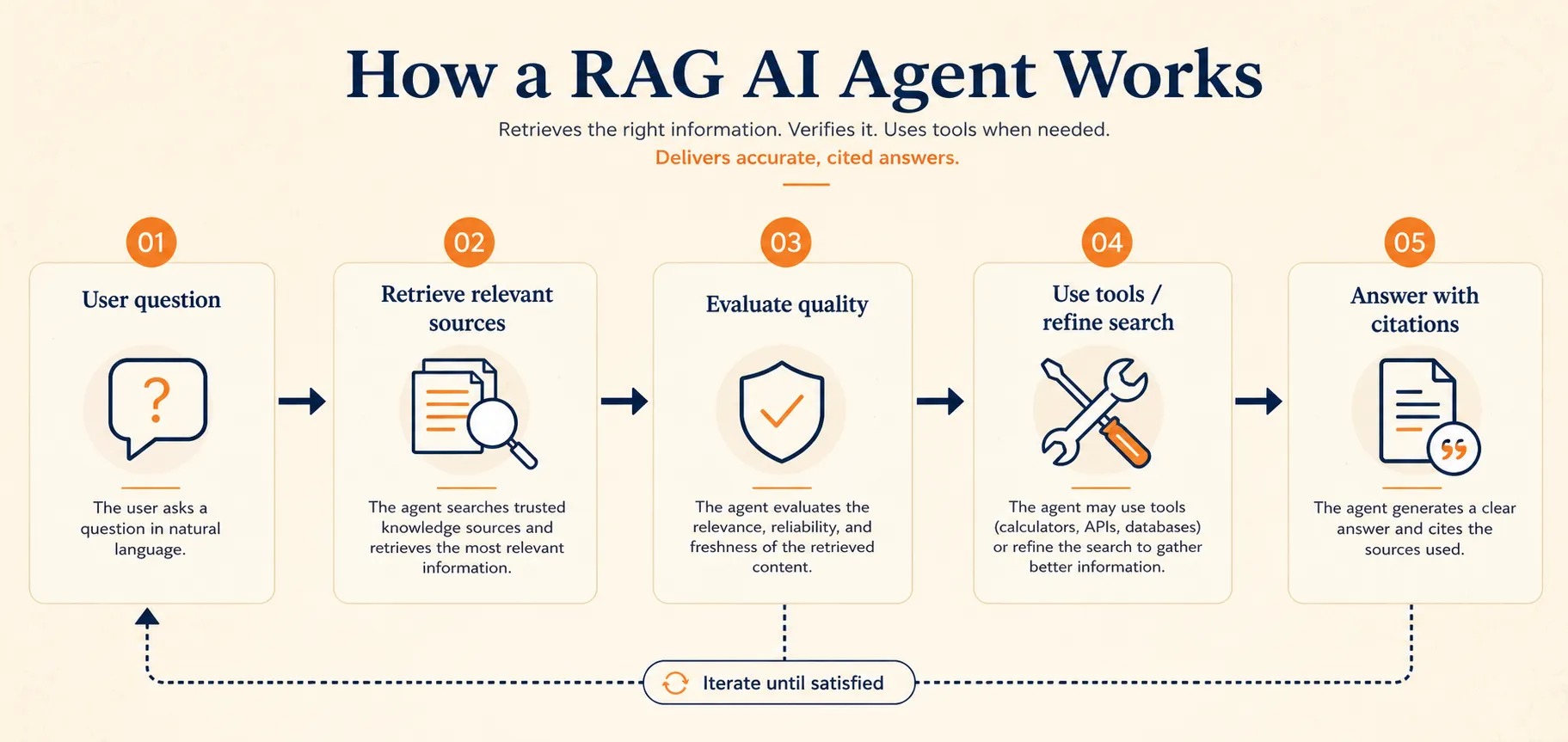
The core difference is autonomy in the retrieval process. Instead of a fixed retrieve-then-generate pipeline, a RAG AI agent uses an agentic architecture where the LLM itself decides:
- What to search for. The agent can decompose a complex question into sub-queries. “What’s our customer churn rate compared to industry average?” might trigger one search for internal churn data and another for industry benchmarks.
- Where to search. The agent can query multiple knowledge bases, APIs, databases, or even live web sources depending on what the question requires.
- Whether results are good enough. After retrieving documents, the agent evaluates relevance. If the results don’t adequately answer the question, it reformulates the query and tries again.
- When to use tools. Beyond retrieval, a RAG AI agent can invoke tools and integrations : running calculations, querying SQL databases, calling APIs, or executing code to process the retrieved information.
This is what the industry calls “agentic RAG,” and it’s the dominant pattern in enterprise AI deployments.
Traditional RAG vs. Agentic RAG
Here’s a concrete comparison to make the distinction clear:
Scenario: A financial analyst asks, “How did our Q1 revenue compare to projections, and what were the primary drivers of any variance?”
Traditional RAG approach:
- Converts the question to an embedding
- Retrieves the 10 most similar chunks from the document store
- Passes them to the LLM with the question
- Generates an answer from whatever was retrieved
If the relevant data is spread across a Q1 earnings report, a board presentation, and a CRM export, traditional RAG might only find part of the answer (or the wrong part).
Agentic RAG approach:
- The agent decomposes the question into sub-tasks: (a) find Q1 actual revenue, (b) find Q1 projected revenue, (c) identify variance drivers
- Queries the financial database for actual revenue numbers
- Searches the planning documents for projections
- Retrieves variance analysis from internal reports
- Evaluates whether it has enough data for each sub-task
- Re-queries with refined searches for any gaps
- Synthesizes a comprehensive answer with source citations
The agentic approach handles multi-hop reasoning, something basic RAG inherently struggles with. According to research from NVIDIA , agentic RAG systems with intelligent memory outperform traditional RAG by 26% on accuracy while using 90% fewer tokens because the agent retrieves only what’s actually needed instead of flooding the context window with marginally relevant chunks.
The Role of AI Agent Memory in RAG Systems
Memory is what separates a stateless Q&A bot from a useful assistant. In a RAG AI agent, memory operates at multiple levels, and getting the memory architecture right determines whether your agent improves over time or keeps making the same mistakes.
Short-Term Memory (Conversation Context)
This is the simplest form: the agent remembers what was said earlier in the current conversation. If a user asks “What’s our refund policy?” and then follows up with “What about for enterprise customers?”, the agent needs conversation context to understand that “what about” refers to the refund policy.
Most LLM-based agents handle this through their context window, the rolling window of text the model can “see” at once. The challenge is that context windows are finite. When a conversation gets long, older messages fall off the window unless you have a strategy for summarizing or selectively retaining important context.
Long-Term Memory (Persistent Knowledge)
Long-term memory is where RAG’s retrieval component does the heavy lifting. The vector database serves as the agent’s persistent knowledge store. But truly capable agents go further with:
- User preference memory. The agent remembers that this particular user prefers concise bullet points over detailed paragraphs, or that they always need data in metric units.
- Task outcome memory. After completing tasks, the agent stores what worked and what didn’t, creating a feedback loop that improves future performance.
- Entity memory. The agent maintains structured knowledge about key entities (people, projects, products) that it references across conversations.
This layered memory approach is central to how agentic AI workflows maintain context across complex, multi-session tasks. Without it, every interaction starts from zero.
Episodic Memory (Learning from Experience)
The most advanced RAG agents implement episodic memory, where the system stores and retrieves examples of previous interactions, decisions, and their outcomes. When the agent encounters a similar question later, it can draw on those past episodes to inform its approach.
This is still an emerging area, but it’s where the biggest gains in agent effectiveness are coming from. Teams that implement episodic memory report significant reductions in repeated errors and faster resolution of similar queries. Of course, none of these memory layers work without a reliable place to store and search the underlying data.
Vector Databases: The Engine Behind RAG
Vector databases store the embeddings (numerical representations of your documents) and enable the fast similarity searches that power retrieval. Unlike traditional databases that search by exact matching, vector databases search by semantic similarity, so a query about “firing an employee” correctly retrieves documents about “involuntary termination procedures” even though none of those words match.
The global vector database market reached $3.2 billion in 2025 and is growing at 24% annually. Four options handle the majority of RAG deployments: Pinecone (fully managed, zero infrastructure overhead), Weaviate (strongest hybrid search combining vector similarity with keyword matching), Chroma (fastest prototyping path, 4x faster after its 2025 Rust rewrite), and pgvector (for teams already running PostgreSQL). At 1 million vectors, all four hit 95%+ recall with default settings. The differences emerge at scale: at 100 million vectors, Pinecone and Weaviate maintain recall without tuning, while pgvector needs careful parameter optimization. But storage and retrieval are only half the picture; what the agent does with retrieved information matters just as much.
AI Agent Tools and Integrations in RAG Systems
What separates a RAG agent from a basic RAG pipeline isn’t just smarter retrieval. It’s the ability to use tools and integrations alongside retrieval to actually get things done.
A well-equipped RAG AI agent doesn’t just find information, it acts on it. The agent’s tool set typically includes:
Retrieval Tools
- Vector search across one or more knowledge bases
- SQL/database queries for structured data (revenue figures, user counts, inventory levels)
- API calls to external services (CRM data, market feeds, weather data)
- Web search for real-time information not in the knowledge base
Processing Tools
- Code execution for calculations, data transformations, and analysis
- Document parsing to extract structured data from PDFs, spreadsheets, or emails
- Summarization to condense long documents before adding them to context
Action Tools
- Email/messaging to send notifications or responses
- Database writes to update records based on findings
- Workflow triggers to kick off downstream processes
The integration layer determines how useful your RAG agent actually is in practice. An agent that can only search documents and generate text is limited. An agent that can search documents, query a database, run a calculation, and draft an email with the results is genuinely useful.
This is why frameworks like LangChain, LlamaIndex, and other agentic AI frameworks have invested heavily in tool integration. LangChain (119K+ GitHub stars) emphasizes complex agent workflows through LangGraph, while LlamaIndex (44K+ stars) focuses on optimizing retrieval quality with hierarchical chunking and sub-question decomposition. Many production systems use both: LlamaIndex as the retrieval layer, LangGraph as the orchestration layer. With these capabilities in place, the question becomes where RAG agents are delivering real value today.
Where RAG AI Agents Are Actually Deployed
RAG isn’t a research curiosity; it’s in production at scale across industries. Here are the deployment patterns showing real results.
Customer Support
Customer support is the most common RAG deployment, and for good reason. Support agents (both human and AI) need instant access to product documentation, ticket histories, troubleshooting guides, and policy documents.
RAG-powered support agents handle this by searching the knowledge base for each customer query and generating contextual responses. The economics are compelling: AI-handled interactions cost $0.70 to $0.90 per interaction compared to significantly higher costs for human-handled tickets. And 73% of human support agents using gen-AI tools report that it reduces time spent on repetitive tasks.
Companies like Intercom, Zendesk, and Freshdesk have all built RAG into their support platforms. The pattern works especially well because support knowledge bases are well-structured and regularly updated, which plays to RAG’s strengths.
Financial Services and Analysis
Financial services firms were among the earliest enterprise RAG adopters, accounting for the largest market share in 2025. The use cases include:
- Research synthesis. Analysts use RAG agents to pull together data from earnings reports, SEC filings, market data feeds, and internal research notes into comprehensive investment summaries.
- Compliance monitoring. RAG agents continuously scan regulatory updates and internal policies to flag potential compliance issues.
- Risk assessment. By retrieving historical data, current market conditions, and internal risk models, RAG agents help analysts build more thorough risk profiles.
These applications require high accuracy and source attribution, both of which are core RAG strengths. When a model cites the specific document and passage it used to generate an answer, analysts can verify the response quickly rather than treating it as a black box.
Internal Knowledge Management
Every company has the same problem: critical knowledge scattered across Google Drive, Confluence, Slack, email, and the brains of long-tenured employees. RAG agents are increasingly deployed as internal knowledge assistants that can search across all of these sources.
The value here is in reducing time-to-answer for internal questions. Instead of posting in Slack and waiting for someone to respond (or searching through 50 Confluence pages), employees ask the RAG agent and get an answer grounded in the company’s actual documentation, with links to the source material.
Glean, Guru, and similar enterprise search platforms all use RAG as their core technology. According to a Forrester report, early enterprise adopters of agentic RAG report up to 40% increase in task automation.
Healthcare
Healthcare is the fastest-growing RAG market segment, with the highest projected CAGR . Use cases include clinical decision support (retrieving relevant research and guidelines during diagnosis), patient communication (generating accurate responses to medical queries based on verified sources), and administrative automation (processing insurance claims by retrieving relevant policy information).
The stakes in healthcare make RAG’s source attribution capability essential. A clinical decision support tool that cites the specific guideline it references is far more useful (and safer) than one that generates unsourced recommendations. If these use cases have you considering a RAG agent for your own team, the next step is understanding the key architectural decisions.
How to Build a RAG AI Agent: Key Decisions
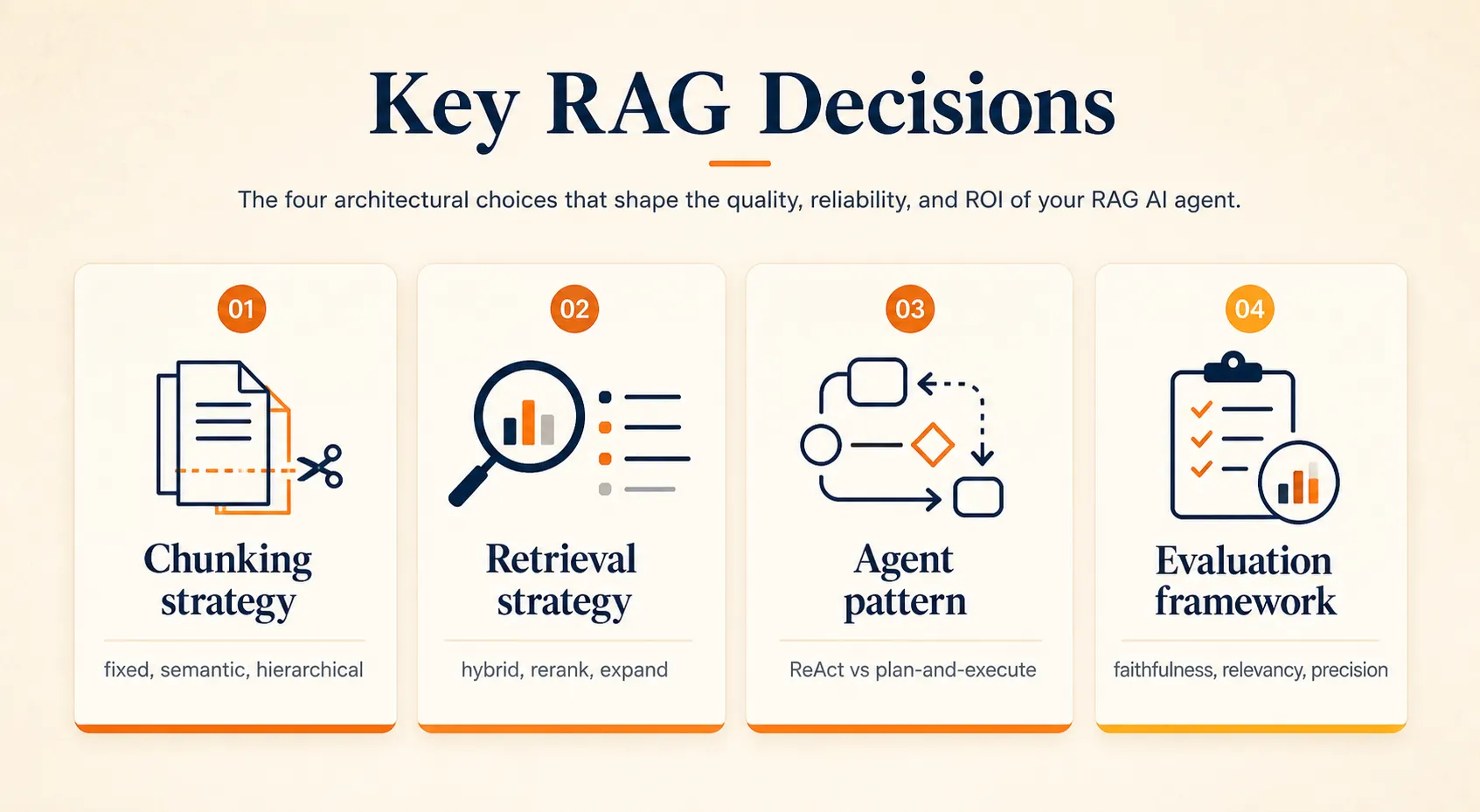
If you’re planning to build a RAG AI agent, here are the decisions that matter most. This isn’t a step-by-step tutorial (that depends too much on your specific stack), but rather the architectural choices that determine whether your system works in production.
Decision 1: Chunking Strategy
Your chunking approach directly affects retrieval quality. Options include:
- Fixed-size chunks (e.g., 500 tokens with 50-token overlap): simple, predictable, works for homogeneous content
- Semantic chunking: splits on topic boundaries rather than token counts; better retrieval quality but more complex to implement
- Hierarchical chunking: creates parent-child relationships between chunks (e.g., a document summary as the parent, individual sections as children); enables multi-resolution retrieval
Start with fixed-size chunks and overlapping windows. Upgrade to semantic or hierarchical chunking only when you can measure that retrieval quality is the bottleneck.
Decision 2: Retrieval Strategy
Pure vector search is a good starting point but rarely sufficient for production:
- Hybrid search combines vector similarity with keyword matching (BM25). This catches cases where the exact terminology matters, like searching for specific error codes, product SKUs, or legal terms.
- Re-ranking adds a second pass where a cross-encoder model scores each retrieved chunk against the original query. It’s slower than initial retrieval but significantly improves precision.
- Query expansion rewrites the user’s query into multiple formulations to improve recall. A question about “reducing churn” might also search for “improving retention” and “customer loyalty.”
Decision 3: Agent Architecture Pattern
For most RAG applications, you’ll choose between two architecture patterns:
- ReAct (Reasoning + Acting): the agent interleaves reasoning and tool calls in a loop, deciding at each step what to do next. This is flexible and handles open-ended queries well, but it can be unpredictable and expensive.
- Plan-and-Execute: the agent creates a plan first (what to search, in what order) and then executes each step. This is more predictable, easier to debug, and cheaper (fewer LLM calls), but less flexible for queries that require dynamic exploration.
For straightforward knowledge retrieval, Plan-and-Execute is usually the better fit. For complex research tasks that require the agent to adapt its strategy based on what it finds, ReAct is more appropriate. Many production systems combine both patterns, using Plan-and-Execute as the default and ReAct as a fallback for complex queries. Our guide on how to build an AI agent covers these architecture choices in more detail.
Decision 4: Evaluation Framework
You can’t improve what you can’t measure. Establish evaluation metrics early:
- Faithfulness (>0.9 target): does the response actually reflect what the retrieved documents say?
- Answer relevancy (>0.85 target): does the response address the user’s actual question?
- Context precision (>0.8 target): are the retrieved documents relevant to the query?
These benchmarks come from production RAG evaluation frameworks like RAGAS and DeepEval. Build automated eval pipelines early; manual testing doesn’t scale. Even with good architecture and metrics, though, RAG has real limitations you should plan for.
Limitations and Failure Modes of RAG
RAG is powerful, but it’s not a silver bullet. Understanding where it breaks helps you design around the failure modes.
Retrieval Failures (73% of All RAG Failures)
The most common RAG failure isn’t the language model generating a bad answer. It’s the retrieval system returning the wrong documents. Industry analysis shows retrieval is the failure point 73% of the time when RAG systems produce incorrect results.
Common retrieval failure patterns:
- Semantic gap: the query and the relevant document use different language to describe the same concept, and the embedding model doesn’t bridge the gap
- Stale embeddings: documents get updated, but the vector store still holds embeddings of the old version. The freshness gap is the most common silent failure in production RAG systems.
- Multi-hop retrieval: the answer requires combining information from multiple documents, and the system only retrieves pieces from one
Domain Reasoning Limitations
Even with perfect retrieval, RAG doesn’t change how the model reasons. A model that misinterprets domain concepts will continue to do so even with perfect context. Retrieval can supply facts, but not judgment. For domains that require specialized reasoning (legal analysis, medical diagnosis, financial modeling), you may still need fine-tuning or domain-specific models alongside RAG.
Scale Challenges
What works in a demo often breaks in production. 70% of enterprise RAG deployments fail before reaching production, and the causes are typically operational:
- Vector search that was instant with 10,000 documents times out with 10 million
- Embedding pipelines that processed fine in batch can’t keep up with real-time document updates
- Context windows that seemed generous get overwhelmed when the agent tries to reference too many documents
Accuracy Caveats
While RAG dramatically improves accuracy over standalone LLMs, it doesn’t eliminate errors. Advanced enterprise RAG tools still experience error rates between 17% and 33% in specialized domains like legal research. Self-reflective RAG (where the system checks its own answers) lowered hallucinations to 5.8% in medical testing, but that’s still not zero. For high-stakes applications, always keep a human in the loop. Understanding these failure modes also helps you budget realistically, because fixing retrieval quality and maintaining accuracy isn’t free.
Cost Considerations for RAG Systems
Building a RAG system involves three main cost layers: embedding generation (converting documents to vectors), vector database hosting, and LLM inference for each query. LLM inference is typically the largest ongoing cost, but semantic caching can cut it by up to 68.8% by reusing responses for similar queries.
A basic prototype can run on free tiers (Pinecone’s starter plan, Chroma’s local mode, open-source embedding models). Production enterprise systems typically involve vector database costs of hundreds to thousands of dollars monthly, plus LLM API costs that scale with query volume. Hidden costs include data pipeline maintenance (keeping embeddings in sync with document updates), evaluation infrastructure, and knowledge graph extraction if used ( 3 to 5x more than baseline RAG).
The ROI picture is strong: enterprises choosing RAG for 30-60% of use cases requiring high accuracy report productivity improvements of 25-40% and cost reductions of 60-80% in optimized implementations. Fortunately, you don’t have to build the infrastructure from scratch to capture that ROI.
The RAG Ecosystem: Frameworks and Tools
You don’t need to build a RAG system from scratch. The ecosystem has matured around three categories:
Orchestration frameworks handle the agent logic. LangChain/LangGraph (119K+ GitHub stars) is the most widely adopted, with stateful agent workflows and built-in persistence . LlamaIndex focuses on retrieval quality with advanced indexing strategies and lower latency overhead . AutoGen (Microsoft) is designed for multi-agent RAG systems where specialized agents collaborate. Many production systems use LlamaIndex as the retrieval layer and LangGraph as the orchestration layer.
Managed RAG platforms let teams ship without building infrastructure. Amazon Bedrock Knowledge Bases, Google Vertex AI Search, and Azure AI Search all offer fully managed RAG with automatic chunking, embedding, and retrieval. They trade flexibility for speed-to-production. The ecosystem is mature enough to build on today, but it’s also changing fast.
What’s Next for RAG AI Agents
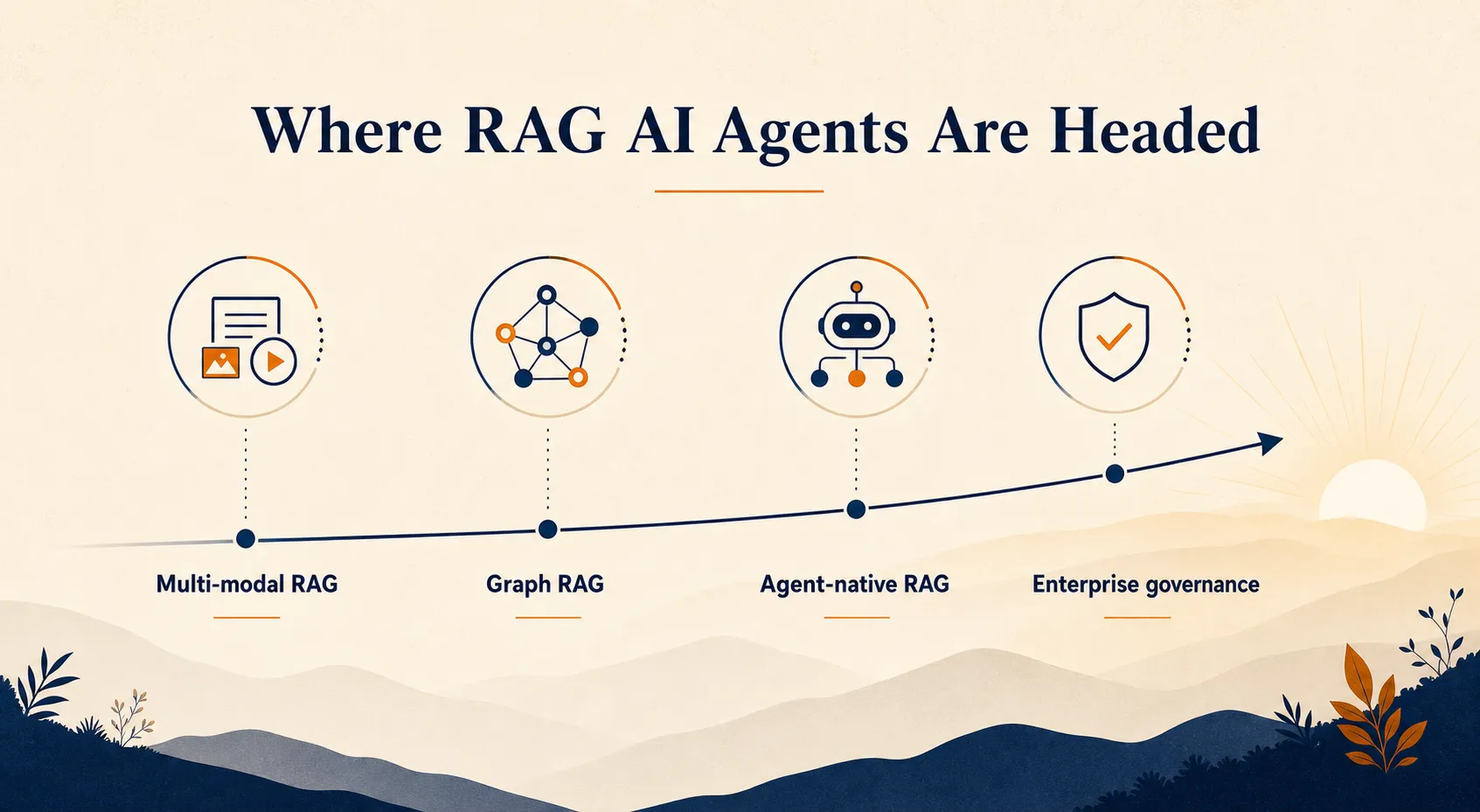
RAG is evolving quickly. Here’s where things are headed:
Multi-Modal RAG
Current RAG systems primarily work with text. The next wave adds images, charts, tables, and even video to the retrieval pipeline. An agent that can look at a product screenshot, find the relevant section of the user manual, and explain the issue is far more useful than one limited to text search.
Graph RAG
Instead of treating documents as flat chunks, graph RAG maps the relationships between entities (people, products, concepts) in a knowledge graph. This enables better reasoning over connected information, though it comes at 3 to 5x the cost of baseline RAG.
Agent-Native RAG
The frameworks are converging. LlamaIndex’s founder has noted that the framework era is shifting toward agent SDKs and MCPs (Model Context Protocols), where retrieval is just one of many capabilities an agent can use. The distinction between “RAG system” and “AI agent” is blurring as agents become the default interface for all knowledge work.
Enterprise-Grade Governance
Procurement teams are starting to demand standardized hallucination metrics contractually. Vendors who can’t produce transparent production-rate data are losing enterprise deals. Expect evaluation, observability, and compliance tooling to become standard components of every RAG deployment. You don’t need to wait for all of these trends to mature before building something useful today.
Getting Started with RAG AI Agents
If you’re exploring RAG for your organization, here’s a practical starting path:
- Start with a clear use case. Don’t build a general-purpose RAG system. Pick one specific knowledge domain (e.g., customer support for one product line) where you can measure improvement.
- Prototype with Chroma + LlamaIndex. Get a basic RAG pipeline working with your actual data in days, not weeks. This gives you a tangible demo to build stakeholder support.
- Establish evaluation metrics early. Use RAGAS or DeepEval to measure faithfulness, relevancy, and precision from day one. Without metrics, you’re guessing.
- Graduate to agentic RAG when basic RAG isn’t enough. If users are asking multi-step questions, needing data from multiple sources, or requiring calculations alongside retrieval, add an agent layer .
- Invest in the data pipeline, not just the model. The quality of your chunking, embedding, and indexing process has more impact on results than which LLM you use.
Whether you’re just prototyping or scaling to production, the fundamentals stay the same.
Final Thoughts
RAG AI agents represent the most practical path to making LLMs useful for real business tasks. They’re not perfect, and they require genuine engineering to get right, but they solve the fundamental problem of grounding AI responses in your actual data. For knowledge-intensive work, that’s a meaningful step forward.
For a broader view of how agents work beyond RAG, explore our guides on types of AI agents , AI agent use cases , and real-world AI agent examples .
FAQs
What is a RAG AI agent?
A RAG AI agent is an AI system that combines a large language model with a retrieval component (typically a vector database) so it can look up relevant information from external knowledge bases before generating a response. This grounds the agent's answers in real data instead of relying solely on what the model memorized during training.
How does RAG reduce AI hallucinations?
RAG reduces hallucinations by giving the language model factual context to reference when generating answers. Instead of guessing or fabricating information, the model can cite retrieved documents. Well-implemented RAG systems can reduce hallucination rates from 20 to 40 percent (typical for standalone LLMs on domain-specific questions) to under 5 percent in production enterprise deployments.
What is the difference between traditional RAG and agentic RAG?
Traditional RAG follows a fixed pipeline: retrieve documents, stuff them into context, generate an answer. Agentic RAG adds an autonomous reasoning layer where the AI agent can decide which sources to query, evaluate whether retrieved results are good enough, refine its search strategy, and use additional tools before generating a final response. Agentic RAG handles complex, multi-step questions far better than traditional RAG.
What vector database should I use for RAG?
It depends on your team and scale. Pinecone is fully managed and requires zero infrastructure work, making it ideal for teams that want to ship fast. Weaviate excels at hybrid search combining vector similarity with keyword matching. Chroma is lightweight and great for prototyping. For teams already running PostgreSQL, pgvector avoids adding another database to the stack. Many production systems start with Chroma for prototyping, then move to Pinecone or Weaviate at scale.
How much does it cost to build a RAG system?
Costs vary widely depending on scale and complexity. Key cost drivers include embedding generation (converting documents to vectors), vector database hosting, and LLM inference for each query. A basic RAG prototype can run on free tiers of most vector databases and open-source embedding models. Production enterprise systems typically involve vector database costs of hundreds to thousands of dollars per month, plus LLM API costs that scale with query volume. Semantic caching can reduce LLM costs by up to 68 percent.
When should I use RAG instead of fine-tuning a model?
Use RAG when your knowledge base changes frequently, when you need source attribution for answers, when you want to avoid the cost and complexity of training, or when you need the model to work with proprietary data it was never trained on. Fine-tuning is better when you need to change the model's behavior, tone, or reasoning style rather than just giving it new information. Many production systems combine both approaches.
More Articles
The 8 Best Lindy AI Alternatives in 2026 (Tested & Compared)

The 8 best Lindy AI alternatives for 2026, anchored to why people leave Lindy, with current pricing, third-party ratings, honest pros and cons, and the best pick for each reason to switch.
The 7 Best Make Alternatives in 2026 (Tested & Compared)
The 7 best Make.com alternatives for 2026, anchored to why people leave Make, with current pricing, third-party ratings, honest pros and cons, and the best pick for each reason to switch.
The 8 Best Zapier Alternatives in 2026 (Tested & Compared)
The 8 best Zapier alternatives for 2026, anchored to why people leave Zapier, with current pricing, third-party ratings, honest pros and cons, and the best pick for each reason to switch.