
A Complete Guide on Creating an Effective Leave Policy for Employees In India


Managing employee leave shouldn't be complicated, but for many startups and growing businesses, it often is.
Without a clear leave policy, HR teams face constant challenges: inconsistent approvals, confusion about entitlements, compliance gaps with Indian labour laws, and endless back-and-forth emails about leave balances. The result is wasted time, payroll errors, and frustrated employees who don't know where they stand.
A well-structured leave policy solves these problems. It brings clarity to your team, ensures fairness in granting leave, keeps you compliant with legal requirements, and reduces the administrative burden on HR.
This guide will help you design a transparent leave policy that meets your business needs. We have also included a free leave policy template to help you get started.
Quick Glance
A well-defined leave policy ensures transparency, consistency, and compliance with Indian labour laws, reducing errors and misunderstandings.
Include common leave types such as sick leave, casual leave, and maternity leave, as well as newer options like mental health days or volunteer time off for employee well-being.
Automating leave management, from accrual tracking to approval workflows, improves HR efficiency, reduces administrative burden, and ensures payroll accuracy.
Leave policies should be customised to your company’s needs, with flexibility for different employee categories and business requirements.
A modern leave management system helps automate policy enforcement, ensures compliance with Indian labour laws, saves HR time, and reduces errors.
What is a Leave Policy for Employees and Why Do You Need It?
A leave policy for employees is a formal document that outlines how employees can request, accrue, and use various types of leave. It is an essential component of your company’s HR practices that ensures transparency, consistency, and fairness across the workforce.
A clear leave policy ensures legal compliance and streamlines administrative tasks.
It clarifies workplace leave entitlements for employees and helps HR and managers manage resources effectively.
Without a proper policy, you risk errors, confusion, and potential compliance issues.
Why You Need a Clear and Compliant Leave Policy
A structured and legally compliant leave policy is essential for businesses to manage employee time off effectively. Here’s why it’s so important:
Employee Rights and Legal Compliance: Ensures your business meets legal obligations under Indian labour laws like the Factories Act or the Maternity Benefit Act.
Impact on Employee Engagement and Satisfaction: Helps employees feel valued and reduces misunderstandings by clearly outlining leave entitlements.
Operational Efficiency: Streamlines the leave process, making it easier for HR teams to manage absences and maintain productivity.
With the foundation in place, it is time to define the leave options that will keep your team supported and your operations running smoothly.
Types of Leave to Include in Your Employee Leave Policy
A clear employee time-off policy ensures that all employees understand their entitlements, helping to avoid confusion and fostering a more transparent work environment. Depending on your business and employee needs, you may want to include a mix of traditional and emerging leave types.
Traditional Leave Types
These are the most commonly offered types of leave. Each has its purpose and ensures employees are supported during essential life events or personal time off.
Sick Leave: Employees need time off when they’re unwell. Define sick leave entitlements based on the number of days employees can take per year and whether a medical certificate is required.
Casual Leave: Casual leave is meant for personal reasons or short, unplanned absences. Set rules on how many casual leave days are granted per year and whether they can be carried over or expire.
Annual Leave: Also known as vacation or paid time off (PTO), this leave allows employees to take time off for rest and personal matters. Establish the amount of annual leave employees are entitled to each year and whether it can be carried over to the next year.
Maternity/Paternity Leave: Maternity and paternity leave support employees during childbirth and early childcare. In India, maternity leave is governed by the Maternity Benefit Act, which provides up to 26 weeks of paid leave for eligible employees. India does not have a single law mandating paternity leave for private-sector employers; it is offered at the discretion of each company.
Recommended Approach: Organisations should define a formal paternity leave policy outlining eligibility, duration, and pay structure to ensure consistency, fairness, and workforce continuity. |
Bereavement Leave: Leave provided during the death of an immediate family member. This is typically 3-5 days.
Compensatory Off: Leave granted to employees who worked overtime or during holidays. This type of leave should align with the company's overtime rules.
Leave Without Pay (LWP): When employees exhaust their paid leave, they may be allowed to take unpaid leave. Define LWP clearly and when it can be used.
Optional but Common Leave Categories in Indian Workplaces
These categories are not legally mandated but are widely adopted as part of progressive HR policies:
Marriage Leave (Policy-Led): Granted for an employee’s wedding. Duration and eligibility are defined by company policy.
Extended Compassionate / Bereavement Leave: Some organisations extend bereavement leave to cover extended family members, depending on cultural and organisational practices.
On-Duty Leave: Applicable when employees are on official assignments such as client visits, business travel, training programs, or conferences. Such days are treated as working days for attendance and payroll.
Emerging Leave Types
These newer leave options reflect the evolving priorities in the modern workplace. They cater to employee well-being, flexibility, and inclusivity.
Mental Health Days: As workplaces evolve, mental health has become a priority. Offering mental health days is a proactive step towards supporting employee well-being and reducing burnout.
Menstrual Leave: Some companies offer menstrual leave to support employees who experience menstrual discomfort. This leave, typically one or two days per month, allows employees to take necessary rest during menstruation.
Unlimited Leave Policies: Although less common, some companies are adopting unlimited leave policies to promote trust and work-life balance. This policy can be desirable to employees who value flexibility and autonomy.
Floating Holidays: Employees can take personal time off for cultural, religious, or family observances. This ensures inclusivity and respects employees’ diverse needs.
Volunteer Time Off (VTO): Offering paid VTO enhances your company’s culture, enabling employees to contribute to social causes. VTO can boost morale and align the organisation with values that employees care about.
With these leave options in place, it is time to focus on the practical steps required to create a policy that works for both your employees and your business.
How to Create a Leave Policy for Employees: A Step-by-Step Guide
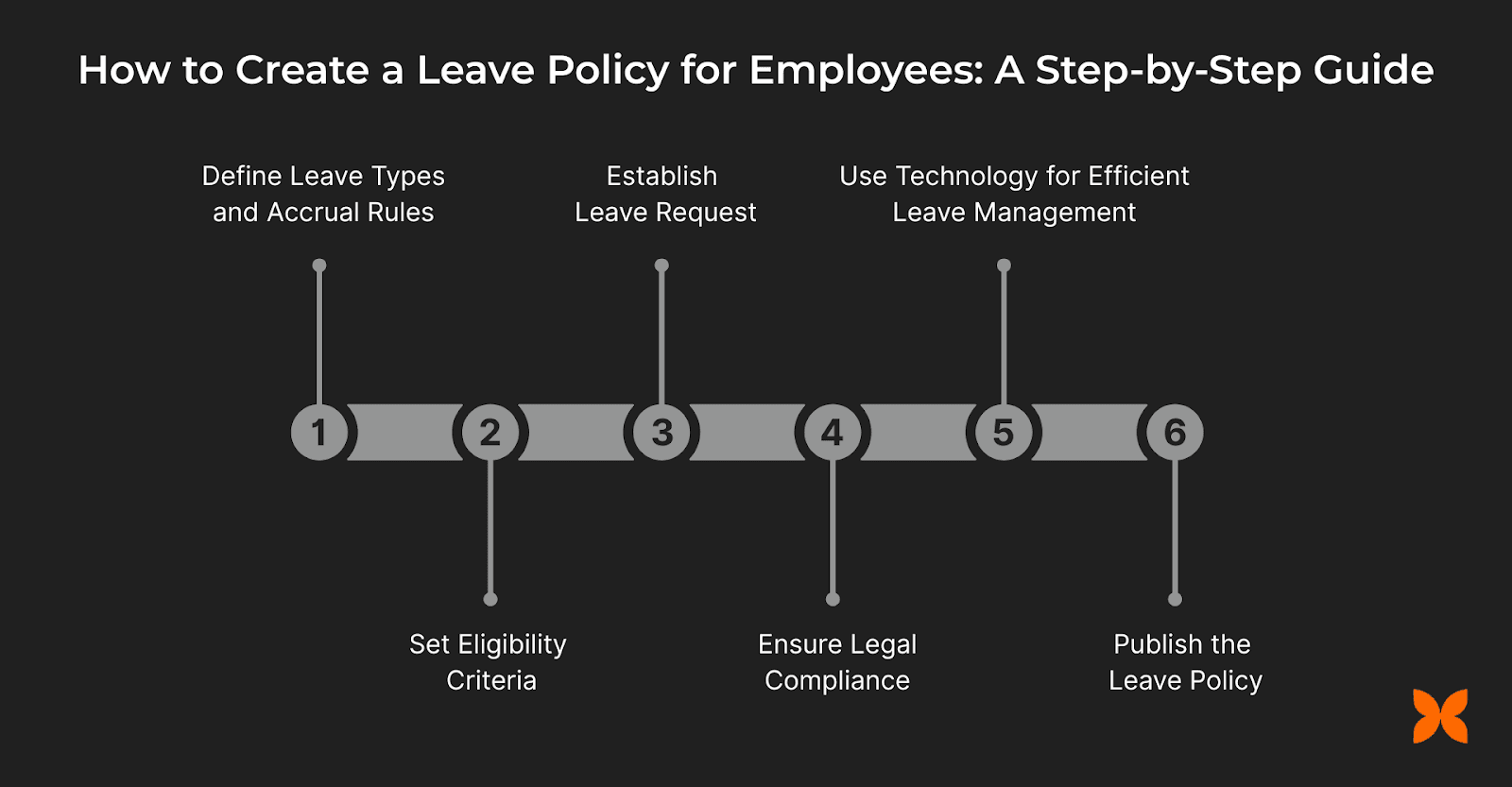
Creating a leave policy document is a straightforward process when broken down into manageable steps. Follow this guide to design a company leave policy that works for both your employees and your business.
Step 1: Define Leave Types and Accrual Rules
The first step in preparing a leave policy is determining the types of leave you will offer and how leave will be accrued over time.
Choose the appropriate leave types (e.g., sick leave, casual leave, maternity leave) based on your employee's needs and the company's requirements.
Set clear accrual rules for leave, specifying whether leave is accrued monthly, annually, or based on other criteria. This ensures clarity and avoids confusion regarding leave entitlement policies.
Step 2: Set Eligibility Criteria and Leave Entitlement
Next, define who is eligible for leave and how much leave each employee can take under your employee leave policy.
Determine eligibility for leave based on employment type (full-time, part-time, or contract).
Set annual leave entitlement, deciding how many days off employees will receive each year. This could be laid out in the leave policy format to ensure easy reference.
Step 3: Establish Leave Request and Approval Process
Clear guidelines help employees know how to request leave and how it will be approved under your leave policy.
Outline the leave request process, including the notice period and required documentation (e.g., a doctor’s note for sick leave). Clear leave request procedures ensure that employees know how to apply for time off, while also allowing HR to manage absences efficiently.
Define the approval process, including who will approve the leave (e.g., managers, HR), to ensure it is easy for employees to follow and for HR teams to manage.
Step 4: Ensure Legal Compliance
Your company's leave policy must meet the legal requirements outlined in Indian labour laws to ensure compliance.
Ensure your policy follows Indian labour laws, such as the Factories Act, Maternity Benefit Act, and any state-specific regulations related to leave policies for employees.
Consult legal resources to confirm the policy aligns with the mandatory leave entitlements policy. This protects both the business and employees.
Step 5: Use Technology for Efficient Leave Management
Using leave management software can simplify the management of employee leave policies and ensure everything runs smoothly.
Implement leave management software like Craze to automate leave tracking, manage requests, and ensure compliance with Indian labour laws. This minimises errors and reduces administrative workload.
Integrate the system with payroll to prevent salary calculation errors and maintain a streamlined leave process for employees.
Step 6: Communicate and Publish the Leave Policy
A leave policy is effective only when employees fully understand it. Clear communication prevents misunderstandings, ensures compliance, and builds trust across the organisation. To make this happen:
Publish the policy in the employee handbook and on the HR portal so it is easily accessible to all employees.
Explain the policy during onboarding and induction sessions to ensure new hires are aware of the rules from day one.
Train managers on leave entitlements, approval workflows, and escalation procedures to ensure consistent and fair application.
Require employees to acknowledge the policy in writing or digitally to confirm their understanding and agreement.
Following these steps ensures your leave policy is applied consistently, understood by everyone, and supports a fair and compliant workplace.
Key Elements of a Well-Structured Leave Policy
A strong leave policy is more than just a list of rules. It should cover key aspects that ensure clarity, fairness, and ease of management. Here are the essential elements to include:
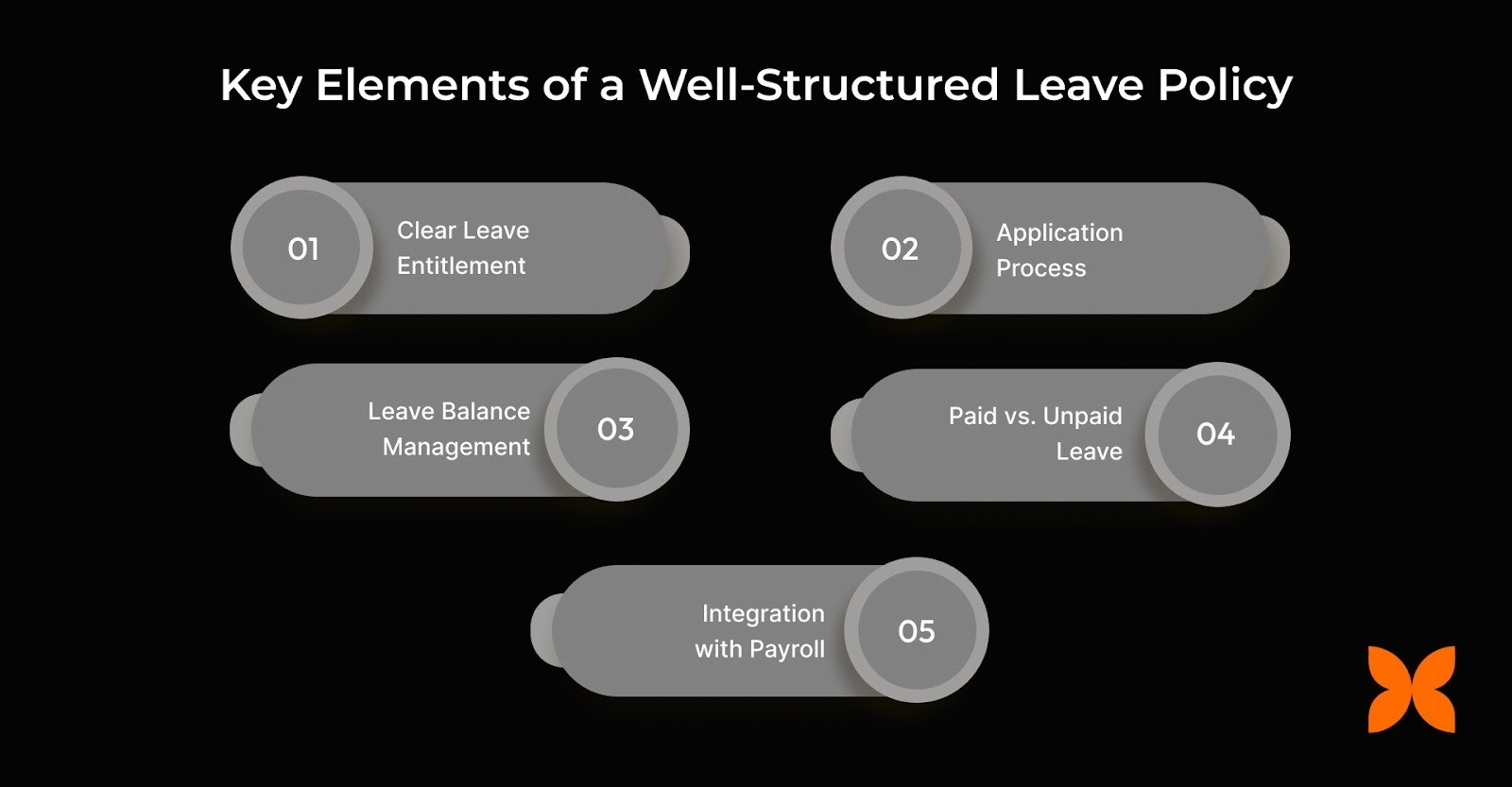
Clear Leave Entitlement and Accrual Rules: Define how much leave employees are entitled to based on role and tenure. Include accrual rules for different types of leave (e.g., monthly accruals for earned leave).
Application Process and Approval Workflow: Clearly state the process for applying for leave and set expectations for approvals and timelines. Include any relevant forms or software tools (e.g., Craze’s Employee Self-Service module to easily apply, track & manage leave application).
Leave Balance Management: Set guidelines for how unused leave is managed, whether it can be carried forward or cashed out. Include policies for part-time employees or contractors if applicable.
Paid vs. Unpaid Leave: Ensure that employees understand which types of leave are paid and which are unpaid. Provide clarity on how unpaid leave impacts salary and benefits.
Integration with Payroll: Ensure that your leave policy is seamlessly integrated with your payroll system to prevent errors in salary calculation.
Now, it is time to put everything into action by using a practical leave policy template that you can customise for your business needs.
Sample Leave Policy Template For You
To help you create a comprehensive, clear, and legally sound leave policy for your employees, here is an editable sample template. You can customize the bracketed placeholders to fit your company's specific entitlements and operational needs.
Leave Policy Template
Company Name: [Insert Company Name]
Policy Owner: [Insert HR Manager/Role]
Effective Date: [Insert Date]
Purpose and Scope
This section establishes the framework for employee leave. It defines the goal of the policy, which is to clearly outline leave entitlements, and specifies the roles covered.
This policy outlines the leave entitlements for employees of [Company Name] and the official procedures for applying for and approving leave.
The policy applies to all full-time employees of the company. Specific entitlements for part-time and contract employees are detailed separately.
Standard Leave Types and Entitlement
This section defines the core categories of paid time off, including entitlement days and specific conditions for each type.
Sick Leave (SL): Employees are entitled to [Insert Number] days of sick leave annually for personal illness or injury. A medical certificate may be required if sick leave exceeds [Insert Number] consecutive days.
Casual Leave (CL): Employees are entitled to [Insert Number] days of casual leave per year. CL is provided for unexpected personal matters and does not carry over to the next year.
Annual/Earned Leave (AL/EL): Employees are entitled to [Insert Number] days of annual leave each year. This leave accrues at [Insert Accrual Rate] per month.
Maternity/Paternity Leave: Female employees are entitled to [Insert Number] weeks of statutory maternity leave, and male employees may be granted [Insert Number] days of paternity leave. Both must comply with statutory requirements and internal notification procedures.
Other Leave: Employees may be eligible for additional discretionary leave, such as bereavement leave, mental health days, or menstrual leave, based on company policy.
Leave Accrual & Carry-Forward
Leave is typically accrued monthly based on the employee's date of joining. Annual Leave (AL) can be carried forward to the next year up to a maximum of [Insert Number] days. Any balance exceeding this limit will lapse at the end of the year.
Eligibility Criteria
Eligibility defines which employees are entitled to the leave benefits described in this policy, often dependent on their employment status and tenure.
Full-Time Employees: Eligible for all leave types after completing the probationary period.
Part-Time Employees: Eligible for pro-rata leave based on the number of hours worked.
Contract Employees: Leave entitlements are based on the specific terms outlined in the employment contract.
Leave Request and Approval Process
A defined process ensures minimal disruption to business operations and maintains clear communication.
Submission: Employees must submit a leave request through the company’s HR system ([Insert Software or Portal]) at least [Insert Number] days in advance for planned leave.
Approval Flow: Requests must be formally approved by the immediate supervisor and subsequently reviewed by HR.
Review Criteria: Final approval depends on the employee’s current leave balance and the current business needs to ensure adequate team coverage, especially during peak times.
Special Leave Considerations
This section highlights unique scenarios that require extra planning or adherence to specific contractual rules.
Employees are strongly encouraged to plan and submit leave requests well in advance to ensure adequate coverage and approval during critical periods.
Any leave taken during the notice period or probation period will follow the specific rules outlined in the respective employment contract or HR policies.
In case of unforeseen sick leave, the employee must inform their manager immediately on the first day of absence.
With the right leave policy template in hand, it is time to think about how you can streamline and manage the entire leave process efficiently.
Definitions
|
How Craze Can Help You Manage Your Leave Policy
Managing employee leave manually can be time-consuming and error-prone. Craze Leaves automates your leave policy, ensuring entitlements, approvals, and payroll calculations are accurate and consistent for every employee.
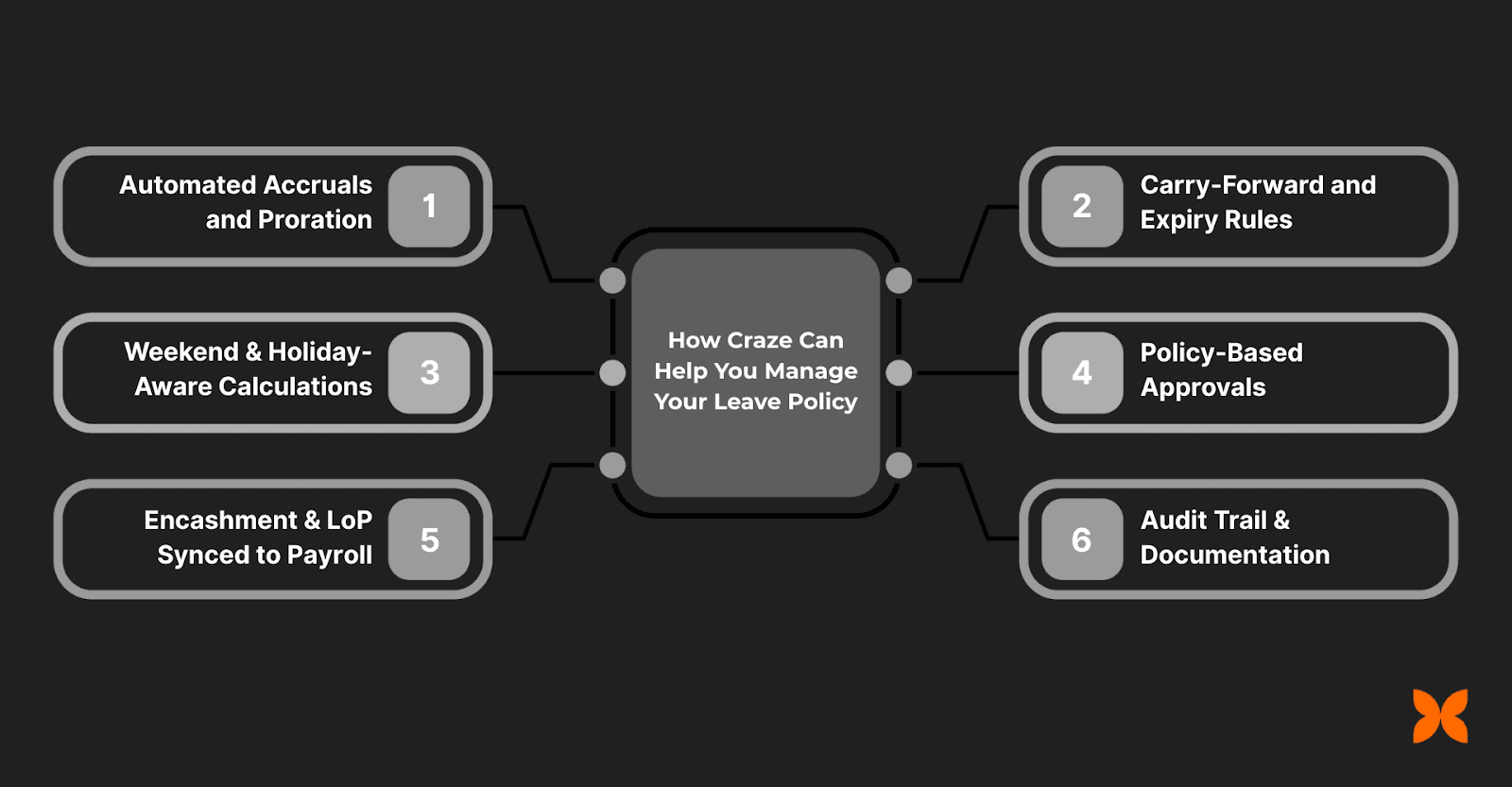
Here’s what that looks like in practice:
Automated Accruals and Proration: Configure monthly or annual accruals and automatically prorate leave for new joiners and exiting employees.
Carry-Forward and Expiry Rules: Set maximum carry-forward limits and expiry dates to prevent year-end disputes over leave balances.
Weekend & Holiday-Aware Calculations: Apply company-specific holiday calendars and weekend patterns to ensure leave deductions are accurate.
Policy-Based Approvals: Implement multi-level approval chains, delegation, and escalation rules for delayed approvals to keep workflows smooth.
Encashment & LoP Synced to Payroll: Automate leave encashment and loss-of-pay calculations, ensuring payroll accuracy without manual intervention.
Audit Trail & Documentation: Maintain a complete history of leave requests, approvals, and supporting documents, such as medical certificates, for compliance and transparency.
With Craze Leaves, your leave policy becomes transparent for employees, predictable for managers, and fully payroll-grade for HR.

FAQs
1. How can I handle leave balance carry-forward and expiration in my company's leave policy?
Set clear rules on how unused leave can be carried forward and how long it can be accumulated. Ensure that your leave policy specifies any expiration dates for leave balances to avoid confusion at year-end.
2. Can I create a leave policy for employees in India that includes custom leave types specific to my industry, like for IT companies?
Yes, you can customise your leave policy for employees to include industry-specific leave types, such as those in software companies, and manage them with Craze for streamlined leave tracking and approvals.
3. How can I handle leave requests during peak business periods to avoid disruption?
Implement clear leave request policies for peak periods. Encourage employees to plan leave well in advance and prioritise requests based on urgency, ensuring the workflow remains uninterrupted.
4. What’s the difference between annual leave and casual leave in a company's leave policy?
Annual leave is typically pre-planned time off for vacation or personal use, while casual leave is meant for unexpected personal matters. Define both clearly in your leave policy format to avoid confusion.
5. How should I manage leave encashment rules in my company's leave policy?
Specify the leave encashment rules in your policy, including how unused leave is compensated, any limits on the number of days eligible for encashment, and the calculation process. This ensures clarity and fairness for employees.
