
Human Resource Management System (HRMS): A Complete Guide for Growing Businesses


As organisations scale, managing employee data, payroll, attendance, and statutory compliance requires structured and reliable systems. A Human Resource Management System (HRMS) is a digital platform designed to centralise and automate these core HR functions across the employee lifecycle.
In India, over 60% of mid-sized businesses moved from manual HR processes to cloud-based HRMS platforms in 2024 as part of broader digital transformation initiatives. By standardising HR operations, HRMS solutions help companies to maintain accuracy, ensure compliance, and support sustainable workforce growth.
In this guide, we will explain what an HRMS is, its key features and components, how it works across the monthly HR cycle, and when a business should adopt one. We’ve also included a practical checklist to choose the right HRMS for your business.
Key Takeaways
HRMS centralises employee data and automates HR tasks such as payroll, attendance, recruitment, and performance management.
Key features include payroll, leave tracking, performance reviews, recruitment, training, compliance, and analytics.
An HRMS streamlines HR operations, making processes data-driven, efficient, and scalable as the business grows.
Benefits include reduced errors, accurate payroll processing, improved compliance, and more time for strategic HR initiatives.
Invest in an HRMS when scaling, facing compliance challenges, or spending too much on manual HR work.
What is a Human Resource Management System (HRMS)?
A Human Resource Management System (HRMS) is an integrated software solution that centralises and automates core HR functions such as payroll, recruitment, benefits, time tracking, and performance management, streamlining employee lifecycle tasks from hiring to retirement, freeing HR for strategic work, and providing data for better workforce decisions.
It combines HR processes with IT, often cloud-based, offering self-service for employees and efficiency for organisations.
HRMS serves as a single system of record for employee information, ensuring data consistency across departments and locations. By standardising HR data and workflows, it supports accurate record-keeping, audit readiness, and regulatory compliance, particularly in organisations with growing or distributed workforces.
Brief History of HRMS
The concept of HRMS dates back to the 1970s when businesses began adopting early forms of technology to manage employee records and payroll. Over time, as organisations grew and their HR needs became more complex, HRMS evolved to include additional functionalities.
These systems began to support recruitment, training, and employee development, moving beyond just administrative functions. With the rise of cloud computing in the 2000s, HRMS transitioned to more flexible, scalable, and cost-effective solutions.
Today, HRMS empowers businesses of all sizes to simplify HR operations and better align workforce strategies with business objectives. As HR technology advanced, different systems emerged to meet specific organisational needs, making it essential to understand how HRMS differs from platforms like HRIS and HCM.
HRMS vs. HRIS vs. HCM: Key Differences
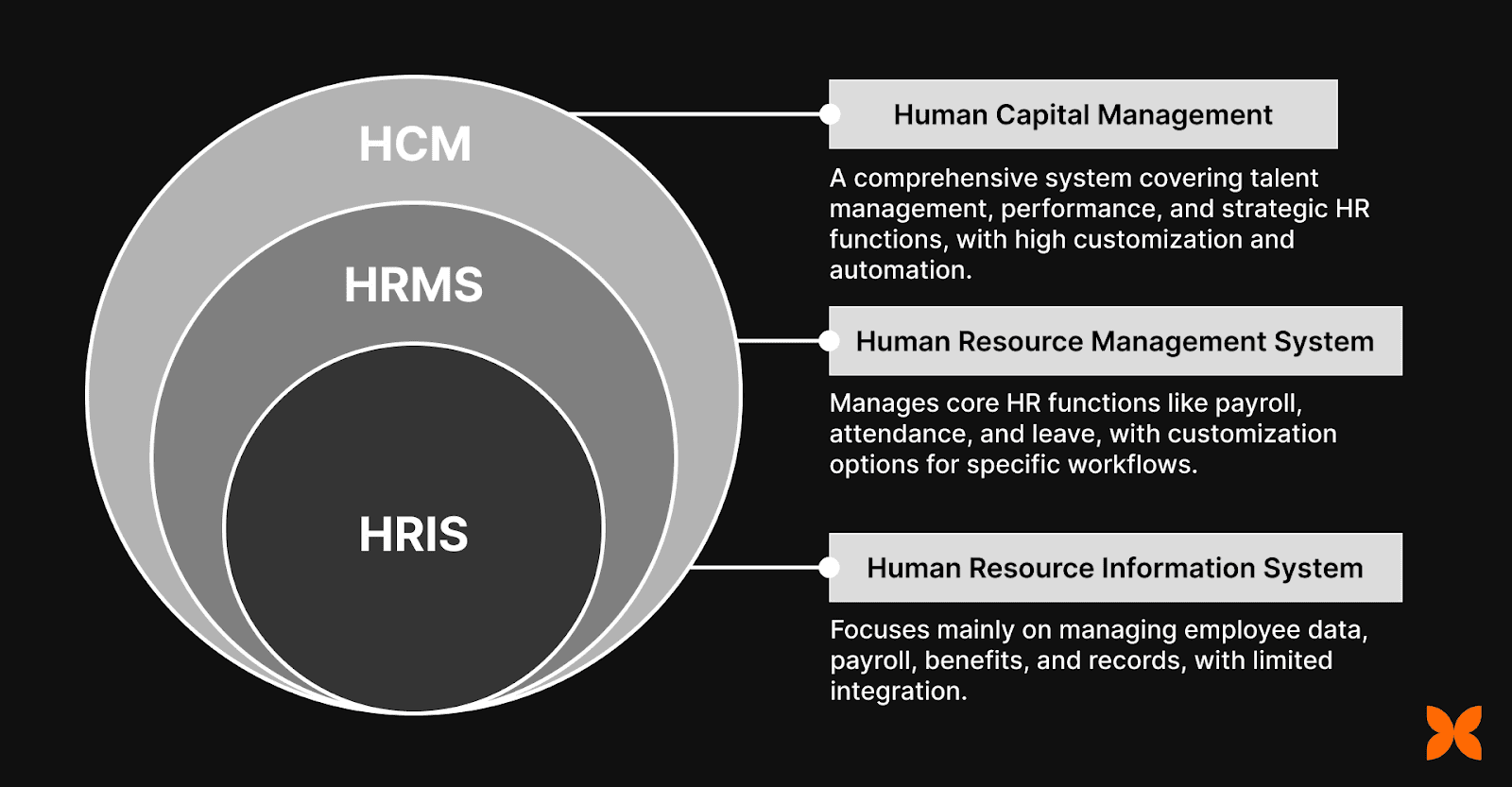
While HRMS, HRIS, and HCM are often used interchangeably, they are distinct systems with different scopes and functionalities. Here’s how they compare:
Feature | HRMS | HRIS | HCM |
Primary Function | Manages HR operations like payroll, leave, and attendance | Focuses mainly on employee data management | Broader system for talent management, performance, and strategic HR functions |
Scope | Comprehensive HR management system that includes payroll, leave, and attendance | Primarily focused on employee records, payroll, and benefits | Encompasses all HR practices, including recruitment, learning, performance, and succession planning |
Automation | Automates core HR functions like payroll, leave management, and attendance | Limited automation; mainly used for data storage | Highly automated, especially for talent management and learning |
Customisation | Can be customised for specific HR workflows | Limited customisation for specific HR needs | Highly customisable to fit business strategies and talent management |
Integration | Easily integrates with payroll, finance, and other HR tools | Often standalone, with limited integration | Integrates all aspects of HR, from recruitment to performance management |
Now, let’s take a closer look at the types of businesses and teams that rely on HRMS tools to keep their people and processes running smoothly.
Who Uses an HRMS?
HRMS is designed for organisations of all sizes, helping various teams manage HR tasks efficiently. From HR professionals to managers and employees, it simplifies processes and ensures accurate, real-time information across the company.
Key Users of HRMS:
HR Teams: Manage payroll, attendance, leave, recruitment, and employee records.
Managers: Track team performance, approve leaves, and monitor workflows.
Finance Teams: Ensure accurate payroll, tax compliance, and benefits administration.
Employees: Access self-service portals for payslips, leave requests, and personal information updates.
Executives: Gain insights through dashboards and reports to make strategic HR decisions.
Now that we understand what an HRMS is and its purpose, let’s explore the key features that make it an essential tool for businesses.
Key Features of a Human Resource Management System
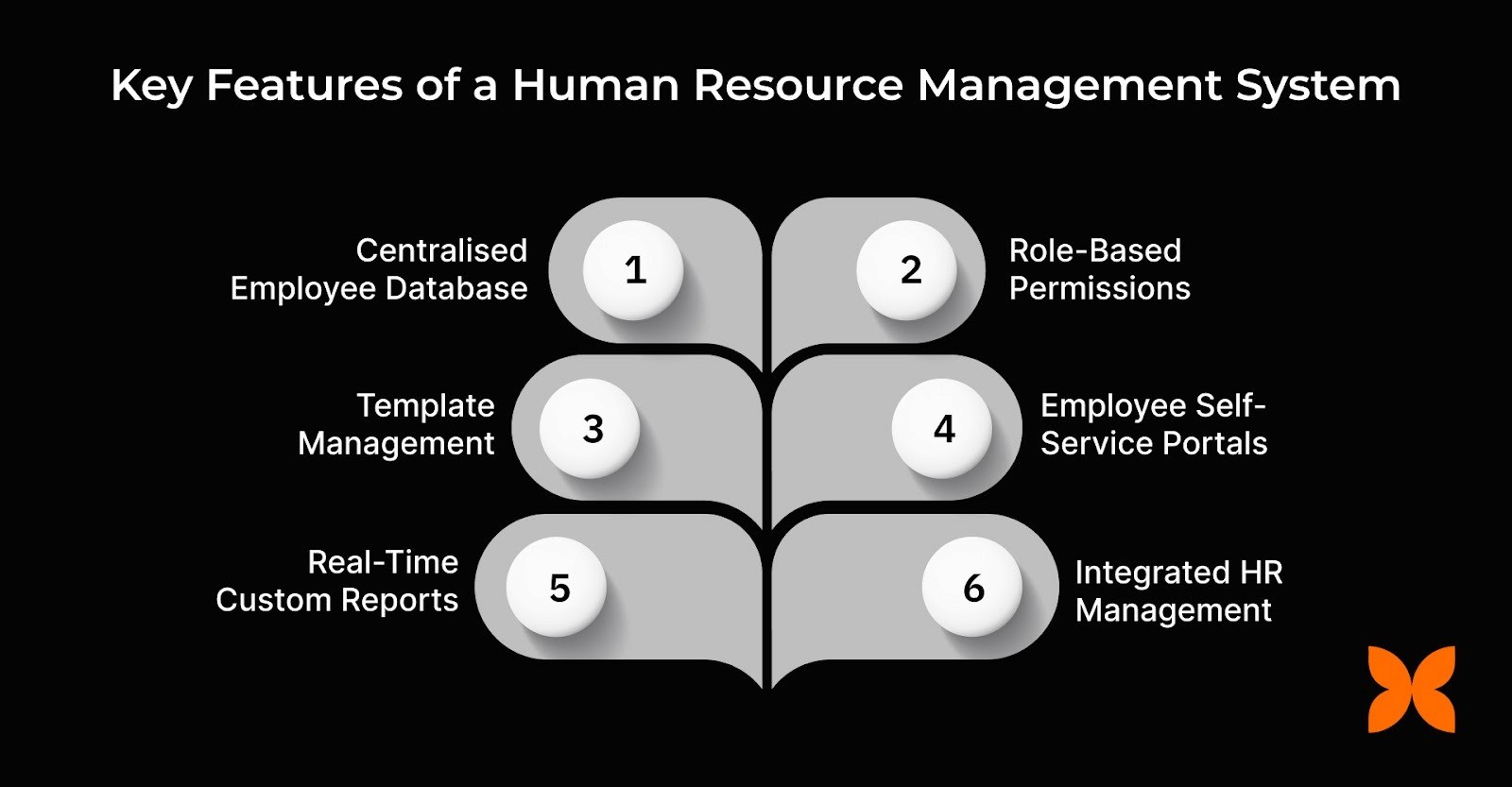
When choosing a Human Resource Management System (HRMS), it is essential to look for features that help automate routine HR tasks and improve overall efficiency. Below are the key features that make an HRMS a vital tool for any organisation:
1. Centralised Employee Database
The HRMS centralises all employee-related information, such as personal details, job roles, compensation history, performance reviews, and more. This ensures that HR teams have instant access to accurate data, allowing for quicker decision-making and better resource management.
Why It’s Important: By maintaining a single, secure repository for employee data, you can easily manage personal details, job history, performance, and benefits, enhancing operational efficiency and reducing administrative overhead.
2. Role-Based Permissions
HRMS platforms allow for role-based permissions, ensuring that the right people have access to the right information. Whether it is managers, HR staff, or employees themselves, role-based access provides a secure way to control who can view, edit, and manage sensitive data.
Why It’s Important: It ensures data security, confidentiality, and compliance with privacy laws, allowing different users to access only the information necessary for their roles.
3. Document Management with Templates
An HRMS includes a document management system that allows HR teams to manage documents like contracts, policies, and certifications. This feature often comes with templates for easy document creation and quick approvals.
Why It’s Important: HR can easily manage employee records, generate documents, and ensure compliance without the need for paper-based systems, thus improving efficiency and reducing manual errors.
4. Employee Self-Service Portals
A self-service portal allows employees to access and update their own data, such as personal information, leave balances, and payroll details. It enhances employee engagement and reduces the administrative burden on HR teams.
Why It’s Important: Employees gain autonomy and can quickly access the information they need, reducing HR workloads and improving the employee experience.
5. Real-Time Custom Reports
HRMS software allows HR teams to generate real-time, customisable reports to track key metrics like attendance, leave balances, payroll, and performance. This feature allows organisations to make data-driven decisions and track trends over time.
Why It’s Important: Real-time access to data and custom reporting improves decision-making and ensures HR teams can quickly respond to changing needs, from managing absenteeism to evaluating employee performance.
6. Integrated HR Management
Modern HRMS platforms integrate with other essential business systems like payroll, attendance tracking, performance management, and recruitment. This integration ensures that all HR functions work together seamlessly, providing a unified system that reduces data silos.
Why It’s Important: Integration reduces the need for manual data entry and ensures that HR functions are aligned, improving efficiency, data accuracy, and compliance.
Also Read: 10 Best HR Software in India For Your Growing Business
The features we have discussed all rely on key components working together. Let’s look at these components in detail to understand how they drive an effective HRMS.
Components of a Human Resource Management System
A Human Resource Management System (HRMS) is a comprehensive solution that combines various HR functions under one umbrella. Here’s a breakdown of the key components that make up a fully functional HRMS:
1. Employee Information Management
At the core of an HRMS is the storage and management of employee data. This component allows HR teams to maintain comprehensive, up-to-date records on all employees, including their personal information, job roles, employment history, performance reviews, and much more.
Core Features:
Employee profiles with basic and professional information
Job history, salary details, and career progression
Automated updates and real-time access to data
Benefits:
Reduces paperwork
Increases data accuracy
Centralises employee information for easy retrieval
Also Read: HRIS Implementation Made Easy: 6-Week Rollout Plan
2. Payroll Management
A crucial part of any HRMS is payroll management. This component ensures that salaries, wages, bonuses, and other employee compensations are processed correctly and on time. Payroll management also ensures adherence to tax regulations and compliance with statutory deductions.
Core Features:
Automated salary calculations based on leave and overtime
Compliance with tax laws (e.g., Provident Fund, ESI)
Direct deposit integration for payroll disbursements
Benefits:
Reduces errors in payroll calculations
Ensures timely and accurate salary payments
Streamlines compliance with labour laws
Also Read: Fast Payroll Implementation: From Start to Launch
3. Leave and Attendance Management
An HRMS includes leave and attendance tracking, which is essential for managing employee absences, vacation requests, and sick days. This component integrates with payroll systems to ensure that time off is accurately reflected in salary calculations.
Core Features:
Automated leave requests and approvals
Leave balance tracking and carry-over management
Real-time attendance tracking (clocking in/out)
Benefits:
Reduces administrative burden for HR teams
Ensures compliance with leave policies and regulatory requirements
Improves transparency and employee satisfaction
Also Read: How to Automate Leave Management (Fast, Practical Guide)
4. Performance Management
Performance management tools within an HRMS allow organisations to track, evaluate, and develop employee performance. This component enables regular performance reviews, goal setting, and feedback, all of which contribute to employee growth and alignment with company goals.
Core Features:
Setting and tracking of individual and team goals (OKRs)
Employee skill tracking and development planning
Benefits:
Encourages continuous employee development
Aligns employee performance with company objectives
Provides valuable insights into workforce effectiveness
5. Recruitment and Talent Acquisition
An HRMS simplifies recruitment by automating candidate sourcing, tracking, and interviewing. It also integrates with job boards and social media platforms to streamline the hiring process, ensuring you attract and hire the best talent.
Core Features:
Job postings, application tracking, and candidate management
Interview scheduling and evaluation tools
Recruitment analytics to track sourcing channels
Benefits:
Speeds up the hiring process
Ensures a seamless candidate experience
Reduces time-to-hire and cost-per-hire
6. Training and Development
An HRMS often includes features for training and development, helping companies create, track, and manage employee learning programmes. This component supports continuous learning and development by providing easy access to training modules, certifications, and progress tracking.
Core Features:
Learning management systems (LMS) integration
Tracking of certifications, courses, and training progress
Personalised development plans for employees
Benefits:
Supports employee growth and skill development
Improves knowledge retention and operational efficiency
Aligns training initiatives with business needs
7. Compliance Management
An HRMS also helps companies ensure compliance with local and national labour laws. The system automatically updates and tracks statutory requirements such as employee benefits, taxes, and reporting.
Core Features:
Automated compliance checks and notifications
Statutory reporting, e.g., PF, ESI, and income tax
Auditing tools and data security measures
Benefits:
Reduces the risk of non-compliance fines
Ensures accurate, timely reporting
Protects sensitive employee data
8. Analytics and Reporting
HRMS platforms include built-in reporting and analytics tools that help HR teams make data-driven decisions. This feature provides insights into employee performance, attendance patterns, compensation trends, and other HR metrics.
Core Features:
Customisable reports and dashboards
Employee turnover, retention, and engagement analysis
Predictive analytics for workforce planning
Benefits:
Improves decision-making with real-time data
Helps identify trends and issues early on
Supports long-term strategic planning
9. Compensation and Benefits Management
This component of an HRMS helps manage employee compensation and benefits, including bonuses, insurance, retirement plans, and other perks. The system automates calculations, ensuring fairness and transparency in the distribution of benefits.
Core Features:
Automated compensation calculations and adjustments
Benefits tracking, including health insurance, retirement funds, etc.
Integration with payroll for accurate disbursement
Benefits:
Ensures equitable and timely distribution of compensation
Reduces errors in benefits and compensation
Enhances employee satisfaction by tracking perks effectively
How Does a Human Resource Management System Work?
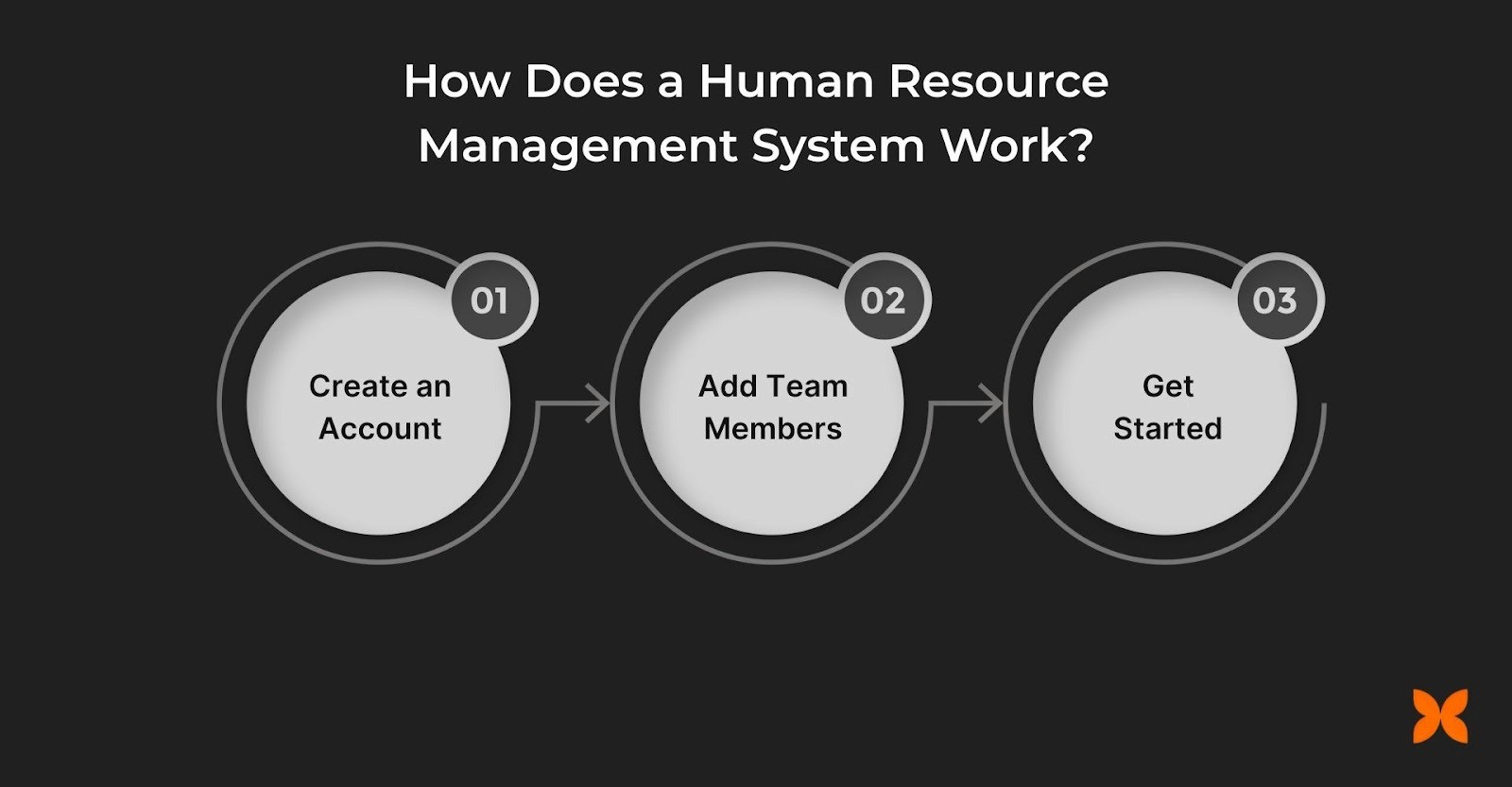
Getting your human resource management system up and running is a simple, smooth process that requires minimal time and effort.
Step 1: Create an Account
Start by creating an account on the HRMS platform. To get started, you will need to input details about your business, including entity information and tax details.
Step 2: Add Your Team Members
Once you have set up your account, the next step is adding your employees. You can add them manually or upload their details in bulk. This information helps the HRMS build a centralised employee database.
Step 3: Get Started
With your account set up, you are ready to go. You can now manage payroll, track leave, and edit employee data with just a click.
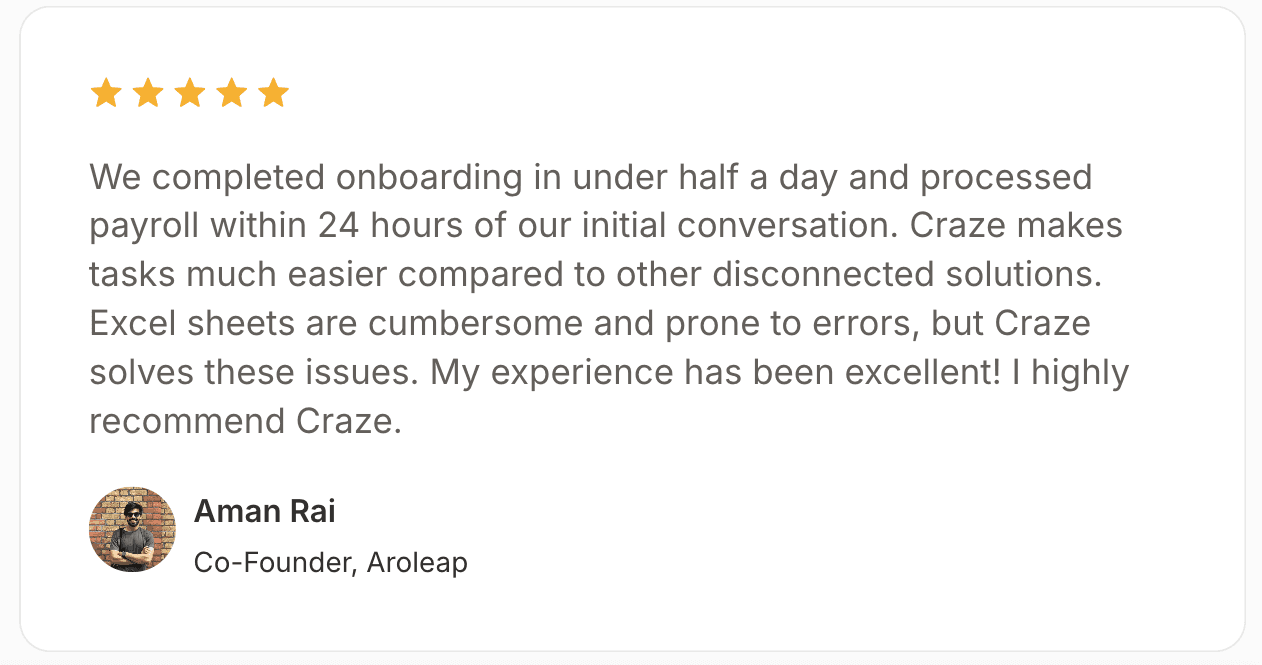
For example, Craze HR software helped “Aeroleap”, a home gym brand featured on Shark Tank, onboard within half a day and process its first payroll in just 24 hours.
Why Your Business Needs a Human Resource Management System
If you are tired of managing HR tasks manually or using outdated systems, an HRMS simplifies and automates key processes for improved efficiency and growth.
Here’s why your business needs a human resource management system:
Eliminate Paperwork: Say goodbye to paper-based processes. An HRMS helps you store and manage all employee data digitally, reducing paperwork and freeing up HR teams for more meaningful tasks.
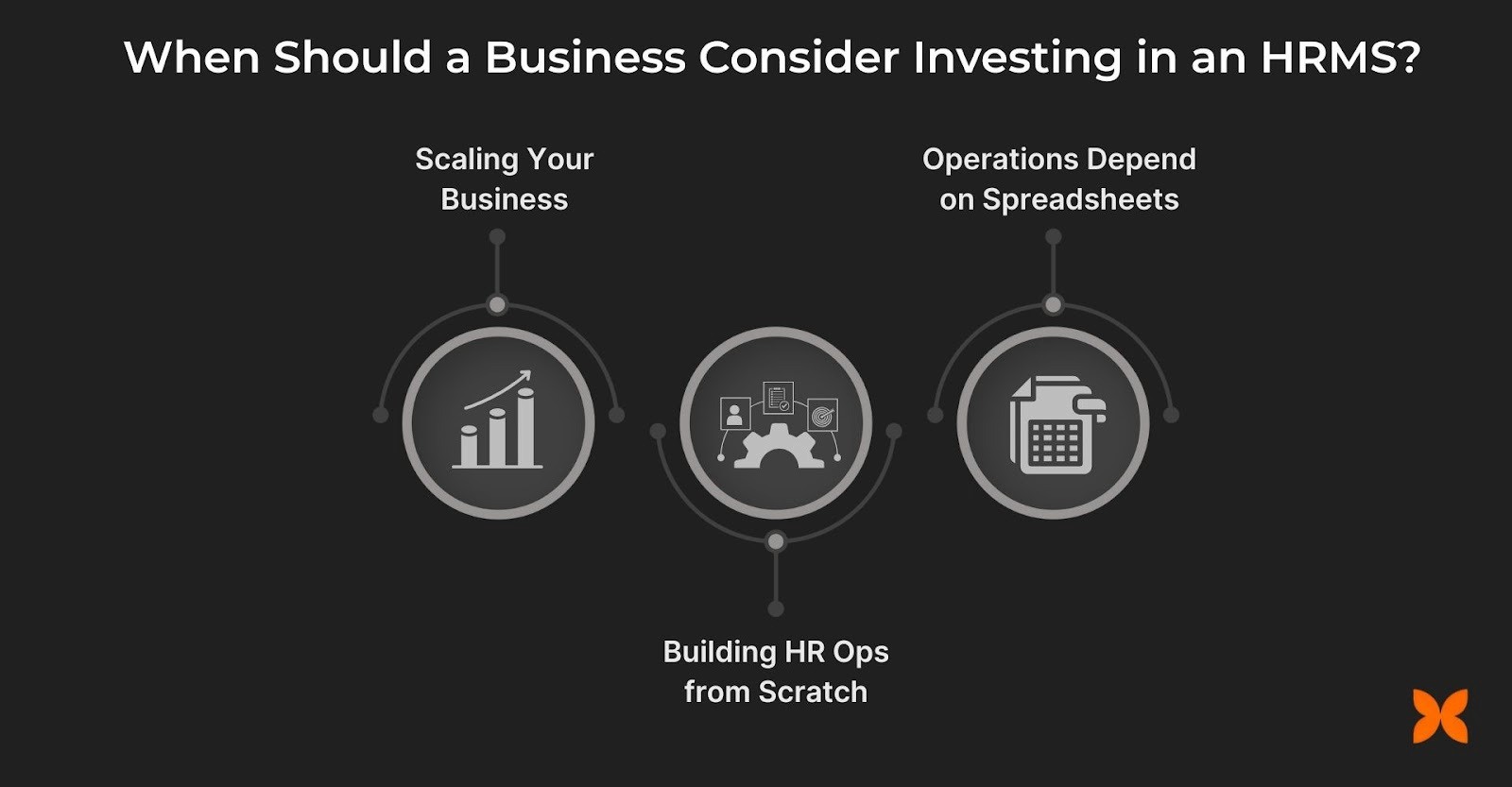
Replace Spreadsheets with Automation: Managing payroll, leave, and attendance using spreadsheets is error-prone and time-consuming. An HRMS automates these processes, ensuring accuracy and saving time.
Accurate and Timely Payroll: An HRMS ensures that payroll is calculated accurately and on time, reducing the chances of errors and compliance issues.
Centralised, Integrated Solution: Instead of using multiple disconnected tools, an HRMS like Craze integrates HR, finance, and IT functions in one platform, improving coordination and simplifying operations.
How Does HRMS Benefit Businesses?
Businesses often face unique challenges as they scale. Managing a growing team with limited resources can impact productivity and employee morale. Here’s how an HRMS can help:
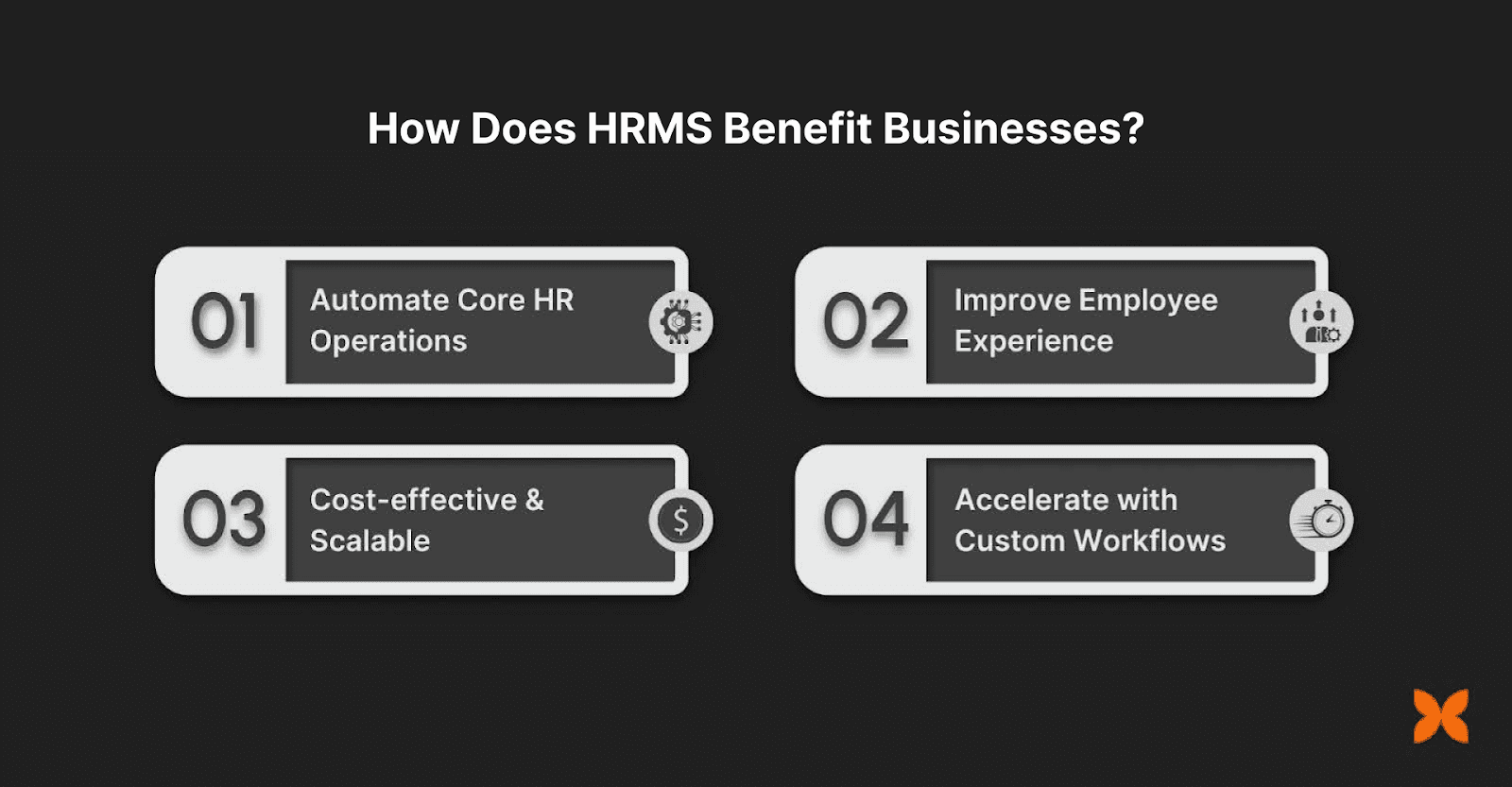
Automate Core HR Operations: Automating tasks like payroll, attendance management, and compliance frees up HR teams to focus on more valuable activities, such as hiring and improving employee satisfaction.
Improve Employee Experience: By automating repetitive tasks, an HRMS improves the employee experience, allowing them to manage their leave requests, attendance, and payslips, while reducing HR's workload.
Cost-effective and Scalable: With an HRMS, businesses can scale their HR operations without investing in expensive, complex systems. The system grows with your company, adapting to your needs.
Faster Turnaround with Custom Workflows: Creating custom workflows for payroll, leave, and attendance management makes HR tasks faster and more efficient, reducing the time spent on manual processes.
Understanding the needs and benefits of an HRMS can help you recognise when it is the right time for your business to make the switch.
When Should a Business Consider Investing in an HRMS?
As businesses grow, the difficulty of managing human resources increases. This is when investing in a Human Resource Management System (HRMS) becomes a smart business decision.
Here are some scenarios when your business should consider implementing an HRMS:
When You Are Scaling Your Business
Manual HR, finance, and IT tasks become unsustainable as your company expands. Automating these processes with an HRMS should be a top priority to avoid bottlenecks and improve overall efficiency.
When You Are Struggling with Compliance and Legal Issues
In India, staying compliant with labour laws is crucial, but it can be difficult to keep track of regulations across multiple states. If you find that you’re frequently scrambling to ensure compliance or facing fines for missed deadlines, an HRMS can automate legal compliance by tracking updates to local and national labour laws. From managing statutory benefits like PF and ESI to ensuring correct tax calculations, an HRMS helps businesses stay ahead of the legal curve.
When HR Tasks Become Time-Consuming
When HR teams are bogged down by administrative tasks like manually entering employee data, tracking absences, and calculating payroll, they have less time to focus on strategic HR initiatives. An HRMS streamlines these processes, automating tasks that would otherwise take up hours. By eliminating manual errors and reducing administrative workload, HR teams can focus on enhancing employee engagement, talent development, and organisational culture.
If any of these challenges resonate with your business, it is time to invest in a human resource management system.
How Do You Find the Right HRMS for Your Business Needs?
Selecting the right HRMS can be a game-changer for businesses, especially for small companies and startups that are growing rapidly. To ensure that you pick the best system for your unique needs, here are the key factors you should consider:
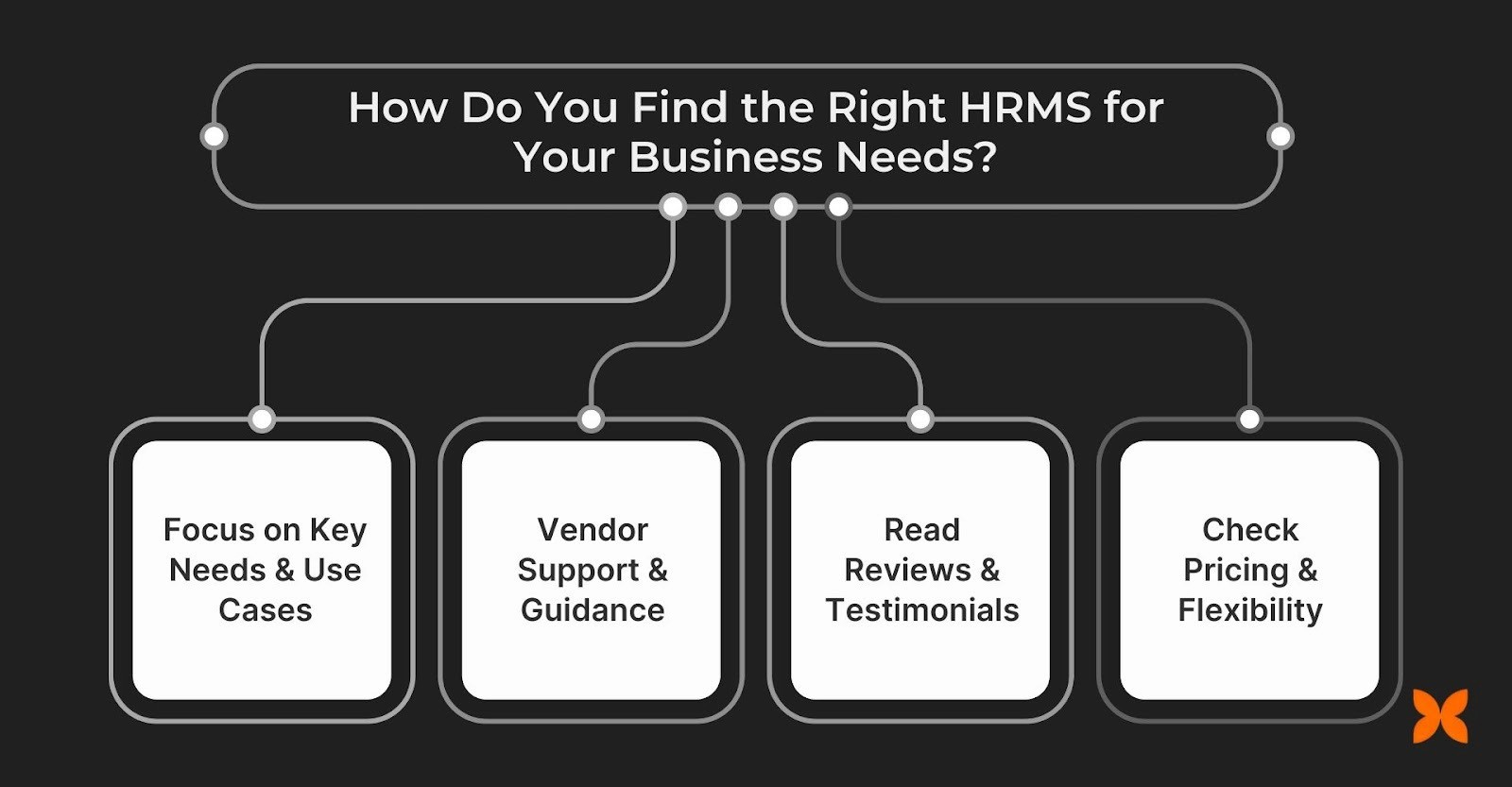
Focus on Key Needs and Use Cases
Before diving into HRMS options, pinpoint your immediate challenges. Many platforms offer a wide range of features, but you may not need them all at this time.
For example, if managing payroll and tracking attendance are your top priorities, start by choosing an HRMS that excels in these areas. This will help you avoid unnecessary complexity while meeting your core needs.
Look for Vendor Support and Guidance
Startups often face unique challenges during the implementation phase. Therefore, make sure the HRMS vendor offers on-demand support.
Whether it is answering questions, offering training, or troubleshooting issues, a responsive customer support team is vital for making your transition smooth and hassle-free.
Read Reviews and Testimonials
Check customer reviews and testimonials from other businesses in your industry to understand their experiences with the HRMS.
Platforms like G2 or Capterra help find detailed reviews from real users. Insights from existing customers will provide a clear picture of the platform's reliability, customer service, and ease of use.
Check Pricing and Flexibility
As your business scales, your needs will evolve. Look for an HRMS that offers flexible pricing plans that can adapt to changes in your team size and requirements. Avoid platforms that have rigid, all-in-one pricing models that lock you into unnecessary features.
A pay-per-user model is often more suited for growing businesses that need scalability without locking themselves into high costs.
If you are ready to solve these challenges and take control of your HR operations, the right tool can make all the difference.
Still Confused? Choose Craze HRMS for Your HR Operations
If managing HR tasks manually is slowing down your team, Craze HRMS is the solution you need. It automates everything from payroll to employee management, letting you focus on scaling your business without the burden of HR operations.
Why Craze HR Software is Ideal for Growing Companies
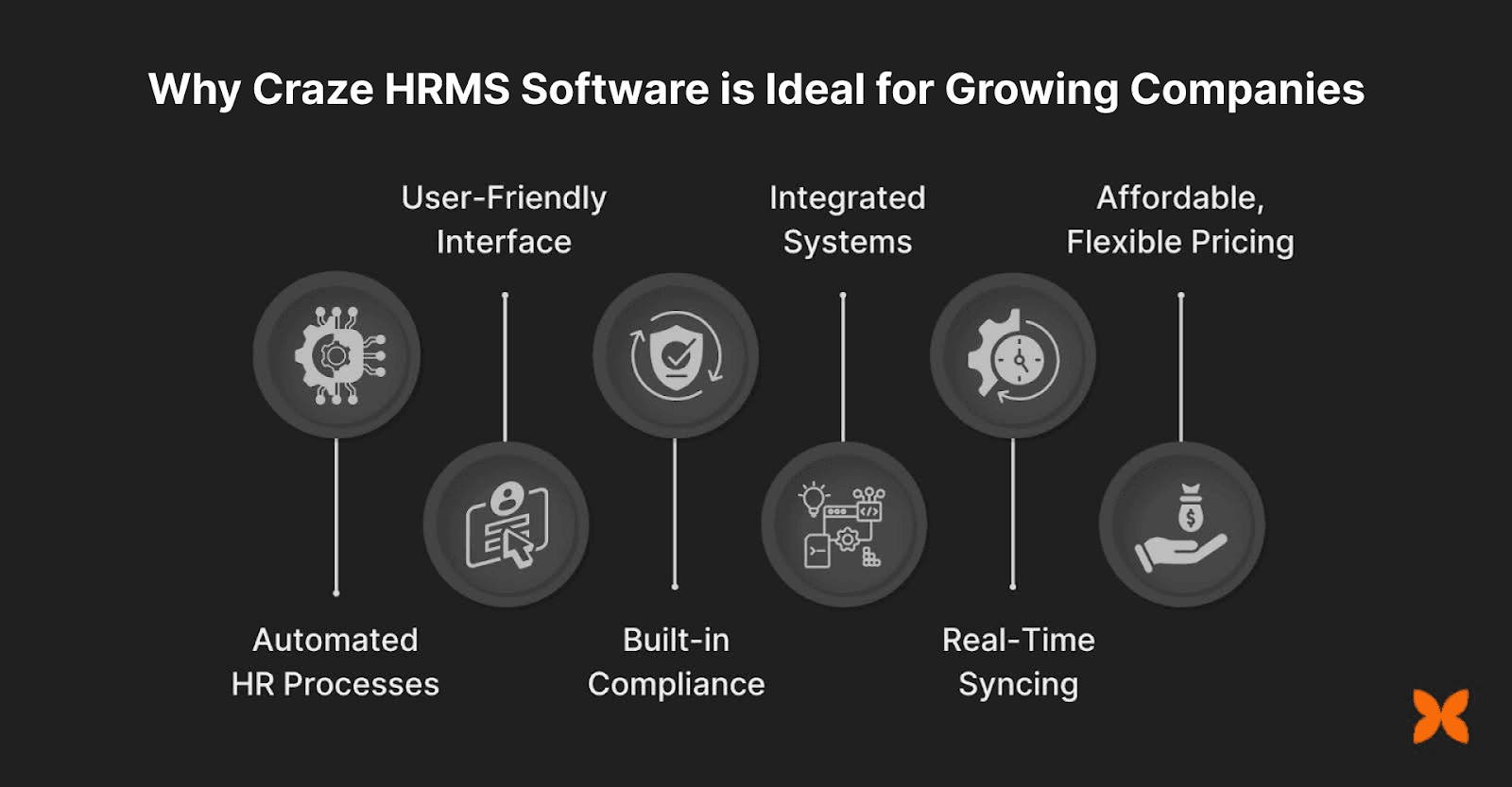
As your small business scales, managing HR processes can become overwhelming. Here’s how Craze HRMS solves these challenges:
Automated HR Processes: Say goodbye to repetitive tasks. From onboarding to offboarding, salary management to document storage, Craze HRMS automates the entire HR lifecycle, saving you time and reducing errors.
Simple, User-Friendly Interface: Craze HRMS is designed for easy use. Your team can manage payroll, attendance, and performance tracking without the need for lengthy training, making HR more efficient and stress-free.
Built-in Compliance: Compliance with HR, labour, wages, tax, and IT laws is automatic with Craze HRMS. You’ll never worry about missing tax deadlines or miscalculating payroll again.
Real-Time Syncing: With automatic real-time syncing between payroll, leaves, and attendance, Craze HRMS ensures accuracy and up-to-date information across all HR functions.
Affordable, Flexible Pricing: Craze HRMS offers transparent, pay-per-user pricing with no hidden fees & no feature restrictions, i.e., all features unlocked from day one.
Starting at just ₹60 per employee per month, it’s the ideal solution for growing businesses that need scalability without financial strain.
Conclusion
Organisations today recognise that efficient HR systems are critical to maintaining competitive advantage. By automating repetitive tasks and minimising human error, these platforms enable HR professionals to dedicate their expertise to high-impact activities like talent strategy and organisational development.
The scalability factor cannot be overstated. A robust HRMS seamlessly accommodates your company's growth trajectory, whether you are expanding your workforce, entering new markets, or diversifying your operations. From candidate tracking to compensation management, these solutions handle increasing complexity without missing a beat.
Implementing the right HRMS is an essential step toward optimising your workforce management and driving business success.
Start with Craze HRMS today and experience the power of streamlined HR management, compliance, and enhanced employee satisfaction.
FAQs
1. What is HRMS used for?
HRMS is used to automate and streamline HR tasks such as payroll, attendance, leave management, recruitment, performance tracking, and employee data management. It helps businesses centralise HR functions, improve efficiency, reduce manual errors, and ensure compliance with labour laws.
2. Can a human resource management system (HRMS) integrate with other business software?
Yes, most HRMS platforms like Craze offer integration with finance, IT, and accounting software. This ensures easy data flow between different business functions, helping you avoid duplicated data and streamline your operations across departments.
3. How does a human resource management system (HRMS) improve compliance for businesses?
A human resource management system automates the tracking and calculation of taxes, benefits, and statutory components such as PF and ESI, ensuring that businesses stay compliant with labour laws and tax regulations. The system helps reduce the risk of errors and ensures timely submissions.
4. Is it difficult to implement a human resource management system (HRMS) in a business that has been using spreadsheets and manual processes?
Switching to an HRMS can be straightforward with proper planning. Most systems offer data migration tools, making the transition smoother. Additionally, HRMS platforms often include support and training to help your team get up to speed quickly.
5. How does an HRMS benefit small businesses or startups specifically?
For small businesses, HRMS like Craze automates essential HR tasks like payroll, leave management, and attendance tracking, freeing up valuable time for your team. It helps reduce administrative overhead, improves accuracy, and scales with the business as it grows.
