


Ever spent hours sifting through leave management software, only to wonder if it truly fits your company’s needs? Choosing the right leave management system features can be confusing, especially with diverse leave policies, multi-state compliance rules, and managing different employee types.
A well-designed Leave Management System (LMS) takes the guesswork out by automating approvals, accurately tracking balances, and reducing HR workload. It also provides employees with clear visibility into their leave entitlements, minimising queries and ensuring fairness across the organisation.
In this blog, we break down 13 essential features of a leave management system that help Indian businesses identify the right solution while ensuring compliance, efficiency, and employee transparency.
A Leave Management System (LMS) is a digital tool that automates leave requests, approvals, accruals, and tracking, replacing manual forms and spreadsheets.
LMS ensures accurate leave balances and compliance with statutory rules, reducing errors and improving transparency for both HR and employees.
Core features include leave application and approval workflows, real-time balance tracking, configurable leave types, holiday calendars, notifications, self-service portals, and audit trails.
Advanced features like policy automation, India-specific compliance packs, payroll integration, multi-level approvals, and analytics dashboards help streamline operations at scale.
Select providers based on compliance capabilities, user-friendliness, integration options, reporting depth, support quality, and total cost of ownership.
A Leave Management System (LMS) is software that automates the entire leave process, from submitting and approving requests to tracking balances and syncing data with payroll systems. It reduces manual effort, prevents errors, and ensures compliance with labour laws, providing a structured workflow for HR teams and employees.
For Indian businesses, an LMS can handle multiple leave types, including Casual Leave (CL), Sick Leave (SL), Earned Leave (EL), and maternity/paternity leave, while accounting for regional holidays and state-specific regulations. Employees get real-time visibility into balances, and managers can efficiently approve or delegate requests, creating a transparent and consistent process.
An LMS streamlines leave processes and centralises records, helping HR teams reduce manual work and maintain accuracy. It also gives founders clear visibility into team availability, improving transparency and workflow efficiency. The following are the key benefits of LMS:
Time Savings: Automates leave requests, approvals, and accrual calculations, reducing repetitive administrative tasks for HR.
Compliance Assurance: Helps organisations stay aligned with Indian labour laws, statutory holidays, and multi-state regulations.
Accurate Payroll: Minimises errors in leave encashment, LOP calculation, and attendance-linked payroll adjustments.
Improved Visibility: Provides founders and managers with real-time insights into team availability and resource planning.
Employee Empowerment: Self-service access enables employees to track balances, submit requests, and view approvals without HR intervention.
By centralising leave management, an LMS creates a structured, reliable workflow that supports compliance, reduces errors, and enhances employee trust.
To ensure your organisation chooses the right solution, it’s essential to understand the key features a Leave Management System should offer. Let’s explore the must-have features next.
Read more: Comprehensive Guide on Leave Management
Before investing in any tool, it’s crucial to ensure the system supports India-specific leave types, regional holidays, and statutory recordkeeping.
Certain features are non-negotiable for statutory compliance, while others primarily enhance operational efficiency and user experience. To clarify this evaluation, we have grouped the features into essential requirements and value-enhancing capabilities.
Core (Must-Have) Capabilities
Most organisations assume the basics are covered, and that’s the risk. Gaps in statutory leave setup, payroll alignment, and audit-ready records often surface only after disputes or compliance issues arise. What’s taken for granted ends up costing the most.
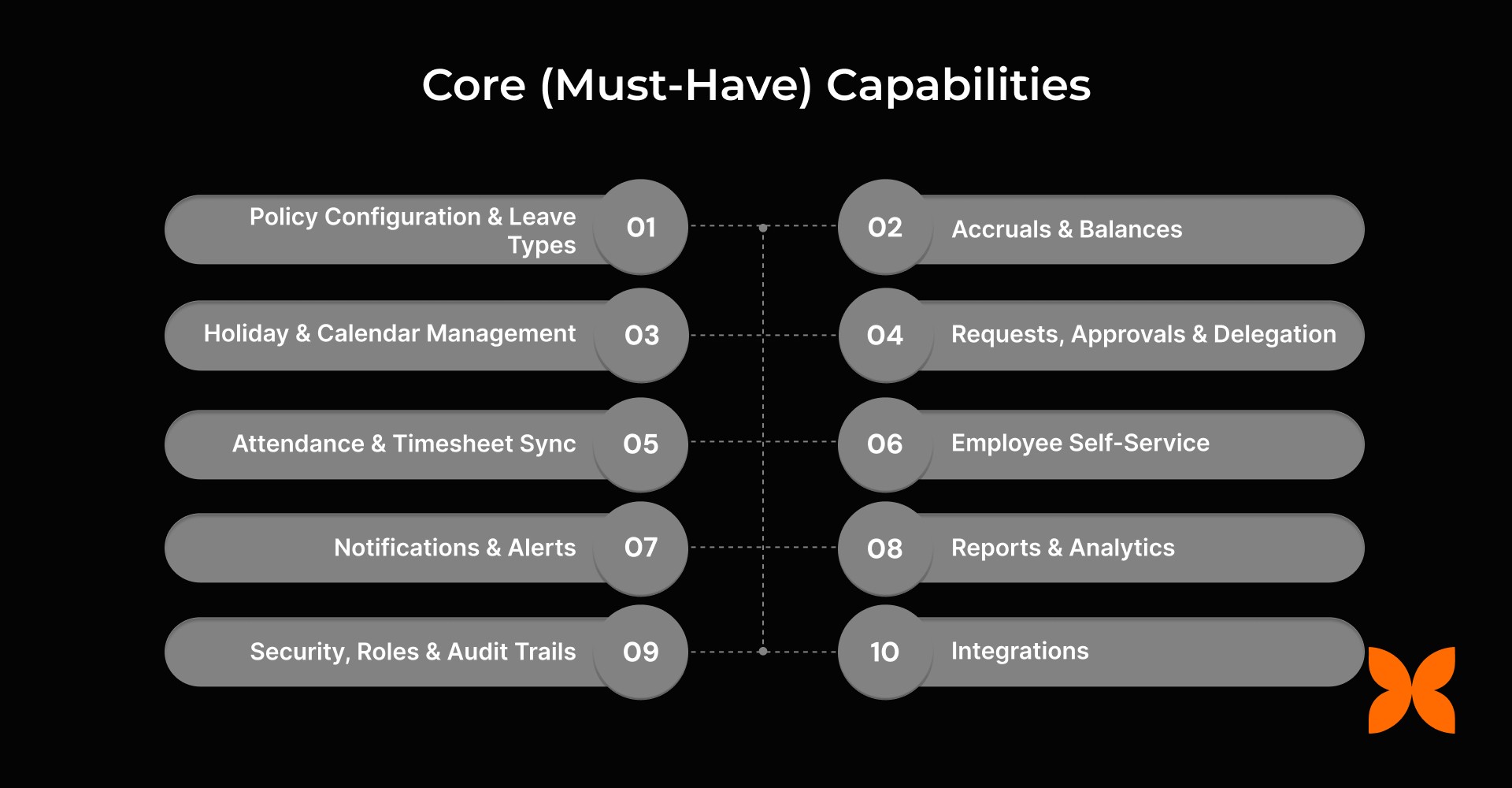
Below are the key must-have and advanced features that define a complete leave management solution.
Policy Configuration & Leave Types: A reliable LMS allows HR teams to configure leave types, rules, and policies in alignment with Indian labour regulations. It supports various employment types, hierarchies, and flexible policies such as carry-forward, encashment, and half-day logic.
Accruals & Balances: Accruals and balances must be accurate and transparent, reflecting real-time adjustments for joining, exit, or policy changes. Audit-ready logs and detailed reports ensure compliance and correct payroll alignment.
Holiday & Calendar Management: Leave systems must integrate with regional and company-wide holidays to prevent conflicts and ensure correct payroll processing. Employees and managers get clear visibility of holiday schedules while avoiding overlaps.
Requests, Approvals & Delegation: Leave approvals should follow organisational hierarchies while maintaining flexibility for delegation and automatic escalations. The system also detects conflicts for overlapping leaves or critical role shortages.
Attendance & Timesheet Sync: Seamless integration with attendance data ensures precise leave calculations and reduces payroll errors. Automatic LOP, comp-off, and overtime calculations ensure accurate, consistent records.
Employee Self-Service (ESS): ESS empowers employees to manage leave requests and balances, reducing HR dependency and increasing transparency. Real-time balance visibility and policy-specific alerts help employees stay informed.
Notifications & Alerts: Proactive notifications keep employees and managers informed and reduce administrative bottlenecks. Alerts include low balances, pending approvals, missing documents, or policy triggers.
Reports & Analytics: Advanced reporting helps HR, finance, and leadership monitor trends and maintain compliance. Dashboards track leave utilisation and absenteeism, and support manpower forecasting for better planning.
Security, Roles & Audit Trails: Role-based access and immutable logs protect sensitive data and ensure regulatory compliance. Full audit trails, encryption, and secure historical storage safeguard records from errors or tampering.
Integrations: A comprehensive LMS integrates with existing HR, payroll, and attendance systems to reduce manual work and maintain consistency. APIs and SSO support streamline workflows and enable seamless data flow.
Advanced Capabilities
Beyond the core functionalities, a modern Leave Management System can provide advanced capabilities that improve workforce planning, enhance field operations, and strengthen compliance with Indian labour laws. These features are particularly valuable for organisations with multi-location teams or complex staffing requirements.
Smart Forecasting & Capacity Planning: Advanced LMS platforms can predict workforce availability and help HR plan effectively during peak leave periods. Scenario-based planning and staffing gap alerts ensure business continuity and optimal resource allocation.
Mobile & Field Readiness: Mobile-friendly LMS tools enable leave approvals, tracking, and policy adherence for remote or field employees, even offline. Real-time dashboards and geo-aware policies help maintain compliance and streamline workflows.
Compliance Toolkit (India): Advanced LMS tools support adherence to Indian labour laws, reducing manual effort in statutory reporting. Automated audit trails, alerts for encashment deadlines, and payroll integration ensure accurate, compliant record-keeping.
Different business stages have varying HR challenges, team sizes, and compliance requirements. The Leave Management System features your company needs most will depend on whether you are a startup, a medium-sized business, or a large enterprise.
The table below highlights the must-have leave management system features for each stage:
LMS Feature | Startups | Medium-Sized Businesses | Enterprises |
Policy Configuration & Leave Types | Simple setup for CL, SL, EL, and custom leaves | Configurable policies by department/location, multi-level approvals | Advanced policy automation, India-specific compliance, carry-forward/encashment, audit-ready logs |
Employee Self-Service (ESS) | Web and mobile access for leave requests and balance tracking | ESS with approval delegation and manager dashboards | Full mobile ESS with geo-aware policies and offline capabilities |
Approvals & Delegation | Single-level approvals with manual escalation | Multi-level approvals with automatic escalation | Complex workflows with SLA-based alerts, delegation, and conflict detection |
Attendance & Timesheet Sync | Basic integration with manual reconciliation | Real-time sync with biometric, QR, or mobile attendance | Enterprise-wide integration with payroll, shifts, and project schedules |
Notifications & Alerts | Basic leave reminders and approval notifications | Team-level alerts for overlapping leaves, pending approvals | Advanced notifications for policy triggers, compliance deadlines, and staffing gaps |
Holiday & Calendar Management | Company-wide holiday visibility | Location-wise holiday calendars with attendance integration | Multi-location calendars with integration across departments and compliance rules |
Reports & Analytics | Simple leave balance reports | Department-wise trends, absenteeism tracking | Enterprise dashboards, forecasting, and audit-ready reporting |
Security & Roles | Basic HR access control | Role-based access for managers, HR, and finance | Enterprise-grade security, encryption, and immutable audit trails |
Integrations | Minimal or manual integration | Integration with HRIS, payroll, and ESS | Full system integrations with ERP, SSO, and mobile field access |
Advanced Compliance | Not critical at the early stage | Statutory compliance features for India | Comprehensive compliance toolkit for multi-location operations and audits |
Before investing in the LMS, Indian businesses must bridge the gap between features and real-world results by choosing the right LMS provider. Let’s look at what to consider when evaluating and selecting the best solution for your needs.
Read more: 10 Best Leave Management Software in India
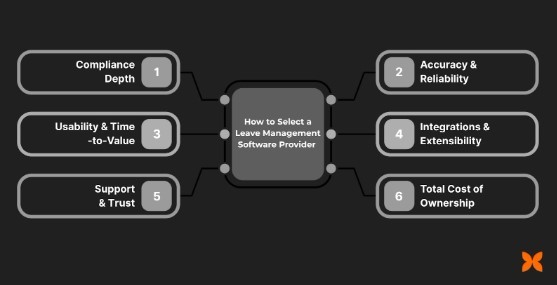
Selecting the right leave management software is key to maintaining transparency, reducing manual work, and ensuring compliance with India’s complex labour laws. A well-chosen solution should fit your company’s size, policies, and growth goals while integrating smoothly with your existing HR and payroll systems.
Here’s what to look for when evaluating providers:
Compliance Depth: Ensure the system supports flexible policies (sandwich rules, encashment, carry-forward) and provides statutory-ready exports, audit trails, and regular updates.
Accuracy & Reliability: Look for proven sync with attendance and payroll systems, safe rollback options, delegated approvals, and built-in conflict detection.
Usability & Time-to-Value: The platform should be quick to set up with templates, offer intuitive interfaces for employees and managers, and maintain full mobile functionality.
Integrations & Extensibility: Prioritise tools that connect seamlessly with attendance, payroll, and core HR software, and support APIs, webhooks, and single sign-on (SSO).
Support & Trust: Check for reliable onboarding support, SLAs, strong documentation, and robust data security (including encryption and backups).
Total Cost of Ownership: Evaluate transparent pricing structures (users, features, add-ons) and balance implementation effort with the long-term time savings gained from automation.
Choosing the right leave management provider comes down to reliability, compliance readiness, and how well the system adapts to your organisation’s needs. A solution that integrates seamlessly, scales easily, and reduces manual effort will deliver long-term value for both HR and employees.
Managing leaves can be stressful when approvals pile up, policies are unclear, or manual errors affect payroll. Craze simplifies this by offering clear visibility, automated policy rules, and seamless integrations, unifying leave, attendance, and payroll to ensure compliance, reduce manual work, and provide employees with a smooth, reliable experience.
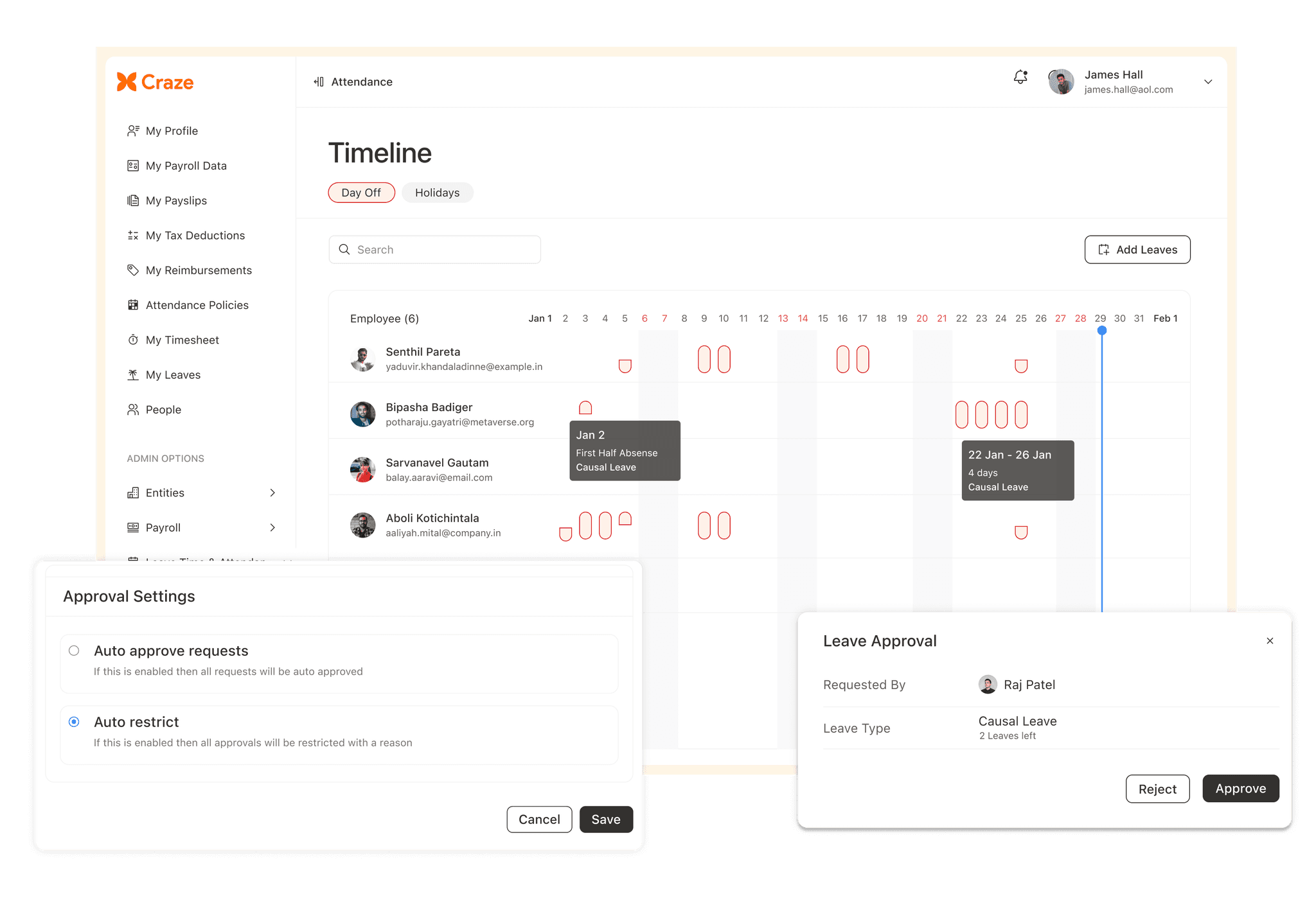
Automated Leave Workflows: Auto-calculate leave balances, accruals, carry-forward, and encashment without manual effort.
Policy-Rich Engine: Includes India-ready leave types, accrual rules, carry-forward/lapse/encashment settings, sandwich rule toggle, comp-off automation, and multi-location calendars.
Seamless Sync: Real-time integration with Attendance (exceptions, OT) and Payroll (balances, encashment), along with automated manager delegation and SLA-based alerts.
Control & Compliance: Features audit trails, export-ready reports, anomaly detection, and role-based access. Deploy quickly using built-in templates and mobile employee self-service (ESS).
Scalable Ecosystem: Extend easily into Performance/OKRs, IT Assets, IAM, and Scheduling as your organisation grows.
Ready to see it in action? Schedule a free call with Craze today and explore how a modern leave management workflow can help your HR team work smarter and more confidently.
1. How does a Leave Management System help reduce unplanned absenteeism?
A modern LMS gives managers real-time visibility into team availability, making it easier to identify patterns of frequent or last-minute leave. Automated alerts, balance visibility, and approval workflows discourage misuse and encourage responsible planning. Over time, this improves discipline and reduces operational disruptions.
2. What happens if internet connectivity is unreliable for field or remote teams?
Many LMS platforms offer offline capabilities or mobile apps that store requests locally until the connection resumes. This ensures field staff can still apply for leave and managers can review pending approvals later. It keeps workflows moving even in low-connectivity environments.
3. Is it possible to automate comp-off management through an LMS?
Yes. Comp-offs can be fully automated by syncing the LMS with attendance or timesheet data. When employees work extra hours or on weekends, the system automatically identifies eligible time and credits comp-off balances. This prevents errors and ensures timely, fair compensation.
4. How secure is employee leave data in a cloud-based LMS?
Cloud-based systems use encryption, role-based access controls, and secure authentication methods, such as SSO, to protect sensitive data. Regular backups and audit logs reduce risk and ensure accountability. Reputed providers also undergo security audits to maintain compliance with industry standards.
5. Can an LMS help during audits or legal inspections?
Absolutely. An LMS stores leave records, policy changes, approvals, accruals, and payouts in a structured, exportable format. During audits, HR can generate reports or statutory documents instantly. This reduces significant manual work and ensures full compliance with Indian labour norms.
