
Internship Offer Letter Format: Key Elements and 5 Free Templates


Drafting an internship offer letter is a critical part of welcoming interns to your organisation. While internship programs are temporary, a formal letter clearly communicates expectations, prevents misunderstandings, and ensures legal and organisational compliance.
Even a minor oversight, such as unclear start dates, stipend details, or reporting lines, can create confusion for both interns and HR teams. Managing multiple interns across departments without a structured template can result in delays, inconsistent communication, or disputes over terms.
This blog will guide you through drafting internship offer letters efficiently, highlighting key elements, best practices, and ready-to-use templates customised for Indian companies.
Key Takeaways
An internship offer letter formally confirms the candidate's selection, the internship duration, the stipend, and the role's responsibilities.
Standardised offer letters help organisations reduce ambiguity, maintain fairness, and professionally document HR and legal compliance.
Each letter should include start and end dates, reporting manager, stipend or benefits, and key responsibilities or deliverables.
Structured, ready-to-use templates ensure clarity, consistency, and efficiency across departments and intern programs.
Well-drafted letters set clear expectations, foster positive engagement, and support a smooth onboarding experience for interns.
What is an Internship Offer Letter?
An internship offer letter is a formal document issued by an employer to a candidate confirming their selection for an internship program. It details key terms, including duration, stipend, reporting structure, and responsibilities.
This letter serves as an official record for both the intern and employer, ensuring clarity about the internship terms. It is used to initiate the onboarding process and formalise agreements, particularly for legal and compliance purposes.
What is the Purpose of an Internship Offer Letter?
Internship offer letters go beyond routine HR communication. They provide clarity, set expectations, and ensure fairness and compliance in the internship process. Here are the key reasons why internship offer letters matter:
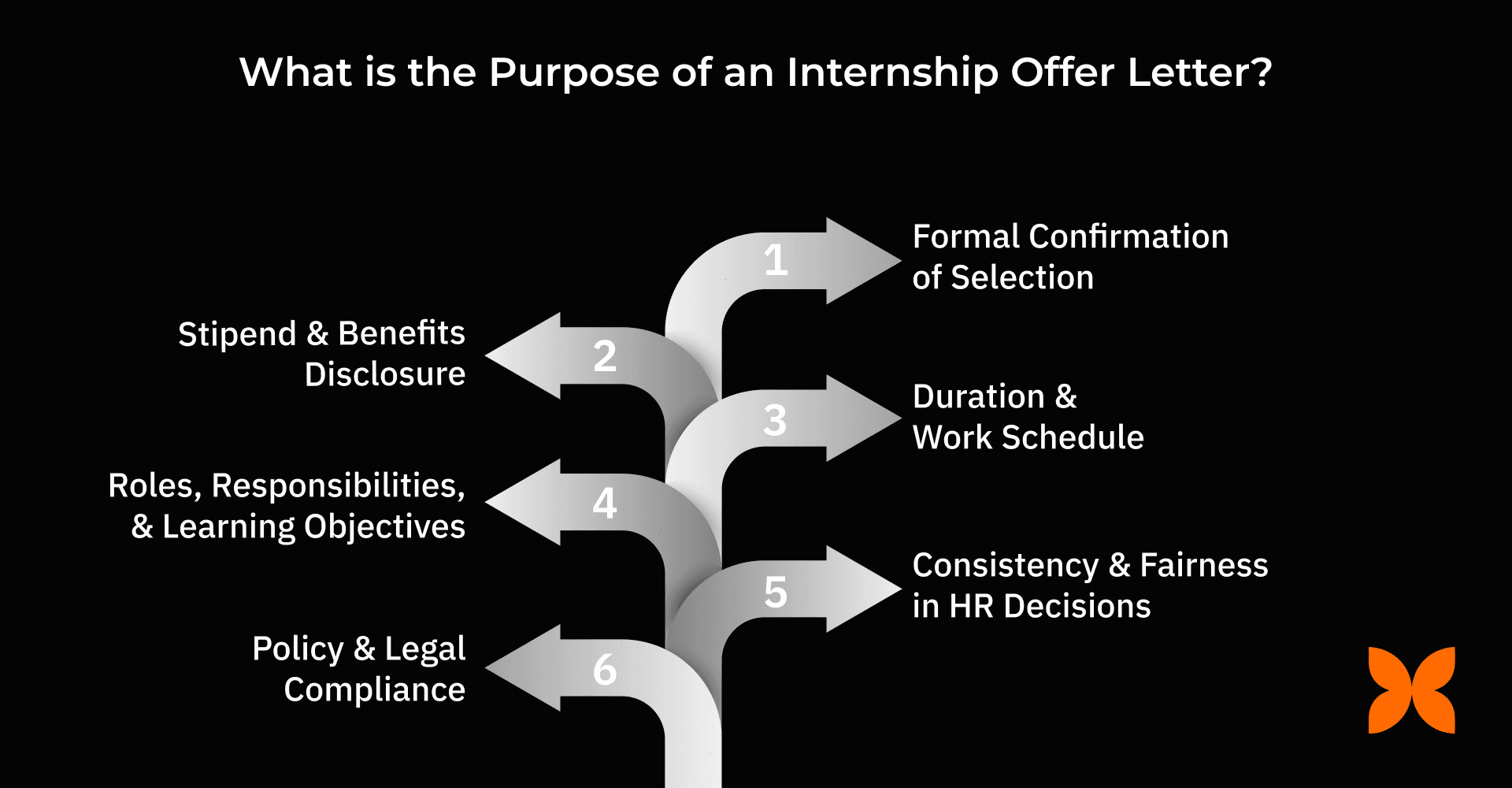
Formal Confirmation of Selection: Officially communicates the candidate’s acceptance into the internship programme and their role.
Stipend and Benefits Disclosure: Clearly outlines remuneration, reimbursements, or other incentives associated with the internship.
Duration and Work Schedule: Defines start and end dates, working hours, and probationary periods (if applicable), ensuring transparency.
Roles, Responsibilities, and Learning Objectives: Details assigned tasks, projects, and expected deliverables to align intern contributions with organisational goals.
Consistency and Fairness in HR Decisions: Standardises internship offers across candidates, reducing ambiguity and supporting equitable treatment.
Policy and Legal Compliance: Ensures adherence to company policies, confidentiality, and applicable Indian labour regulations for interns.
Now that we understand why internship offer letters are essential, let’s look at the key elements that every effective internship offer letter should contain.
Key Elements of an Effective Internship Offer Letter Format
To ensure clarity, transparency, and professional integrity, an internship offer letter must follow a clearly defined structure. The following six components establish the standard framework for a well-drafted and legally compliant internship offer document.
1. Candidate and Reference Details
Include the full name of the intern, any reference or application number, and the department or programme they have applied for. This establishes context and ensures the letter is correctly attributed.
Tip: Verify the candidate’s full name, application ID, and contact details to avoid administrative or legal errors.
2. Internship Purpose and Role
Clearly mention the purpose of the internship, the role or designation, and the department in which the intern will work. This sets clear expectations for both the candidate and the organisation.
Tip: Provide a concise description of the role to avoid ambiguity or misinterpretation.
3. Internship Duration and Dates
Specify the start and end date of the internship, including working hours or schedule, if applicable. Clearly state any probation or evaluation period if part of the programme.
Tip: Accurate dates ensure proper record-keeping, onboarding, and compliance with organisational policies.
4. Stipend, Benefits, and Entitlements
Mention the stipend or remuneration, if any, along with other benefits such as travel allowances, certificates, or access to company facilities. Include any conditions attached to these benefits.
Tip: Clearly outline financial and non-financial benefits to avoid confusion or disputes.
5. Terms and Conditions
Include essential terms such as reporting structure, confidentiality obligations, code of conduct, attendance expectations, and termination clauses if applicable.
Tip: Clear terms protect both the organisation and the intern and ensure mutual understanding of obligations.
6. Authorisation and Validation
Ensure the letter is signed by an authorised HR representative or departmental head, including their designation and date of issue. This validates the internship offer as an official organisational record.
Tip: Confirm the signatory has the authority to issue the offer under company policy before sending.
Next, let’s walk through a step-by-step guide to drafting an effective internship offer letter.
How to Draft an Internship Offer Letter: 6 Key Steps to Follow
Drafting an internship offer letter requires structure, clarity, and a professional tone. When done well, it communicates selection outcomes, sets clear expectations, and reinforces a positive onboarding experience for interns. Follow these practical steps to draft an effective internship offer letter:
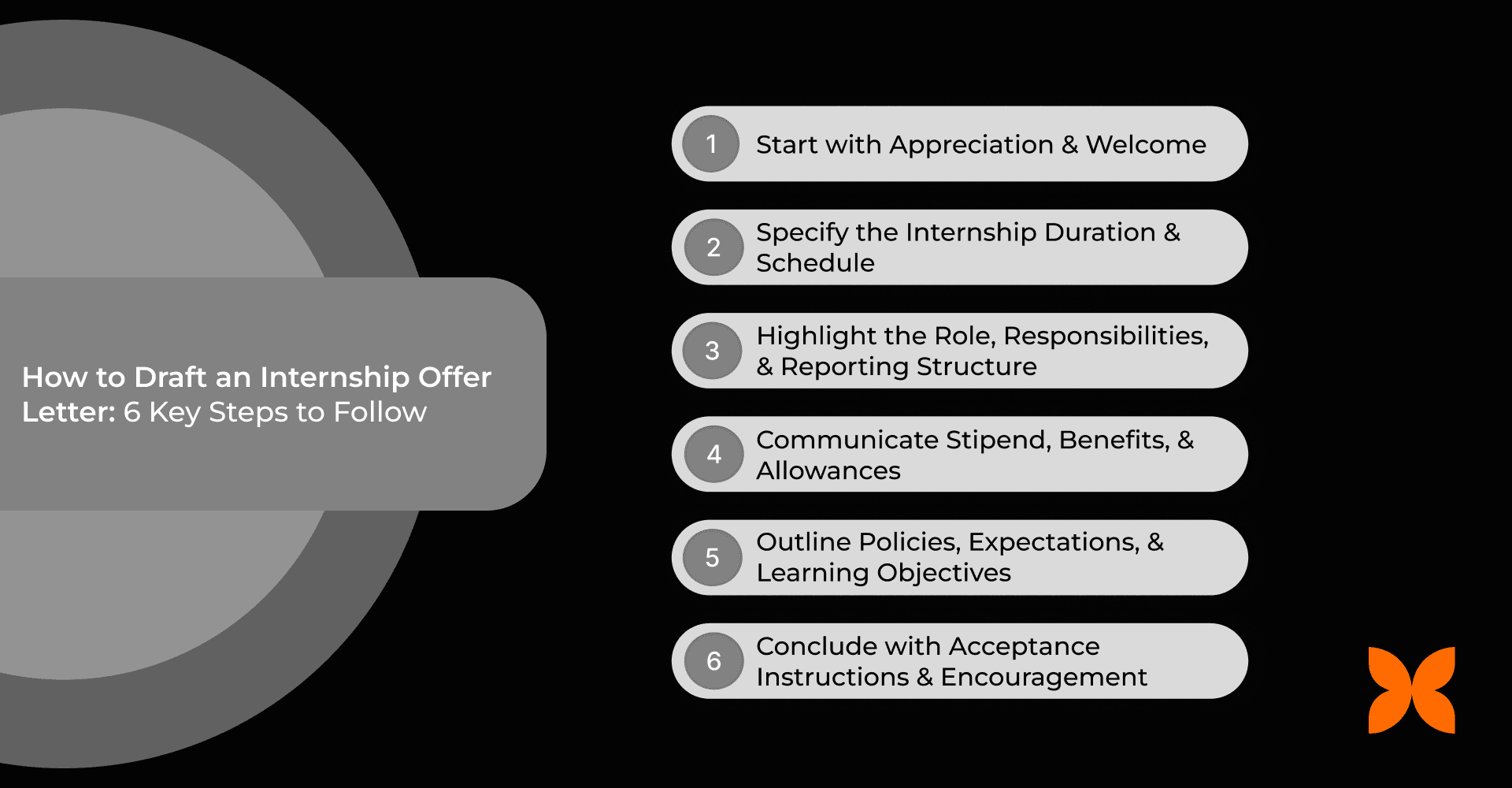
1. Start with Appreciation and Welcome
Begin the letter by congratulating the intern and expressing excitement about their joining. This establishes a positive and respectful tone.
Example: “We are delighted to offer you an internship with [Company Name] and welcome you to our team.”
2. Specify the Internship Duration and Schedule
Clearly mention the start and end dates, daily/weekly work hours, and any probationary period if applicable. This provides context and ensures alignment with HR records.
Example: “Your internship will begin on 1 February 2026 and conclude on 31 July 2026, with working hours from 9:30 AM to 5:30 PM.”
3. Highlight the Role, Responsibilities, and Reporting Structure
Summarise key tasks, learning objectives, and the reporting manager or mentor assigned to guide the intern. This ensures clarity on expectations.
Example: “You will report to [Manager Name] in the Marketing department and work on social media campaigns and content creation.”
4. Communicate Stipend, Benefits, and Allowances
Detail the stipend, payment frequency, and any additional benefits or reimbursements. Include the effective date to avoid confusion.
Example: “You will receive a monthly stipend of ₹15,000, payable on the last working day of each month.”
5. Outline Policies, Expectations, and Learning Objectives
Include confidentiality requirements, attendance expectations, and performance evaluation criteria. Highlight any training or mentorship planned.
Example: “You are expected to adhere to company policies, maintain confidentiality, and submit weekly progress reports.”
6. Conclude with Acceptance Instructions and Encouragement
End the letter on a welcoming note and provide clear instructions for accepting the offer, such as signing and returning the letter.
Example: “Please sign and return a copy of this letter to confirm your acceptance. We look forward to your contributions and learning during your internship.”
Also Read: Increment Letter Format: Key Elements & 10 Free Templates
With these steps clearly outlined, you can now move on to practical internship offer letter templates that HR teams can adapt for different roles, programs, or internship types.
Internship Offer Letter Templates
Using standardised templates saves time while maintaining a professional and consistent approach across your organisation. These five samples cover the most common internship scenarios, helping HR teams issue letters quickly, accurately, and in compliance with the law.
1. Standard Internship Offer - Template
Use this letter for general internship offers, clearly communicating role, duration, and stipend.
Date: [Date]
Subject: Internship Offer
Dear [Intern Name],
We are pleased to offer you an internship with [Company Name] in the [Department] for the period [Start Date – End Date]. This letter outlines your role, responsibilities, and compensation to ensure a smooth onboarding process.
Your reporting manager will be [Manager Name], who will guide you throughout the internship. You will receive a stipend of [Amount] per month, effective from [Date]. Your responsibilities will include [Key Responsibilities].
Please sign and return this letter to confirm your acceptance and join us for a valuable learning experience.
Sincerely,
[Name]
[Position], [Company Name]
2. Paid Internship Offer - Template
Use this template when offering a paid internship, highlighting stipend and role expectations.
Date: [Date]
Subject: Paid Internship Offer
Dear [Intern Name],
Congratulations! You have been selected for a paid internship in the [Department] at [Company Name]. This letter confirms your selection and provides details about your role, responsibilities, and stipend.
Your internship will run from [Start Date] to [End Date], with a monthly stipend of [Amount]. You will report to [Manager Name] and work on [Projects/Tasks], contributing to meaningful deliverables.
We look forward to your learning, growth, and valuable contributions during the internship period.
Sincerely,
[Name]
[Position], [Company Name]
3. Remote Internship Offer - Template
Ideal for interns working remotely, clarifying reporting, communication, and stipend details.
Date: [Date]
Subject: Remote Internship Offer
Dear [Intern Name],
We are pleased to offer you a remote internship with [Company Name], beginning [Start Date] and concluding [End Date]. This letter details your responsibilities, reporting structure, and stipend for remote work.
You will report to [Manager Name] and collaborate virtually on [Tasks/Projects]. You will receive a monthly stipend of [Amount], payable electronically, ensuring timely and transparent compensation.
Please confirm your acceptance by signing and returning this letter to begin your remote internship.
Sincerely,
[Name]
[Position], [Company Name]
4. Short-term / Project-based Internship - Template
Suitable for project-specific or short-term internships, highlighting deliverables and mentorship.
Date: [Date]
Subject: Project-Based Internship Offer
Dear [Intern Name],
We are offering you a short-term internship for [Project Name] in the [Department] from [Start Date] to [End Date]. This letter clarifies your tasks, expected deliverables, and stipend details.
Your mentor will be [Mentor Name], who will guide you on project objectives and deliverables. You will receive a stipend of [Amount], contingent upon completing assigned tasks effectively.
Kindly confirm your acceptance by signing and returning this letter to begin your project-based internship.
Sincerely,
[Name]
[Position], [Company Name]
5. Internship with Certificate / Learning Focus - Template
Best for internships with a learning-oriented focus, where certificates or formal recognition are awarded upon completion.
Date: [Date]
Subject: Internship Offer & Certificate
Dear [Intern Name],
We are pleased to offer you an internship at [Company Name] from [Start Date] to [End Date]. This letter outlines your responsibilities, stipend, and the certificate you will receive upon successful completion.
You will report to [Manager Name] and work on [Tasks/Projects]. Your stipend will be [Amount] per month, and your contributions will be formally acknowledged with a certificate upon completion of your internship.
Please sign and return this letter to confirm your acceptance and begin your learning journey with us.
Sincerely,
[Name]
[Position], [Company Name]
Next, let’s take a closer look at best practices for drafting an Internship Offer Letter to ensure clarity, professionalism, and a seamless onboarding experience for candidates.
Best Practices for Writing an Internship Offer Letter
Even minor oversights in an internship offer letter, such as unclear start dates, missing stipend details, or incomplete terms, can create confusion and delays in onboarding. Following these best practices ensures clarity, professionalism, and legal compliance:
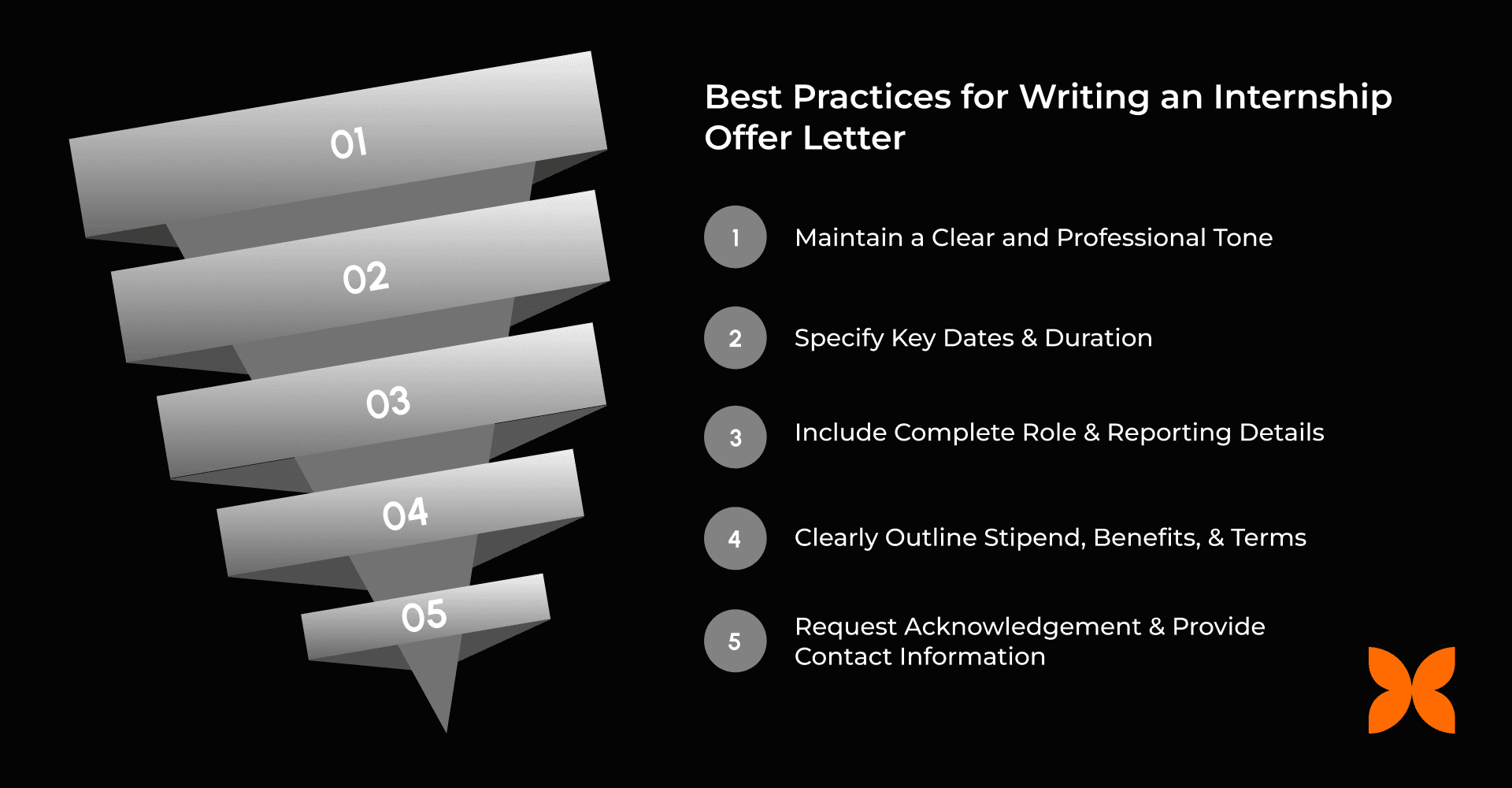
Maintain a Clear and Professional Tone: Use polite, formal, and factual language. Avoid casual phrasing or assumptions about prior understanding, even if the candidate has been selected internally.
Specify Key Dates and Duration: Clearly state the start and end dates, and the internship's working hours or schedule. This helps candidates plan and supports accurate HR and payroll records.
Include Complete Role and Reporting Details: Provide a clear description of the role, department, supervisor, and key responsibilities. This sets expectations and prevents misunderstandings about duties or reporting lines.
Clearly Outline Stipend, Benefits, and Terms: Include stipend or financial support details, allowances, training access, or any other entitlements. Specify any conditions tied to benefits, attendance, or performance.
Request Acknowledgement and Provide Contact Information: Ask the candidate to acknowledge receipt of the offer and provide a contact point for queries. This ensures formal acceptance and a smooth onboarding process.

Final Thoughts
Inconsistent or informal internship confirmations can create confusion around start dates, stipend terms, reporting structures, and learning expectations. Many organisations still rely on emails or verbal communication, which often leads to onboarding delays, documentation gaps, and avoidable disputes.
Structured internship offer letters provide clarity, maintain fairness, and serve as official records for internship engagements. They help organisations standardise hiring practices and ensure compliance with internal policies and applicable labour regulations. Platforms like Craze help centralise internship documentation workflows, making it easier to manage offer letters alongside other onboarding and HR records.

FAQs
1. Do I need to issue an internship offer letter for all interns?
Yes. Every intern should receive a formal offer letter confirming their selection, internship duration, stipend, role, and applicable terms. This ensures clarity, consistency, and proper documentation.
2. Can internship offer letters be emailed?
Yes. Internship offer letters can be issued via email. However, it is recommended to obtain a written acknowledgement from the intern and retain a signed copy for HR records.
3. What is the difference between an internship offer letter and an appointment letter?
An internship offer letter confirms selection for a temporary learning engagement with a defined duration and stipend. An appointment letter is issued for permanent or contractual employment roles.
4. Can an internship offer letter be customised for part-time or remote interns?
Yes. Internship offer letters should clearly specify work hours, remote or hybrid arrangements, reporting structure, and communication expectations while maintaining a standard format.
5. Should internship letters include confidentiality and policy clauses?
Yes. Including confidentiality, conduct, and policy compliance clauses protects the organisation and sets clear professional expectations for interns.
