
Resignation Acceptance Letter: Key Elements and 10+ Free Samples


When an employee decides to move on, how you handle their resignation can speak volumes about your company’s professionalism.
In India, a structured resignation acceptance process not only ensures compliance and protects your organisation but also strengthens your employer brand. Many companies still rely on informal emails or verbal confirmations, which can create gaps in HR records and even lead to disputes.
In this blog, you’ll learn what a resignation acceptance letter is, why it matters, the key elements it should contain, and ready-to-use sample templates customised for Indian organisations.
Key Takeaways
A resignation acceptance letter formally acknowledges an employee’s resignation and confirms the necessary exit formalities.
Standardised letters support HR compliance, reduce ambiguity, and uphold professionalism.
Each letter should include employee details, notice period, last working day, handover instructions, and exit clearance steps.
Using structured, ready-to-use templates ensures consistency across departments and roles.
Well-drafted letters maintain transparency, reinforce organisational policies, and preserve goodwill with departing employees.
What is a Resignation Acceptance Letter?
A resignation acceptance letter is a formal document issued by an employer to acknowledge and accept an employee’s resignation. It records the employer’s confirmation of the resignation and formally closes the employment relationship from an administrative and HR standpoint.
This letter is issued to full-time, contractual, and probationary employees and becomes part of the employee’s official HR file. It documents agreed exit terms, such as acceptance of resignation and the last working day, ensuring the resignation is formally recognised in organisational records.
Why is a Resignation Acceptance Letter Important?
A resignation acceptance letter is critical for managing employee exits in a structured, compliant, and professional manner. It protects organisational interests while ensuring clarity and consistency throughout the offboarding process. Key reasons include:
Provides Formal Confirmation of Exit: Removes ambiguity by officially confirming acceptance of resignation and the last working day.
Ensures Policy and Contractual Compliance: Aligns the exit process with employment contracts, notice clauses, and internal HR policies.
Creates a Legally Defensible Record: Serves as documented proof of resignation acceptance in case of future disputes or audits.
Facilitates a Controlled Transition: Enables structured handover, asset recovery, and completion of exit formalities without disruption.
Clarifies Settlement and Benefits: Sets clear expectations for final salary, leave encashment, reimbursements, and settlement timelines.
Protects Employer Branding: Maintains professionalism and goodwill, supporting positive alumni relationships and long-term reputation.
Also Read: Relieving Letter Format: Elements & 7 Free Templates
To ensure a compliant, well-documented employee exit, it is essential to understand the key components of an effective resignation acceptance letter.
Key Elements of an Effective Resignation Acceptance Letter
Accepting a resignation is the final step in an employee’s journey with you, and the letter needs to be both professional and legally sound. These core components provide a roadmap for the document, ensuring you include everything from the confirmed last working day to the next steps for the handover process.
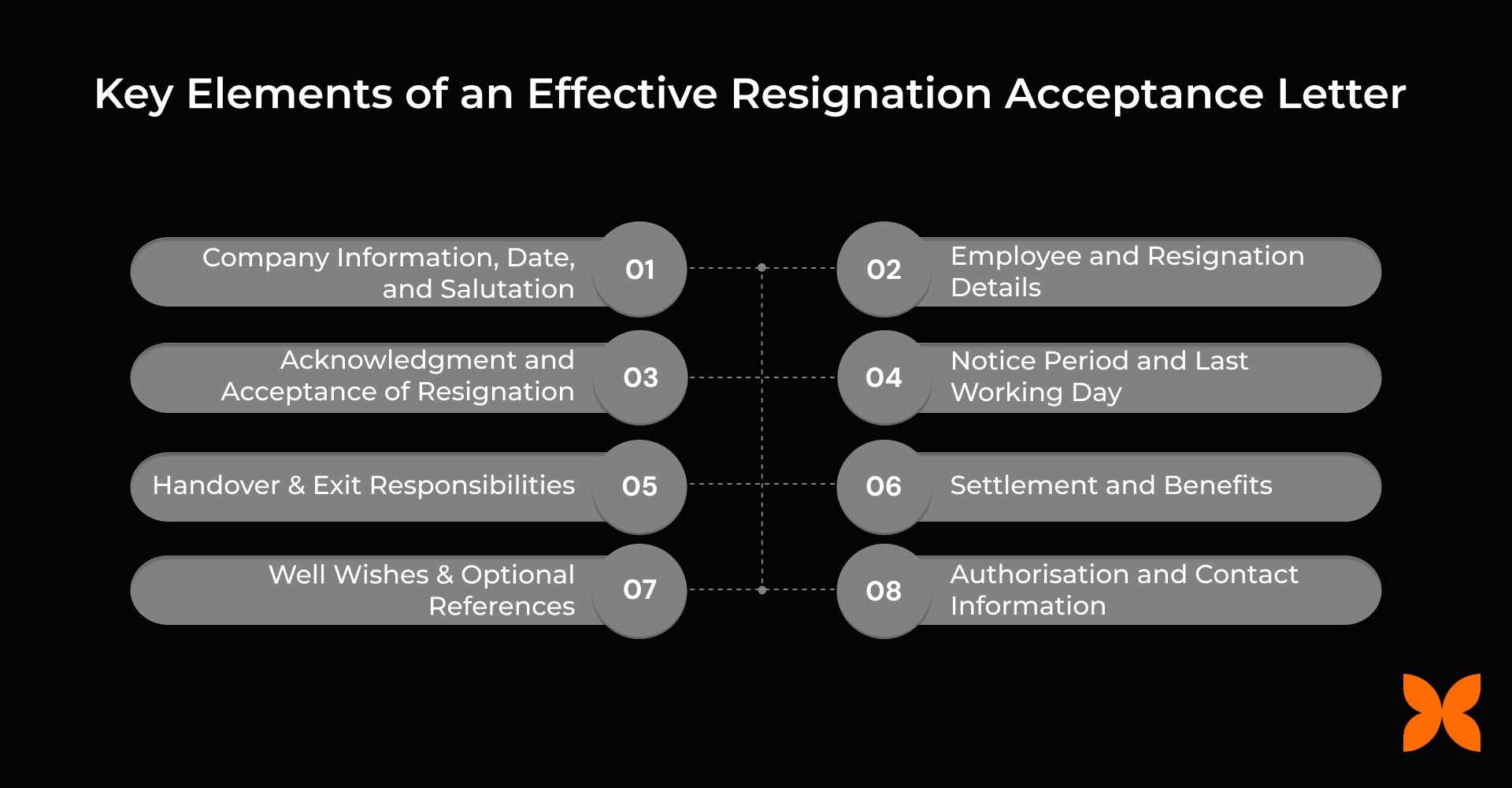
1. Company Information, Date, and Salutation
Use the official company letterhead and clearly mention the date of issue. Begin with a professional salutation such as “Dear [Employee Name].”
Tip: Use official letterhead and the employee’s registered name to ensure formal recognition and clean HR records.
2. Employee and Resignation Details
Include the employee’s full name, designation, department, employee ID, and the date the resignation was submitted. This confirms the affected employment record and contractual terms.
Tip: Cross-check the notice period clause in the employment agreement to avoid disputes.
3. Acknowledgement and Acceptance of Resignation
Formally acknowledge receipt of the resignation and confirm its acceptance. Briefly recognise the employee’s contributions to specific teams, projects, or responsibilities.
Tip: Reference concrete roles or deliverables rather than generic appreciation statements.
4. Notice Period and Last Working Day
Clearly confirm the applicable notice period and specify the employee’s last working day in line with company policy.
Tip: Call out any deviation, such as early release or extended notice, to maintain payroll and compliance alignment.
5. Handover and Exit Responsibilities
Outline expectations for task handover, knowledge transfer, and return of company assets such as laptops, access cards, or confidential information.
Tip: Assign a clear handover contact and reference a transition plan if applicable.
6. Settlement and Benefits
Detail the final salary, leave encashment, reimbursements, incentives, and any applicable deductions. Include an expected timeline for final settlement.
Tip: Mention the final payout date or payroll cycle to set clear expectations.
7. Well Wishes and Optional References
Close the letter with a professional expression of goodwill and, where appropriate, an offer to provide a reference.
Tip: This reinforces employer branding and supports positive alumni relationships.
8. Authorisation and Contact Information
Ensure the letter is signed by an authorised HR representative or department head, including designation and date. Provide a contact for exit or settlement-related queries.
Tip: Proper authorisation makes the letter legally defensible and audit-ready.
With the key components clearly defined, the next step is to understand how to put them together into a clear, professional resignation acceptance letter.
How to Write a Resignation Acceptance Letter: 4 Key Steps
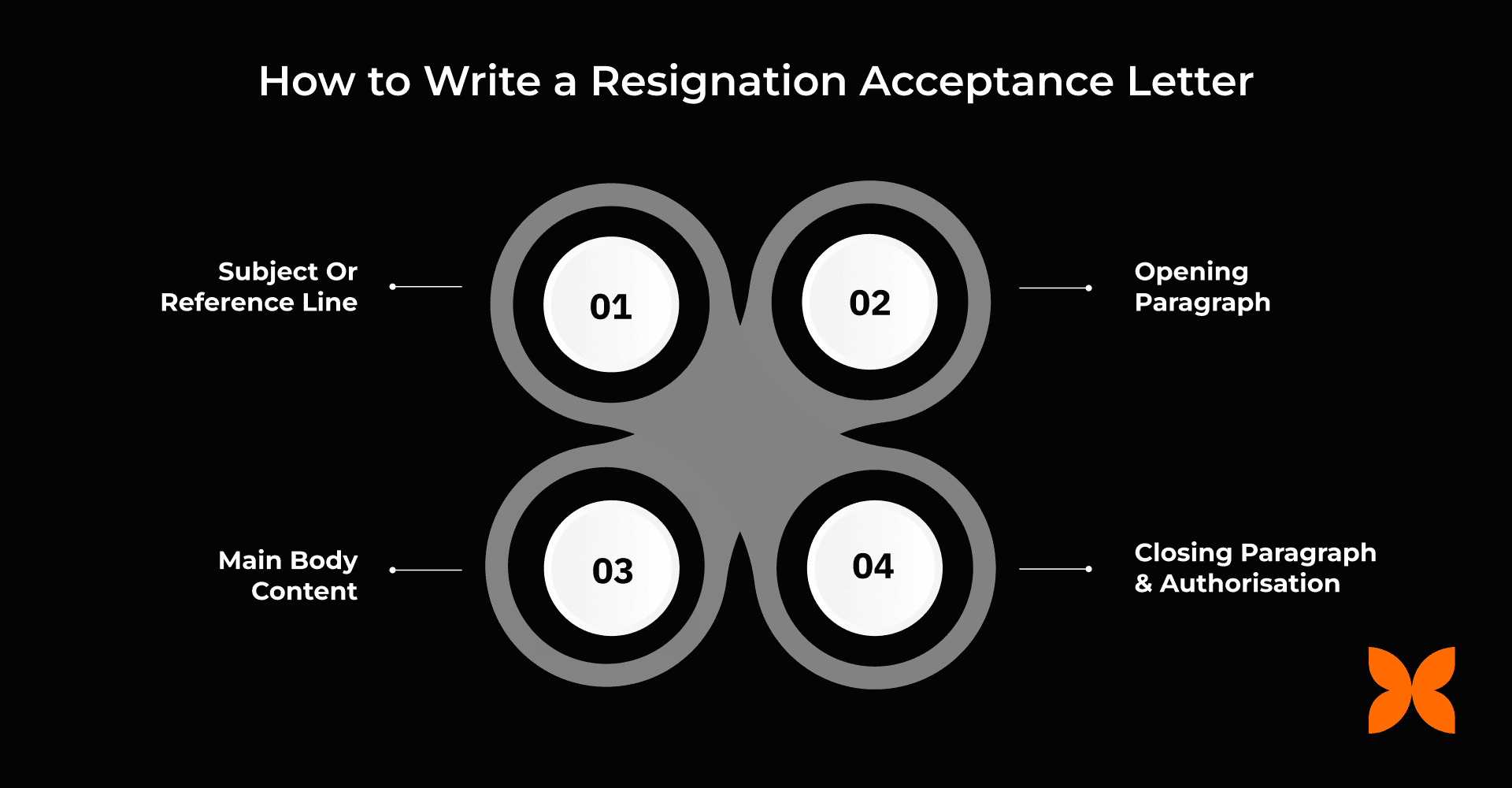
Drafting this letter is about more than just saying "goodbye"; it is your chance to formally set the terms for a smooth exit. These steps help you choose the right tone and guide you in clearly stating the final date and handover requirements so there is no confusion during the notice period.
Step 1. Subject or Reference Line
Include a clear subject or reference line that states the purpose of the letter and identifies the employee. This helps with internal filing and future reference.
Examples:
Subject: Acceptance of Resignation - [Employee Name]
Reference: Resignation Acceptance Letter
Step 2. Opening Paragraph
Begin the letter by formally acknowledging receipt of the employee’s resignation and confirming its acceptance. This establishes clarity from the outset.
Examples:
“This letter confirms receipt and acceptance of your resignation dated [date].”
“We hereby accept your resignation from the position of [Job Title], submitted on [date].”
Step 3. Main Body Content
The body of the letter should concisely and professionally cover all essential employment exit details.
A brief note recognising the employee’s contribution to the organisation.
Confirmation of the notice period and the final working day.
Any instructions related to the handover of responsibilities or the return of company property.
A reference to final settlement, benefits, or exit formalities, where applicable.
Each point should be addressed clearly to avoid misinterpretation.
Step 4. Closing Paragraph and Authorisation
Conclude the letter with a courteous, professional closing that shows appreciation and preserves goodwill. A respectful sign-off reinforces a positive employer image and supports long-term professional relationships.
Examples:
“We appreciate your contributions and wish you success in your future endeavours.”
“We thank you for your service and wish you all the best in your next professional chapter.”
The letter should then be formally signed by an authorised representative, typically an HR manager or senior leader, with their designation and the date included. This confirms the letter’s authenticity, authority, and official standing within organisational records.
Also Read: Understanding Employee Exit Formalities: A Simple Checklist Guide
Having covered the essentials, let us now look at resignation acceptance letter templates that translate these guidelines into clear, usable documents.
Resignation Acceptance Letter Templates
Using standardised templates ensures clarity, professionalism, and consistency when acknowledging employee resignations. These ready-to-use resignation acceptance letter templates cover common scenarios, helping you issue them quickly and accurately.
1. General Resignation Acceptance Letter Template
This template is suitable for standard resignation scenarios where no specific reason is provided. It is neutral and professional, and it expresses appreciation for the employee’s tenure.
[Date]
Subject: Acceptance of Resignation - [Employee Name]
Dear [Employee Name],
We have received your resignation and formally acknowledge your decision to leave [Company Name]. Your last working day will be [Last Working Day].
We sincerely appreciate your contributions during your time with us. It has been a pleasure working with you, and we wish you success in all your future endeavours.
Please ensure all handover procedures are completed before your departure.
Sincerely,
[Your Name]
[Your Designation]
[Company Name]
2. Resignation Due to Personal Reasons - Acceptance Letter Template
Use this template when personal or family obligations prompt the resignation. It conveys understanding while maintaining professionalism.
[Date]
Subject: Resignation Acknowledgement - [Employee Name]
Dear [Employee Name],
We have received your resignation letter dated [Resignation Date], citing personal reasons. This letter formally accepts your decision, with your last working day being [Last Working Day].
Although we are sorry to see you leave, we respect your choice and thank you for your contributions during your tenure at [Company Name]. We hope this next chapter provides you with the balance and focus you are seeking.
Please complete all necessary handover procedures in accordance with HR guidelines.
Best regards,
[Your Name]
[Your Designation]
[Company Name]
3. Resignation for Career Growth/Better Opportunity - Acceptance Letter Template
This format is ideal when an employee leaves for a better opportunity or to advance their career. It acknowledges their aspirations and shows support.
[Date]
Subject: Acceptance of Resignation - [Employee Name]
Dear [Employee Name],
We acknowledge receipt of your resignation dated [Resignation Date], with your final working day as [Last Working Day]. We understand your decision to pursue a new opportunity and fully support your career progression.
Thank you for your valuable contributions to [Company Name]. Your efforts have positively impacted the team, and we wish you continued success in your professional journey.
Please coordinate with your manager and HR to complete a smooth handover and exit process.
Warm regards,
[Your Name]
[Your Designation]
[Company Name]
4. Resignation for Higher Studies - Acceptance Letter Template
Use this letter when an employee leaves to pursue further education. It conveys support for their upskilling and professional growth.
[Date]
Subject: Resignation Acceptance - [Employee Name]
Dear [Employee Name],
This letter acknowledges your resignation dated [Resignation Date], with your last working day as [Last Working Day]. We understand that you wish to pursue higher education and commend your commitment to personal development.
We truly appreciate your contributions to [Company Name] and thank you for your dedication during your tenure. We wish you all the best in your academic journey and future endeavours.
Please complete all exit formalities in accordance with HR guidelines.
Best regards,
[Your Name]
[Your Designation]
[Company Name]
5. Resignation Due to Relocation - Acceptance Letter Template
This template is suitable for employees leaving because of a move to a different city or country. It conveys understanding and support.
[Date]
Subject: Acceptance of Resignation - [Employee Name]
Dear [Employee Name],
We have received your resignation dated [Resignation Date], effective from [Last Working Day], due to relocation. While we are sad to see you go, we fully support your move.
Your contributions to [Company Name] have been greatly valued, and we thank you for your professionalism and dedication. We wish you success in this new chapter of your life.
Please ensure all handover procedures and asset returns are completed before your departure.
Best regards,
[Your Name]
[Your Designation]
[Company Name]
6. Resignation Due to Health Reasons - Acceptance Letter Template
This template acknowledges resignations based on health concerns and conveys empathy while remaining professional.
[Date]
Subject: Acceptance of Resignation - [Employee Name]
Dear [Employee Name],
We have received your resignation dated [Resignation Date], effective from [Last Working Day], due to health-related concerns. We respect your decision to prioritise your well-being.
Thank you for your contributions during your time with [Company Name]. We wish you a smooth recovery and the very best in the future.
Please complete all necessary exit procedures before your final working day.
Sincerely,
[Your Name]
[Your Designation]
[Company Name]
7. Resignation Upon Retirement - Acceptance Letter Template
Use this letter to honour an employee’s retirement, expressing gratitude for their long-term service.
[Date]
Subject: Acceptance of Retirement Resignation - [Employee Name]
Dear [Employee Name],
We acknowledge receipt of your resignation due to retirement, effective from [Last Working Day], as per your letter dated [Resignation Date].
We sincerely thank you for your dedication, loyalty, and valuable contributions over the years. We wish you a fulfilling and enjoyable retirement and hope you stay in touch.
Sincerely,
[Your Name]
[Your Designation]
[Company Name]
8. Resignation for Internal Transfer - Acceptance Letter Template
This format applies when an employee resigns to change roles or departments within the same organisation. It shows support as the transition is formalised.
[Date]
Subject: Acceptance of Resignation for Internal Transfer - [Employee Name]
Dear [Employee Name],
We have received your resignation dated [Resignation Date] for an internal transfer, with your last working day being [Last Working Day]. We support your decision and look forward to your continued contributions in your new role.
Thank you for your dedication to [Company Name]. Please coordinate with HR for a smooth handover and transition.
Best regards,
[Your Name]
[Your Designation]
[Company Name]
9. Resignation Following Poor Performance or Termination - Acceptance Letter Template
Use this template when accepting a resignation related to performance concerns or termination. It remains neutral and factual.
[Date]
Subject: Acceptance of Resignation - [Employee Name]
Dear [Employee Name],
We acknowledge receipt of your resignation dated [Resignation Date], effective [Last Working Day]. We appreciate your efforts during your time with [Company Name].
Please ensure the return of company property and completion of all pending tasks before your final day.
Sincerely,
[Your Name]
[Your Designation]
[Company Name]
10. Resignation During Probation - Acceptance Letter Template
This template is for resignations submitted during probation, keeping the tone concise and professional.
[Date]
Subject: Resignation Acceptance - [Employee Name]
Dear [Employee Name],
We acknowledge your resignation dated [Resignation Date] from the position of [Job Title], effective [Last Working Day].
Though your tenure was brief, we appreciate your contributions and wish you success in your future career. Please ensure the return of company property and completion of formalities prior to your departure.
Sincerely,
[Your Name]
[Your Designation]
[Company Name]
11. Resignation After Maternity or Paternity Leave - Acceptance Letter Template
Use this template when an employee resigns after maternity or paternity leave, while expressing respect for their personal decision.
[Date]
Subject: Acceptance of Resignation - [Employee Name]
Dear [Employee Name],
We have received your resignation dated [Resignation Date], effective [Last Working Day], following your recent maternity/paternity leave. We respect your decision to focus on personal commitments.
We thank you for your contributions during your tenure and wish you and your family the very best. Please complete all necessary exit procedures in accordance with HR guidelines.
Warm regards,
[Your Name]
[Your Designation]
[Company Name]
Next, let’s examine the key practices that make a resignation acceptance letter respectful and seamless for both the employee and the organisation.
Best Practices for Writing a Resignation Acceptance Letter
The best acceptance letters strike a balance between being legally clear and staying on good terms with the departing employee. These tips help you polish your message so it feels supportive rather than cold, ensuring the notice period stays productive, and the door remains open for a "boomerang" hire in the future.
Maintain a Neutral and Respectful Tone: Acknowledge the employee’s decision professionally and courteously. Avoid emotional language, personal opinions, and sensational phrases to maintain a positive, professional relationship.
Include Employee-Specific Details: Clearly mention the last working day, handover instructions, and role-specific notes. Adjust the content according to the reason for resignation, whether personal, relocation, health, career change, or retirement, to provide clarity and consideration.
Ensure Compliance and Consistency: Align the letter with internal HR policies, employment agreements, and applicable Indian labour laws. Using standardised templates improves clarity, reduces administrative errors, and ensures legal defensibility.
Document and Proofread Carefully: Keep copies of the letter and any related correspondence for HR records and future reference. Review the letter for grammar, tone, and clarity to ensure professional communication.
Issue Promptly: Respond to the resignation promptly to maintain professionalism, demonstrate respect for the employee’s decision, and support smooth transition planning.

Final Thoughts
Crafting a resignation acceptance letter ensures clarity, maintains professionalism, protects organisational interests, and facilitates a smooth transition for both the employee and the company. Using structured templates and following best practices makes the process efficient, consistent, and legally defensible.
For businesses looking to streamline such HR processes, Craze offers an integrated people operating system that automates HR, payroll, finance, and IT tasks in one place. With Craze, managing employee onboarding, exits, and all people operations becomes fast, accurate, and hassle-free.
Take control of your HR workflow and enhance employee experience. Request a Demo today to see how Craze can simplify your people operations.
FAQs
1. Can a resignation acceptance letter be verbal?
No. A written letter ensures formal acknowledgement, legal clarity, and a documented record of the employee’s exit.
2. When should a resignation acceptance letter be issued?
Ideally, immediately after receiving the resignation to confirm the last working day and outline exit procedures.
3. Can the letter include feedback or performance notes?
Optionally. Short, professional comments are welcome, but avoid negative or personal remarks to maintain goodwill.
4. Is a resignation acceptance letter different from a relieving letter?
Yes. Acceptance letters acknowledge resignation, while relieving letters confirm completion of duties and clearance of responsibilities.
5. What happens if the employee disagrees with the notice period or the last working day?
Document the discussion professionally and adjust the letter accordingly, ensuring both parties’ agreement is captured in writing.
