


The way you define your workforce dictates your company's entire philosophy.
If you are like most growing businesses, you focus on human resources (HR), treating people management as a cost and strictly dealing with payroll and rules. But a smart, growth-focused mindset views human capital (HC) as an asset to invest in for higher future returns, treating employees as assets to be developed.
This investment pays off quickly: 40 to 60 % of an employee's knowledge and skill comes directly from their work experience. Recognising the difference between treating people as a cost and treating them as an asset is key to your success because the value you put in determines the value your team gives back.
In this blog, you will learn the difference between human resource and human capital and see how applying both effectively can improve workforce decisions for organisations.
Human Resources (HR) is an operational function that manages people as a cost, focusing on daily administration, compliance, and minimising immediate risk.
Human Capital (HC) is a strategic discipline that views employees as an asset, focused on long-term investment, skill development, and maximising future ROI.
The HC mindset provides the strategic direction (identifying future skill needs) that the HR function then executes (recruiting and compensating the talent).
Alignment is crucial. HC uses HR's operational data (e.g., turnover rates) to make predictive decisions (e.g., targeted development plans) that drive business value.
Moving to an all-in-one system like Craze eliminates administrative chaos, allowing leaders to shift time and focus from transactional tasks to strategic human capital development.
Human resources (HR) is the essential function responsible for the day-to-day administration, compliance, and support of your workforce. It focuses on the operational and regulatory aspects required to keep your business running smoothly and legally.
HR ensures the proper execution of standard employment practices, managing the paperwork and processes employees require from hiring through exit. It serves as the backbone of workforce stability and administrative consistency.
The Core Focus of HR
HR's primary purpose is to oversee processes and maintain compliance with labour laws and company policies. This is often viewed as a cost centre, focused on minimising risk and managing necessary expenditures related to your people.
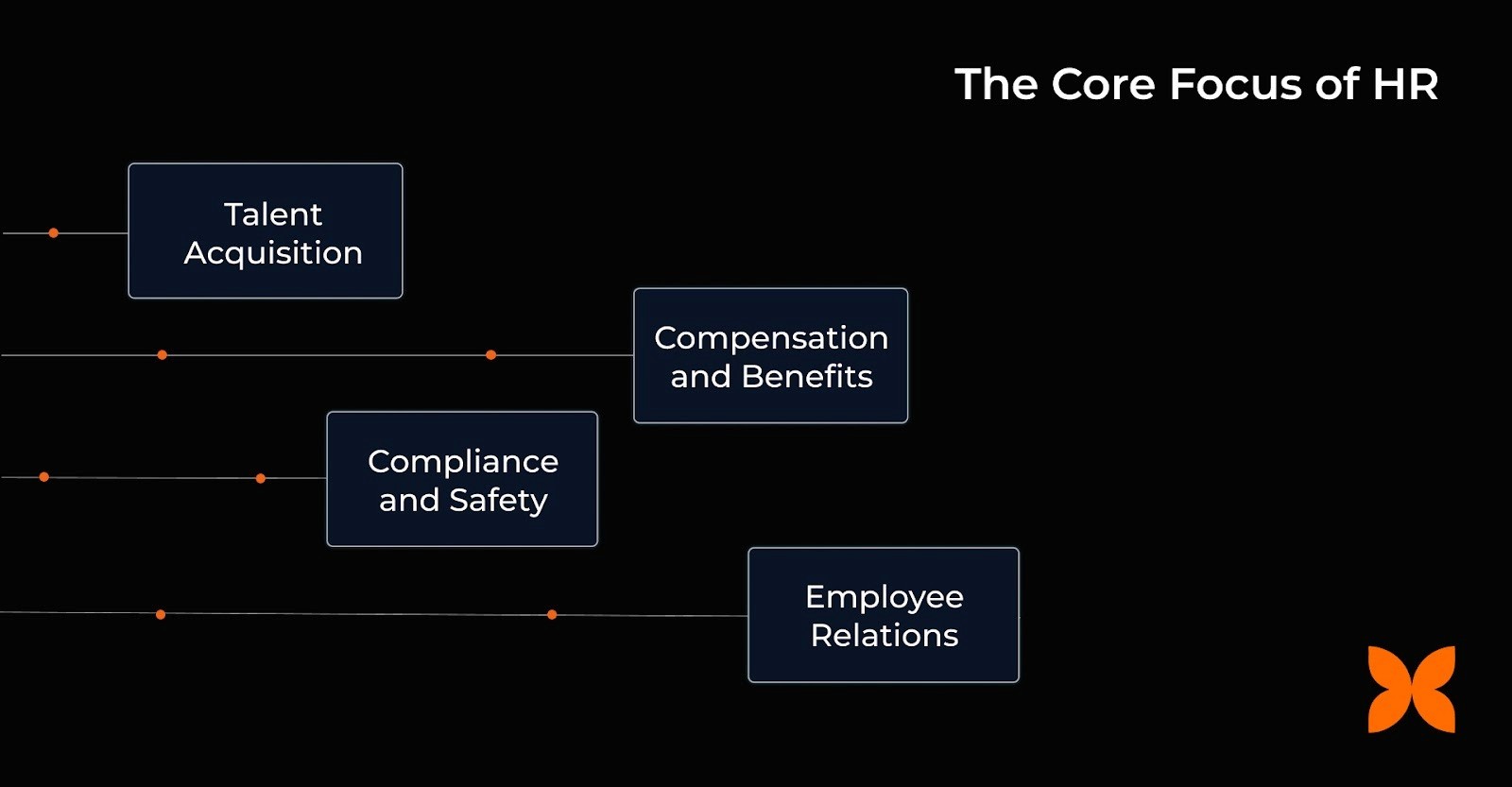
The following are the key responsibilities within the HR function:
Talent Acquisition: Managing recruitment, hiring, and new employee orientation (onboarding).
Compensation and Benefits: Administering payroll, managing employee benefits, and handling leave administration.
Compliance and Safety: Ensuring the business adheres to all local and federal labour regulations, and managing workplace safety protocols.
Employee Relations: Addressing employee grievances, mediating conflicts, and maintaining organisational structure and policy adherence.
The Operational Side of HR
Beyond the core mandate, HR manages the critical operational systems that maintain daily efficiency and productivity. These processes ensure the reliable flow of information and action across the entire employment lifecycle:
Performance Tracking: Implementing systems for monitoring, documenting, and evaluating employee performance reviews.
Time and Attendance: Overseeing the processes for tracking employee working hours, ensuring accurate data for payroll, and scheduling.
Personnel Data Management: Maintaining accurate, secure, and compliant records of all employee data and documents.
If managing these critical operational systems feels overwhelming, platforms like Craze unifies your HR, Payroll, and IT data to automate administrative tasks.
HR establishes the necessary operational controls; however, to shift from managing costs to actively generating value, we must examine the concept of human capital.
Also Read: 8 Key Objectives of Human Resource Management (HRM)
Human capital (HC) refers to the economic value that employees bring to a business, measured by their collective skills, experience, training, and knowledge. Instead of viewing people solely as an operational cost (as in HR), the HC approach treats employees as assets to be invested in.
This viewpoint aligns directly with the idea that an employee’s continuous growth and development are the primary drivers of a company's ability to innovate, maintain a competitive edge, and achieve long-term growth.
The Core Focus of HC
The primary purpose of human capital management is to maximise the return on investment (ROI) from your workforce. Management intentionally enhances employees' knowledge and abilities, knowing that this improves overall business outcomes and adaptability.
The focus shifts to forward-looking, value-generating activities:
Talent Development: Creating and funding specialised training programs, mentorship, and certifications to increase employee capability and output.
Performance Optimisation: Linking individual development plans directly to organisational goals to ensure that every investment in skill contributes to the company's growth.
Workforce Planning: Forecasting future skill needs and proactively building talent pipelines to ensure the organisation has the necessary capabilities to meet market demands.
Retention Strategy: Investing in career advancement and skill development to boost employee loyalty and reduce the high costs associated with turnover.
Strategic and Economic Impact of HC
Investment in human capital yields long-term benefits that extend far beyond immediate administrative needs:
Improved Output: Employees with better, current skills perform at a higher level, leading to superior quality, higher output, and greater profitability.
Adaptability: A well-developed workforce is more agile, enabling the organisation to respond quickly to changes in technology, market trends, or competition.
Enhanced Innovation: Encouraging continuous learning and development fosters a culture where new ideas and process improvements naturally emerge, driving the company forward.
Understanding the immense value generated by human capital requires us to clearly define the fundamental differences between this strategic view and the traditional operational focus of human resources.
The distinction between human resources (HR) and human capital (HC) is fundamental: HR manages people as a necessary cost, while HC treats them as a strategic asset. This core philosophical difference dictates how each function operates, measures success, and contributes to the business.
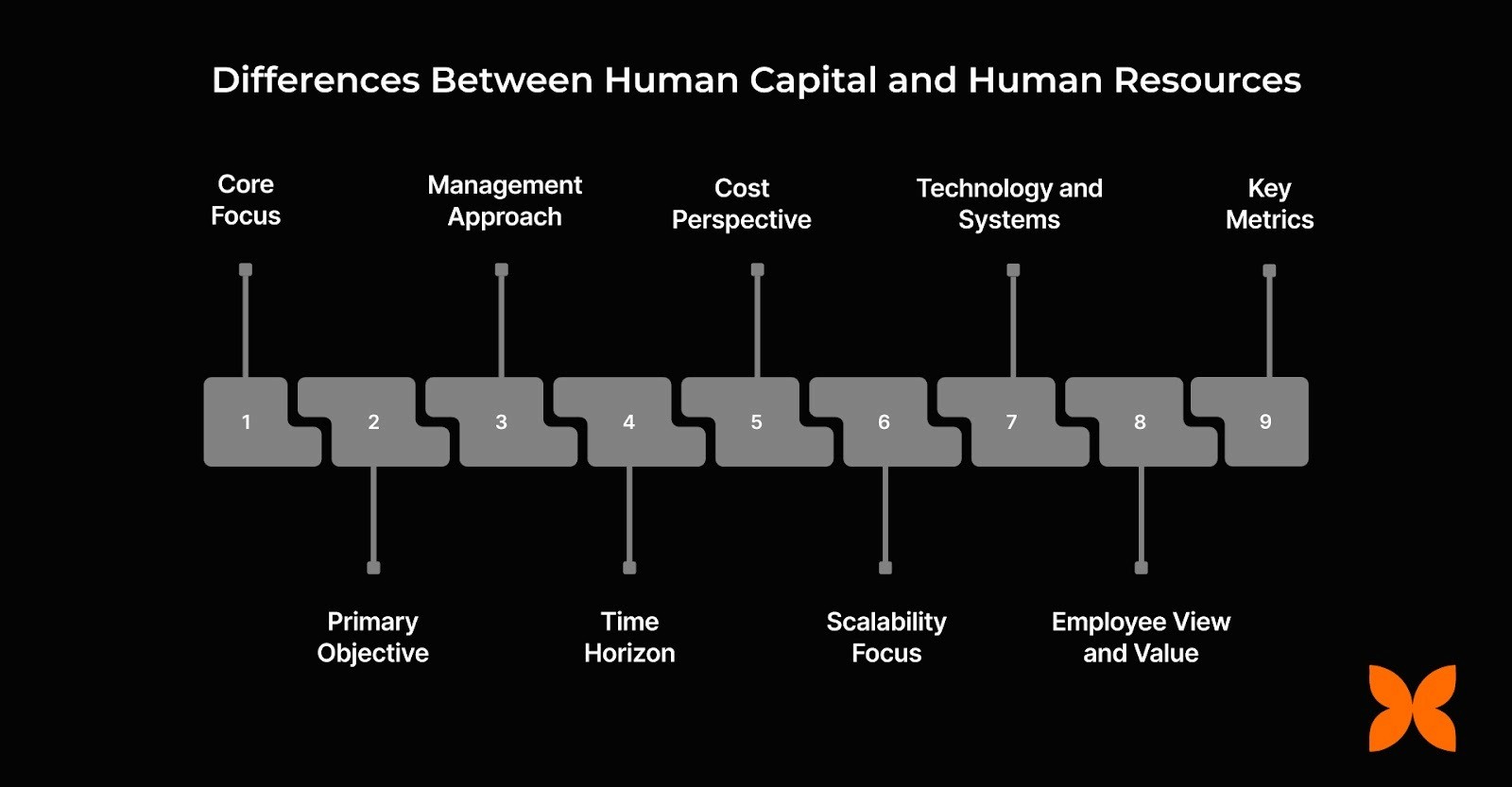
To understand how these mindsets affect your business practices, here is a breakdown of their differing approaches across key management aspects:
Core Focus
This describes the primary area of responsibility for each function.
HR Focus: Centered on operational administration and regulatory mandates. The focus is on processes, managing paperwork, and ensuring fairness and consistency across the workforce.
HC Focus: Centered on strategic capability and future readiness. The focus is on identifying skill gaps, building talent pipelines, and ensuring the workforce can meet upcoming business demands.
Primary Objective
The objective is the ultimate goal each function seeks to achieve for the organisation.
HR Objective: To minimise immediate risk and liability while ensuring day-to-day administrative efficiency (e.g., getting payroll out on time, staying compliant with the latest labour law).
HC Objective: To maximise the collective value of the workforce and drive long-term business growth by strategically enhancing employee potential.
Management Approach
This refers to the methodology or approach used to manage people-related tasks.
HR Approach: Tactical and reactive. Management tends to be task-oriented, addressing issues (like conflict resolution or policy updates) as they arise to solve immediate problems.
HC Approach: Strategic and proactive. Management is investment-oriented, focusing on building long-term talent structures (like succession planning) and making deliberate, calculated moves to increase skill depth.
Time Horizon
The difference in focus dictates how far into the future each function plans.
HR: Primarily short-term. Activities like weekly payroll, immediate conflict resolution, and compliance deadlines dominate the focus.
HC: Distinctly long-term. Activities involve multi-year skill development programs, forecasting future leadership needs, and building an adaptive organisational culture.
Cost Perspective
This addresses how each function views expenditures related to the workforce.
HR Cost View: Expenses (salaries, benefits, training) are primarily seen as operating costs that must be accurately tracked and controlled within the budget.
HC Cost View: Expenditures on development and talent acquisition are viewed as capital investments expected to yield a measurable financial return (ROI) over time.
Scalability Focus
This relates to how each function prepares for and handles organisational growth.
HR Scalability: Focused on procedural scalability. The goal is to standardise processes, systems, and documents so that HR can handle a larger volume of employees without a proportional increase in HR staff.
HC Scalability: Focused on talent scalability. The goal is to develop the existing talent pool and leadership capacity to prepare the organisation for market expansion or product growth.
Technology and Systems
The systems and data used reflect the function's priorities: administrative versus analytical.
HR Systems: Focused on transactional efficiency. Technology is typically used for record-keeping, payroll processing, scheduling, and digital compliance documentation.
HC Systems: Focused on analytical insights. Technology is used for performance modelling, identifying critical skill gaps, personalising learning journeys, and measuring Human Capital ROI (HCROI).
Employee View and Value
This is the most fundamental philosophical difference, defining how employees are measured and treated.
HR: Employees are seen as a resource to be utilised effectively to complete a job function. Their value is measured by the salary they cost.
HC: Employees are seen as an asset to be developed and grown. Their value is measured by the skills they gain and the ROI they generate (e.g., increased output, innovation).
Key Metrics
The type of data each function consumes and generates directly reflects its strategic or operational goal.
HR: Relies on operational metrics. Examples include turnover rates, cost-per-hire, compliance documentation status, and time-to-fill a role.
HC: Relies on strategic metrics. Examples include Human Capital ROI (HCROI), internal skill gap analysis, revenue per employee, and performance vs. potential.
To summarise these differences clearly, the table below compares HR and HC across key workforce management areas.
Aspect | Human Resources (HR) | Human Capital (HC) |
Focus | Operational, Administrative, Regulatory Compliance | Strategic, Value Generation, Future Capability |
Objective | Minimise risk; Ensure day-to-day stability | Maximise skill potential; Drive long-term growth |
Management Approach | Tactical and Reactive | Strategic and Proactive (Investment-based) |
Cost View | Operating Cost (to be managed and controlled) | Capital Investment (expected to generate ROI) |
Scalability | Procedural Scalability (Standardise systems) | Talent Scalability (Develop leadership/skills) |
Timeframe | Short-Term (Payroll, Daily Admin) | Long-Term (Succession, Skill Development) |
Technology Use | Transactional Efficiency (Record-keeping, Payroll) | Analytical Insight (Skill Modelling, ROI Measurement) |
Employee View | Resource to be managed (Cost) | Asset to be invested in (Value) |
Key Metric | Turnover rate, Cost-per-hire, Compliance status | HCROI, Skill gap analysis, Revenue per employee |
We've established the distinct roles of HR (cost management) and HC (value investment); now, the key to building a successful modern workforce lies in aligning these two philosophies.
Also Read: Difference Between HRM and HRD: Key Insights Explained
While they represent different philosophies, human resources (HR) and human capital (HC) are interdependent and must be aligned to drive success. HR provides the necessary operational backbone, and HC provides the strategic direction. When they work together, the result is greater than the sum of their parts.
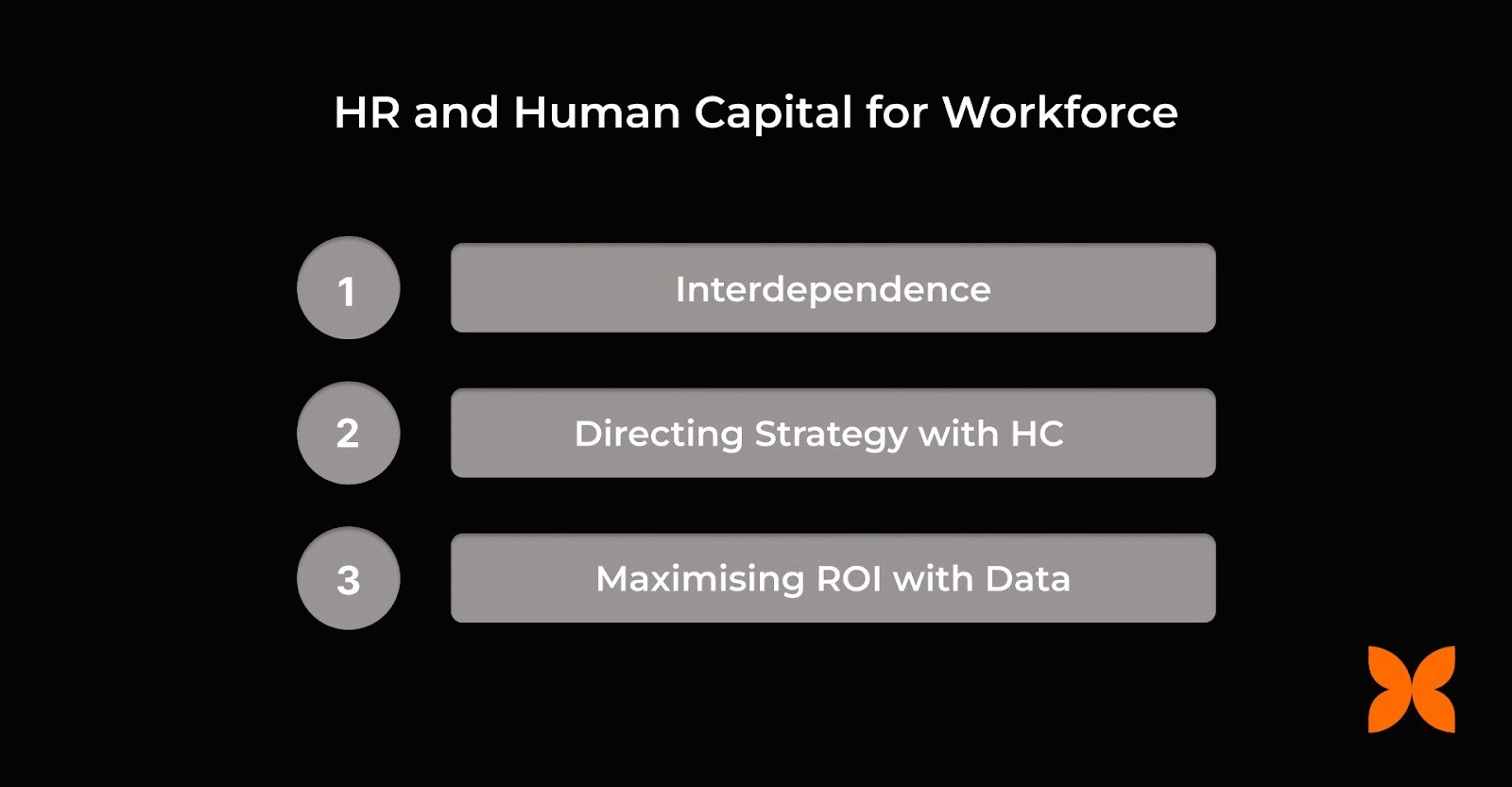
Interdependence: The Foundation of Value
Neither function can maximise value on its own. HR and HC constantly rely on each other to move talent forward:
HR Delivers the Talent: HR's recruitment and administrative processes are responsible for hiring, onboarding, and legally managing the person.
HC Develops the Talent: HC takes the employee delivered by HR and invests in their skills, ensuring they grow into a high-value asset aligned with the company's future needs.
For example, when HR successfully recruits top engineering talent, HC then implements a specific development program to keep those engineers ahead of industry trends, maximising their long-term output.
Directing Strategy with HC
The human capital mindset must guide HR's operational functions. This ensures that daily HR tasks are not just reactive administrative duties, but intentional steps toward a larger business goal.
HC defines the need: If the business goal is expansion into a new market, HC identifies the future skills required for that market.
HR executes the plan: HR then uses this information to structure compensation, design focused recruiting efforts, and implement specific training programs needed for the expansion.
By aligning people strategy with business objectives, the company ensures every hire and every training dollar is a calculated investment.
Maximising Return on Investment (ROI) with Data
The integration of HR and HC is best measured through data. By sharing data across the operational and strategic sides, you move from simple reporting to predictive action:
HR data (Operational): Provides metrics on payroll costs, absenteeism, and turnover rates.
HC data (Strategic): Uses operational data, alongside performance metrics, to forecast future skill gaps and measure the financial return from training investments.
For instance, by using HR turnover data, HC can predict which high-potential employees might leave and proactively offer personalised career development plans, protecting your most valuable assets.
Also Read: Understanding Human Resource Planning: Definition, Process, and Importance
The difference between human resources and human capital lies at the heart of balancing operations and growth. While HR focuses on managing administrative responsibilities, costs, and compliance, human capital is about recognising people as appreciating assets who drive strategic value and future readiness.
The transition to strategic human capital management often breaks down under administrative chaos. Constant switching between payroll, IT, and HR systems to meet compliance deadlines drains time that should be invested in growing your people.
Craze solves this problem by providing a unified operating system for HR, Payroll, and IT. By consolidating these functions, Craze eliminates manual work and data friction, allowing your leaders to shift their focus from administration to strategic talent investment.
Fully Automated Workflows: Eliminate data entry from onboarding to payroll, freeing up time for development and planning.
Unified Platform: Over 10 integrated apps ensure all your people data (HR, Payroll, Finance, IT) is in sync for accurate strategic decisions.
Compliance Made Simple: Tax regulations and labour laws are built into the system, automatically ensuring accuracy and reducing compliance risk.
Strategic Payroll: Run customisable payroll cycles and generate detailed reports that support Human Capital ROI analysis.
Ready to cut administrative waste and focus on building the value of your team? Book a demo with Craze to get the all-in-one system that transforms operational efficiency into a strategic advantage.
What role does leadership play in building human capital?
Leaders shape the learning culture, prioritise development investments, and ensure that employees have opportunities to gain skills that support long-term organisational goals.
Can a company have human capital without human resources?
Not effectively. While human capital focuses on strategy and development, you still need HR to handle core operational and legal functions such as hiring, benefits administration, and compliance. The two are interdependent.
Why is investing in human capital essential for business growth?
Investing in HC leads to a more skilled, engaged, and adaptable workforce. This directly improves innovation, increases long-term productivity, and reduces the high costs associated with employee turnover, making the business more competitive.
Is human capital a part of human resources?
In most organisations, human capital management (HCM) is the strategic extension of HR. While HR manages the day-to-day operations, HCM focuses on developing employee potential through training, leadership pathways, and long-term planning.
Which is more strategic: HR or human capital?
Human capital is more strategic. It focuses on future growth, skill development, and aligning talent potential with the company's long-term business goals. HR is generally more operational, handling current administrative and compliance needs.
