
Confirmation Letter Format: Key Elements and 10 Free Templates


Drafting an employee confirmation letter is a crucial step in the HR workflow. While probation evaluations provide insight into performance, formally confirming an employee’s permanent status requires precision, clarity, and adherence to company policy.
Even after an employee has successfully completed probation, failing to properly document confirmation can cause confusion about role responsibilities, salary eligibility, benefits, or the reporting structure. Managing multiple confirmations across departments without a standard framework may also delay HR records and payroll updates.
In this blog, you will learn how to draft confirmation letters efficiently, with step-by-step guidance and 10 ready-to-use templates customised for Indian organisations.
Key Takeaways
A confirmation letter formally validates an employee’s permanent status after probation.
Standardised letters help HR teams maintain consistency, legal compliance, and clarity.
Each letter should include probation details, confirmation date, revised compensation (if any), and role responsibilities.
Ready-to-use templates save time and ensure professional, uniform communication.
Well-drafted letters boost employee confidence, transparency, and organisational credibility.
What is a Confirmation Letter?
A confirmation letter is a formal document issued by an employer to verify an employee’s transition from probationary to permanent status. It may also include details such as revised salary, updated responsibilities, and eligibility for benefits. This letter serves as an official record for HR, payroll, and legal compliance, helping both the employee and the employer maintain clarity about the terms of employment.
Confirmation letters are commonly used after successful probation evaluations, contract periods, or completion of training or project-based assessments. They provide written proof of employment, prevent misunderstandings about roles or compensation, and formalise the employee’s permanent status, ensuring transparency and adherence to company policies and statutory requirements.
What is the Purpose of a Confirmation Letter?
Confirmation letters go beyond routine HR notifications. They provide clarity, ensure legal compliance, and help motivate employees. The key purposes include:
Formal Record of Employment: Validates the employee’s permanent status with the organisation.
Compensation and Benefits Eligibility: Confirms any salary revisions, benefits, or allowances post-probation.
Role and Responsibility Clarity: Clearly defines ongoing responsibilities and reporting lines.
Employee Motivation and Retention: A formal confirmation boosts morale and reinforces commitment.
Policy and Legal Compliance: Aligns with company policies and Indian labour regulations governing employment confirmation.
Now that we know why confirmation letters are essential, let’s review the vital components that every effective confirmation letter should contain.
Key Elements of an Effective Confirmation Letter Format
Every formal letter needs a specific set of details to be valid and useful for your records. Including these core components ensures that the document clearly outlines the change in status while providing all the information needed for payroll and compliance audits.
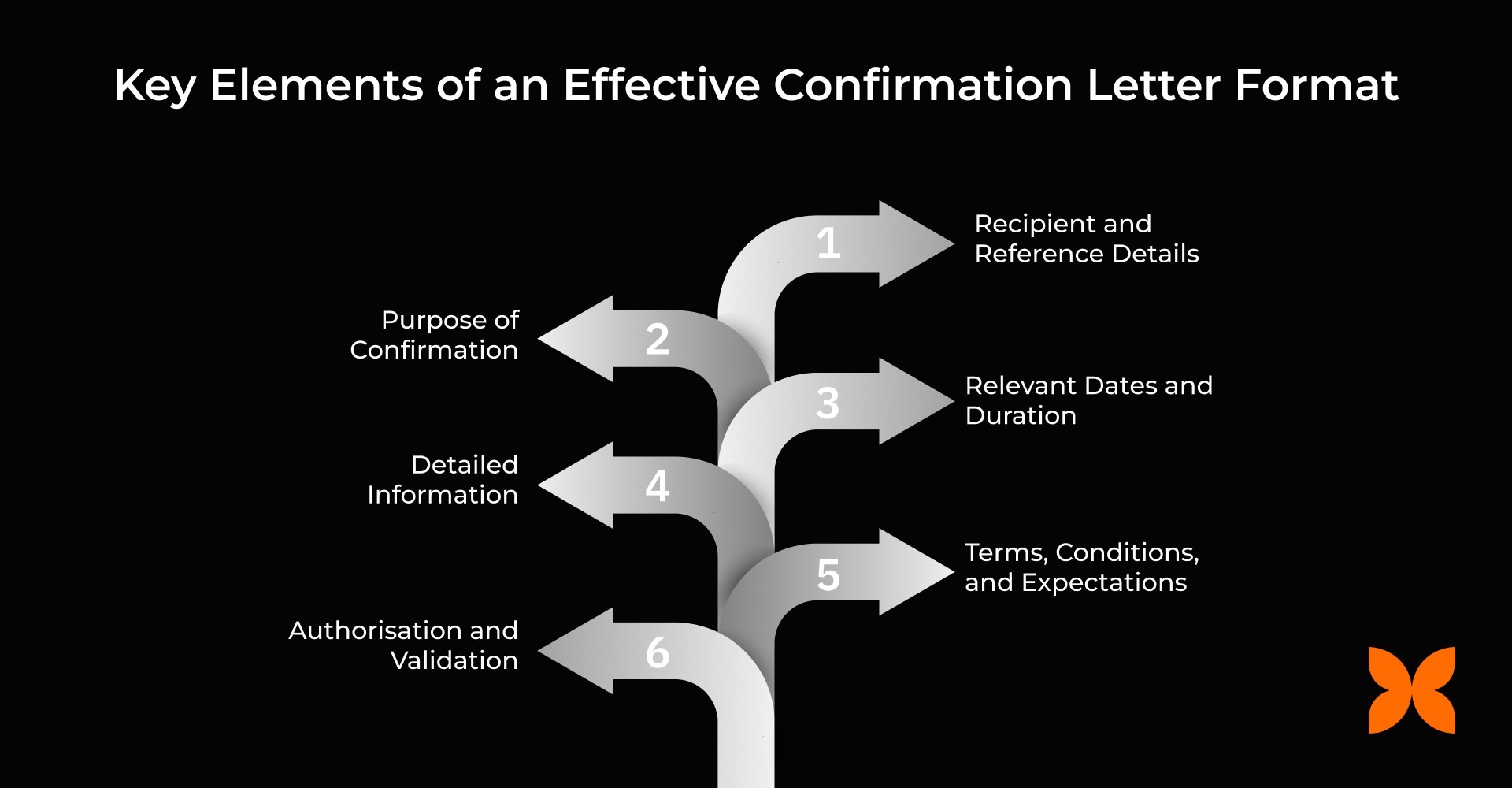
1. Recipient and Reference Details
Include the full name of the employee, candidate, intern, vendor, or participant, along with a reference number or booking request ID where applicable. These details establish context and ensure the letter is correctly attributed.
Tip: Verify names, designations, and reference numbers carefully to avoid administrative or legal errors.
2. Purpose of Confirmation
Clearly state the reason for the letter, such as employment confirmation, interview scheduling, training enrolment, payment processing, or reservation confirmation. This sets the context and provides immediate clarity.
Tip: Keep the purpose concise and unambiguous to prevent confusion.
3. Relevant Dates and Duration
Include dates such as joining date, probation end date, interview schedule, training period, payment date, or reservation date. Duration, if applicable, should also be mentioned.
Tip: Accurate dates help maintain proper HR, audit, and compliance records.
4. Detailed Information
Provide all essential details depending on the type of confirmation, such as:
Job title, reporting manager, and CTC for employment confirmations
Interview venue, panel, and time for interview confirmations
Training programme details for training confirmations
Payment mode, amount, and transaction reference for payment confirmations
Location, number of participants, and booking details for reservations
Tip: Complete information reduces follow-up queries and ensures administrative clarity.
5. Terms, Conditions, and Expectations
Mention any associated terms or conditions, such as benefits eligibility, attendance requirements, payment terms, cancellation policies, or responsibilities.
Tip: Clearly define obligations or conditions to prevent disputes or misunderstandings.
6. Authorisation and Validation
Ensure the letter is signed by an authorised manager, HR representative, or administrative head, including their designation and date of issue. This validates the confirmation as an official organisational record.
Tip: Confirm that the signatory has the authority to issue the confirmation under company policy before dispatch.
Also Read: Appointment Letter Format: Key Elements & 10 Free Templates
Next, let’s walk through a step-by-step guide to drafting an effective confirmation letter.
How to Write an Effective Confirmation Letter: 6 Key Steps
Drafting this letter requires a professional yet encouraging tone to reflect the employee's success. This guide walks you through how to phrase the announcement, describe the new terms of employment, and present the information in a way that is easy for the employee to understand.
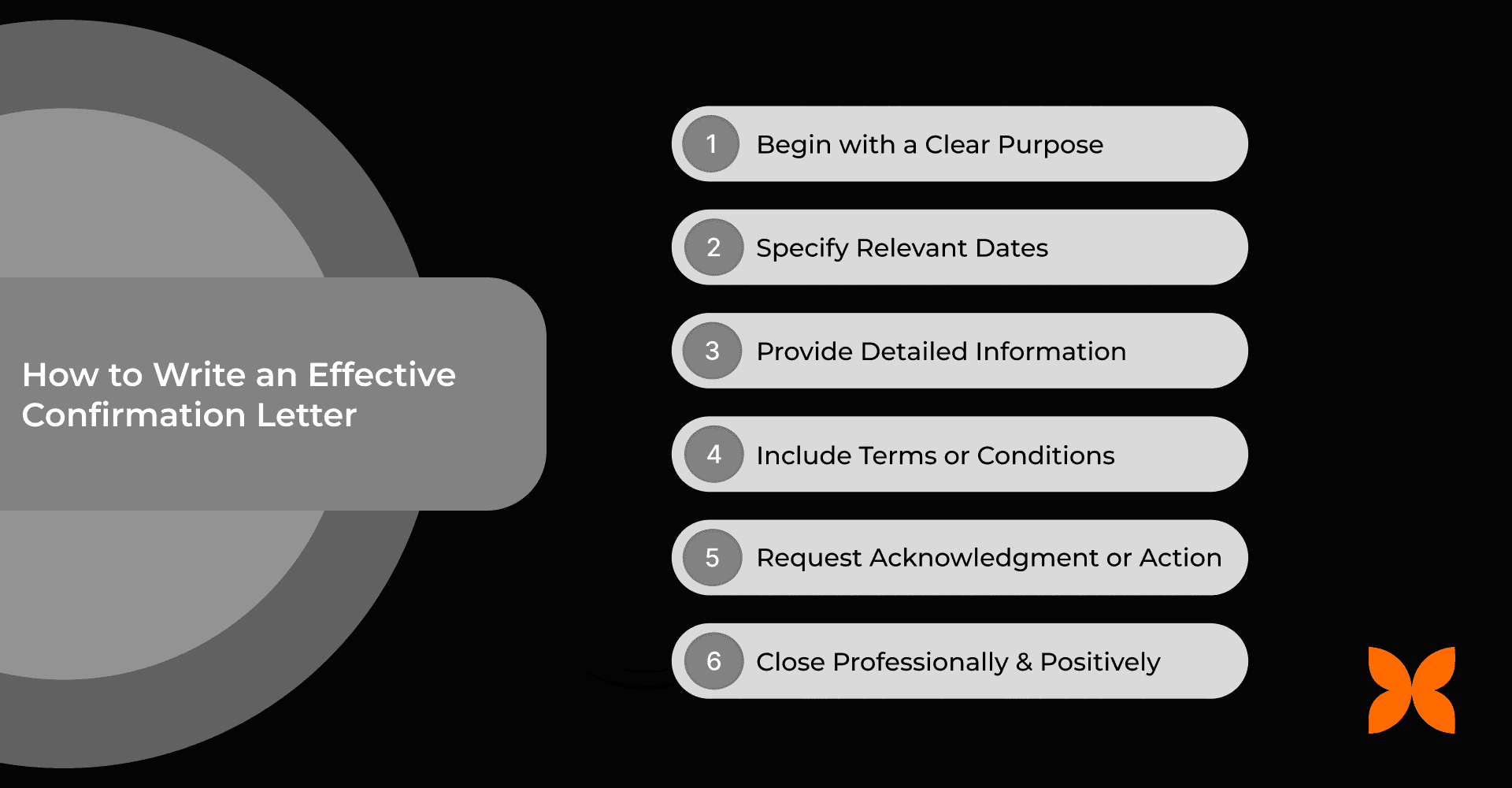
Step 1. Begin with a Clear Purpose
Start the letter by clearly stating the reason for issuing the confirmation. This ensures the recipient immediately understands the context.
Example: “This is to confirm your successful completion of the probation period and permanent employment with (Company Name).”
Step 2. Specify Relevant Dates
Include the date of the event, joining, reservation, or transaction being confirmed. Precise dates support record-keeping and compliance.
Example: “Your probation period from 1 April 2025 to 30 September 2025 has been successfully completed, effective from 1 October 2025.”
Step 3. Provide Detailed Information
Clearly outline all relevant details, including role, designation, reporting manager, payment, reservation, and training details. Complete information prevents ambiguity.
Example: “You are confirmed in the position of (Job Title) reporting to (Manager Name) with an annual CTC of (Amount).”
Step 4. Include Terms or Conditions (if applicable)
Mention any terms, responsibilities, or conditions associated with the confirmation, such as benefits eligibility, attendance expectations, or cancellation policies.
Example: “You will now be entitled to all benefits as per company policy, and your continued performance will be reviewed annually.”
Step 5. Request Acknowledgement or Action
Ask the recipient to acknowledge the confirmation or complete a related action to ensure formal closure.
Example: “Kindly acknowledge receipt of this confirmation letter for our records.”
Step 6. Close Professionally and Positively
End the letter with a formal, encouraging statement that reinforces professionalism and goodwill.
Example: “We congratulate you on this confirmation and look forward to your continued contributions to the organisation.”
Also Read: Offer Letter Format: 10 Sample Templates for Modern Businesses
With the key steps for drafting a confirmation letter clearly outlined, we can now review practical formats and ready-to-use templates that HR teams and managers can adapt for their employees.
Confirmation Letter Format and Templates
Using standardised confirmation letter templates helps maintain clarity, professionalism, and consistency across all organisational communications. These templates cover the most common scenarios, enabling HR, administration, and operations teams to issue letters quickly and accurately.
1. Employment Confirmation Letter
Issued after successful completion of probation to formally confirm permanent employment status, compensation eligibility, and statutory benefits. Provided by HR as an official employment record.
(Company Name)
Registered Office Address
City, State, PIN Code
Phone: (Official Contact Number) | Email: (Official Email ID) | Website: (Company Website)
(Date)
Subject: Confirmation of Employment
Dear (Employee Name),
We are pleased to inform you that upon successful completion of your probation period from (Start Date) to (End Date), your employment with (Company Name) has been reviewed and approved for confirmation.
Accordingly, you are hereby confirmed as a permanent employee with effect from (Confirmation Date) in the designation of (Job Title), reporting to (Reporting Manager).
Your annual compensation shall be (Revised CTC) as per company policy, and you will now be eligible for all applicable employee benefits, leave entitlements, and statutory provisions.
We appreciate your performance and commitment during the probation period and look forward to your continued contribution to the organisation.
Yours sincerely,
(Authorised Signatory Name)
(Designation)
(Company Name)
2. Job Offer Acceptance Confirmation
Issued when a selected candidate formally accepts the job offer and joins the organisation. Maintained by employers as legal proof of hiring acceptance and onboarding approval.
(Company Name)
Registered Office Address
City, State, PIN Code
Phone: (Official Contact Number) | Email: (Official Email ID) | Website: (Company Website)
(Date)
Subject: Confirmation of Acceptance of Employment Offer
Dear (Hiring Manager Name),
I am writing to formally confirm my acceptance of the offer for the position of (Job Title) at (Company Name) as per the terms and conditions outlined in the offer letter dated (Offer Date).
I confirm my joining date as (Joining Date) and accept the offered compensation package of (CTC), including associated benefits.
I look forward to joining the organisation and contributing to its objectives.
Yours sincerely,
(Candidate Name)
(Address)
(Contact Number)
3. Interview Confirmation Letter
Issued to confirm interview schedules with shortlisted candidates and ensure smooth coordination during the hiring process. Sent by recruitment teams as part of structured hiring communication.
(Company Name)
Registered Office Address
City, State, PIN Code
Phone: (Official Contact Number) | Email: (Official Email ID) | Website: (Company Website)
(Date)
Subject: Interview Schedule Confirmation
Dear (Candidate Name),
This is to confirm your interview for the position of (Job Title) with (Company Name) scheduled on (Date) at (Time) at (Location/Video Link).
You are requested to carry your updated resume, identification proof, and relevant documents for verification.
Please confirm your availability for the interview at your earliest convenience.
Regards,
(HR Name)
(Designation)
(Company Name)
4. Appointment Confirmation Letter
Issued for internal promotions, leadership appointments, or departmental transfers to formally record role changes, authority, and reporting structure.
(Company Name)
Registered Office Address
City, State, PIN Code
Phone: (Official Contact Number) | Email: (Official Email ID) | Website: (Company Website)
(Date)
Subject: Appointment Confirmation
Dear (Employee Name),
We are pleased to inform you that you have been appointed to the position of (Designation) in the (Department Name) department with effect from (Effective Date).
In this role, you will be responsible for (Key Responsibilities) and will report directly to (Reporting Manager).
Your appointment has been approved by management in accordance with company policy.
We wish you success in your new assignment.
Yours sincerely,
(Authorised Signatory)
(Company Name)
5. Internship Confirmation Letter
Issued to confirm internship selection and joining details for the campus hiring and training programme records.
(Company Name)
Registered Office Address
City, State, PIN Code
Phone: (Official Contact Number) | Email: (Official Email ID) | Website: (Company Website)
(Date)
Subject: Internship Confirmation Letter
Dear (Intern Name),
We are pleased to confirm your selection for the internship programme with (Company Name) in the (Department Name) department from (Start Date) to (End Date).
During this period, you will be assigned projects under the guidance of (Supervisor Name) and will receive a monthly stipend of (Stipend Amount).
Your reporting date will be (Joining Date) at (Office Location).
We look forward to your learning journey with us.
Regards,
(HR Manager Name)
6. Training Confirmation Letter
Issued to confirm employee enrolment in internal or external training programmes. Sent by HR or learning and development teams for official records.
(Company Name)
Registered Office Address
City, State, PIN Code
Phone: (Official Contact Number) | Email: (Official Email ID) | Website: (Company Website)
(Date)
Subject: Training Programme Confirmation
Dear (Employee Name),
This is to confirm your nomination and enrolment for the training programme titled (Training Name), scheduled from (Start Date) to (End Date) at (Training Location/Platform).
The programme forms part of your professional development plan, and attendance is mandatory.
Please ensure your availability for the complete duration of the programme.
Regards,
(Training Coordinator Name)
(Company Name)
7. Attendance Confirmation Letter
Issued to confirm participation in official meetings, training sessions, or conferences for audit, compliance, and administrative records.
(Company Name)
Registered Office Address
City, State, PIN Code
Phone: (Official Contact Number) | Email: (Official Email ID) | Website: (Company Website)
(Date)
Subject: Attendance Confirmation
Dear (Participant Name),
This is to confirm your attendance at (Event Name) held on (Date) at (Venue), organised by (Organising Authority).
Your participation is duly recorded for official and compliance purposes.
Regards,
(Admin Manager Name)
8. Payment Confirmation Letter
Issued to confirm salary, bonus, reimbursement, or vendor payments for official financial and audit records. Sent by the finance or HR departments.
(Company Name)
Registered Office Address
City, State, PIN Code
Phone: (Official Contact Number) | Email: (Official Email ID) | Website: (Company Website)
(Date)
Subject: Payment Confirmation
Dear (Recipient Name),
This is to confirm that a payment of (Amount) towards (Purpose) has been processed on (Payment Date) via (Payment Mode) under reference number (Transaction ID).
Please acknowledge receipt of the payment for our records.
Regards,
(Finance Manager Name)
(Company Name)
9. Order Confirmation Letter
Issued to confirm purchase orders placed with vendors and record transaction details. Sent by procurement or operations teams for official documentation.
(Company Name)
Registered Office Address
City, State, PIN Code
Phone: (Official Contact Number) | Email: (Official Email ID) | Website: (Company Website)
(Date)
Subject: Purchase Order Confirmation
Dear (Vendor Name),
We hereby confirm our purchase order for (Item Name) in a quantity of (Quantity), with a total value of (Order Value), as per the agreed commercial terms.
The delivery is scheduled on or before (Delivery Date) at (Delivery Address).
Kindly acknowledge receipt of this order.
Regards,
(Procurement Head)
(Company Name)
10. Reservation Confirmation Letter
Confirms official company travel, accommodation, or event bookings and serves as a formal record for employees and vendors. Issued by the administration or HR department.
(Company Name)
Registered Office Address
City, State, PIN Code
Phone: (Official Contact Number) | Email: (Official Email ID) | Website: (Company Website)
(Date)
Subject: Reservation Confirmation
Dear (Service Provider Name),
This is to confirm our reservation for (Service Description) on (Date) for (Number of Persons) under the company name (Company Name).
Please confirm the booking, including applicable charges and cancellation terms.
Regards,
(Admin Manager Name)
(Designation)
(Company Name)
(Contact Details)
Next, let’s take a closer look at best practices for drafting a confirmation letter to ensure clarity, consistency, and professionalism across all organisational communications.
Best Practices for Writing a Confirmation Letter
A high-quality letter does more than just state facts; it makes the employee feel valued and secure in their role. Using consistent formatting, specific language, and a positive tone helps prevent back-and-forth questions and ensures the transition feels like a professional milestone.
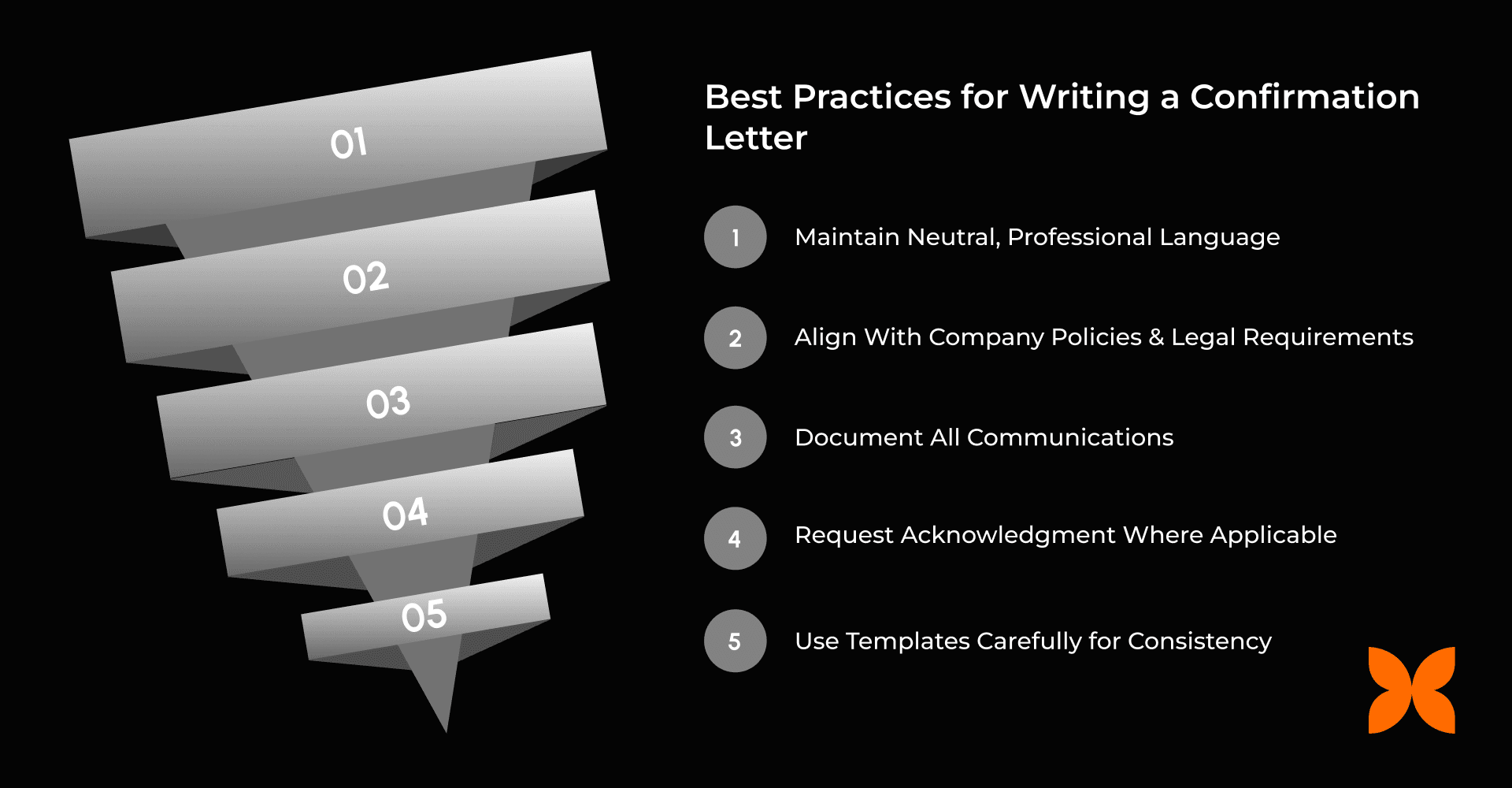
Maintain Neutral, Professional Language: Use clear, factual, and courteous language. Avoid overly casual or emotionally charged wording, even if confirming positive outcomes.
Align With Company Policies and Legal Requirements: Ensure all confirmations, whether for employment, internship, training, payments, or reservations, comply with internal policies, employment laws, and statutory regulations.
Document All Communications: Keep copies of all confirmation letters, acknowledgements, and related correspondence. This supports HR, administration, finance, and audit records.
Request Acknowledgement Where Applicable: For confirmations such as employment acceptance, training enrolment, or payments, request formal acknowledgement to ensure proper record-keeping and closure.
Use Templates Carefully for Consistency: Templates save time and ensure uniformity across the organisation, but letters should never feel generic. Each confirmation must accurately reflect the individual case.

Final Thoughts
Inconsistent or poorly documented confirmation processes can create confusion, delays, and unnecessary follow-ups. Many SMEs still rely on emails or manual tracking methods, which often lead to errors and inefficiencies.
Structured confirmation letters provide transparency, maintain professionalism, and serve as official records for employment, training, payments, reservations, and other organisational processes. Platforms like Craze help centralise HR and administrative documentation workflows, making it easier to manage confirmation letters alongside other employee lifecycle records.
FAQs
1. Can a confirmation letter be issued for remote employees?
Yes. Confirmation letters for remote employees should clearly mention reporting structure, role, and any location-specific responsibilities or allowances.
2. Is it necessary to issue a separate confirmation letter for promotions?
Not always. If a promotion coincides with confirmation, the letter can combine both, clearly stating the role change, revised responsibilities, and compensation details.
3. Should interns receive a confirmation letter upon successful completion?
Yes. If the internship converts to full-time employment or involves certificate issuance, a formal confirmation letter ensures clarity and serves as proof of completion.
4. How long should employers retain confirmation letters?
Employers should maintain copies in HR records for at least the duration of employment plus statutory retention requirements, typically 3 to 5 years, for audit and legal purposes.
5. Can confirmation letters include clauses for probation extensions or conditions?
Yes. Letters may mention conditional confirmation or extended probation periods, specifying the terms, duration, and evaluation criteria to avoid disputes.
