
Employment Verification Letter: Key Elements and 3 Free Samples


Drafting a professional employment verification letter can be more challenging than it seems. Even if you are familiar with an employee’s tenure and role, accurately recording their job title, employment dates, and reporting structure can be tricky.
The consequences of an incomplete or unclear letter can be significant: it may delay background checks, loan approvals, or visa processes, and lead to repeated HR follow-ups. Handling multiple verification requests without a structured approach can create administrative bottlenecks and affect organisational credibility.
In this blog, you will learn what an employment verification letter is, why it matters, the key components it should include, and ready-to-use templates designed specifically for Indian organisations.
Key Takeaways
An employment verification letter formally confirms an individual’s employment history, role, tenure, and other relevant details.
Properly structured letters prevent ambiguity, ensure legal compliance, and enhance organisational credibility.
Each letter should include employee details, tenure, job designation, reporting manager, and confirmation of salary or roles, as applicable.
Pre-designed templates simplify verification requests for internal or external purposes.
Accurate, timely, and authorised letters maintain professionalism and support HR processes.
What is an Employment Verification Letter?
An employment verification letter (EVL) is an official document issued by an employer to confirm an employee’s employment details. It is often requested by current or prospective employers, financial institutions, government authorities, or visa processing agencies to validate an individual’s employment history, designation, tenure, and sometimes salary.
The letter serves as formal proof that the employee worked with the organisation and provides verifiable information for professional or legal purposes. It can be issued for full-time employees, contractual staff, or ex-employees and becomes part of the HR record for reference.
Why Employees Request an Employment Verification Letter?
Employees may seek an employment verification letter for a wide range of personal and professional purposes. Understanding these reasons helps employers provide accurate, timely responses, improving HR efficiency and the employee experience.
Financial Applications: Verification letters are often required when employees apply for home loans, personal loans, credit cards, or auto loans, as financial institutions need confirmation of income and employment stability.
Rental or Lease Agreements: Landlords and property managers may request proof of employment to ensure tenants can meet rental obligations.
Educational Purposes: Employees applying for student loans, scholarships, or tuition deferments may need to confirm their employment status and income.
Professional Requirements: Some employees may require verification letters for visa applications, immigration purposes, or background checks for new roles.
While employees are not always obliged to explain why they need the letter, providing essential details upfront can be very helpful. These details may include their job title, employment dates, current salary (if required), and the recipient’s contact information. Doing so helps HR departments draft precise letters, reduces back-and-forth communication, and ensures verification meets its intended purpose without delay.
With these contexts in mind, the next step is to understand the key components that make an employment verification letter effective and legally defensible.
Key Elements of an Effective Employment Verification Letter
An employment verification letter should be factual, concise, and consistent, and should include all essential employer and employee details that third parties may require. Each section should be carefully crafted to maintain professionalism, authenticity, and legal compliance.
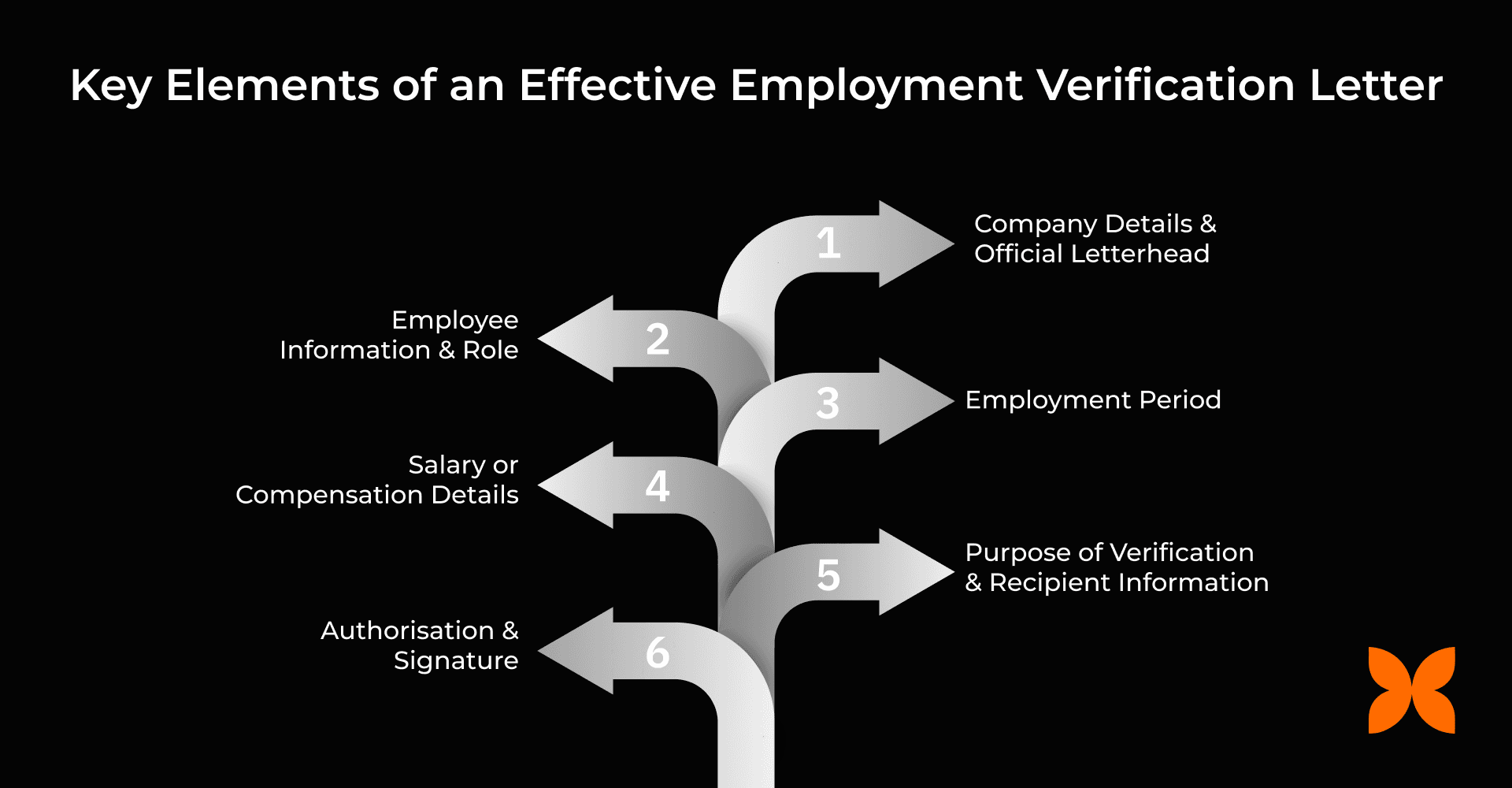
1. Company Details and Official Letterhead
Include the company name, address, contact person, and official logo. This establishes the document's authenticity and signals that it is a formal, verifiable letter.
Tip: Always use the company’s official letterhead and include HR or authorised contact information to avoid disputes or doubts about authenticity.
2. Employee Information and Role
Clearly state the employee’s full name, job title, department, and employment type (full-time, part-time, or contractor). This ensures the recipient can accurately identify the employee and their role within the organisation.
Tip: Double-check spelling and designation to prevent errors that could invalidate the verification or cause confusion.
3. Employment Period
Provide the employee’s start date and, if applicable, end date. For current employees, you can state ‘present’ as the end date. Accurate dates allow third parties to confirm job stability or previous work history.
Tip: Refer to HR records to ensure dates match official employment records; inconsistencies can lead to delays or additional verification requests.
4. Salary or Compensation Details (If Applicable)
Include salary, wage, or pay frequency only if company policy or local regulations permit disclosure. This information is commonly requested for loans, rental agreements, or visa applications.
Tip: Always obtain employee consent before including salary details to maintain confidentiality and comply with privacy policies.
5. Purpose of Verification and Recipient Information
Mention the purpose of the verification (e.g., loan, rental, visa) and the intended recipient or organisation, based on employee consent. Specifying the purpose ensures compliance and reduces the risk of misuse of the letter.
Tip: Keep the purpose brief and factual; avoid adding personal opinions or subjective comments about the employee.
6. Authorisation and Signature
The letter should be signed by an authorised HR representative, manager, or company officer, with their designation and date. This confirms authenticity and ensures the letter carries official weight.
Tip: Include contact details for follow-up queries, making it easier for the recipient to verify the information if needed.
Also Read: Offer Letter Format: 10 Sample Templates for Modern Businesses
To ensure a compliant, well-documented employment verification letter, it is essential to understand the key components that make it accurate, professional, and legally defensible.
How to Write an Employment Verification Letter: 6 Key Steps
Your goal is to provide a factual and objective record that helps your employee complete a personal or professional application. These steps guide you through verifying the specific data requested, such as salary or tenure, and putting it into a formal format that external organisations will accept as valid proof.
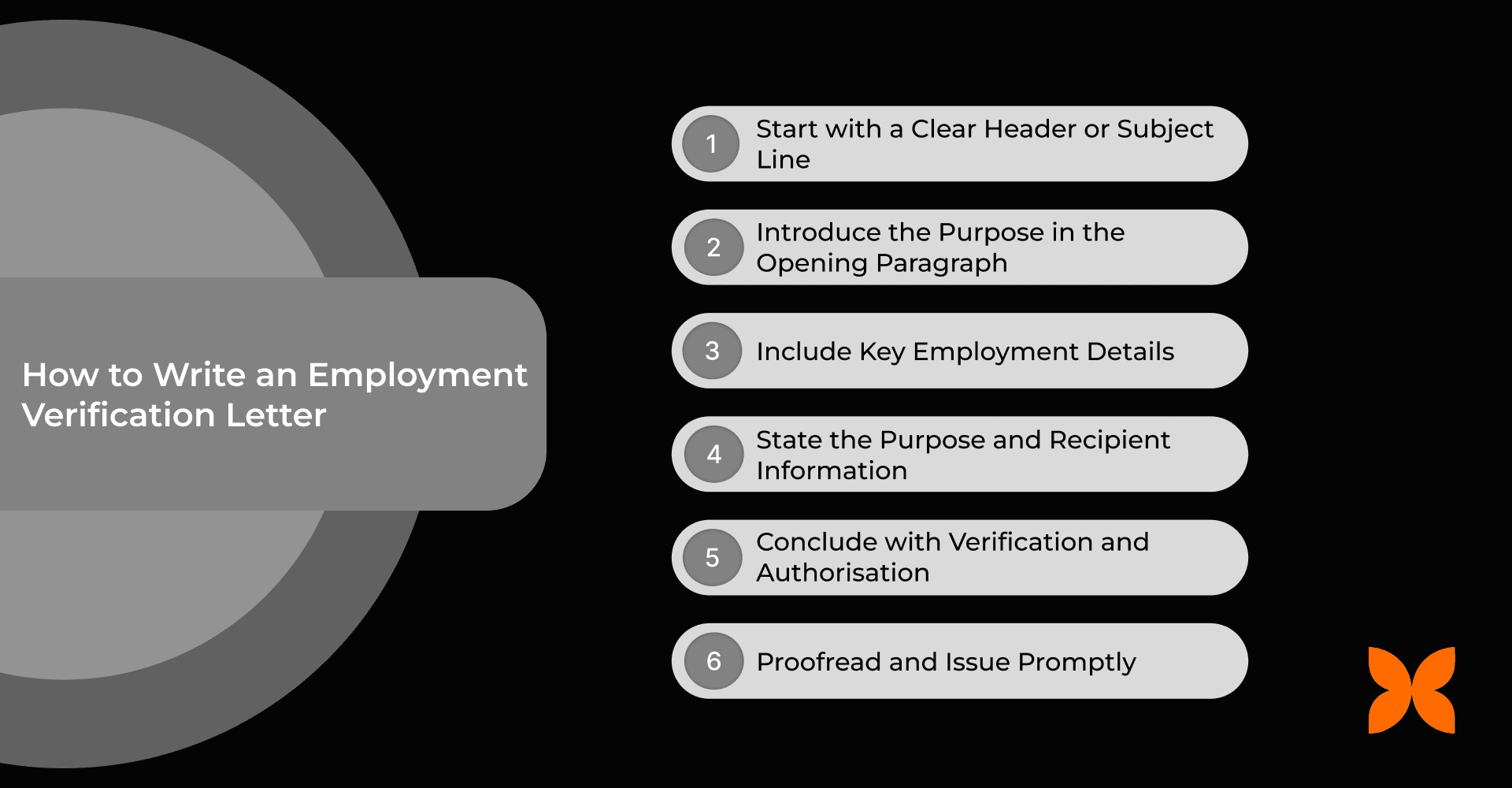
Step 1. Start with a Clear Header or Subject Line
Include a subject line that clearly conveys the letter's purpose and identifies the employee. This helps HR and third parties quickly understand the context.
Example:
Subject: Employment Verification Letter - Priya Sharma
Reference: Verification of Employment - Rajesh Kumar
Step 2. Introduce the Purpose in the Opening Paragraph
Begin by stating that the letter is being issued to verify the employee’s employment. Include the employee’s name, designation, and department, if applicable.
Example: “This letter confirms that Priya Sharma has been employed with XYZ Technologies as a Software Engineer in the Development Department since 15 January 2021.”
Step 3. Include Key Employment Details
Provide essential information requested by the third party, such as employment type (full-time, part-time, or contractual), employment period, and, if permitted, compensation details.
Example: “Ms. Sharma is employed on a full-time basis. Her current annual CTC is INR 12,00,000, and she has been with the company since 15 January 2021.”
Step 4. State the Purpose and Recipient Information
Clearly mention why the verification is being issued (e.g., loan application, rental, visa) and the intended recipient or organisation.
Example: “This verification is issued upon the employee’s request for submission to ICICI Bank as part of her home loan application.”
Step 5. Conclude with Verification and Authorisation
End the letter by affirming that the information provided is accurate. Include the name, designation, signature, and date of the authorised HR representative or manager.
Example:
“We confirm that the information provided above is accurate to the best of our knowledge.
Signed,
Rahul Mehta
HR Manager
XYZ Technologies
Date: 10 January 2026”
Step 6. Proofread and Issue Promptly
Ensure the letter is clear, grammatically correct, and aligned with company policy. Prompt issuance reflects professionalism and maintains a positive employee experience.
Example: “The letter was prepared, reviewed, and issued on 10 January 2026, in accordance with company HR guidelines.”
Also Read: Joining Letter Format: How to Write it, Key Details, and 6 Samples
With this step-by-step approach, you can draft accurate and professional employment verification letters. Next, we will provide ready-to-use templates for various employee scenarios, making the process even easier and consistent.
Employment Verification Letter Templates
Using standardised templates ensures clarity, professionalism, and consistency when confirming employee details. These ready-to-use employment verification letter templates cover common scenarios, helping you draft them quickly and accurately.
1. General Employment Verification Letter
This letter confirms the employee’s tenure, designation, and current employment status. It can be used for general verification purposes, such as banks, landlords, or official documentation.
Subject: Employment Verification Letter
(Date)
To Whom It May Concern,
This is to certify that (Employee Name) is employed with (Company Name) as (Designation). The employee has been associated with the organisation since (Date of Joining) and is currently employed on a (full-time/part-time/contractual) basis.
As of the date of this letter, the employee is actively working with the organisation. This letter is issued upon the employee’s request for general verification purposes.
For any further clarification, please contact (HR Contact Details).
Sincerely,
(Name)
(Position)
(Company Name)
2. Employment Verification Letter With Salary Details
This version includes the employee’s salary information in addition to employment details. It is suitable when income verification is required, for example, for loans or official applications.
Subject: Employment Verification Letter with Salary Details
(Date)
To Whom It May Concern,
This letter confirms that (Employee Name) is employed with (Company Name) as (Designation) since (Date of Joining).
The employee’s current employment details are as follows:
Employment status: (Full-time / Part-time / Contract)
Designation: (Designation)
Current salary: (Monthly or Annual Amount)
This letter is issued at the employee's request for official verification purposes.
For any further information, please contact (HR Contact Details).
Sincerely,
(Name)
(Position)
(Company Name)
3. Employment Verification Letter for Visa or Immigration Purposes
This letter confirms the employee’s employment specifically for visa or immigration applications. It ensures the employee has proof of employment for official immigration requirements.
Subject: Employment Verification Letter for Visa or ImmigrationEmployment Verification Letter for Visa or Immigration
(Date)
To Whom It May Concern,
This letter is to confirm that (Employee Name) is employed with (Company Name) as (Designation) and has been working with the organisation since (Date of Joining).
The employee is currently employed on a (full-time/part-time/contractual) basis. This letter is issued to support visa or immigration documentation requirements.
For any additional verification, please contact (HR Contact Details).
Sincerely,
(Name)
(Position)
(Company Name)
Let’s now examine the common mistakes to avoid, covering structure, content, authorisation, and legal compliance, to ensure your letters are professional and error-free.
Common Errors to Avoid in Employment Verification Letters
Employment verification letters may appear routine, but even small errors can lead to compliance risks, processing delays, and credibility concerns. Understanding the most common mistakes helps you issue accurate, professional, and legally sound verification documents with confidence.
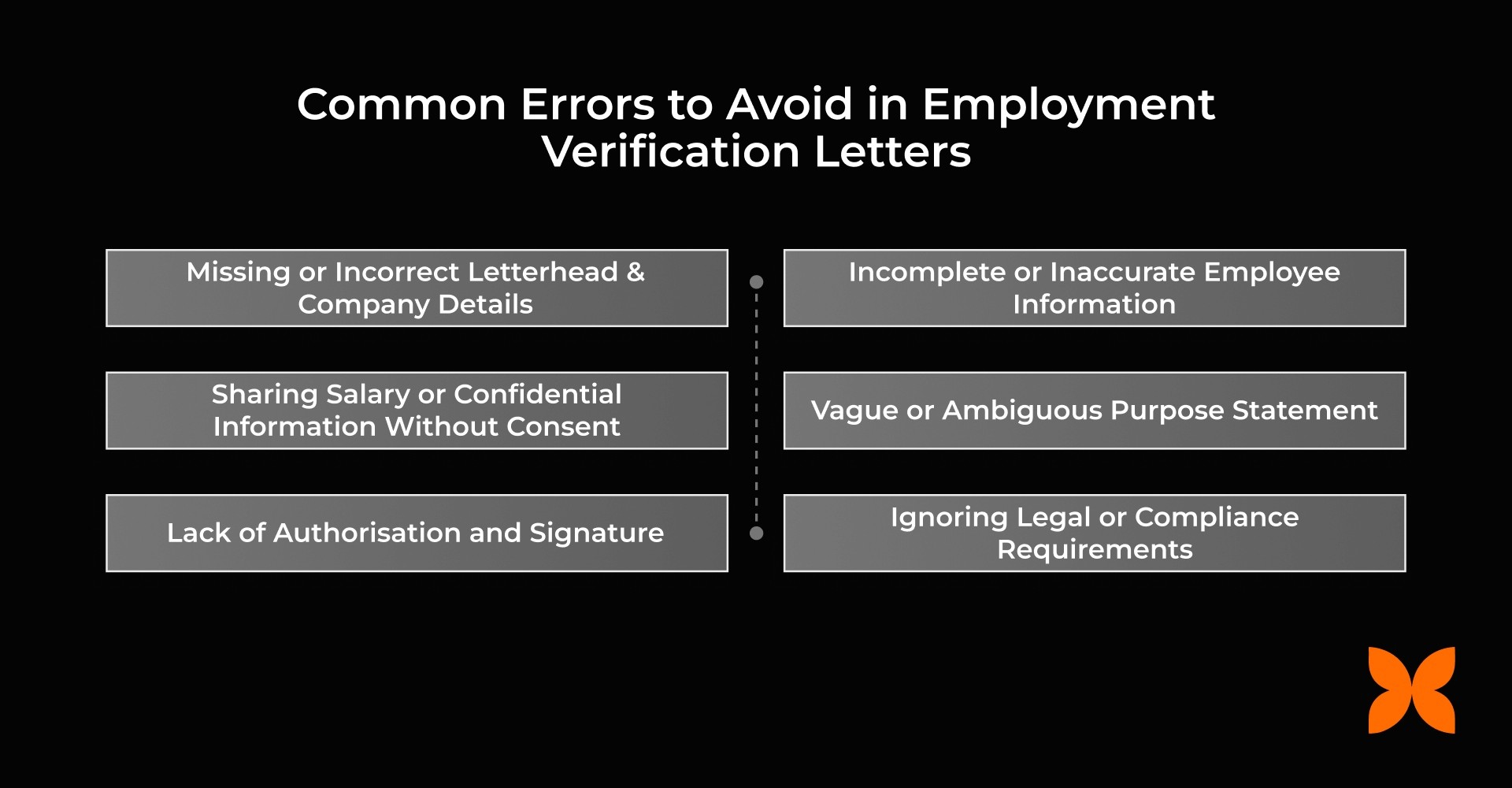
Missing or Incorrect Letterhead and Company Details: A verification letter without the official letterhead, company address, or authorised contact details can appear unofficial or invalid. Always use the company’s official letterhead, include a valid HR contact, and ensure an authorised signatory is mentioned to maintain credibility.
Incomplete or Inaccurate Employee Information: Providing incorrect or incomplete employee details, such as an outdated job title, an incorrect start date, or a missing department, can lead to verification delays or disputes. Always cross-check employee records before drafting the letter to ensure all information is accurate.
Sharing Salary or Confidential Information Without Consent: Sharing salary or other sensitive information without an employee's consent may violate internal policy or Indian privacy norms. Only disclose compensation or benefits if explicitly requested and approved by the employee.
Vague or Ambiguous Purpose Statement: Letters that do not clearly indicate the purpose of the verification (loan, visa, rental, background check) may be rejected or misused. Clearly specify the intended purpose and the recipient organisation to avoid ambiguity.
Lack of Authorisation and Signature: Unsigned letters or letters without an authorised HR signatory reduce credibility. Always ensure the letter is signed, includes the signatory’s designation, and is dated to validate the verification.
Ignoring Legal or Compliance Requirements: Failing to align the letter with employment contracts, company policies, or Indian labour laws can expose the company to legal liability. Before issuing the letter, confirm compliance with internal policies and relevant regulations.
By avoiding these mistakes, HR professionals can issue employment verification letters that are accurate, professional, legally compliant, and trusted by recipients.
Final Thoughts
A well-structured employment verification letter is a critical document that reflects your organisation’s professionalism, credibility, and compliance standards. It provides third parties with accurate, verifiable employment information while keeping your HR records consistent and well-documented. When drafted correctly, it builds trust with employees, financial institutions, landlords, and verification agencies.
Manually managing verification requests can quickly become inefficient and error-prone, especially as your workforce grows. Craze streamlines HR operations by automating employee documentation, verification workflows, and compliance processes from a single platform, ensuring every employment verification letter is accurate and authorised.
FAQs
1. Can an employment verification letter be verbal?
No. Employment verification must be provided in writing to ensure formal acknowledgement, legal validity, and proper documentation for audit and compliance purposes.
2. Who can authorise an employment verification letter?
Employment verification letters should be issued and signed by authorised HR representatives, department heads, or designated company officers in accordance with internal policy.
3. Can salary information be shared?
Salary details should only be disclosed with the employee’s written consent and in compliance with company policy and applicable privacy regulations.
4. Is an employment verification letter the same as a reference letter?
No. An employment verification letter confirms factual employment details such as role, tenure, and status, whereas a reference letter provides a professional assessment or recommendation.
5. What if employment dates or details are disputed?
Maintain accurate HR records, rely on official employment documentation, and issue a factual, neutral letter based on verified records to avoid disputes or liability.
