The Future of AI Agents: What's Real, What's Next, and What to Do Now
AI agents are moving from flashy demos to real production workloads. Here's what the data says about where they're headed, what's actually working, and how to prepare your organization.

By: Kabir Nagral
Co-Founder and CEO
Published
Updated
Edited by Craze Editorial Team · See our Editorial Process
Every major AI lab, enterprise vendor, and startup is racing to ship agents that can do real work, not just answer questions. The market has crossed $7 billion , protocols are standardizing, and companies like Klarna and JPMorgan are reporting measurable ROI from production deployments. But the gap between “we’re experimenting with agents” and “agents are running in production” is still enormous, and Gartner expects over 40% of agentic AI projects to be scrapped by 2027.
This article breaks down what the data actually says about the future of AI agents: where the market stands, which trends matter, what’s delivering results today, how agents are changing work, and what your organization should do about it.
TL;DR
- The market is real and growing fast. The global AI agents market hit roughly $7.8 billion in 2025 and is on track to pass $10.9 billion in 2026, with a projected compound annual growth rate near 50%.
- Enterprise adoption is widespread but shallow. About 79% of organizations report some level of agentic AI adoption, yet only 31% have an agent running in production.
- Narrow, well-defined tasks are where agents deliver today. Code review, IT operations, customer support triage, and multi-source research are producing measurable ROI. Fully autonomous, open-ended agents remain unreliable.
- Protocols are standardizing quickly. MCP (agent-to-tool) and A2A (agent-to-agent) joined under the Linux Foundation AI & Agents Foundation in late 2025, backed by OpenAI, Anthropic, Google, Microsoft, and AWS.
- Expect a correction before the next leap. Over 40% of agentic AI projects will be canceled by the end of 2027, according to Gartner, mostly due to operationalization failures, not technology shortcomings.
What We Mean by “AI Agents” (A Quick Refresher)
If you’ve been following the AI space, you’ve probably noticed that “agent” gets slapped onto just about everything now. A chatbot with an API call? Agent. A workflow automation with an LLM step? Also agent.
A fully autonomous system that plans, reasons, and executes multi-step tasks with minimal human involvement? That’s an agent too.
An AI agent is a software system powered by a large language model that can perceive its environment, reason about what to do, take actions using external tools, and learn from the results. The key distinction from a regular chatbot is autonomy: you give it a goal, and it figures out the steps.
That said, there’s a spectrum. Some agents handle a single task with a couple of tool calls. Others coordinate with multiple agents, access dozens of tools, and run complex agentic workflows across enterprise systems. The types of AI agents you’ll encounter range from simple reflex agents to sophisticated learning agents that improve with every interaction.
Understanding where your use case falls on that spectrum matters a lot for what’s realistic today versus what’s still aspirational. Let’s look at the numbers.
The AI Agent Market in 2026: Where Things Stand
Market Size and Growth
The AI agent market has moved well past the “emerging technology” phase. The global market reached approximately $7.8 billion in 2025 and is projected to hit $10.9 billion in 2026, according to Grand View Research. Precedence Research puts the 2026 figure slightly higher at $11.5 billion .
The growth rate tells the bigger story. The market is expanding at a compound annual growth rate of roughly 45% to 50%, depending on whose model you trust. MarketsandMarkets projects the market reaching $47 billion by 2030.
North America dominates with about 40% of global revenue, followed by Europe and Asia-Pacific. By technology segment, machine learning leads at roughly 31% market share, and single-agent systems still account for about 59% of deployments, though multi-agent architectures are growing faster.
Where the Money Is Going
The investment picture in 2026 is staggering, if a bit top-heavy. AI captured 61% of all global venture capital in 2025, totaling $258.7 billion. In Q1 2026 alone, AI startups raised $255.5 billion , surpassing the entire 2025 total, though three mega-deals accounted for two-thirds of that capital.
Within the agentic AI category specifically, companies raised $2.66 billion across 44 rounds through April 2026, compared to $1.09 billion in the same period of 2025. All that capital is chasing a set of trends that are reshaping what agents can actually do.
The AI Agent Landscape: Six Trends Shaping the Future
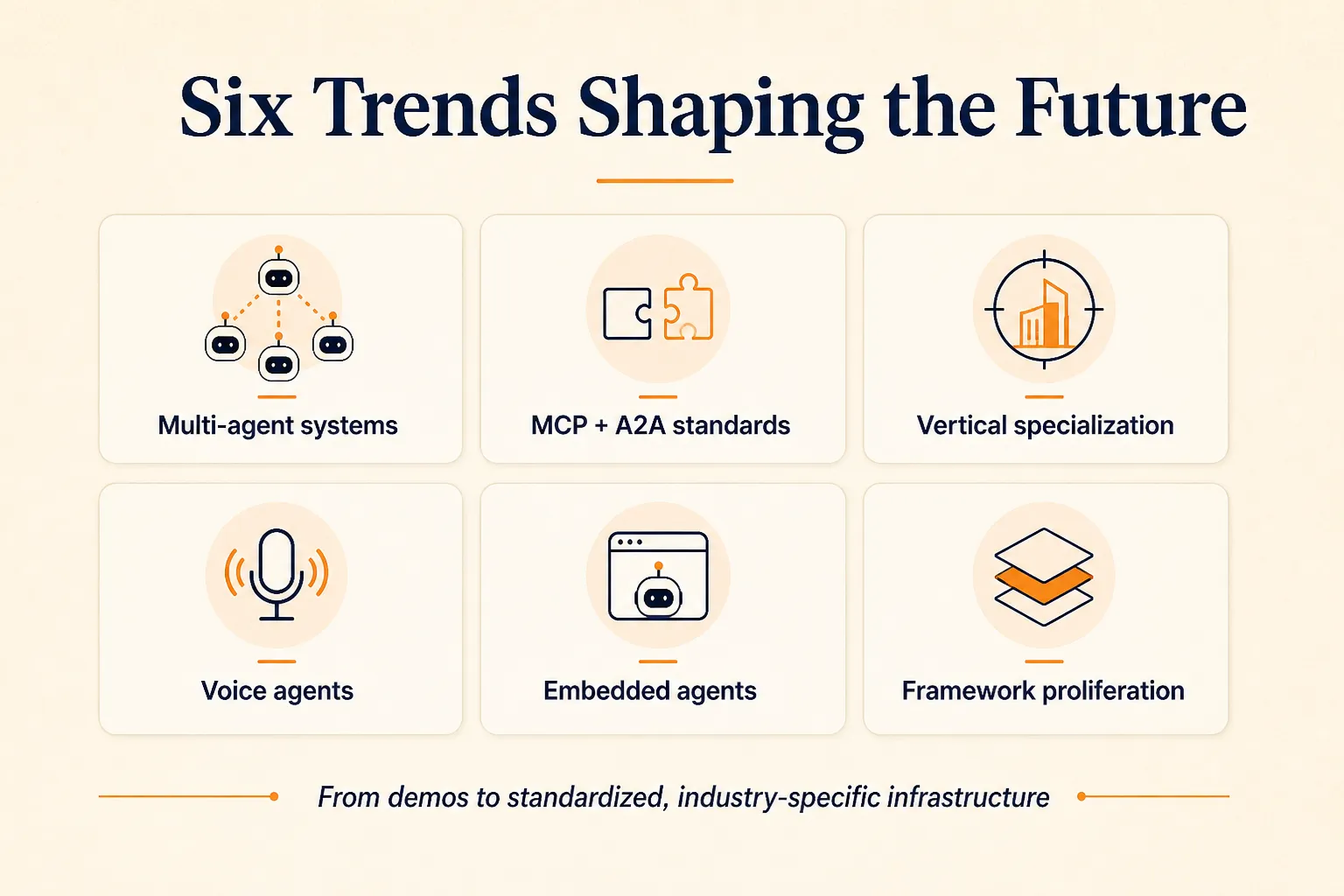
1. The Rise of Multi-Agent Systems
Single agents handling single tasks got us through the early phase. The future belongs to teams of specialized agents working together.
Gartner reported a 1,445% surge in enterprise inquiries about multi-agent systems from Q1 2024 to Q2 2025. That’s not just curiosity; it reflects a real shift in how companies are thinking about deploying agents at scale.
In a multi-agent setup , you might have one agent handling data extraction, another analyzing the results, a third generating reports, and an orchestration layer coordinating the whole thing. Each agent can be optimized for its specific task, tested independently, and swapped out without breaking the pipeline.
The practical benefit is reliability. A single agent trying to do everything tends to make compounding errors. Specialized agents with clear boundaries tend to fail in smaller, more manageable ways.
2. Protocol Standardization: MCP and A2A
If multi-agent systems are the future, they need a common language. That’s exactly what’s happening.
Two major protocols have emerged. MCP (Model Context Protocol), originally from Anthropic, handles the “vertical” connection between agents and tools. Google’s A2A (Agent-to-Agent) protocol handles “horizontal” communication between agents. Both joined the Linux Foundation AI & Agents Foundation in December 2025, with founding support from OpenAI, Anthropic, Google, Microsoft, AWS, and Block.
Here’s why this matters: before standardization, every agent framework had its own way of connecting to tools and other agents. Building integrations was tedious and fragile. With MCP and A2A becoming industry standards, an agent built with one framework can potentially interact with tools and agents from completely different ecosystems.
Think of it like the moment the web settled on HTTP. The individual components already existed, but the shared protocol made everything interoperable. We’re at a similar inflection point for agents.
3. Vertical Specialization Over Horizontal Generalization
The most successful agents in production today aren’t general-purpose assistants. They’re vertical AI agents built for specific industries and specific tasks.
This makes sense when you think about it. A customer support agent needs to understand your product, your policies, and your tone. A healthcare scheduling agent needs to handle HIPAA compliance, insurance verification, and appointment protocols. A legal document review agent needs jurisdiction-specific knowledge.
Specialized agents show 3 to 5 times higher retention rates than horizontal tools. The AI agent landscape in 2026 reflects this: market maps now show dozens of categories from finance and accounting to HR and talent acquisition, each with dedicated agent vendors.
A three-tier ecosystem has emerged: infrastructure platforms (like VAPI and Retell AI) that power the compute layer, vertical-specific vendors that own the domain expertise, and white-label agencies that customize and resell. Companies building deep vertical expertise are winning, while generic “do anything” agents struggle with specialized vocabulary, compliance needs, and workflow integration.
4. Voice Agents Go Mainstream
Voice is one of the fastest-growing agent modalities. 87.5% of builders are actively building voice agents, not just researching them. The voice recognition market hit $18.4 billion in 2025 and is projected to reach $61.7 billion by 2031.
What changed? Latency dropped below the threshold where conversations feel natural. Emotional intelligence capabilities (detecting frustration, urgency, confusion) have reduced call escalations by up to 25%. And voice agents can now handle real-time personalization mid-conversation, adjusting their approach based on caller history and sentiment.
Conversational AI agents are moving from novelty to necessity, particularly in customer service, healthcare scheduling, and field service dispatch where hands-free interaction has obvious advantages.
5. Enterprise Platforms Embed Agents Everywhere
Gartner predicts that 40% of enterprise applications will include task-specific AI agents by 2026, up from less than 5% in 2025. More specifically, 80% of enterprise software shipped or updated in Q1 2026 embeds at least one AI agent, up from 33% in 2024.
This isn’t agents as a standalone product. It’s agents woven into the tools you already use: your CRM, your project management platform, your accounting software, your code editor. Salesforce has Agentforce, ServiceNow has Now Assist, Microsoft has Copilot agents, and nearly every major SaaS vendor is racing to add agent capabilities.
The upside is accessibility. You don’t need to build an AI agent from scratch; your existing software will increasingly come with agent features built in. The downside is that “embedded agent” quality varies wildly, and many of these features are still more marketing than substance.
6. Agent Frameworks Proliferate
Every major AI lab now has its own agent framework. OpenAI has the Agents SDK, Google released ADK, Anthropic shipped the Agent SDK, Microsoft maintains Semantic Kernel and AutoGen, and HuggingFace built Smolagents. On the open-source side, LangGraph, CrewAI, and several others are competing for developer adoption.
This is both a sign of maturity and a source of fragmentation. If you’re evaluating agent builders today, the choice of framework shapes your agent’s capabilities, integration options, and long-term flexibility. Protocol standardization (MCP, A2A) is helping reduce lock-in, but framework choice still matters for the architecture of your system.
AI Agent Trends in 2026: What the Analysts Say
Gartner’s View: Rapid Growth, Significant Failure Rate
Gartner is simultaneously bullish and cautious. On one hand, they project that agentic AI could drive approximately 30% of enterprise application software revenue by 2035, surpassing $450 billion, up from 2% in 2025. They also predict 60% of brands will use agentic AI for one-to-one customer interactions by 2028.
On the other hand, Gartner predicts that over 40% of agentic AI projects will be scrapped by the end of 2027. The reason isn’t that the technology fails; it’s that current models don’t have the maturity to autonomously achieve complex business goals, and organizations struggle to operationalize agents beyond pilots.
The takeaway: 2025 showed rapid experimentation. 2026 and 2027 will be about separating projects that deliver real value from those that looked good in a demo but can’t survive contact with production data and real users.
McKinsey’s Estimate: Trillions in Potential Value
McKinsey estimates AI agents could add $2.6 to $4.4 trillion in value annually across various business use cases. They also found that high-performing organizations are three times more likely to scale agents successfully than their peers.
What separates the high performers? According to McKinsey, it’s not the technology. It’s organizational readiness: clean data, clear ownership, integration capabilities, and a culture that supports iterative deployment rather than big-bang launches.
Deloitte: The Gap Between Talk and Deployment
Deloitte’s Tech Trends 2026 report highlights a persistent gap between enthusiasm and execution. While 96% of organizations plan to expand AI agent usage, many are stuck in pilot phase. Enterprise data readiness remains the single biggest blocker, ahead of talent shortages and regulatory concerns.
So what does that gap between ambition and reality look like in practice?
What’s Actually Working (And What Isn’t)
The Wins
IT Operations and Employee Service
Constrained environments with clear boundaries and human-in-the-loop approval are where agents shine. Automated ticket routing, first-line support responses, and routine system monitoring produce measurable time savings.
Code Review and Development Assistance
Agents that read pull requests, check against style guides, flag potential bugs, and suggest fixes are genuinely useful. They don’t replace developers, but they catch the stuff that’s easy to miss at 4 PM on a Friday.
Multi-Source Research and Synthesis
Asking an agent to research a topic across 20-plus sources and produce a structured report with citations works reliably. For the types of AI agent use cases involving information gathering and synthesis, agents save hours of manual work.
Customer Support Triage
AI agents for customer support that classify incoming tickets, pull relevant context from knowledge bases, and draft responses for human review are reducing average handling time by 20% to 40% in multiple reported deployments.
Finance and Accounting
Finance AI agents handling invoice matching, expense categorization, and reconciliation are structured enough to deliver high accuracy. The data is tabular, the rules are explicit, and exceptions are flagged for human review.
The Struggles
Fully Autonomous, Open-Ended Tasks
Asking an agent to “handle my inbox” or “manage this project” still produces unreliable results. Agents work best when the goal is specific, the tools are defined, and the success criteria are clear.
Computer Use on Complex Interfaces
Agents that navigate web browsers and desktop applications work on simple, structured tasks but fail frequently on dynamic, complex interfaces. This is still more demo than production-ready for most real-world use cases .
Cross-System Workflows Without Clean Data
If your CRM data is messy, your agent will make messy decisions. Garbage in, garbage out applies with extra force when the system acting on the garbage has real autonomy.
High-Stakes Decisions Without Guardrails
Agents making financial trades, legal judgments, or medical recommendations without human oversight? Still a bad idea. The error rate is low enough to be impressive in demos but too high for decisions where mistakes have serious consequences. The wins and struggles above give you the categories, but named examples with dollar figures paint a clearer picture.
Real-World Results: Case Studies and ROI
The numbers look compelling when agents are deployed against the right problems. Companies report an average ROI of 171% from agentic AI deployments, with 74% of executives achieving ROI within the first year. But these averages mask a wide spread: a 2025 MIT study found that 95% of generative AI pilots fail to deliver measurable returns. The difference between the winners and the rest comes down to scope, data readiness, and whether the use case was genuinely suited to automation.
Here’s what quantified results actually look like across industries.
Klarna: Customer Service at Scale
Klarna’s AI customer service agent handled the equivalent workload of 853 full-time agents by Q3 2025, saving the company roughly $60 million. But the story has a useful caveat: Klarna later brought back human representatives after discovering that fully automated support eroded customer satisfaction in complex cases. The lesson isn’t that agents don’t work for support. It’s that the most effective deployments pair agent speed on routine queries with human judgment on escalations.
JPMorgan Chase: Research and Analysis
JPMorgan runs over 450 AI use cases in production daily, with agentic AI generating investment banking presentations in 30 seconds that previously took analysts hours. Their LLM Suite serves roughly 200,000 employees across research analysis, document summarization, and idea generation.
Morgan Stanley: Legacy Code Migration
DevGen.AI reviewed over 9 million lines of legacy code and saved Morgan Stanley’s developers approximately 280,000 hours. Across the industry, enterprises adopting coding assistants report a 376% ROI lift over three years, with payback in under six months.
AtlantiCare: Clinical Documentation
Providers using AtlantiCare’s AI documentation agent saw a 42% reduction in documentation time, saving approximately 66 minutes per day. In healthcare, where physician burnout drives turnover costs of $500,000 to $1 million per departure, documentation automation delivers ROI that goes beyond direct time savings.
Cross-Industry Patterns
Cost savings of 26% to 31% are reported across supply chain and procurement, finance and accounting, and customer operations. Time-to-ROI varies significantly by use case: customer service agents typically show returns within two weeks, while supply chain orchestration takes 12-plus months to deliver measurable impact.
The pattern across these examples is consistent: agents deliver the strongest ROI on high-volume, well-structured tasks within established workflows, not on open-ended automation of entire functions.
How AI Agents Are Reshaping Work
The workforce question is unavoidable. If agents can handle the workload of 853 customer service reps (Klarna’s number), what happens to the humans?
The data suggests the answer is more nuanced than either the optimists or pessimists claim. The World Economic Forum’s Future of Jobs Report 2025 projects that 92 million jobs will be displaced globally by 2030, but 170 million new roles will emerge, resulting in a net gain of 78 million positions. Job disruption will touch roughly 22% of all roles, but the net direction is creation, not elimination.
That said, the transition won’t be smooth or evenly distributed. Gartner predicts AI’s impact on global jobs will be roughly neutral through 2026, but specific roles face sharper disruption. Paralegals face an 80% automation risk by 2026, medical transcription is already 99% automated, and entry-level data processing roles are shrinking in nearly every sector.
The Shift From Doing to Managing
The more accurate framing isn’t “agents replace workers.” It’s “agents change what work looks like.” The pattern emerging across enterprises is a shift from humans doing repetitive execution to humans managing AI-driven execution: setting goals, reviewing outputs, handling exceptions, and making judgment calls that agents can’t.
Organizations succeeding with agents are creating entirely new roles around agent oversight, according to Harvard Business Review . AI agent managers coordinate blended human-AI teams, deciding which tasks go to agents versus humans based on context, capability, and risk tolerance. AI product managers own the roadmap for autonomous agent products. Agent systems engineers design the architectures that connect agents to enterprise workflows.
These aren’t theoretical roles. Roughly 60% of new enterprise software projects in 2026 include an agentic component, which means every one of those projects needs people who understand how to specify, deploy, monitor, and govern agents.
Skills, Not Job Titles, Are What’s Shifting
Workers with AI skills command wage premiums up to 56% higher than their peers, according to PwC’s Global AI Jobs Barometer. And 91% of employees say their organizations use at least one AI technology in 2025. The gap isn’t between companies that use AI and those that don’t. It’s between workers who can collaborate effectively with AI systems and those who can’t.
The World Economic Forum estimates that nearly two-fifths of current skills will become obsolete within five years. The fastest-growing skills by 2030 include a mix of technical capabilities (AI literacy, data analysis, systems thinking) and distinctly human ones (critical thinking, collaboration, creative problem-solving). The roles least likely to be automated are those requiring empathy, complex judgment, and physical dexterity in unpredictable environments.
For organizations, the practical implication is clear: invest in upskilling now, not after the disruption arrives. The companies getting this right treat agents as tools that accelerate career development. Junior employees working alongside agents learn faster, handle more complex tasks earlier, and move up the ladder in less time because they’re not stuck on the manual grunt work that used to consume their first two years. Of course, how fast any of this plays out depends partly on what regulators decide.
The Regulatory Picture: EU vs. US
The EU AI Act
The EU AI Act becomes fully applicable in August 2026. It classifies AI systems into risk tiers, from minimal to unacceptable, and imposes escalating requirements for transparency, human oversight, documentation, and conformity assessment.
For AI agents specifically, the picture is complicated. As a TechPolicy.Press analysis noted, the Act wasn’t written with autonomous agents in mind. It identifies five governance challenges agents pose: performance, misuse, privacy, equity, and oversight. The harmonized technical standards for high-risk AI systems, now delayed to late 2026, haven’t yet addressed agents explicitly.
If you’re deploying agents in Europe or serving European users, you’ll also need to navigate the GDPR, the Cyber Resilience Act, and the Digital Services Act. The compliance overhead is real, but it’s also pushing vendors toward better documentation, explainability, and audit trails, which benefits everyone.
On May 7, 2026, the EU Council and Parliament agreed to simplify and streamline AI rules, signaling awareness that the original framework needs updating for the pace of development.
The US Approach
The US is taking a markedly different approach. In December 2025, President Trump issued an executive order establishing a federal AI policy framework focused on maintaining US global AI dominance through minimal regulation. The order created an AI Litigation Task Force to challenge state AI laws considered too restrictive.
In March 2026, the White House released a National Policy Framework recommending that Congress broadly preempt state-level AI legislation.
This creates a transatlantic split. Companies operating globally need to build agents that can comply with the stricter EU requirements while potentially benefiting from lighter US regulation. In practice, most serious enterprise vendors are building to the higher standard, since it’s easier to relax compliance than to retrofit it.
Preparing Your Organization: A Practical Playbook
The future of AI agents doesn’t require you to bet your entire technology strategy on any single vendor or approach. Here’s what practical preparation looks like.
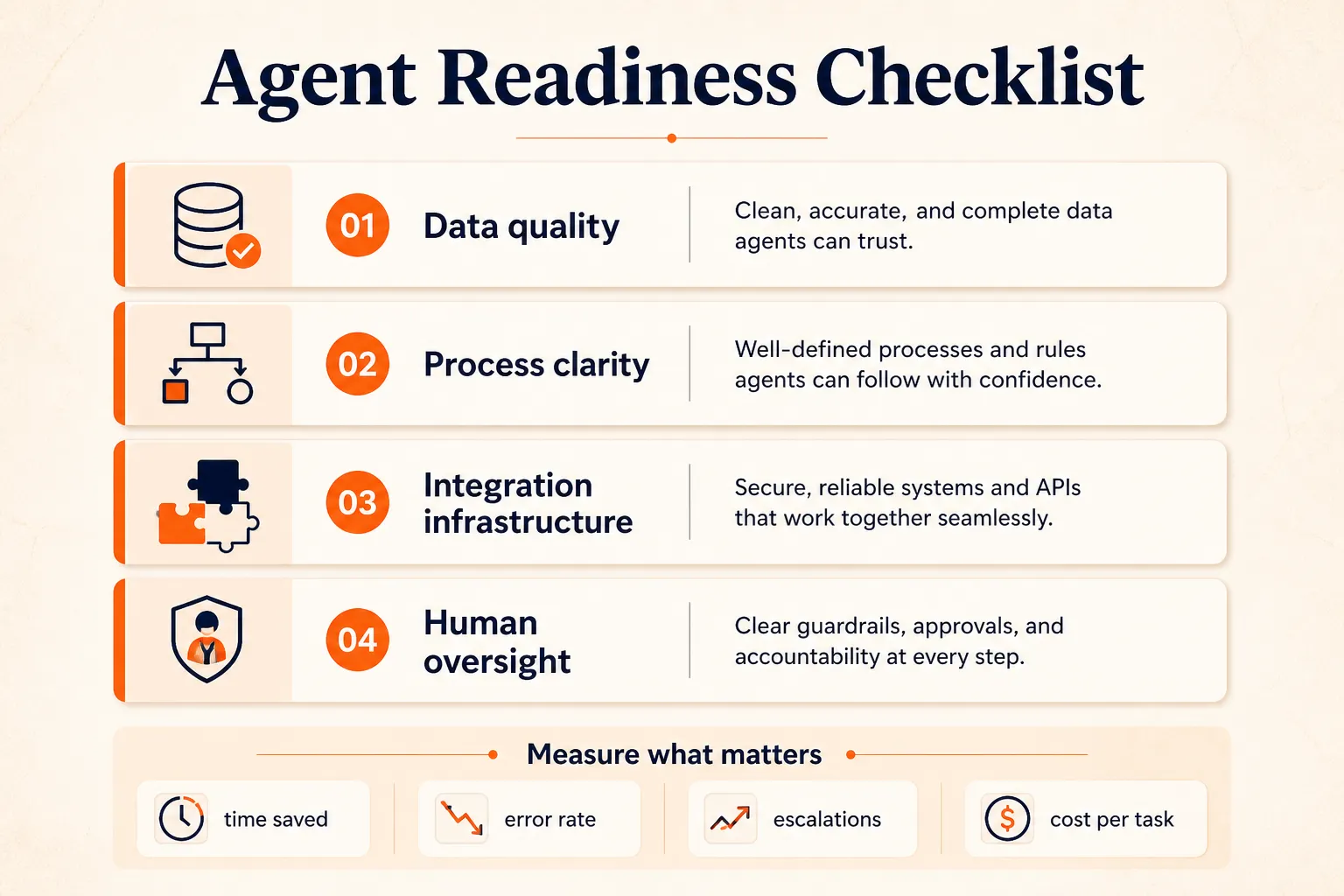
Step 1: Audit Your “Agent Readiness”
Before you buy or build anything, assess three things:
- Data quality. Agents are only as good as the data they can access. If your CRM is a mess, fix that first. If your knowledge base is outdated, update it before pointing an agent at it.
- Process clarity. Can you describe your workflows in explicit, step-by-step terms? Agents need clear instructions, defined tools, and measurable success criteria. Ambiguous processes produce ambiguous results.
- Integration infrastructure. Agents need to connect to your existing systems. API availability, authentication mechanisms, and data access policies all need to be in place.
Step 2: Start With the Boring Stuff
The most successful agent deployments aren’t flashy. They’re automating the tedious, repetitive tasks that nobody wants to do but everyone depends on. Think: data entry validation, report generation from structured sources, ticket classification, meeting scheduling, and document formatting.
These tasks share a common profile: clear inputs, predictable patterns, well-defined success criteria, and low consequences for errors. They’re the perfect proving ground for agents in your organization.
Look at your team’s day-to-day work. The tasks that make people groan, the ones that eat up time without requiring deep expertise, are your best starting candidates. Browsing proven use cases and real-world examples can help you spot patterns that apply to your team.
Step 3: Pick the Right Architecture
Your architecture choice depends on your needs:
- Single agents work for isolated tasks. They’re simpler to build, test, and maintain. If your use case is “summarize this document” or “route this support ticket,” a single agent is probably enough.
- Multi-agent systems are better for complex workflows that cross functional boundaries. If your use case involves research, analysis, decision-making, and reporting across different data sources, multi-agent orchestration becomes worthwhile.
- Embedded agents (built into your existing SaaS tools) are the lowest-effort option. They won’t be customized to your specific needs, but they provide a fast way to start experiencing agent capabilities.
Your agent architecture will likely evolve as you learn which patterns fit your workflows best.
Step 4: Build in Human Oversight From Day One
Every agent deployment needs a clear escalation path. Define what decisions the agent can make autonomously, what requires human approval, and what triggers an immediate handoff to a human.
This isn’t about being cautious for the sake of it. It’s about building trust incrementally. Start with tight guardrails, measure performance, and loosen constraints as you develop confidence in the agent’s reliability. The organizations succeeding with agents are the ones that treat autonomy as something earned through demonstrated competence, not granted upfront.
Step 5: Measure What Matters
Define your success metrics before deployment, not after. Good metrics for agent deployments include:
- Time saved per task compared to manual execution
- Error rate compared to human performance on the same task
- Escalation frequency (how often does the agent need human help?)
- User satisfaction (do the people working with the agent find it helpful?)
- Cost per completed task (including compute, API calls, and human oversight time)
Avoid vanity metrics like “number of agent interactions” or “tasks attempted.” What matters is tasks completed correctly and time actually saved. With those foundations in place, here’s what the broader market trajectory looks like.
What the Next Two Years Look Like
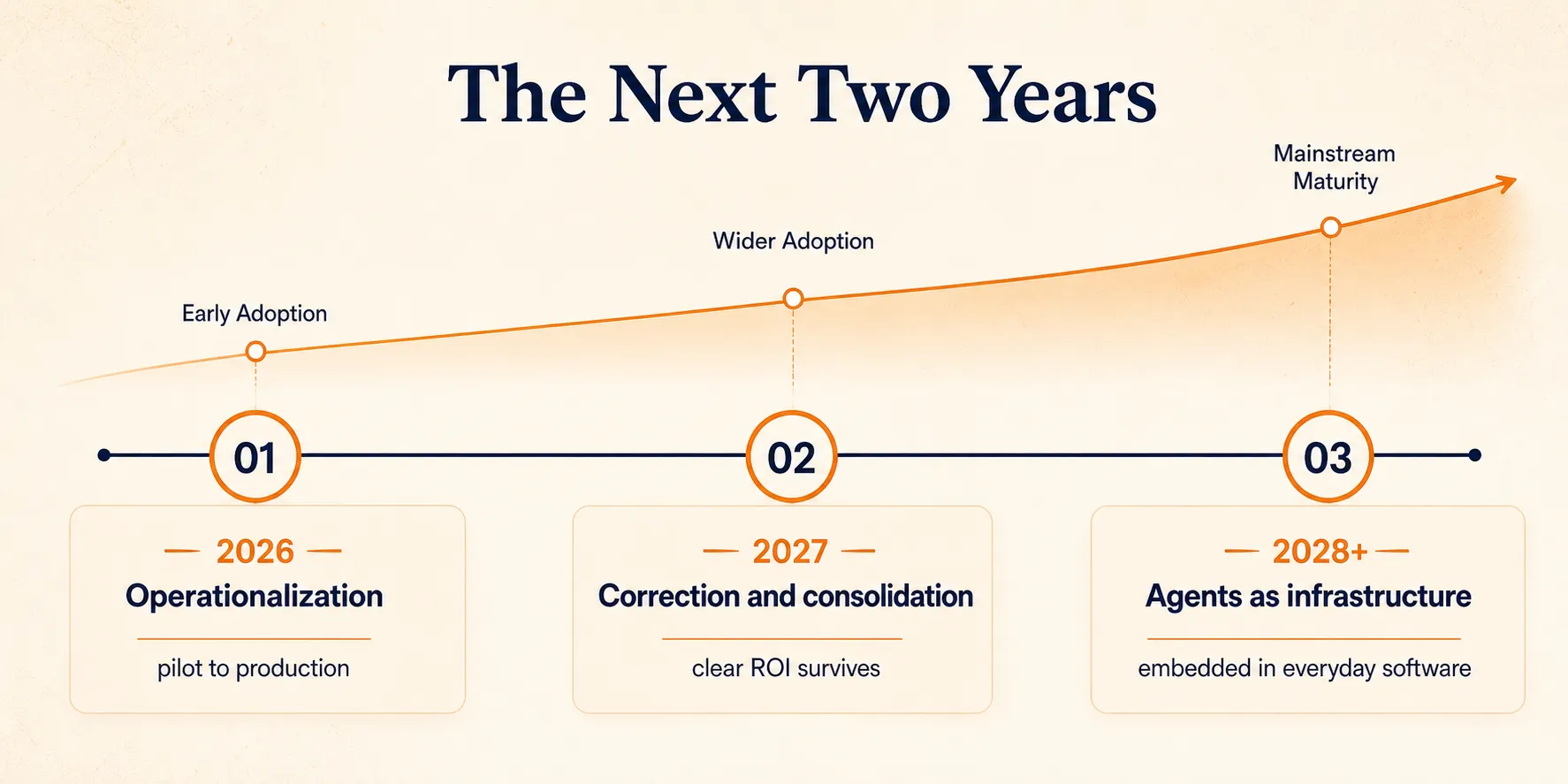
2026: The Year of Operationalization
The experimentation phase is wrapping up. 2026 is about moving from pilot to production, which means confronting the operational challenges that demos don’t reveal: identity management, permissions, auditability, error handling, and change management.
Expect consolidation in the agent builder market as organizations standardize on platforms that handle these operational requirements well. The vendors who make agents easy to deploy, monitor, and govern will win over those who focus purely on capabilities.
Protocol adoption (MCP and A2A) will accelerate, making it easier to swap components and avoid vendor lock-in. This is good news for buyers.
2027: The Correction and Consolidation
Gartner’s prediction of 40%-plus project cancellations will play out. This isn’t a sign that agents don’t work; it’s the normal pattern when a technology moves from hype cycle peak into the productive phase. Projects with clear ROI will survive. Projects built on vague “let’s see what AI can do” mandates will not.
Multi-agent systems will become the default architecture for complex enterprise workflows, replacing the single-agent-does-everything approach. Agent skills and specialization will matter more than raw model capability.
2028 and Beyond: Agents as Infrastructure
At some point, “AI agent” will stop being a category and start being assumed. Just as nobody talks about “cloud-based software” anymore (because nearly all software is cloud-based), agents will become an expected component of business software.
Gartner estimates that by 2028, a third of enterprise applications will embed agentic AI, with 15% of routine decisions made autonomously. McKinsey’s $2.6 to $4.4 trillion value estimate starts looking achievable at this scale, not from any single killer application, but from thousands of small productivity gains compounding across every business function.
What This Means for You
The future of AI agents isn’t one big moment. It’s a steady accumulation of capabilities that make software more useful, workflows more efficient, and teams more productive.
Here’s the honest version: if you haven’t started experimenting with agents yet, you’re not too late. The technology is mature enough to be useful and young enough that best practices are still forming. But you also can’t afford to wait two more years. The organizations building agent competency now will have a significant advantage when the infrastructure and tooling mature.
Start with a real problem, not a technology looking for a problem. Pick something boring and valuable, build in human oversight, and measure the results. Then expand.
The hype will come and go. The agents that do useful work will stick around.
If you’re just getting started, our guide on what an AI agent actually is covers the fundamentals, and the AI Agent hub maps out the broader ecosystem.
FAQs
Will AI agents replace human workers?
Not wholesale, and not soon. AI agents are best at automating narrow, repetitive tasks within larger workflows, not replacing entire job functions. The pattern that's working in 2026 is humans setting goals and guardrails while agents handle execution on well-defined tasks. Think of them as very capable interns who need clear instructions and supervision, not autonomous replacements for experienced professionals.
What industries are adopting AI agents fastest?
Banking and insurance lead with roughly 47% of organizations running agents in production, according to S&P Global Market Intelligence. Customer service, IT operations, and software development follow closely. Healthcare and government trail at 18% and 14% respectively, largely due to stricter regulatory requirements and data sensitivity concerns.
How much does it cost to deploy an AI agent?
Costs vary widely. No-code agent builders start at $50 to $500 per month for simple workflows. Enterprise deployments with custom integrations typically run $50,000 to $500,000 for initial setup, plus ongoing compute and API costs. The biggest hidden cost isn't the technology itself; it's the data preparation, integration work, and change management needed to make agents useful.
What's the difference between AI agents and chatbots?
Chatbots respond to individual prompts in a conversation. AI agents can plan multi-step tasks, use external tools, take actions across systems, and work toward goals with minimal human input between steps. A chatbot answers your question about flight prices. An agent researches options, compares them against your preferences, checks your calendar, and books the best option. For a deeper comparison, see our guide on AI agents vs chatbots.
What regulations apply to AI agents?
The EU AI Act, which becomes fully applicable in August 2026, classifies AI systems by risk level and imposes requirements for transparency, human oversight, and documentation. In the US, a December 2025 executive order established a federal AI policy framework aimed at preempting stricter state-level laws. For any agent handling personal data, GDPR and similar privacy laws also apply. The regulatory picture is still evolving, especially for autonomous agent capabilities.
More Articles
The 8 Best Lindy AI Alternatives in 2026 (Tested & Compared)

The 8 best Lindy AI alternatives for 2026, anchored to why people leave Lindy, with current pricing, third-party ratings, honest pros and cons, and the best pick for each reason to switch.
The 7 Best Make Alternatives in 2026 (Tested & Compared)
The 7 best Make.com alternatives for 2026, anchored to why people leave Make, with current pricing, third-party ratings, honest pros and cons, and the best pick for each reason to switch.
The 8 Best Zapier Alternatives in 2026 (Tested & Compared)
The 8 best Zapier alternatives for 2026, anchored to why people leave Zapier, with current pricing, third-party ratings, honest pros and cons, and the best pick for each reason to switch.