


Managing employee performance can feel like a difficult task, especially when current systems lead to mistakes and confusion. As teams grow and business goals change, it’s easy for performance tracking to become inconsistent, leaving gaps in feedback and development.
45% of organisations say that driving a consistent performance management process is their top goal, yet many still face challenges in making this work.
This blog will show you how to address these issues, offering practical steps to make employee performance audits more accurate, efficient, and aligned with your company’s needs.
Conducting an employee performance audit ensures that individual performance aligns with your business goals, boosting productivity and growth.
The audit process includes setting clear goals, monitoring performance, providing continuous feedback, and evaluating results.
Craze's Performance Management Software simplifies the audit process by automating reviews, offering 360-degree feedback, and tracking real-time performance.
Regular audits help identify skill gaps and improve employee engagement, fostering a culture of growth and continuous improvement.
Use insights from performance audits to make data-driven decisions that guide talent management and enhance organisational success.
An employee performance audit is a detailed review of how well employees are meeting the goals set by the organisation. It involves comparing actual performance to the predefined objectives and identifying areas of strength and areas that need improvement.
This audit helps ensure that employees are on track and aligned with the company’s overall goals.
Benefits of Employee Performance Audits
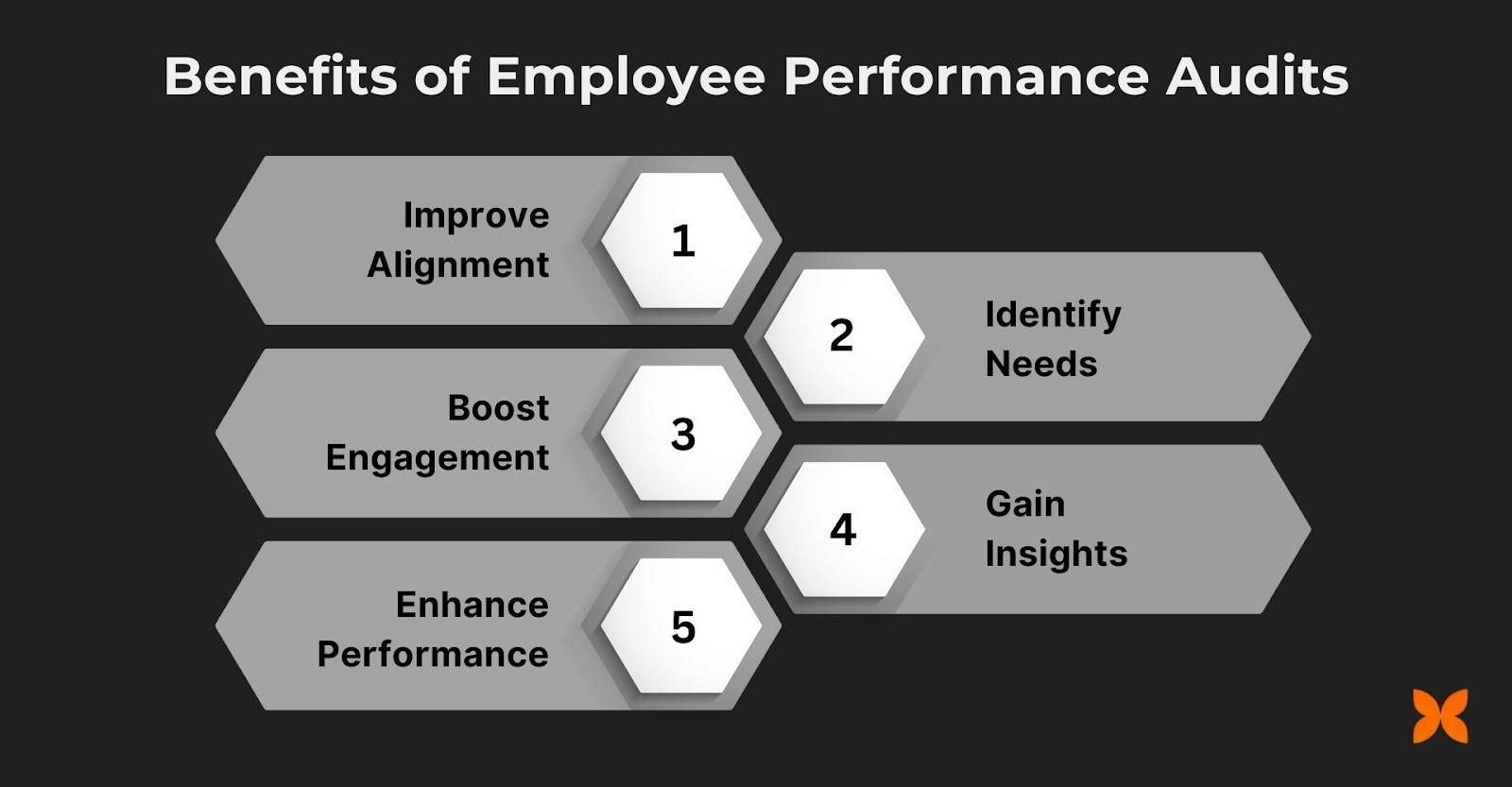
Conducting regular performance audits offers a range of benefits for both employees and the organisation:
Improve Alignment: Ensures that employee efforts align with the company’s strategic goals.
Spot Development Needs: Highlights areas where employees require additional skills or training to enhance their performance.
Increase Employee Engagement: Regular feedback keeps employees motivated and helps them stay focused on growth.
Get Data-Driven Insights: Provides valuable data to inform decisions about promotions, raises, or additional training.
Enhance Performance: Consistent evaluations lead to better overall performance as employees are guided towards improvement.
The next step is to understand how to conduct a thorough employee performance audit that aligns employee efforts with business goals.
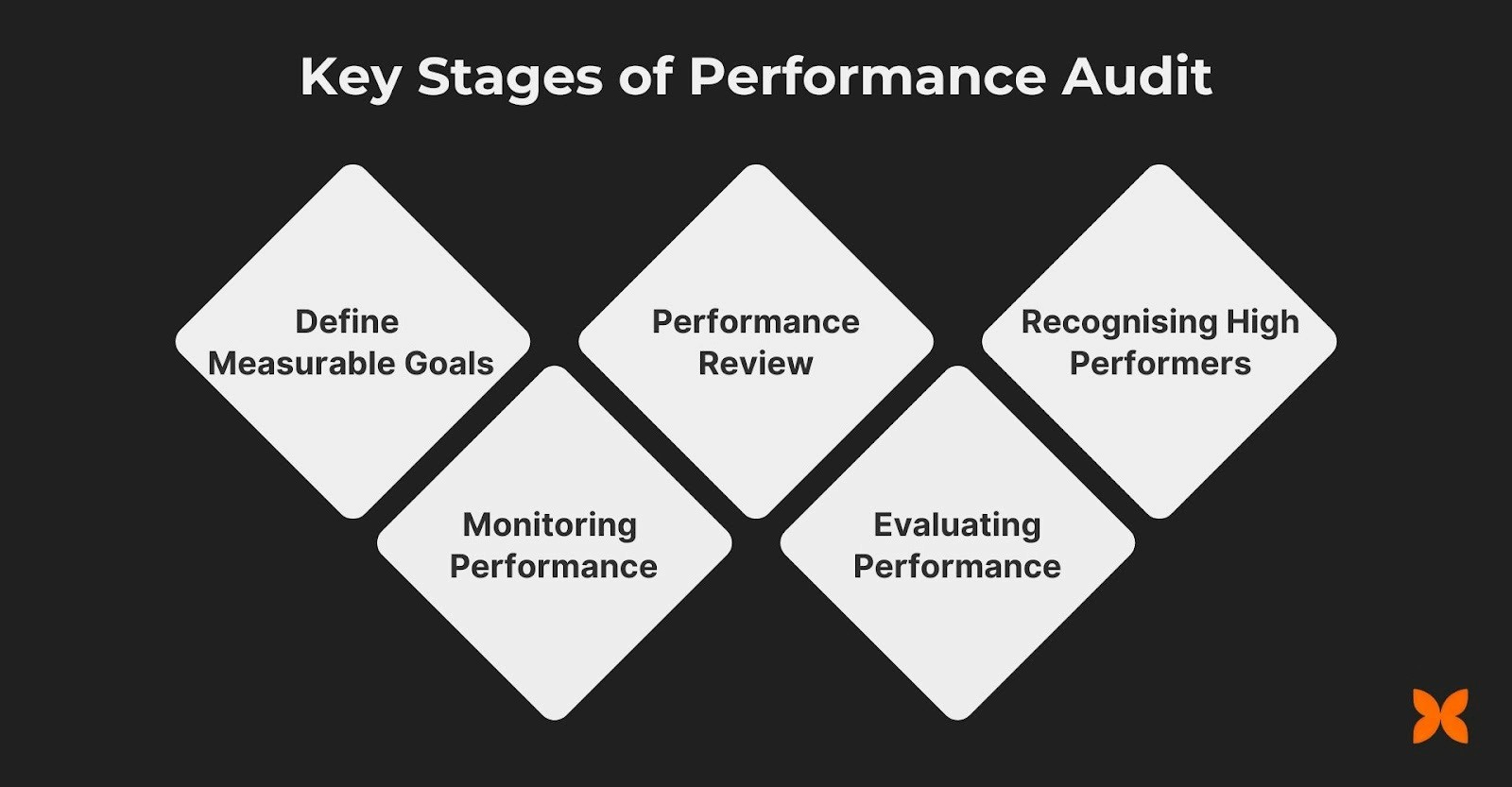
To effectively conduct an employee performance audit, it’s important to break the process down into clear, actionable stages.
Stage 1: Setting Clear, Measurable Goals
Start by defining OKRs (Objectives and Key Results) that align directly with your business objectives. OKRs offer a structured approach to goal-setting, enabling you to clearly define what needs to be achieved and how success will be measured.
Unlike traditional goal-setting, OKRs focus on both the outcome (the objective) and the key results (the measurable actions to achieve it). By setting OKRs, you provide employees with clear direction and a roadmap for achieving both personal and organisational goals.
OKRs help create a focused framework for employees, ensuring clarity in expectations.
Linking OKRs to performance management aligns employee efforts with broader company goals, providing structure to assessments.
Clear, measurable OKRs drive employee growth, making it easier to track progress and give real-time feedback.
To make tracking and managing these goals easy, use Craze’s Goals & OKR Software, which allows you to set, monitor, and review OKRs at both the individual and organisational levels.
Stage 2: Monitoring Performance
Tracking employee performance continuously with real-time metrics and feedback is crucial for early intervention and support.
Continuous feedback ensures that employees are on track and can adjust their efforts as needed.
Employee engagement increases when they receive timely and constructive feedback.
Performance metrics provide clear data points, making it easier to identify issues early on.
Stage 3: Regular Performance Reviews
Reviews are essential for providing employees with a comprehensive evaluation.
360-degree feedback gathers insights from managers, peers, and employees themselves.
These reviews provide a well-rounded view of performance across different work areas.
Regular reviews help identify strengths and areas for improvement, making the process more holistic.
Stage 4: Evaluating Performance
Measure employee performance against their goals to accurately assess their contributions. Using data-driven insights makes the evaluation process more reliable.
Employee performance should be assessed with a mix of quantitative metrics and qualitative feedback.
Performance appraisal based on predefined criteria leads to fairer evaluations.
Performance analytics provide valuable insights into trends, strengths, and areas that require attention.
Stage 5: Recognising High Performers
Recognising and rewarding top performers motivates others and strengthens a high-performance culture across the organisation.
Employee recognition boosts morale and encourages a positive work environment.
Rewards and recognition can be tied to achievements, reinforcing the desired behaviour.
Building a high-performance culture ensures sustained growth and continuous improvement.
Even with a clear process in place, many organisations encounter challenges that make effective performance audits difficult.
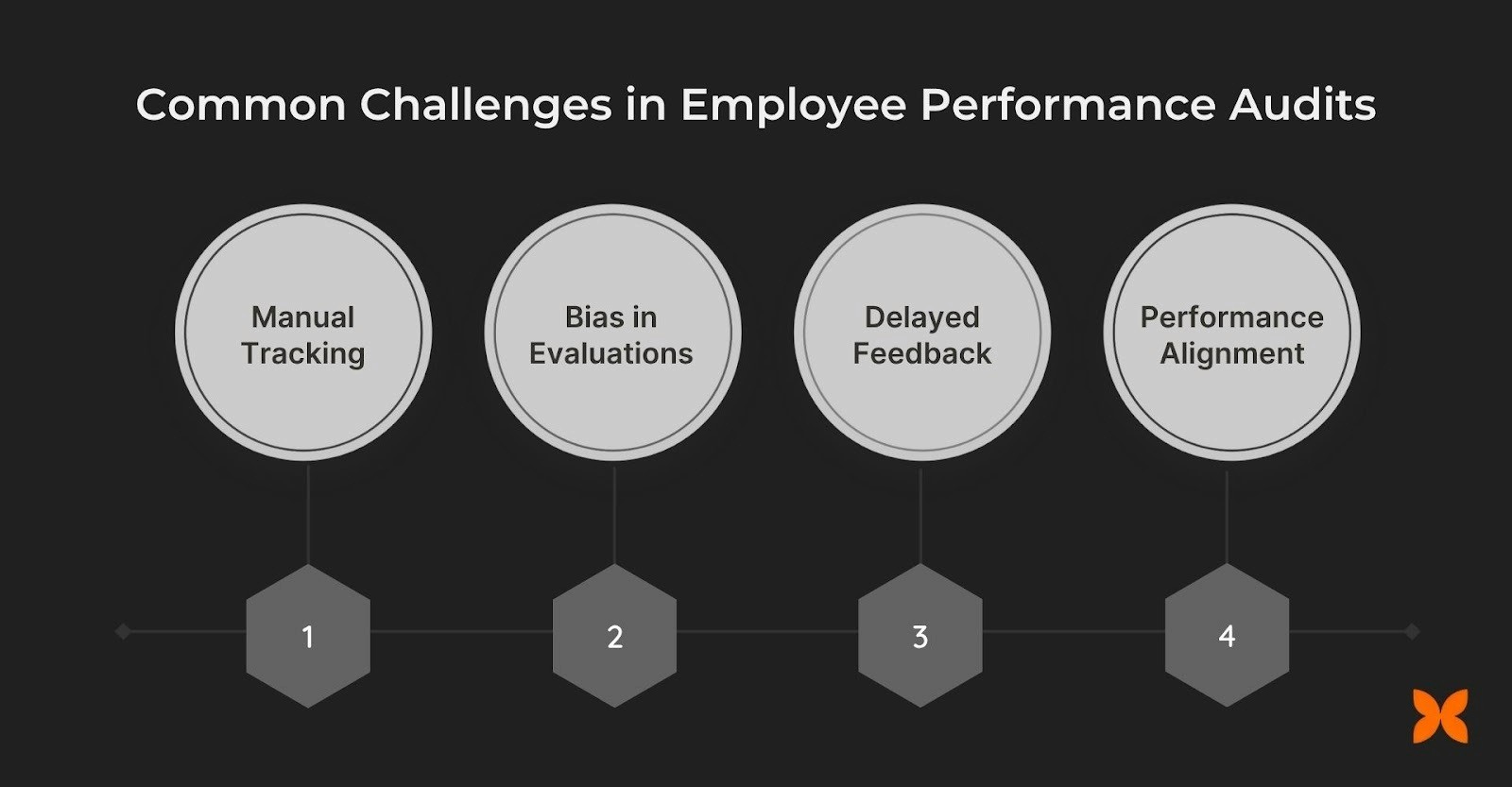
Understanding the issues in employee performance audits is key to improving the audit process and driving better performance outcomes.
1. Manual Tracking and Data Inconsistencies
Relying on manual tracking methods like spreadsheets or paper documents can create significant challenges in performance audits. These manual processes are prone to errors, as data is often misinterpreted, lost, or inaccurately recorded.
The lack of a centralised system makes it hard to track employee progress across departments, leading to inconsistencies in how performance is measured and reported. Furthermore, these manual systems demand considerable time and effort from HR teams, increasing administrative burdens and slowing down the overall process.
2. Subjective Evaluations and Bias
Performance reviews that depend on subjective judgement can result in unfair evaluations. Personal biases, unconscious preferences, or inconsistent rating standards can lead to skewed assessments. This not only affects the accuracy of the audit but can also lead to employee dissatisfaction.
Employees who feel their performance reviews are based on personal biases may lose trust in the review process, which can harm morale and engagement. Without clear, objective evaluation criteria, these biases become hard to identify and address.
3. Limited or Delayed Feedback
One of the most critical issues in performance audits is the lack of timely feedback. In many organisations, feedback is provided only during annual or quarterly reviews, which delays employees' understanding of their strengths and areas for improvement.
This gap in feedback can prevent employees from making necessary adjustments to their performance, leading to missed growth opportunities. Moreover, employees may feel disconnected from the goals they are working towards if they don’t receive continuous feedback that guides their progress.
4. Difficulty Aligning Performance with Business Goals
For many organisations, linking individual performance to overall business objectives is a major challenge. When employees do not see a direct connection between their work and the company’s strategic goals, it can result in disengagement. Employees might not feel motivated to perform at their best if they don’t understand how their contributions drive success.
This misalignment can lead to a lack of focus and reduced productivity, as employees may not see the value in achieving goals that don't seem to directly impact the company.
Solving these challenges requires the right tools to ensure efficiency and accuracy in performance audits.
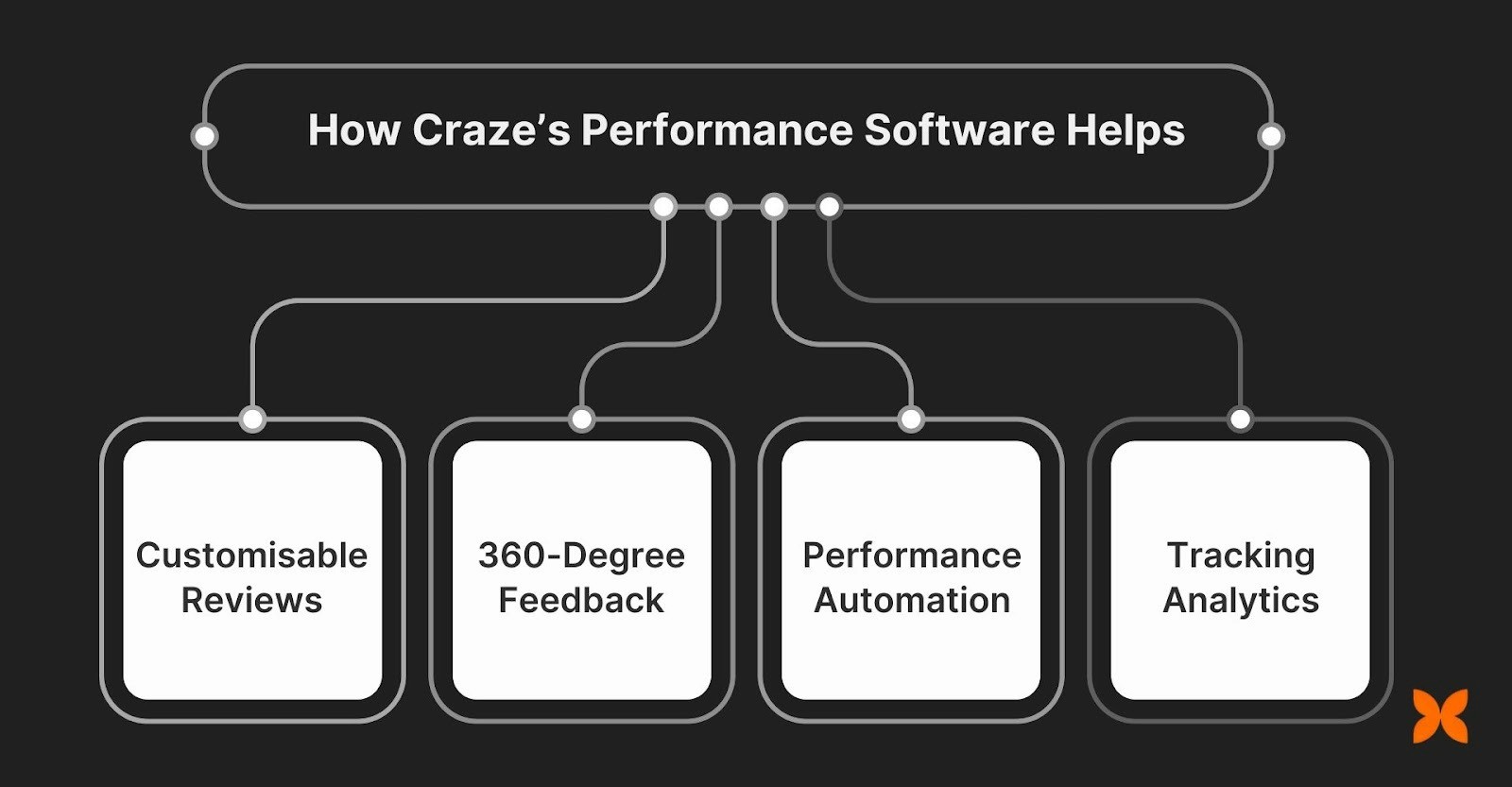
Addressing the challenges of employee performance audits requires efficient and easy-to-use solutions. Craze’s Performance Management Software offers a simple and effective way to conduct accurate and fair performance evaluations.
1. Customisable Reviews
Craze’s software ensures that reviews reflect the organisation's important goals and criteria.
Customisable performance reviews allow businesses to define review cycles, permissions, and questions based on their requirements.
Performance management software helps create custom evaluation criteria, ensuring reviews are aligned with your company’s needs.
2. 360-Degree Feedback
360-degree feedback ensures that performance evaluations cover all aspects of an employee’s contributions. This approach offers a fuller, more balanced view of performance.
Gather feedback from self, peer, upward, and downward reviews to get a complete picture of employee performance.
Employee development is improved by collecting feedback from multiple sources, encouraging holistic growth.
Easily customise feedback forms for different teams or roles to ensure relevance.
3. Automated Performance Reviews
Craze’s software reduces the time spent on administrative tasks and speeds up evaluations.
Automated performance reviews help schedule and track reviews without needing manual effort.
Manage performance appraisals efficiently with custom review cycles, deadlines, and automatic reminders.
HRMS integration ensures smooth coordination with other HR processes, saving time across teams.
4. Real-Time Tracking & Analytics
Real-time tracking and analytics provide businesses with immediate insights into employee performance, enabling better, faster decisions during audits.
Performance analytics allow managers to monitor progress and identify areas for improvement.
Data insights help recognise top performers, skills gaps, and areas that need attention for continuous development.
Real-time tracking ensures that performance data is always up-to-date, allowing managers to act quickly.
Performance audits offer valuable insights that actively drive employee development, foster growth, and ensure alignment between individual performance and business goals.
Identify skill gaps through performance data to pinpoint areas where employees need further training or development.
Modify learning and development programs based on audit results to address specific gaps and strengthen employee skills.
Implement targeted employee training initiatives to close these gaps and enhance overall performance.
Use performance insights from audits to inform talent management decisions, such as promotions and skill development opportunities.
Optimise team dynamics by ensuring the right people are in the right roles based on audit findings.
Align employee growth with organisational goals using data-driven insights to keep businesses on track for success.
Using data from performance audits helps you address skill gaps, improve employee growth, and align your team’s progress with company goals.
Conducting regular employee performance audits is essential for any organisation looking to align individual efforts with company goals, foster employee growth, and ensure long-term success. By consistently assessing performance, businesses can identify areas for improvement, celebrate their strengths, and drive overall productivity.
Craze’s Performance Management Software makes the process simpler and more effective. With features like customisable reviews, 360-degree feedback, and real-time tracking, Craze helps you improve your performance audits, reduce bias, and ensure that evaluations are accurate and aligned with your organisational objectives.
Q1. How can I ensure that my employee performance audit process is fair and unbiased?
A1. Set clear, objective criteria and use standardised evaluation forms. Provide training to avoid biases and implement 360-degree feedback for a well-rounded perspective.
Q2. What are the key differences between performance appraisals and performance audits?
A2. Appraisals focus on individual performance, often tied to compensation. Audits assess the overall effectiveness and fairness of the performance management system.
Q3. How often should an organisation conduct employee performance audits?
A3. Ideally, employee performance audits should be conducted annually. This allows businesses to evaluate the effectiveness of their performance management and identify areas for improvement.
Q4. What role does technology play in enhancing the employee performance audit process?
A4. Technology automates data collection, analysis, and reporting, reducing administrative work. It provides real-time tracking and generates actionable insights for decision-making.
Q5. How do I communicate the results of an employee performance audit to my team?
A5. Ensure feedback is constructive and transparent. Focus on strengths and areas for growth, and provide clear steps for improvement to align with team and company goals.
