


When employees are consistently absent, it feels like a hidden cost on your balance sheet. Missed work days aren't just an HR problem; they directly disrupt projects, force other staff to pick up the slack, and seriously hurt your company's output.
Research in labour-intensive sectors confirms that a 10-percentage point increase in absenteeism can lead to a significant drop in line productivity. This demonstrates why every percentage point of improved attendance translates directly into stability and efficiency.
This blog will walk you through simple, actionable strategies to enhance employee attendance. You’ll learn how to build a motivating culture where employees feel engaged and committed to showing up and performing their best every day.
Use biometric, mobile, or cloud-based systems to ensure accurate time capture and reduce manual errors.
Define working hours, leave procedures, and consequences to maintain accountability.
Provide staggered shifts, remote options, or shift swaps to help employees manage personal responsibilities without affecting operations.
Encourage early intervention and reward reliable attendance to improve engagement and accountability.
Analyse attendance trends to identify absenteeism patterns, adjust workloads, plan resources, and ensure compliance.
Low employee attendance directly impacts multiple areas of business performance. Its effects are rarely confined to a single department and often compound over time.
Key business risks of poor attendance include:
Productivity and Workflow Disruption: Unplanned absences break the rhythm of daily operations. Tasks are delayed, handovers fail, and managers spend time reallocating work instead of focusing on strategic priorities.
Rising Payroll and Operational Costs: To maintain output, organisations rely on overtime, temporary staffing, or last-minute shift adjustments. These short-term fixes increase payroll costs and reduce overall efficiency.
Increased Pressure on Reliable Employees: When absences are frequent, dependable team members are expected to fill the gaps left by absent colleagues. Over time, this leads to fatigue, frustration, and a higher risk of burnout or attrition.
Client Delivery and Service Quality Risks: In customer-facing or deadline-driven roles, inconsistent attendance affects response times, service quality, and the ability to meet SLAs, directly impacting customer trust.
Compliance and Safety Exposure: In labour-intensive industries, inadequate staffing levels can compromise safety protocols and regulatory compliance, creating risks beyond productivity alone.
To address these challenges effectively, employers must first understand the causes of attendance issues in the Indian workplace.
Attendance challenges rarely stem from a single cause. In most Indian organisations, absenteeism is driven by a combination of personal constraints, workplace conditions, and systemic gaps that accumulate over time.
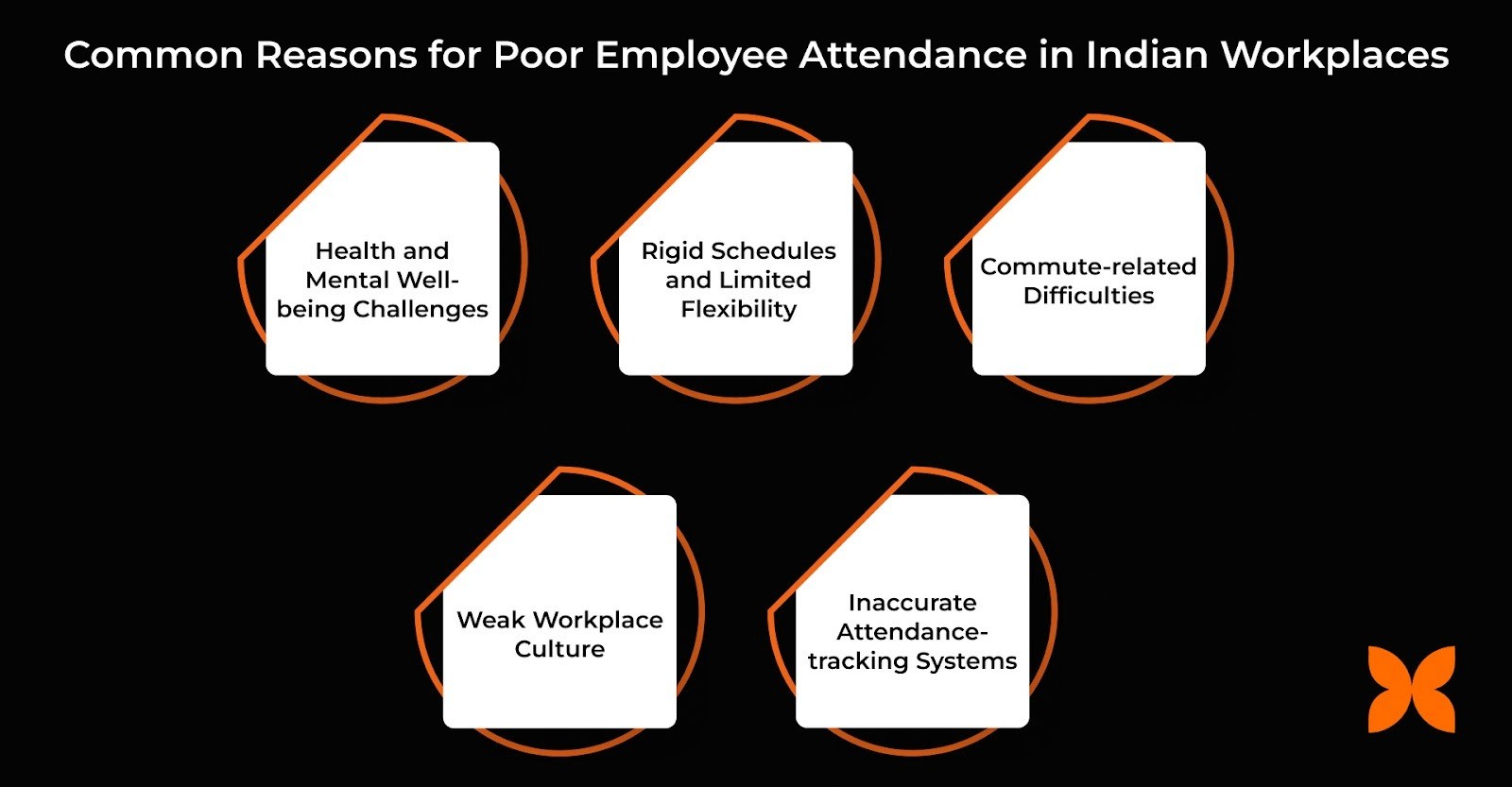
The most common reasons for poor employee attendance include:
Health and Mental Well-being Challenges: Chronic health conditions, stress, and burnout contribute to repeated absences, particularly in high-pressure or shift-based roles.
Rigid Schedules and Limited Flexibility: Fixed working hours that do not account for personal responsibilities or life events often force employees to take unplanned leave.
Commute-related Difficulties: Long travel times, unreliable transport, and urban congestion remain significant barriers to punctuality and consistent attendance in Indian cities.
Weak Workplace Culture or Management Practices: Lack of recognition, poor communication, and unsupportive leadership reduce engagement, leading employees to be less motivated to maintain regular attendance.
Outdated or Inaccurate Attendance-tracking Systems: Manual processes and frequent errors lead to disputes, erode trust, and undermine accountability, further aggravating attendance issues.
Recognising which of these factors is affecting your organisation helps you shift from reacting to absences to proactively improving attendance. Once the root causes are clearly understood, you can implement targeted strategies that deliver measurable and sustainable improvements in employee attendance.
Improving employee attendance requires a proactive, structured approach that addresses root causes rather than symptoms. The following strategies have consistently delivered results across Indian organisations.
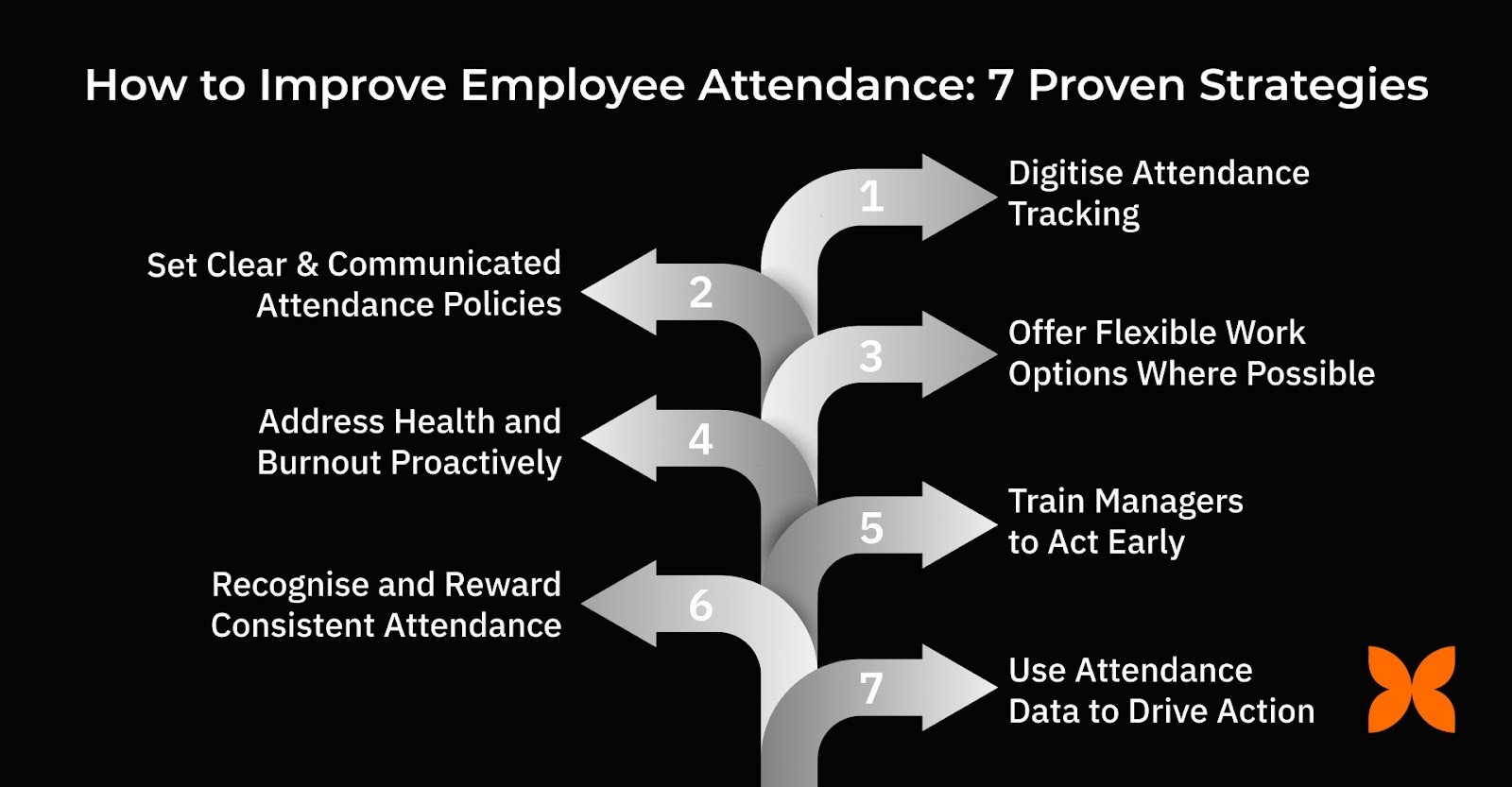
1. Digitise Attendance Tracking
Manual registers and spreadsheets often create errors, disputes, and disengagement in Indian workplaces. Digital attendance systems such as biometric scanners, mobile apps, or cloud-based platforms provide real-time visibility and accurate tracking for both office and factory staff.
Benefits include:
Accurate time capture, preventing disputes over late arrivals, short breaks, or overtime.
Reduced payroll discrepancies, ensuring employees are compensated correctly according to hours worked.
Quick issue identification, allowing managers to spot absenteeism patterns, monitor multi-shift staff, and plan for peak periods.
Digitised attendance records form the foundation for fair, efficient, and transparent workforce management.
2. Set Clear and Communicated Attendance Policies
Employees cannot meet expectations that are unclear or inconsistently applied. A well-defined policy clarifies attendance rules and ensures fairness across teams.
Key points include:
Working hours and shift rules, including rotational shifts, grace periods, and overtime, are aligned with Indian labour laws.
Leave and regularisation procedures, with step-by-step instructions for sick, casual, and compensatory leave.
Consequences for absenteeism are consistently applied to maintain accountability and prevent bias.
Clearly communicated policies build trust, reduce confusion, and make attendance expectations transparent.
3. Offer Flexible Work Options Where Possible
Rigid schedules can conflict with personal responsibilities, commuting challenges, or cultural events in India. Structured flexibility reduces unplanned absences and supports employee engagement.
Practical approaches include:
Staggered start and end times are effective in metro cities with heavy traffic.
Hybrid or remote work is suitable for IT, consulting, and back-office roles.
Shift swaps with managerial approval, helping production, retail, and service teams manage personal commitments.
Flexibility must be well-documented, monitored, and communicated to balance employee needs with operational continuity.
4. Address Health and Burnout Proactively
Frequent absences often reflect physical or mental strain. Proactive wellness initiatives help Indian organisations reduce absenteeism and improve productivity.
Examples include:
Regular health check-ups and vaccination drives in factories or high-density offices.
Mental health support or Employee Assistance Programs (EAPs) to tackle stress and burnout.
Reasonable workload distribution to prevent overburdening small teams.
Supporting employee well-being strengthens attendance reliability and fosters a motivated workforce.
5. Train Managers to Act Early
Managers are the first line of defense against chronic absenteeism. Training them to identify and address attendance issues early prevents small patterns from escalating.
Key practices include:
Spotting recurring absence patterns and trends using data.
Conducting private, supportive discussions to uncover underlying causes (commute issues, family responsibilities, health concerns).
Offering corrective or temporary solutions before formal escalation.
Early, empathetic interventions strengthen manager-employee relationships and reinforce attendance expectations.
6. Recognise and Reward Consistent Attendance
Positive reinforcement motivates employees more effectively than penalties alone. Recognition creates a culture where reliability is valued and visible.
Examples suitable for Indian workplaces:
Public acknowledgement during team meetings or on digital platforms.
Digital badges, certificates, or intranet shout-outs.
Attendance-linked incentives like transport reimbursement, festival bonuses, or extra leave days.
Even small gestures reinforce consistency and set positive examples for peers.
7. Use Attendance Data to Drive Action
Data is only valuable if it informs decisions. Attendance analytics allow Indian organisations to anticipate challenges and take proactive measures.
Data-driven strategies include:
Identifying departments or shifts with high absenteeism.
Predicting understaffing during monsoons, festivals, or peak production months.
Adjusting shifts, workloads, or resource allocation based on patterns rather than guesswork.
Using insights from attendance data ensures sustained improvement and operational continuity.
Attendance systems play a direct role in improving attendance by clarifying how time is tracked and how policies are enforced. Instead of relying on manual registers or loosely monitored spreadsheets, organisations gain a single, reliable source of truth for employee presence, late arrivals, and leave usage.
A well-implemented attendance system helps businesses by:
Automating Daily Time Capture: Uses biometric devices, mobile apps, or web-based check-ins to reduce manual entries and human error.
Standardising Attendance and Leave Rules: Applies the same policies across roles, departments, and locations, ensuring fairness and consistency.
Integrating Attendance with Payroll: Ensures accurate salary calculations, overtime tracking, and deductions without repeated corrections.
Enabling Employee Self-service: Allows employees to view attendance records, request corrections, and understand how time data impacts pay.
Next, let’s look at how Craze enables real-time attendance management, as improving attendance grows more challenging across locations, shifts, and work models.
Craze provides an attendance management system built for Indian organisations of all sizes, with automated tracking, configurable policies, and direct payroll connectivity. It centralises attendance, overtime, loss-of-pay rules, and timesheets, while ensuring all data is processed in accordance with India-specific policies.
Here are the core capabilities of Craze’s Attendance Management System:
Automated Attendance & Policy Rules: Attendance, overtime, and timesheets are captured automatically, with customisable rules for work hours, minimum hours, loss-of-pay, default attendance, and department- or location-specific variations.
Flexible Regularisation Workflow: Missed punches or corrections follow configurable approval paths that can be auto-approved or routed to managers or department heads based on predefined conditions.
Over time, LOP & Holiday Handling: Craze enforces organisation-specific rules for overtime, including multipliers and rounding, loss-of-pay policies, and separate policies for holidays and weekends, to ensure consistent treatment across all teams.
Secure Clock In via Geo or Biometrics: Clock-ins and clock-outs are validated at authorised locations or via biometric devices, enabling accurate, fraud-resistant attendance tracking.
Payroll Sync, Reporting & Audit Logs: Attendance data flows directly into payroll for accurate payslips. Detailed timesheets, downloadable reports, and audit logs support compliance and internal reviews.
By combining these features, Craze helps organisations streamline attendance management, minimise administrative work, and ensure payroll is accurate, compliant, and fully aligned with real workforce activity.
1. How can small businesses in India manage attendance without costly software?
Small businesses can use affordable cloud-based attendance apps or mobile check-in tools. These provide real-time records and reduce payroll errors when combined with simple attendance rules.
2. Does offering flexible work hours reduce absenteeism?
Yes. Flexibility helps employees manage personal responsibilities, reducing unplanned leave and improving long-term attendance consistency.
3. How should employers address habitual latecomers fairly?
Use attendance data to identify patterns, discuss root causes privately, offer temporary adjustments, and apply disciplinary steps consistently if issues persist.
4. What role does recognition play in attendance management?
Recognition reinforces positive behaviour and builds motivation. Acknowledging consistent attendance encourages reliability across teams.
5. Can absenteeism trends reveal workplace issues?
Yes. Department-level absenteeism often highlights workload, management, or morale problems that require organisational intervention.
