


Most leaders set goals, but few achieve them consistently. A Gallup study shows that only 2 in 10 employees feel their performance is managed to inspire excellence. With competing priorities and limited resources, it’s hard to track what truly drives results.
This is where OKRs (Objectives and Key Results) and KPIs (Key Performance Indicators) help. But the challenge remains: which framework should you rely on, and can they work together?
This blog compares OKR vs KPI, showing HR managers at startups and growing teams how both frameworks align goals, track performance, and drive measurable business growth.
OKRs vs KPIs: OKRs are designed to drive long-term, ambitious goals, while KPIs track ongoing performance to ensure consistent progress toward those goals.
OKRs Inspire Growth: OKRs push teams to strive for measurable, high-impact objectives, aligning efforts toward significant business outcomes.
KPIs Ensure Stability: KPIs focus on monitoring and optimizing daily operations, ensuring the business maintains consistent performance and meets key benchmarks.
OKRs and KPIs Complement Each Other: Together, OKRs and KPIs align teams toward big goals while ensuring daily operations are effectively supporting progress.
Balanced Strategy: Combining OKRs for growth and KPIs for performance tracking ensures steady progress and long-term success.
Objectives and Key Results are a goal-setting framework designed to help organisations set clear, measurable goals. The concept is simple but can transform how your business operates.
Objectives are the "what" you want to achieve. They should be ambitious, inspirational, and clear. Think of them as your guiding star. They define the direction your team should head toward.
Key Results are the "how" you will measure progress. They are specific, quantifiable outcomes that track your success toward the objective. Key Results are the measurable steps you take to reach the objective.
Unlike to-do lists, OKRs don’t describe activities (e.g., “run 10 campaigns”) but measurable impact (e.g., “increase leads by 40%”). Typically, OKRs are set on a quarterly or yearly basis.
Example: Let’s say you’re a software company aiming to grow your customer base. Here’s how an OKR might look:
Objective: Expand our customer base by 25% this quarter.
Key Result 1: Acquire 500 new customers.
Key Result 2: Increase website traffic by 30%.
Key Result 3: Achieve a 15% conversion rate from trials to paid users.
You have a clear path to follow and track progress by breaking down the objective into key results. OKRs help align teams, maintain focus, and push to promote performance.
KPIs (Key Performance Indicators) are critical metrics used to assess the efficiency and success of specific business activities aligned with broader organisational objectives. Unlike OKRs, which are designed to set ambitious, time-bound goals, KPIs focus on continuous performance tracking. They offer quantitative insights into the ongoing health and operational effectiveness of key business functions.
In contrast to OKRs’ growth-driven targets, KPIs provide actionable data that helps businesses optimise operations, maintain performance consistency, and ensure long-term success. By monitoring KPIs, organisations can refine strategies, improve decision-making, and stay on track to achieve their core objectives.
Example: Imagine you're managing a sales team. Here are some KPIs you might track:
KPI 1: Monthly sales revenue (in dollars).
KPI 2: Customer satisfaction score (CSAT).
KPI 3: Number of new leads generated.
These KPIs are all measurable and directly related to your team's performance. Regularly tracking them gives you a snapshot of how well the business functions. KPIs are more static than OKRs, meaning they don’t change as often but are important for tracking progress over time.
At first glance, OKRs and KPIs might seem similar. Both are three-letter acronyms used in goal setting, so it’s easy to confuse them. However, they represent distinct frameworks for planning and measuring performance. Understanding these differences is crucial for businesses seeking to set ambitious goals while maintaining stable operational results.
The table below compares OKRs vs KPIs, highlighting how each framework differs across key aspects of business planning and performance measurement:
Aspect | OKRs | KPIs |
Nature | OKRs are bold, aspirational goals that push a company to achieve new heights. | KPIs are more focused, tracking specific metrics related to business performance. |
Focus | OKRs focus on achieving significant, long-term goals and driving progress. | KPIs focus on tracking steady, ongoing performance and efficiency. |
Purpose | OKRs help teams align with broader company objectives and inspire action. | KPIs measure how well the company is performing against set benchmarks. |
Time Frame | OKRs are typically set for shorter periods, like a quarter or a year, to keep the team moving forward. | KPIs are tracked continuously, often monthly or yearly, to maintain steady performance. |
Flexibility | OKRs are adaptable, allowing businesses to adjust goals as they progress. | KPIs are more fixed, with less frequent changes once set. |
Outcome | OKRs are meant to push boundaries, focusing on progress, not just completion. | KPIs monitor existing performance, focusing on consistency and meeting targets. |
Type of Metrics | OKRs include both quantitative and qualitative measures that aim for growth. | KPIs are purely quantitative, focusing on specific, measurable results. |
Implementation | OKRs are great for inspiring teams and creating direction for growth. | KPIs are used for tracking performance against existing goals and ensuring stability. |
Why Does Knowing The Difference Matter?
OKRs are the driving force behind achieving big, transformational goals. They help teams set ambitious and measurable goals, making them feel engaged and motivated. For example, a company might set an OKR to increase market share by 30% in a quarter, with clear key results like adding 500 new customers and improving website traffic by 20%. OKRs give a company the direction to push towards something bigger.
On the other hand, KPIs are performance trackers that help businesses stay on course. They measure day-to-day results and keep things in check. For example, KPIs like customer acquisition cost or monthly sales help a company monitor its performance relative to established goals.
For Example, Let’s say your company wants to grow its customer base.
Your OKR could be: Increase customer acquisition by 25% this quarter. The Key Results for that might be: Acquire 500 new customers and Boost website traffic by 15%.
Your KPIs might be: Customer acquisition cost (CAC) and Conversion rate. These KPIs would show how efficiently you’re converting leads into customers.
So, OKRs will drive your team’s bigger vision, while KPIs will track how well you're progressing toward that vision.
Knowing when to use OKRs for bigger, aspirational goals and KPIs to track ongoing performance can ensure your business stays focused and successful.
OKRs and KPIs are necessary tools, but knowing when to use each is key to optimising performance and achieving success. Here’s a breakdown of when each tool is most effective, along with examples to clarify the distinction.
When to Use OKRs
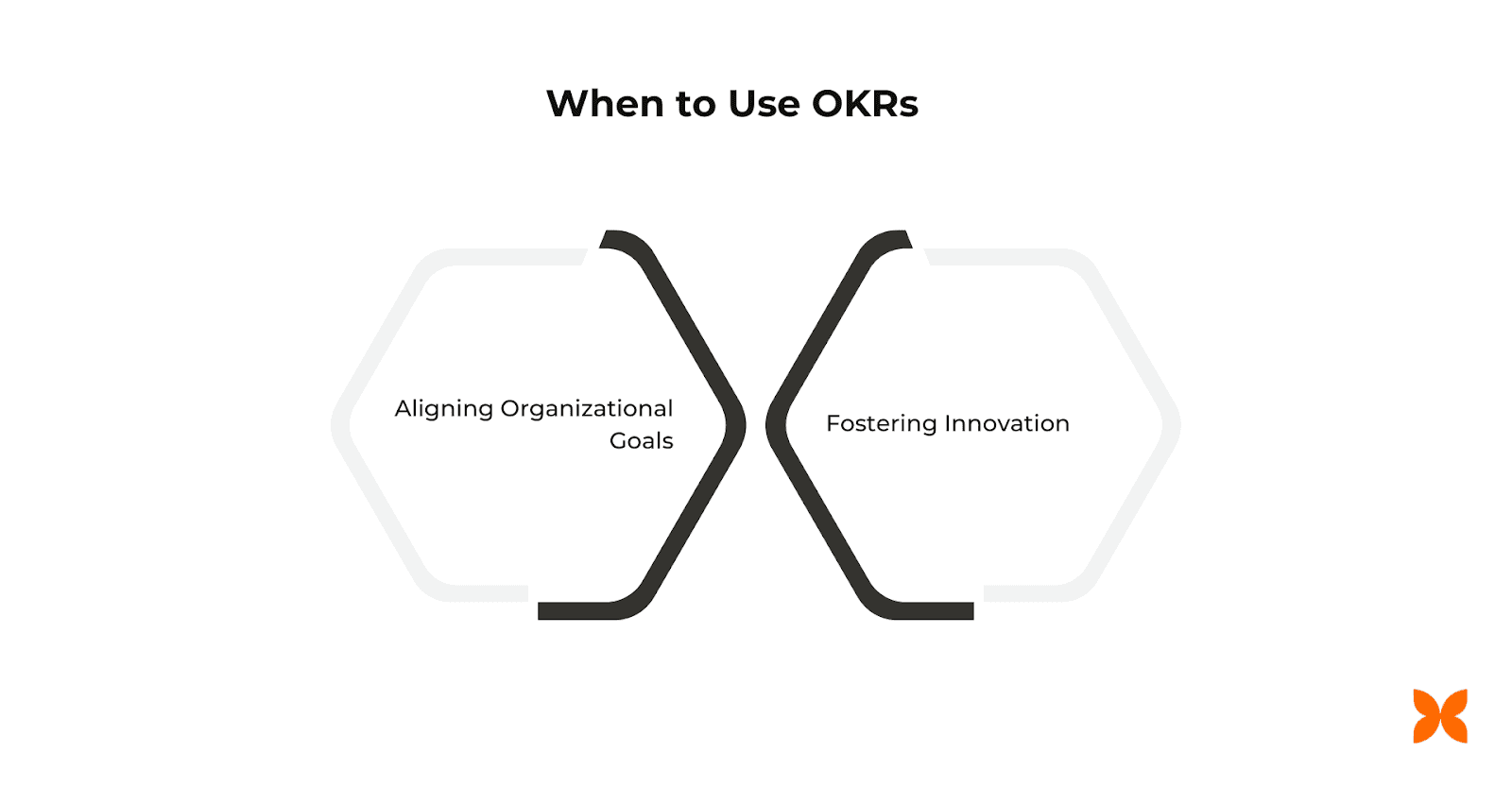
OKRs are perfect when you need to align your team around a big, ambitious goal. They work well for driving innovation, scaling up, or pursuing something new. Here are some scenarios where OKRs can be highly effective:
Aligning Organisational Goals:
Let’s say your company is planning to expand into a new market. Your OKR might be: Launch a successful product in the European market. The key results could include:Achieve a 10% market share within six months.
Establish partnerships with at least five local distributors.
In this case, the OKR helps everyone in the company focus on the same end goal, even if their roles differ.
Fostering Innovation:
If you're trying to innovate and push boundaries in your industry, OKRs can guide your efforts. For example:Objective: Launch a next-gen product that sets the company apart.
Key Results:
Develop the prototype within 4 months.
Secure three industry partnerships before the product release.
OKRs provide clear, measurable outcomes that can push a company beyond its current limits.
When to Use KPIs
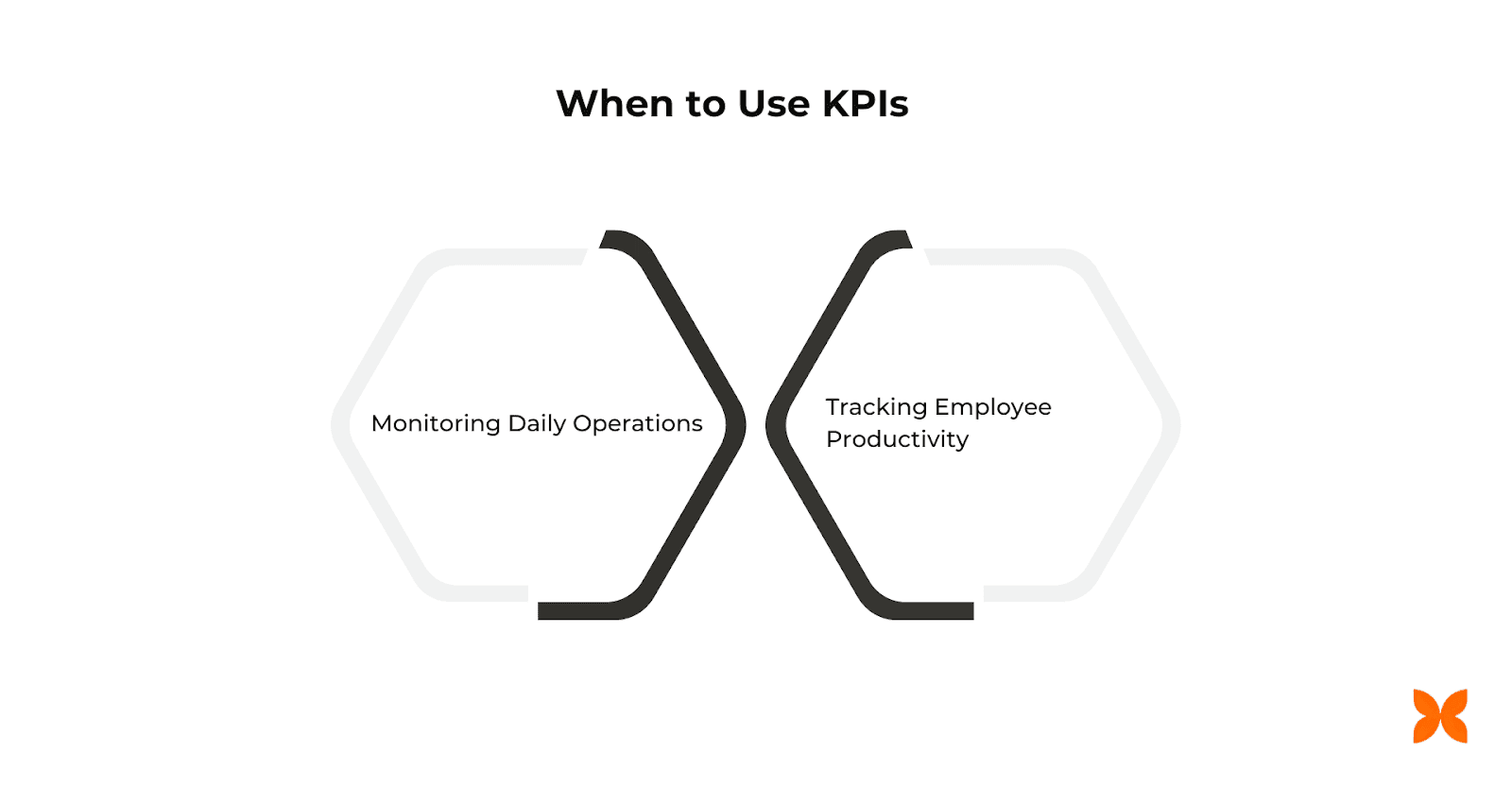
KPIs, on the other hand, are best for measuring ongoing performance and efficiency. They are great for tracking existing programs or evaluating how well your team sticks to established targets. Here are some examples of when KPIs are especially useful:
Monitoring Daily Operations:
You’re managing a marketing team, and one of your primary goals is to keep website traffic consistent. A relevant KPI could be:Monthly website visits: 50,000 visits per month.
This KPI helps you track how effectively you drive traffic and whether the current strategy works. It's a clear, ongoing metric that ensures steady performance.
Tracking Employee Productivity:
KPIs can also be used to track employee output, which is particularly useful in performance reviews. For instance:Sales team KPI: Close 30 deals per month.
Customer support KPI: Resolve 90% of tickets within 24 hours.
These KPIs focus on the day-to-day operations, providing a snapshot of how well the team is performing.
Example Scenario: Let’s say your company is working on improving customer service. OKR enhances customer satisfaction by improving service efficiency. Reduces average response time by 30%. Achieves a 95% customer satisfaction score.
Once the OKR is in place, you can track your KPIs for more specific, ongoing insights, such as:
Average response time (measured daily or weekly).
Customer satisfaction score (tracked monthly).
Setting OKRs to drive improvement and using KPIs to track performance gives a complete view of progress.
OKRs are great for setting ambitious goals that inspire progress, while KPIs focus on tracking the performance of specific metrics. While both play distinct roles, they can complement each other correctly.
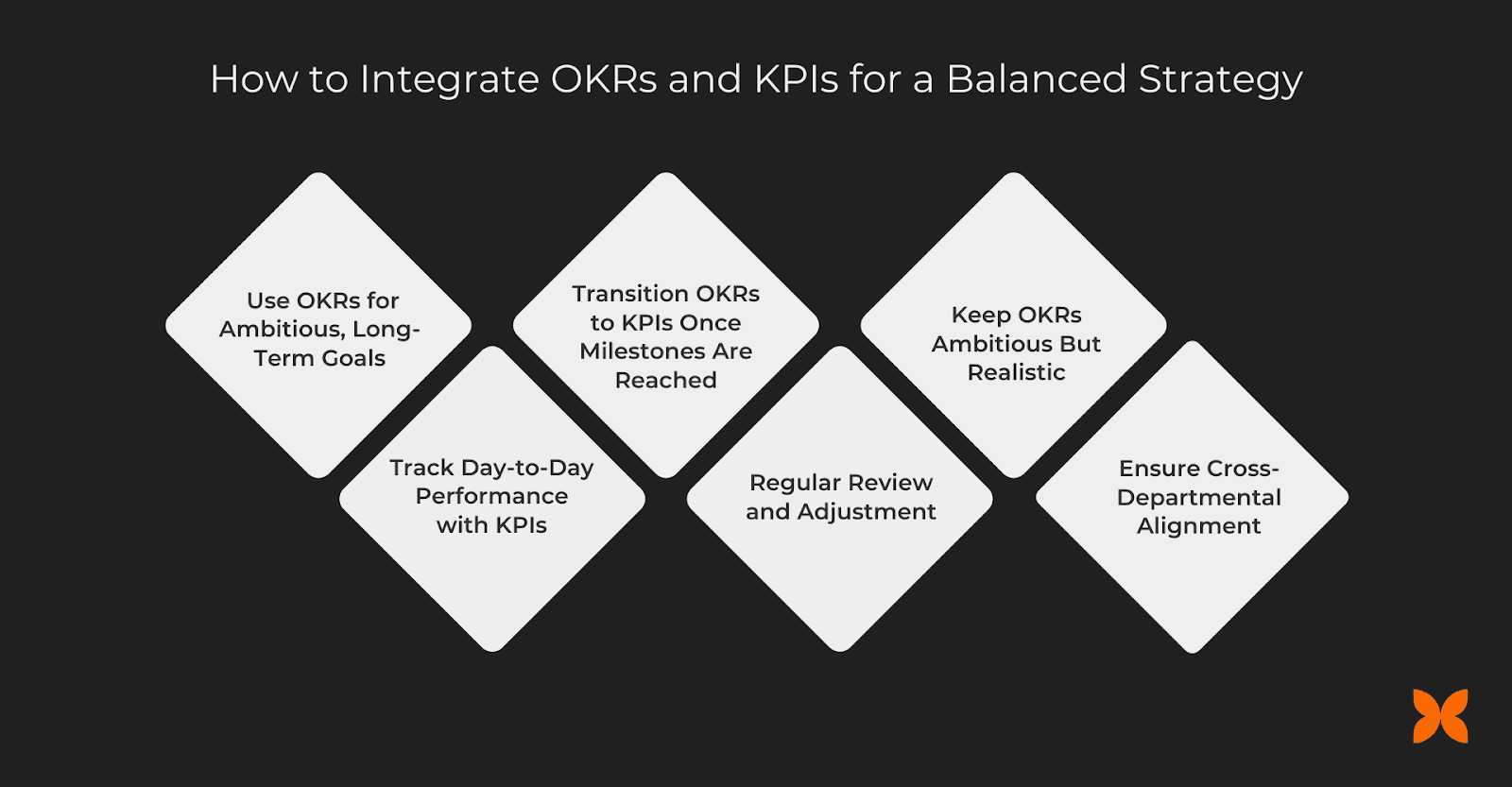
To get the best results from both OKRs and KPIs, it’s important to understand how to combine them effectively. While they serve different purposes, together, they create a balanced approach that can propel your business forward.
1. Use OKRs for Ambitious, Long-Term Goals
Start by setting OKRs that align with your company’s vision and long-term aspirations. These goals should be clear and measurable, pushing your teams to achieve big, bold objectives. They will give your organisation direction and purpose and help align efforts across all departments.
Example: Imagine you run an e-commerce company looking to expand its market share. Your OKR might be:
Objective: Expand market share by 20% in the next quarter.
Key Result 1: Increase website traffic by 30%.
Key Result 2: Launch a targeted marketing campaign to reach 1,000 new customers.
This OKR is ambitious and measurable, with key results that show exactly how success will be tracked.
2. Track Day-to-Day Performance with KPIs
Once you have your OKRs, you’ll need to measure progress regularly. That’s where KPIs come in. KPIs are the metrics that help you monitor performance daily, weekly, or monthly. These indicators give you clear insights into whether your actions to achieve your OKRs are working.
Example: For the e-commerce company, the KPIs could be:
KPI 1: Monthly sales revenue.
KPI 2: Customer acquisition cost (CAC).
KPI 3: Conversion rate from ads to sales.
These KPIs will help track the effective strategies implemented to reach the OKRs. For instance, if the website traffic is increasing but sales aren’t, the company can focus on improving conversion rates or optimising their ads.
3. Transition OKRs to KPIs Once Milestones Are Reached
As you progress toward your OKRs, some key results might become more stable or predictable. You can then transition certain key results into KPIs to track them as ongoing performance metrics.
Example: Once the e-commerce company achieves its goal of increasing traffic by 30% and successfully launches the marketing campaign, these results can become KPIs, such as:
KPI 1: Website traffic (measured regularly to ensure continued growth).
KPI 2: Conversion rate from visitors to customers (to track ongoing performance).
This shift allows you to maintain a dynamic strategy, using OKRs for growth and innovation and KPIs to monitor the ongoing success of established goals.
4. Regular Review and Adjustment
Review your OKRs and KPIs regularly to ensure they align with the business strategy. Adjust your approach if KPIs show that current actions do not yield the desired result. Similarly, OKRs can be updated as business goals evolve.
Example: If an e-commerce company sees that while traffic is up, customer retention is low, it may update its OKRs to improve retention rates with new key results related to improving customer experience or offering loyalty rewards.
5. Keep OKRs Ambitious But Realistic
While OKRs should challenge your team, they should also be achievable. Striking the right balance ensures that your objectives push for growth without being discouraged. Keep the goals aligned with your company’s current capacity and resources, but don’t shy away from ambitious targets that drive innovation.
Example: If your objective is to increase sales by 50% in a quarter, but your team is already overwhelmed, it might be better to adjust the target to something more achievable, such as 30%, while focusing on more practical key results like increasing lead generation by 20% or boosting conversion rates.
6. Ensure Cross-Departmental Alignment
To succeed with the correct usage of OKR and KPI, all departments should align with the company’s larger goals. This ensures that everyone is working toward the same vision and that the KPIs used by different teams contribute to the success of the overarching OKRs.
Example: The marketing, sales, and customer support teams should all contribute to the OKRs of improving customer satisfaction. Marketing might focus on communication efforts, sales might ensure product knowledge, and support might work on enhancing service. KPIs for each department should measure their specific contribution to the goal.
Knowing when to use OKR vs KPI is essential for effective performance management. While both are useful, they serve different purposes at different stages of your business process. Here’s how to decide when to apply each framework based on your goals and needs.
Use OKRs When Setting Long-Term, Strategic Goals
OKRs are ideal when you’re focusing on big-picture, strategic goals. These goals should push your team toward innovation, growth, and transformation. OKRs help organisations align their teams with the overall vision and rally them around achieving something significant.
Example: Imagine you run a tech startup looking to expand your product offering. Your OKR for the next quarter could be:
Objective: Launch a new AI-powered product.
Key Result 1: Develop and test the prototype by the end of the quarter.
Key Result 2: Sign 10 partnerships with industry leaders.
Key Result 3: Secure $500,000 in pre-orders.
This OKR focuses on a bold, strategic goal. It pushes the team to innovate, collaborate, and meet measurable milestones. This is where OKRs shine—providing clear direction and measurable results for ambitious goals.
Use KPIs to Monitor Ongoing Performance
On the other hand, KPIs are best used to monitor and track the performance of ongoing operations. KPIs are the way to go if you’re measuring business performance in a specific area, such as sales, customer satisfaction, or production. KPIs help ensure that things are running smoothly and that the business meets its benchmarks.
Example: For the same tech startup, KPIs would be useful for tracking the performance of its existing operations during the quarter. These could include:
KPI 1: Monthly sales revenue from current product lines.
KPI 2: Customer satisfaction score for the existing products.
KPI 3: Number of support tickets resolved within 24 hours.
These KPIs measure real-time performance and provide insights into how well the business functions daily. They help you manage current performance, improve efficiency, and ensure operational health.
When OKRs Turn Into KPIs
Sometimes, once you achieve certain OKRs, they may evolve into KPIs. For instance, if a startup successfully launches a product (OKR) and continues to track sales, customer feedback, and retention over time, these activities become KPIs for ongoing performance management.
Example: Once the new AI-powered product is launched, the startup will want to track its success. This includes monitoring:
KPI 1: Product sales growth month over month.
KPI 2: Customer retention rate.
KPI 3: Percentage of customers who upgrade to the premium version.
These KPIs now track the ongoing success of the newly launched product. The OKR-driven objective has been achieved, and these KPIs will guide continued performance and improvements.
In today’s fast-paced business world, aligning your teams around clear, measurable goals is important. OKR vs KPI offer distinct yet complementary approaches to drive performance, accountability, and success. OKRs challenge teams with bold objectives and measurable outcomes, pushing for growth and innovation, while KPIs monitor ongoing performance and keep your business operations on track. These frameworks can transform how your business sets and tracks goals when used together, ensuring long-term progress and day-to-day efficiency.
However, managing OKRs and KPIs can become complex, especially when you have multiple teams, changing goals, or an expanding business. With Craze’s Goals and OKR software, you can easily set, track, and measure goals in real-time, ensuring every team member is aligned and accountable. Craze’s intuitive platform simplifies goal management, from defining OKRs to tracking KPIs, helping you optimise performance, boost productivity, and stay on top of your business goals.
Don’t let confusion or misalignment hinder your growth. Craze helps businesses like yours stay focused, agile, and on track to achieve ambitious objectives and key performance targets. Book a demo today to discover how Craze can help you unlock your team’s full potential and drive sustainable success.
What is the difference between OKR and KPI?
OKRs (Objectives and Key Results) are ambitious, time-bound goals designed to drive growth and align teams toward big-picture objectives. KPIs (Key Performance Indicators) are metrics that track ongoing performance, ensuring operations remain consistent. While OKRs focus on achieving transformative results, KPIs monitor day-to-day activities, providing measurable insights into efficiency and progress. Together, they balance strategic ambition with operational stability.
Can OKRs and KPIs be used together?
Yes, OKRs and KPIs complement each other. OKRs set ambitious goals and define measurable outcomes to push teams toward growth. KPIs track ongoing performance to ensure daily operations support those objectives. By integrating them, businesses can pursue long-term strategic targets while monitoring efficiency, enabling a balanced approach to achieving both transformative goals and consistent results.
When should I use OKRs instead of KPIs?
Use OKRs when focusing on ambitious, strategic, or transformational goals. They work best for innovation, scaling up, or entering new markets, where the aim is to inspire teams and achieve measurable progress toward big objectives. KPIs, in contrast, are better for tracking steady, ongoing performance in existing operations rather than driving breakthrough initiatives.
How do KPIs help in tracking OKR progress?
KPIs provide measurable insights into day-to-day operations that support achieving OKRs. For example, if an OKR aims to increase customer acquisition, KPIs like conversion rate, website traffic, or sales revenue indicate whether actions are effective. Tracking these metrics ensures teams stay on course, identify gaps early, and adjust strategies to meet key results, creating a clear link between operational performance and strategic goals.
