
Appraisal Letter Format: Key Elements and 5 Free Templates


Drafting the perfect appraisal letter is often the most time-consuming part of the performance review cycle. You know which employees deserve a raise or promotion, but balancing professional recognition with legal and financial accuracy can create significant writer’s block.
The stakes are higher than they appear; a vague comment or a misaligned salary table can trigger confusion, repeated HR queries, or disputes over effective dates and CTC components. When handling multiple departments and varied performance levels, manual drafting without a clear framework can create an administrative bottleneck, risking delays across the entire appraisal process.
In this blog, you will learn how to draft appraisal letters efficiently, highlighting key elements, best practices, and five ready-to-use templates customised for Indian organisations.
Key Takeaways
An appraisal letter formally communicates performance evaluation outcomes, salary revisions, and promotions to employees.
Standardised appraisal letters help employers reduce ambiguity, maintain fairness, and professionally document HR decisions.
Each letter should include performance ratings, the effective date of revision, new compensation (if any), and next steps.
Structured, ready-to-use templates ensure clarity and consistency across departments and roles.
Well-drafted letters maintain transparency, adhere to company policies, and enhance employee engagement.
What is an Appraisal Letter?
An appraisal letter is a formal document from an employer to an employee that communicates the outcome of a performance evaluation. It details salary revisions, promotions, incentives, and other performance-based rewards.
It serves as an official record for both the employee and the employer, clearly and professionally documenting performance-related decisions. Appraisal letters are used for annual performance reviews, probation evaluations, promotions, and special merit-based recognitions.
What is the Purpose of an Appraisal Letter?
Appraisal letters go beyond routine HR communication. They provide clarity, motivate employees, and maintain consistency and fairness in performance management. Here are the key reasons why appraisal letters matter:
Documented Performance Evaluation: Records an employee’s achievements, strengths, and improvement areas in a structured, defensible format.
Compensation and Benefits Confirmation: Formally documents salary revisions, bonuses, incentives, or CTC changes arising from the appraisal cycle.
Goal Setting and Role Expectations: Defines measurable goals, responsibilities, and performance expectations for the upcoming review period.
Career Progression and Development Planning: Communicates promotion outcomes, role changes, training needs, or long-term growth pathways discussed during appraisal.
Consistency and Fairness in HR Decisions: Ensures uniform appraisal practices across employees, reducing bias and supporting equitable treatment.
Policy and Legal Compliance: Aligns appraisal outcomes with internal HR policies and applicable Indian labour regulations related to increments and promotions.
Now that we know why appraisal letters are essential, let’s review the vital components that every effective appraisal letter should contain.
Key Elements of an Effective Appraisal Letter Format
To be legally sound, an appraisal letter must follow a clearly defined structure that leaves no room for misinterpretation. The following six components establish the standard framework for a well-drafted and compliant appraisal document.
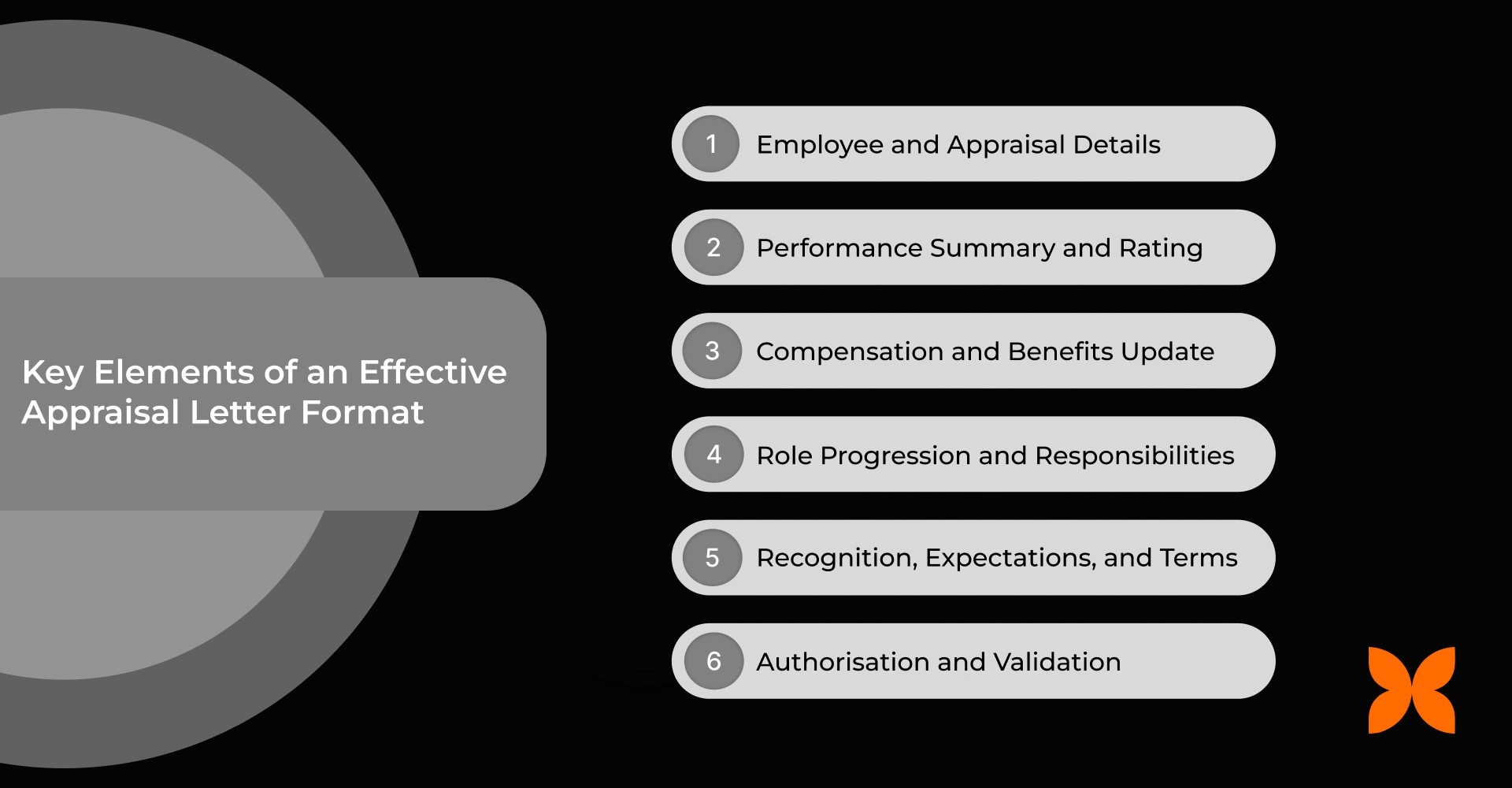
1. Employee and Appraisal Details
Include the employee’s full name, designation, employee ID, department, and the appraisal period. These details establish context, confirm applicability, and ensure the letter is correctly attributed to the employee.
Tip: Verify identifiers carefully to avoid administrative or legal errors.
2. Performance Summary and Rating
Summarise the employee’s key contributions, achievements, and overall performance during the review period, along with the assigned performance rating or score. This section forms the core evaluation record.
Tip: Keep the assessment factual, balanced, and aligned with internal evaluation criteria.
3. Compensation and Benefits Update
Clearly state any salary revisions, revised CTC, increment percentages, bonuses, or allowance changes resulting from the appraisal. Mention the effective date from which these changes apply.
Tip: Present old and revised figures clearly to prevent ambiguity or disputes.
4. Role Progression and Responsibilities (If Applicable)
Confirm any promotion, designation change, or expansion of responsibilities arising from the appraisal outcome. This formally records career progression decisions.
Tip: Link role changes to documented performance outcomes or policy criteria.
5. Recognition, Expectations, and Terms
Acknowledge the employee’s efforts and contributions while outlining future expectations, goals, or development plans. Include any applicable terms or conditions tied to compensation or role changes.
Tip: Keep expectations measurable and aligned with organisational objectives.
6. Authorisation and Validation
Ensure the letter is signed by an authorised manager or HR representative, including their designation and date of issue. This validates the appraisal as an official company record.
Tip: Confirm the signatory’s authority under internal HR policy before issuance.

Next, let’s walk through a step-by-step guide to drafting an effective appraisal letter.
How to Draft an Appraisal Letter: 6 Key Steps to Follow
Writing an appraisal letter requires structure, clarity, and the right tone. When done well, it communicates performance outcomes, recognises contributions, and reinforces a culture of transparency and appreciation within the organisation. Follow these practical steps to draft an effective appraisal letter:
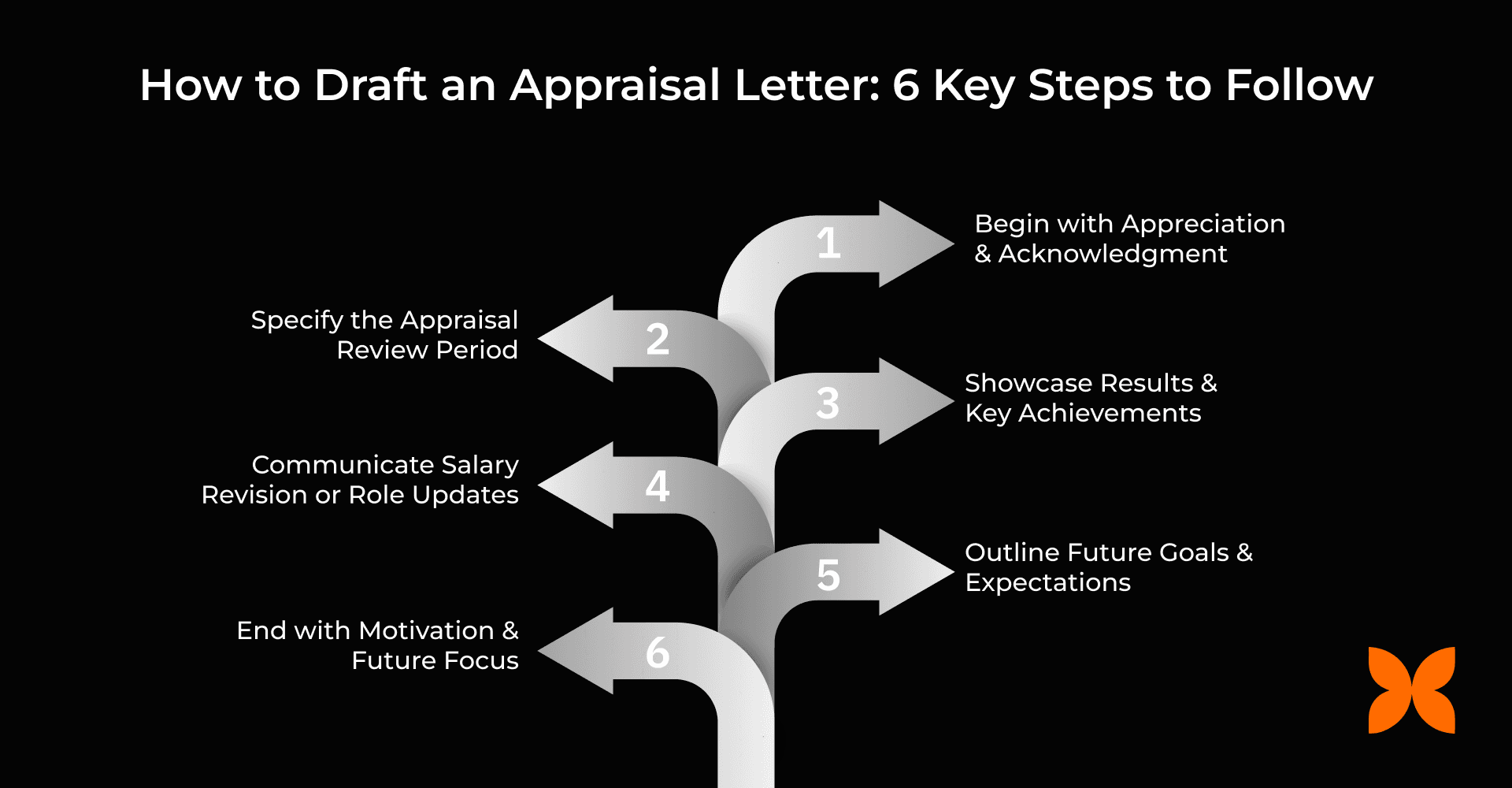
1. Begin with Appreciation and Acknowledgment
Start the letter by recognising the employee’s efforts and contributions during the appraisal period. This establishes a positive and respectful tone.
Example: “We appreciate your dedication and the consistent value you have contributed to the organisation over the past year.”
2. Specify the Appraisal Review Period
Clearly mention the timeframe being assessed to provide context and support accurate HR records.
Example: “This appraisal reflects your performance during the period from April 2025 to March 2026.”
3. Highlight Performance Outcomes and Key Achievements
Summarise notable accomplishments, goals achieved, and performance indicators met during the review cycle. This demonstrates objectivity and transparency.
Example: “During this period, you successfully met key deliverables, exceeded project timelines, and consistently achieved your performance targets.”
4. Communicate Salary Revision or Role-related Updates
Detail any changes to compensation, increments, bonuses, or role adjustments, along with the effective date, to avoid ambiguity.
Example: “Based on your performance, your annual compensation has been revised from ₹7,00,000 to ₹8,00,000, effective 1 April 2026.”
5. Outline Future Goals and Expectations
Define objectives, development areas, or training plans for the upcoming review cycle to align individual growth with organisational goals.
Example: “For the coming year, we encourage you to focus on strengthening leadership capabilities and mentoring junior team members.”
6. Conclude with Encouragement and Forward-looking Intent
End the letter on a motivating note that reinforces the employee’s confidence in their continued growth and contributions.
Example: “Congratulations on your performance. We look forward to your continued success and valuable contributions to the organisation.”
Also Read: Increment Letter Format: Key Elements & 10 Free Templates
With the key steps for drafting an appraisal letter clearly outlined, we can now look at practical formats and ready-to-use templates that HR teams and managers can adapt for their employees.
Appraisal Letter Format and Templates
Using standardised templates saves time while maintaining a professional and consistent approach across your organisation. These five samples cover the most common appraisal scenarios, helping HR teams issue letters quickly, accurately, and in compliance with the law.
1. Standard Annual Appraisal – Template
Use this letter to communicate the outcomes of a routine annual performance review, including performance rating and standard salary revisions.
(Date)
Subject: Annual Performance Appraisal
Dear (Employee Name),
We are pleased to share the outcome of your annual performance review for the period (Start Date – End Date). Based on your contributions, you have received a performance rating of (Rating).
Effective (Date), your salary will be revised to (New Salary), reflecting a (Percentage) increment. Your role and responsibilities will remain the same / change to (New Role, if applicable).
We appreciate your hard work and dedication and look forward to your continued contributions.
Please refer to Annexure A below for a detailed breakdown of your revised monthly salary structure. For any queries related to this appraisal, please contact (HR/Manager Name, Contact Details).
Sincerely,
(Name)
(Position), (Company Name)
Annexure A
Expected Monthly Salary Structure (Effective: DD/MM/YYYY)
Salary Component | Monthly Amount (₹) |
Basic Salary | |
House Rent Allowance (HRA) | |
Special Allowance | |
Conveyance Allowance | |
Other Allowances | |
Gross Salary | |
Employer PF Contribution | |
Employer Gratuity | |
Total Cost to Company (CTC) |
Note: Salary and benefits under this remuneration structure are payable after statutory deductions. Deductions, including TDS, Provident Fund, ESI, and Professional Tax, will be made in accordance with applicable laws.
2. Promotion-Based Appraisal – Template
Use this letter to notify employees about a promotion or role change resulting from exceptional performance or expanded responsibilities.
(Date)
Subject: Promotion & Appraisal Notification
Dear (Employee Name),
We are pleased to inform you that, based on your outstanding performance, you are promoted to (New Designation) effective (Date). Your revised salary will be (New Salary), along with associated benefits and allowances.
Your achievements, including (brief achievements), have significantly contributed to the team’s success. Please continue to uphold performance standards in your new role.
Please refer to Annexure A below for a detailed breakdown of your revised monthly salary structure. For any queries related to this promotion or compensation revision, please contact (HR/Manager Name).
Sincerely,
(Name)
(Position), (Company Name)
Annexure A
Expected Monthly Salary Structure (Effective: DD/MM/YYYY)
Salary Component | Monthly Amount (₹) |
Basic Salary | |
House Rent Allowance (HRA) | |
Special Allowance | |
Conveyance Allowance | |
Other Allowances | |
Gross Salary | |
Employer PF Contribution | |
Employer Gratuity | |
Total Cost to Company (CTC) |
Note: Salary and benefits under this remuneration structure are payable after statutory deductions. Deductions, including TDS, Provident Fund, ESI, and Professional Tax, will be made in accordance with applicable laws.
3. Probation Completion Appraisal – Template
Use this letter to confirm the successful completion of an employee’s probation period, along with any salary or role adjustments.
(Date)
Subject: Probation Completion Appraisal
Dear (Employee Name),
Congratulations on successfully completing your probation period. Based on your performance, you have been confirmed in the (Designation) role, effective (Date).
Your revised salary will be (New Salary), and your responsibilities will include (Key Responsibilities). We look forward to your continued growth and contributions.
For any queries, contact (HR/Manager Name).
Sincerely,
(Name)
(Position), (Company Name)
Please refer to Annexure A below for a detailed breakdown of your revised monthly salary structure. For any queries related to this confirmation or compensation, please contact (HR/Manager Name).
Sincerely,
(Name)
(Position), (Company Name)
Annexure A
Expected Monthly Salary Structure (Effective: DD/MM/YYYY)
Salary Component | Monthly Amount (₹) |
Basic Salary | |
House Rent Allowance (HRA) | |
Special Allowance | |
Conveyance Allowance | |
Other Allowances | |
Gross Salary | |
Employer PF Contribution | |
Employer Gratuity | |
Total Cost to Company (CTC) |
Note: Salary and benefits under this remuneration structure are payable after statutory deductions. Deductions, including TDS, Provident Fund, ESI, and Professional Tax, will be made in accordance with applicable laws.
4. Incentive / Bonus Notification – Template
Use this letter to formally communicate performance-based incentives, bonuses, or rewards, highlighting the contributions that earned them.
(Date)
Subject: Performance Bonus Notification
Dear (Employee Name),
We are pleased to inform you that, based on your performance during the review period (Start – End), you are eligible for a performance bonus of (Amount/Percentage), effective (Date).
Your consistent efforts, including (key achievements), have contributed to the company’s objectives. We appreciate your commitment and dedication.
For questions, contact (HR/Manager Name).
Sincerely,
(Name)
(Position), (Company Name)
5. Special Recognition Appraisal – Template
Use this letter to acknowledge exceptional contributions, milestone achievements, or extraordinary performance that goes beyond regular appraisal cycles.
(Date)
Subject: Special Performance Recognition
Dear (Employee Name),
We wish to recognise your exceptional contribution to (Project/Task). As a token of appreciation, you are awarded (Incentive/Bonus/Certificate), effective (Date).
Your efforts have significantly impacted team performance and company success. We encourage you to continue your high standards of work.
For any queries, contact (HR/Manager Name).
Sincerely,
(Name)
(Position), (Company Name)
Also Read: Relieving Letter Format: Elements & 7 Free Templates
Next, let’s take a closer look at best practices for drafting an appraisal letter to ensure it is clear, motivating, and compliant.
Best Practices for Writing an Appraisal Letter
Even minor drafting oversights, such as incorrect appraisal periods, unclear performance remarks, or inconsistent salary figures, can create confusion, dissatisfaction, and unnecessary HR escalations. Adhering to these best practices acts as a safeguard to ensure your communication is accurate, professional, and legally sound:
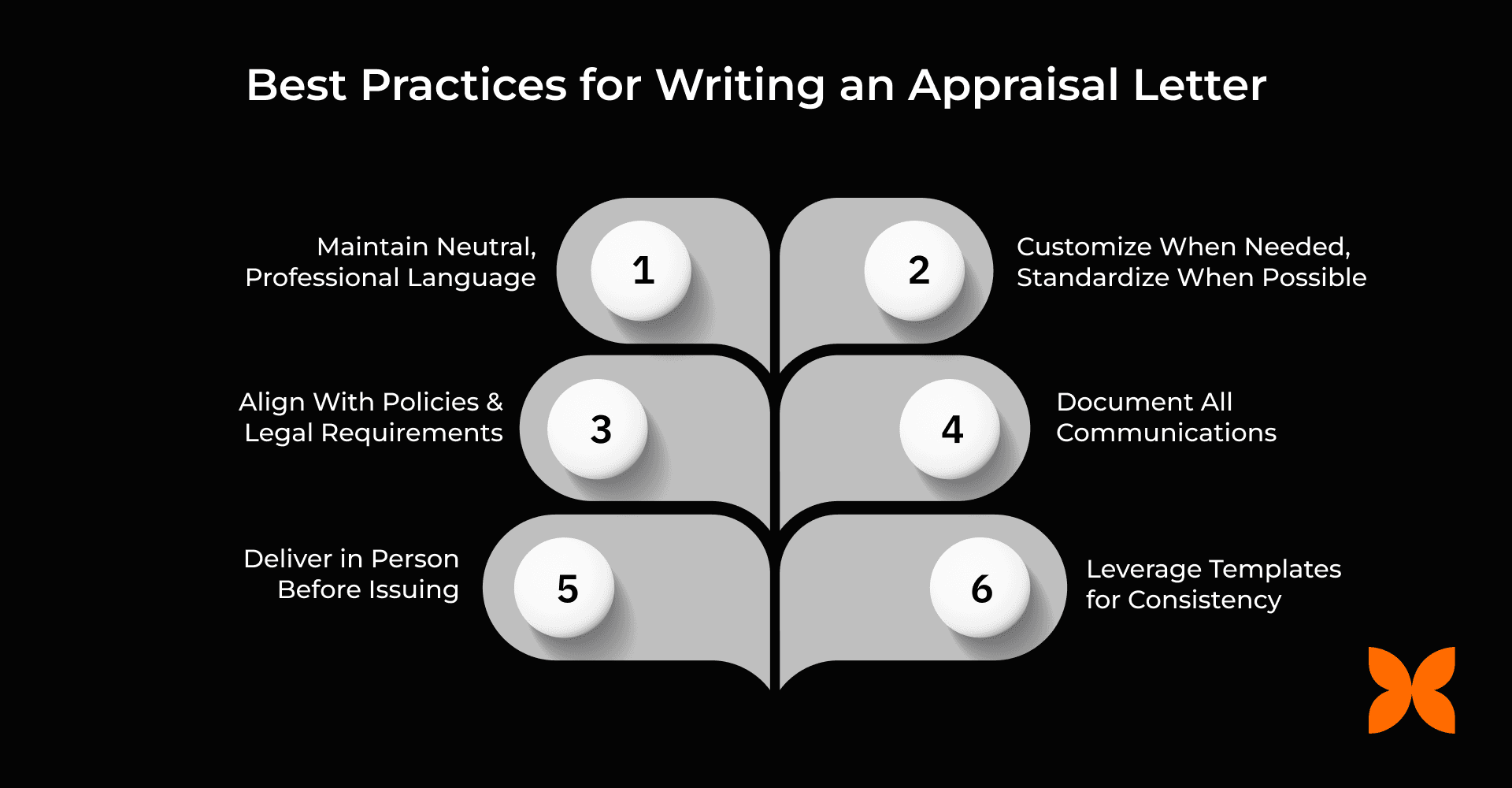
Maintain Neutral, Professional Language: Keep feedback factual and avoid emotionally charged words.
Personalise Where Necessary, Standardise Where Possible: Customise key details such as ratings and achievements, but maintain a consistent structure.
Align With Company Policies and Statutory Requirements: Ensure salary revisions, promotions, and benefits comply with Indian labour regulations and internal policies.
Document All Communications: Keep copies of letters, acknowledgements, and related documents.
Deliver in Person Before Issuing: Whenever possible, discuss appraisal results in person or virtually before sending the letter.
Use Templates Carefully for Consistency: Templates save time and ensure fairness, but appraisal letters should never feel generic or copied. Each letter must clearly reflect the employee’s individual performance and contribution.

Final Thoughts
Inconsistent or poorly documented appraisal processes can create confusion, lower employee motivation, and increase the risk of disputes. Many SMEs still rely on email or manual tracking methods, which often lead to errors and inefficiencies.
Structured appraisal letters provide transparency, maintain fairness, and serve as legal records for performance-related decisions. Platforms like Craze help centralise HR documentation workflows, making it easier to manage appraisal letters alongside other employee lifecycle records.
Take control of employee performance management today. See how Craze can streamline your appraisal process, ensure compliance, and enhance employee engagement. Request a Demo Today!
FAQs
1. Do I need to issue an appraisal letter for every employee?
Yes. Any employee receiving a salary revision, promotion, bonus, or other incentive should be issued a formal appraisal letter documenting the decision and maintaining HR records.
2. Can appraisal letters be emailed?
Yes, emailing appraisal letters is acceptable. However, it is recommended to obtain an acknowledgment from the employee, and ideally, provide a hard copy for record-keeping purposes.
3. What is the difference between an appraisal letter and an appreciation letter?
An appraisal letter covers performance review outcomes, ratings, salary changes, or promotions. An appreciation letter recognises achievements without mentioning compensation or future goals.
4. How often should appraisal letters be issued?
Appraisal letters are typically issued annually. They should also be provided upon completion of probation, upon promotion, or at special recognition milestones to ensure proper documentation.
5. Can appraisal letters differ by employee category?
Yes. Letters may vary for managers, probationary staff, or contract workers. Tailored language should reflect the employee’s role, responsibilities, and any contractual obligations while maintaining consistency and fairness.
