
Appreciation Letter Format: Key Elements and 10 Free Samples


Drafting an appreciation letter that truly acknowledges employee contributions can be challenging, even when you understand its importance. You know which employees deserve recognition, but balancing genuine acknowledgement with a professional, structured format can be difficult.
The stakes are higher than they appear; a vague message or unclear phrasing can reduce impact, confuse recipients, or fail to reinforce positive performance. Recognising multiple employees across departments without a clear framework can create administrative bottlenecks, leading to inconsistency and missed opportunities to motivate your team.
In this blog, you will learn how to draft appreciation letters efficiently, highlighting key elements, best practices, and ready-to-use templates to ensure recognition is clear, meaningful, and impactful.
Key Takeaways
An appreciation letter formally recognises an employee’s contributions, motivates them, and records performance milestones.
Standardised letters maintain consistency, fairness, and professional recognition across employees and departments.
Each letter should include employee details, the purpose of recognition, specific achievements, and relevant dates.
Pre-designed templates simplify issuing letters for performance, team contribution, or project completion.
Using the right tone, structure, and documentation reinforces professionalism and organisational culture.
What is an Appreciation Letter?
An appreciation letter is a formal written communication from an employer or manager to an employee that recognises exceptional work, achievements, or contributions. It highlights specific accomplishments, expresses gratitude, and serves as a motivational tool to reinforce desired behaviours.
Appreciation letters are used across various scenarios, including project success, exceeding targets, consistent performance, innovation, teamwork, or long-term service. They provide both a formal record and a morale boost, ensuring that employees feel valued and motivated to maintain high performance.
Why Appreciation Letters Matter?
While informal recognition is valuable, formal appreciation letters provide organisations with clear, lasting benefits by acknowledging employee contributions, reinforcing positive behaviour, and supporting a culture of recognition.
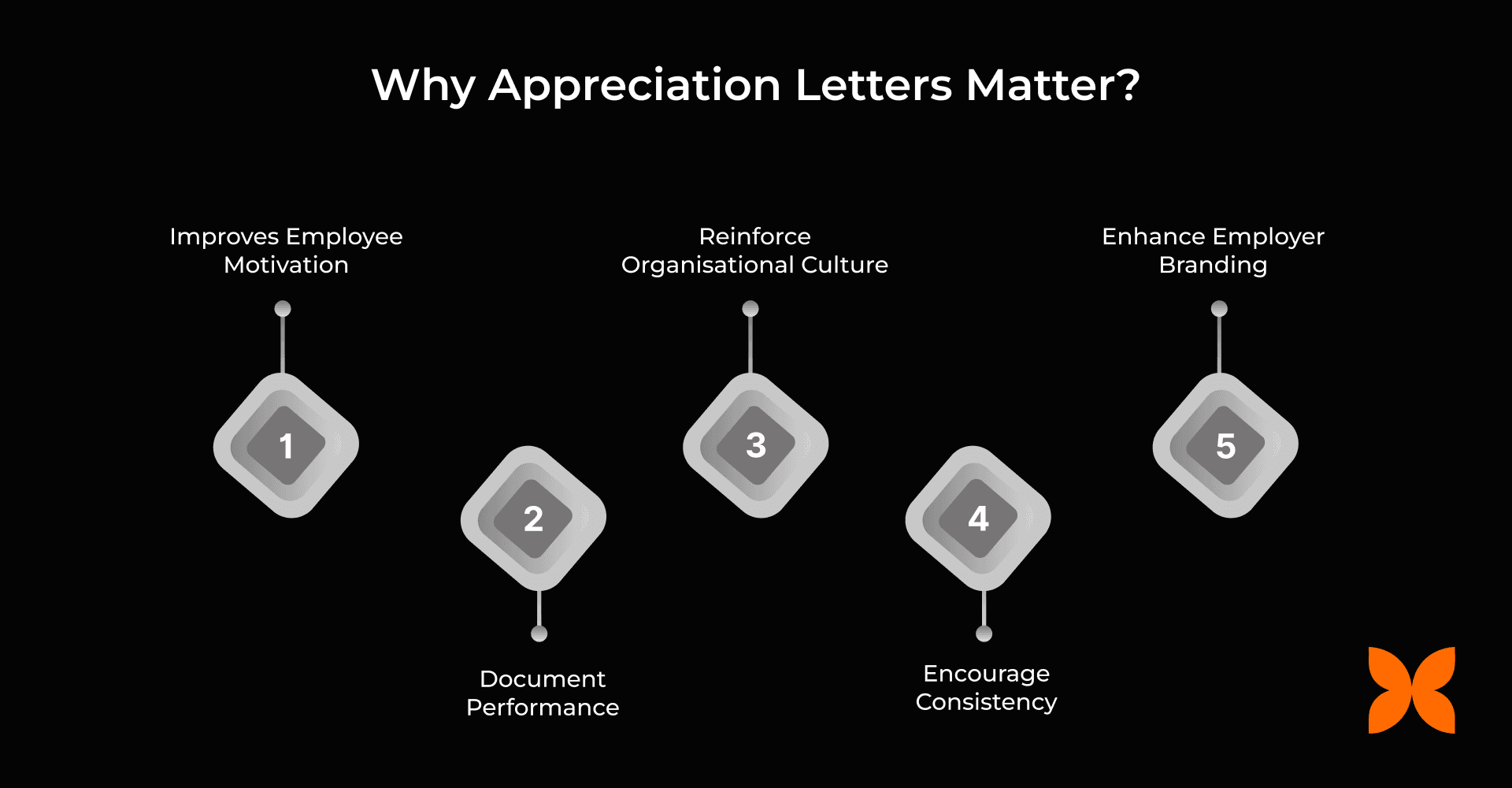
Improves Employee Motivation: Publicly acknowledging contributions fosters engagement, commitment, and pride.
Document Performance: Appreciation letters serve as official records in performance appraisals, promotions, or internal evaluations.
Reinforce Organisational Culture: Regular recognition helps establish a positive, supportive work environment, enhancing retention.
Encourage Consistency: Standardised letters ensure all employees feel equally valued, avoiding perceptions of bias.
Enhance Employer Branding: Recognition practices reflect professionalism and help attract top talent.
With this understanding, let’s explore the key elements that an effective appreciation letter should include.
Key Elements of an Effective Appreciation Letter
For recognition to feel meaningful, the letter must be specific and well-organised. These core components provide a framework that moves beyond a simple "thank you," ensuring the employee’s hard work is documented in a way that is clear, formal, and suitable for their professional file.
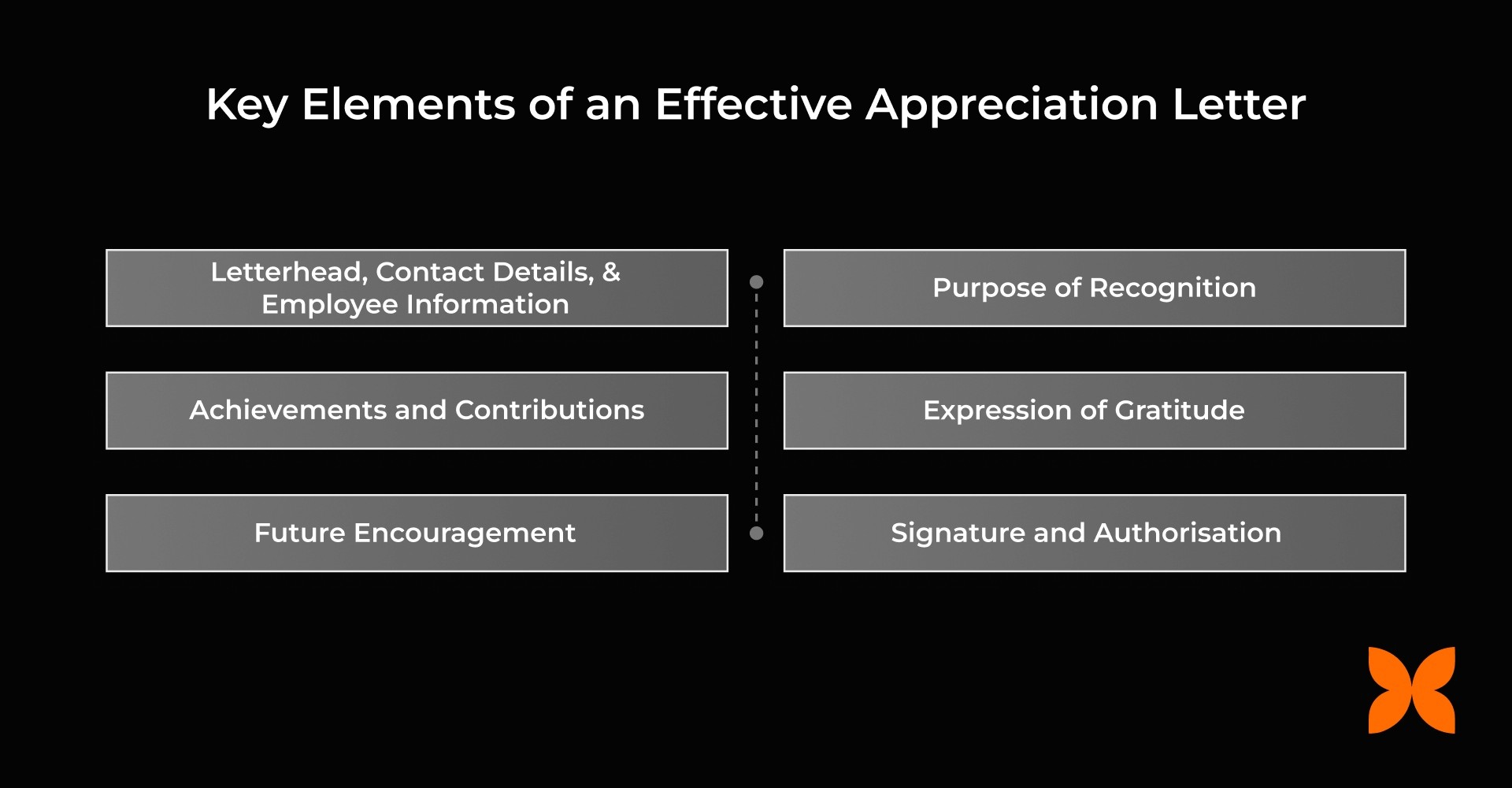
1. Letterhead, Contact Details, and Employee Information
Include the company name, registered address, HR contact details, date, and complete employee information, such as full name, designation, employee ID, and department. This establishes authenticity and provides a clear context.
Tip: Verify spellings of names and job titles to avoid administrative or legal inaccuracies.
2. Purpose of Recognition
Clearly state the reason for issuing the appreciation letter. Identify the specific achievement, project, or behaviour being recognised to ensure transparency and relevance.
Tip: Avoid generic statements; precise recognition carries more value.
3. Achievements and Contributions
Describe measurable results or meaningful contributions, such as exceeding targets, delivering key projects, improving processes, or supporting team outcomes.
Tip: Where possible, include outcomes, timelines, or metrics to strengthen credibility.
4. Expression of Gratitude
Communicate appreciation professionally and sincerely, linking the employee’s contribution to its impact on the team, department, or organisation.
Tip: Maintain a positive, balanced tone without being overly exaggerated.
5. Future Encouragement
Reinforce the organisation’s confidence in the employee by encouraging continued performance, growth, and engagement.
Tip: Close with a forward-looking statement that motivates continued contribution.
6. Signature and Authorisation
Include the name, designation, and signature of the reporting manager, HR head, or authorised signatory. This formal approval adds legitimacy to the letter.
Tip: Ensure the signatory has appropriate authority within the organisation.
Next, let’s walk through a step-by-step guide to drafting an effective appraisal letter.
How to Draft an Appreciation Letter: 6 Key Steps
The goal of this drafting process is to turn a general feeling of gratitude into a professional record of success. These steps help you gather the right details, choose a tone that matches the achievement, and structure the message so the employee feels truly seen and valued by the organisation.
Step 1: Include Header and Employee Information
Start with your company’s letterhead, contact details, and the date. Include the employee’s full name, designation, department, and employee ID (if applicable).
Example: “Employee: Riya Sharma, Software Engineer, IT Department, Employee ID: 1023”
Step 2: Begin with a Clear Subject Line and Salutation
Use a concise subject line that indicates the purpose. Begin with a professional greeting.
Example:
“Subject: Appreciation for Outstanding Performance
Dear Ms. Sharma,”
Step 3: State the Purpose of the Letter
Clearly explain why the letter is being issued. Specify the achievement, contribution, or behaviour being recognised.
Example: “We would like to formally recognise your exceptional work on the XYZ project, where your innovative solutions improved efficiency by 20%.”
Step 4: Highlight Achievements and Contributions
Provide measurable results or specific contributions. Include dates, milestones, or metrics to reinforce credibility.
Example: “Your initiative in redesigning the workflow reduced processing time from 5 days to 3 days, directly impacting team productivity.”
Step 5: Express Gratitude and Encourage Future Performance
Thank the employee sincerely and motivate continued engagement or excellence.
Example: “We sincerely appreciate your dedication and hard work, and we look forward to your continued contributions to the team’s success.”
Step 6: Close Formally with a Signature
End with a professional sign-off. Include the name, designation, and signature of the reporting manager or authorised signatory.
Example:
“Sincerely,
Amit Verma
HR Manager, ABC Ltd.”
With the key steps for drafting an appreciation letter covered, let’s explore practical, ready-to-use formats you can adapt for various employee scenarios.
Appreciation Letter Format and Templates
Using standardised templates ensures clarity, professionalism, and consistency when recognising employee contributions. These ready-to-use appreciation letter templates cover common scenarios, helping you draft them quickly and effectively.
1. Appreciation Letter for Exceptional Performance
This letter is appropriate when an employee exceeds performance targets or demonstrates outstanding work on a project.
(Date)
Subject: Appreciation for Outstanding Performance
Dear (Employee Name),
We would like to formally acknowledge your exceptional performance as (Position) in (Department). Your contribution to (specific project/task) has significantly exceeded expectations.
Your dedication, innovative ideas, and consistent effort have made a measurable impact on our goals, particularly (mention specific results or achievements).
We sincerely appreciate your hard work and commitment to excellence and look forward to your continued contributions.
Sincerely,
(Name)
(Position), (Company Name)
2. Appreciation Letter for Team Contribution
This letter is suitable for recognising an employee who demonstrates excellent teamwork, collaboration, or support in group projects.
(Date)
Subject: Appreciation for Team Contribution
Dear (Employee Name),
We wish to recognise your valuable contribution to the success of (Project/Team). Your collaboration, support, and proactive approach have greatly enhanced team efficiency and morale.
Your efforts in (specific tasks or initiatives) have been instrumental in achieving the project objectives on time.
Thank you for your dedication and teamwork. We look forward to your continued involvement and leadership within the team.
Sincerely,
(Name)
(Position), (Company Name)
3. Appreciation Letter for Innovation
This letter is ideal for acknowledging an employee who introduces a new idea, process improvement, or innovation that benefits the organisation.
(Date)
Subject: Appreciation for Innovation
Dear (Employee Name),
We want to acknowledge your innovative approach and the successful implementation of (project/idea). Your creativity and problem-solving skills have resulted in (specific benefits such as cost savings, efficiency improvements, or revenue gains).
Your initiative reflects our organisational values and sets a strong example for your peers. We appreciate your commitment to continuous improvement.
Sincerely,
(Name)
(Position), (Company Name)
4. Appreciation Letter for Long-term Service
This letter is intended to express appreciation for an employee who has completed a significant tenure with the organisation.
(Date)
Subject: Appreciation for Years of Service
Dear (Employee Name),
On behalf of (Company Name), we would like to express our sincere appreciation for your (X) years of dedicated service. Your commitment, professionalism, and contributions have played a vital role in our growth and success.
We value your loyalty and look forward to many more years of collaboration and achievement together.
Sincerely,
(Name)
(Position), (Company Name)
5. Appreciation Letter for Special Achievement
This letter is used to formally recognise an employee who achieves a milestone, earns a certification, or receives significant recognition outside their everyday responsibilities.
(Date)
Subject: Appreciation for Special Achievement
Dear (Employee Name),
We would like to formally recognise your achievement of (certification/award/milestone). Your dedication to self-improvement and professional excellence is commendable.
Your accomplishment has positively impacted (team/department/organisation) and serves as an inspiration to your colleagues.
Thank you for your continued commitment to excellence.
Sincerely,
(Name)
(Position), (Company Name)
6. Appreciation Letter for Work Anniversary
This letter is suitable for celebrating an employee’s tenure and loyalty during annual work anniversaries.
(Date)
Subject: Happy Work Anniversary
Dear (Employee Name),
As we celebrate your (X) year(s) of work anniversary with (Company Name), we sincerely appreciate your dedication, hard work, and consistent contributions to the organisation.
Your loyalty and commitment have been vital to our growth, and we look forward to many more years of collaboration and shared success.
Best regards,
(Name)
(Position), (Company Name)
7. Appreciation Letter for Support
This letter can be used to acknowledge an employee who provides exceptional help or support during a project or critical situation.
(Date)
Subject: Appreciation for Support
Dear (Employee Name),
We want to express our gratitude for your unwavering support during (Project/Task). Your willingness to go above and beyond has contributed significantly to the team’s success.
Your proactive assistance and dedication have not gone unnoticed, and we deeply value your contribution.
Warm regards,
(Name)
(Position), (Company Name)
8. Appreciation Letter for Customer Service
This letter is appropriate for recognising an employee who demonstrates exceptional service to clients or customers.
(Date)
Subject: Appreciation for Outstanding Customer Service
Dear (Employee Name),
We would like to acknowledge your exceptional dedication to delivering outstanding service to our clients. Your ability to understand client needs and provide timely solutions has strengthened our customer relationships.
Your commitment and attitude significantly impact (Company Name), and we truly appreciate your efforts.
Sincerely,
(Name)
(Position), (Company Name)
9. Appreciation Letter for Project Achievement
This letter is suitable for recognising an employee who completes a key project or achieves significant project goals.
(Date)
Subject: Appreciation for Project Achievement
Dear (Employee Name),
We would like to recognise your exceptional contribution to the successful completion of (Project Name). Your expertise, hard work, and problem-solving skills were instrumental in achieving project objectives.
Your dedication has made a meaningful impact on the team and organisation, and we value your efforts immensely.
Warm regards,
(Name)
(Position), (Company Name)
10. Appreciation Letter for Reliability and Dedication
This letter is used to acknowledge an employee who consistently demonstrates reliability, commitment, and dedication to the organisation.
(Date)
Subject: Appreciation for Dedication and Reliability
Dear (Employee Name),
We sincerely appreciate your consistent reliability and dedication to your role. Your commitment to delivering high-quality work and supporting the team has set a strong example for your colleagues.
Your professionalism and unwavering work ethic significantly contribute to the organisation’s success, and we are grateful for your efforts.
Sincerely,
(Name)
(Position), (Company Name)
Now that you’ve reviewed the most common appreciation letter formats, the next step is understanding how to write them effectively to ensure your message is impactful.
Best Practices for Writing an Appreciation Letter
The most effective letters go beyond standard templates to offer praise that feels earned and authentic. These tips focus on the nuances of timing, personalisation, and detail that transform a routine document into a powerful tool for employee engagement and long-term loyalty:
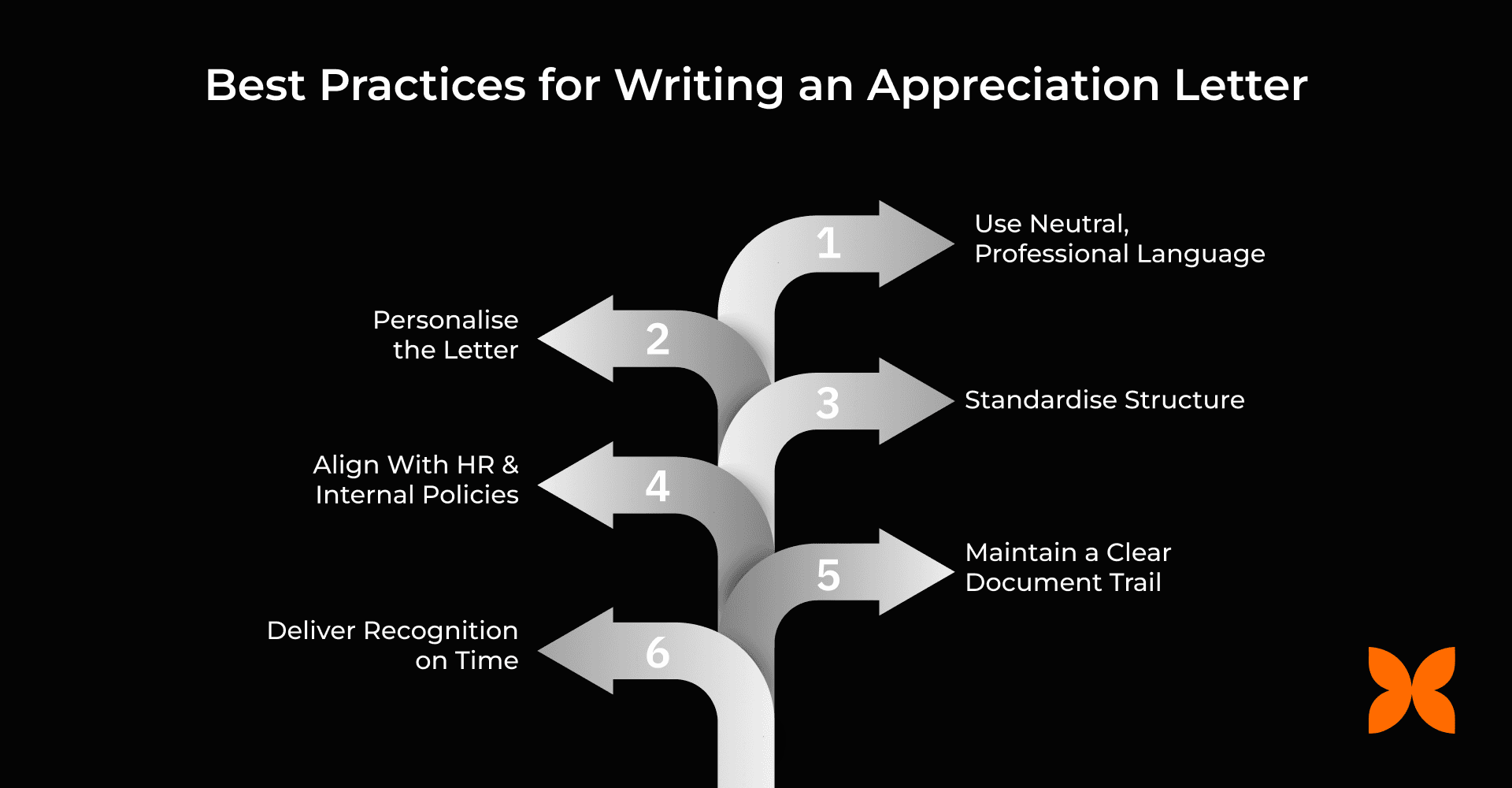
Use Neutral, Professional Language: Maintain a sincere and positive tone without exaggeration or flattery. Recognition should be factual and focused on measurable contributions.
Personalise the Letter: Reference specific achievements, outcomes, or examples to make the appreciation relevant and credible, rather than relying on generic praise.
Standardise Structure: Adopt a consistent format across all appreciation letters to ensure fairness, while customising the content to individual roles and contributions.
Align With HR and Internal Policies: Ensure recognition letters comply with internal HR practices and accurately reflect the performance being acknowledged.
Maintain a Clear Document Trail: Retain copies of appreciation letters in employee records to support future appraisals, promotions, or reference checks.
Deliver Recognition on Time: Issue appreciation letters soon after achievements or milestones to reinforce positive behaviour and maximise impact.

Final Thoughts
Without formal recognition, even high-performing employees may feel undervalued, which can affect morale, consistency, and long-term retention. Many Indian organisations still rely on informal or ad hoc appreciation practices that are difficult to track and easy to overlook.
Structured, clear, and professionally written appreciation letters help organisations recognise contributions consistently and reinforce a culture of accountability and appreciation. Platforms like Craze support this by streamlining HR workflows and standardising employee documentation within a unified people operations system, reducing manual effort and process gaps.
Recognise employee contributions in a structured and consistent way. Explore how Craze can support your HR processes and see how it fits into your organisation’s people operations. Request a Demo today!
FAQs
1. Do I need to issue an appreciation letter for every achievement?
No. Appreciation letters should be reserved for meaningful contributions, key milestones, or achievements that clearly impact business outcomes or organisational culture.
2. Can appreciation letters be shared via email?
Yes. Appreciation letters may be sent digitally; however, issuing them on official company letterhead, whether digital or printed, adds formality and allows proper record-keeping in HR files.
3. Should team members be mentioned in an individual appreciation letter?
Only when the achievement involved collaboration, while acknowledging teamwork is appropriate, should the letter primarily highlight the individual’s specific role and contribution.
4. How frequently should appreciation letters be issued?
They are most effective when used strategically, such as during performance reviews, project completions, certifications, or exceptional accomplishments, rather than for routine duties.
5. Should appreciation letters vary by employee level or role?
Yes. Letters for senior leadership, managers, or contract staff should be customised to reflect their responsibilities, scope of impact, and organisational expectations.
