


Managing employee paperwork efficiently is crucial for your HR team. When important documents such as tax forms, compensation history, and updated contact details are scattered across multiple folders and shared drives, it leads to significant inefficiency and frustration.
Due to this decentralised system, every compliance deadline, from annual audits to statutory filings, becomes an unnecessary fire drill. This administrative struggle carries a real financial risk, as regulatory non-compliance under the Digital Personal Data Protection (DPDP) Act, 2023, can result in fines of up to ₹250 crore. The employee record management system (ERMS) is the immediate solution, centralising all personnel data into a single, secure source of truth.
This blog identifies the best employee record management system for your needs by breaking down the top 7 software options in 2026. Choosing the right platform is the key to transforming data management from a liability into a scalable business asset.
An employee record management system (ERMS) centralises all lifecycle documents and automates compliance to stop administrative chaos.
Fragmented employee records create significant legal liabilities, making an ERMS a necessary governance tool.
Prioritise platforms with native Indian compliance support (PF, ESI, TDS, PT) and strong data security (RBAC and encryption).
Solutions like Craze and Rippling offer all-in-one HR/IT unification, while others provide deep, localised compliance.
Ensure successful implementation by auditing existing data and executing a phased rollout with mandatory user training.
An employee record management system (ERMS) is a centralised, digital platform that securely stores, organises, and manages all documents and data related to an employee's tenure at a company. This system holds everything from their signed job offers and salary history to compliance forms (like PAN and Aadhaar) and performance reviews. It is the company's secure, comprehensive repository for all official workforce data.
The core function of an ERMS is to replace inefficient manual processes, such as paper filing and scattered digital folders, with a unified, controlled platform. By automating data entry and tracking history, an ERMS drastically reduces administrative tasks and eliminates the high risk of human error in payroll and auditing.
To truly understand its necessity, let’s explore why this level of governance is crucial for Indian businesses right now.
Also Read: HR Compliance Checklist for Indian Organisations: A Complete Guide
As companies scale rapidly, manual data storage becomes a significant liability, highlighting the need for reliable record management. In 2026, advanced data governance is not merely an HR preference; it is a foundational requirement for regulatory compliance and efficient growth.
Here are the key reasons why you should prioritise adopting the best employee record management system (ERMS) for your organisation:
Mitigating Compliance Risk: Ensures immediate, accurate adherence to complex and evolving Indian labour laws, income tax (TDS), PF/ESI filings, and critical data security mandates, such as the DPDP Act, 2023.
Faster, Error-Free Audits: Provides instantaneous, organised access to every single employee document and history trail, cutting audit preparation time from weeks to hours and eliminating costly data errors.
Centralised, Secure Data Access: Consolidates all personnel information, from onboarding forms to exit documents, into one secure digital location, eliminating the risk of data silos, loss, or unauthorised access.
Automating Administrative Overload: Drastically reduces the time spent on manual administrative tasks like data entry, file searching, and record updating, freeing up HR and finance staff for strategic work.
Supporting Distributed Workforces: Allows for secure, role-based access to records for managers and HR staff across different cities, seamlessly supporting hybrid and remote team operations.
Informed Decision Making: Provides clean, accurate, and up-to-date data for analytical needs, enabling better decision-making on promotions, compensation reviews, and resource allocation.
With data governance non-negotiable for scaling, let’s look at the top seven contenders driving the best employee record management system landscape in 2026.
Also Read: HR Records Management: The Ultimate Business Guide
Choosing the right ERMS means aligning its capabilities with your company's growth stage and specific compliance needs. The ideal platform must simplify Indian statutory requirements while providing the security and accessibility demanded by modern distributed teams.
Here is a focused comparison of the top platforms driving efficiency in the market today:
System | Key Features | Best For |
|---|---|---|
Craze | All-in-one HR/Payroll/IT Central HR Hub Full PF/ESI/TDS sync | Startups, Mid sized & Fast Growing Indian businesses |
Rippling | Unified HR, Payroll, & IT Automated provisioning/deprovisioning of assets | Globally scaling and distributed teams that need centralised IT control. |
BambooHR | Extremely user-friendly interface Secure record Custom fields Simple core HR | SMBs prioritising simplicity and excellent user experience (UX). |
Zoho People | Highly customisable database Document Management HR Help Desk integration | Businesses invested in the Zoho ecosystem needing custom workflows. |
Keka HR | Mobile-first Employee Self-Service (ESS) CoreHR data hub Strong native compliance | Large sized firms especially with blue collar workforce prioritising UX and payroll compliance. |
HROne | InboxforHR™ control centre High customisation AI Voice Commands F&F settlement | Indian retail & manufacturing enterprises needing high configuration and administrative efficiency. |
GreytHR | Central HR Hub Payroll & compliance sync ESS | Healthcare & Educational organisations |
Craze
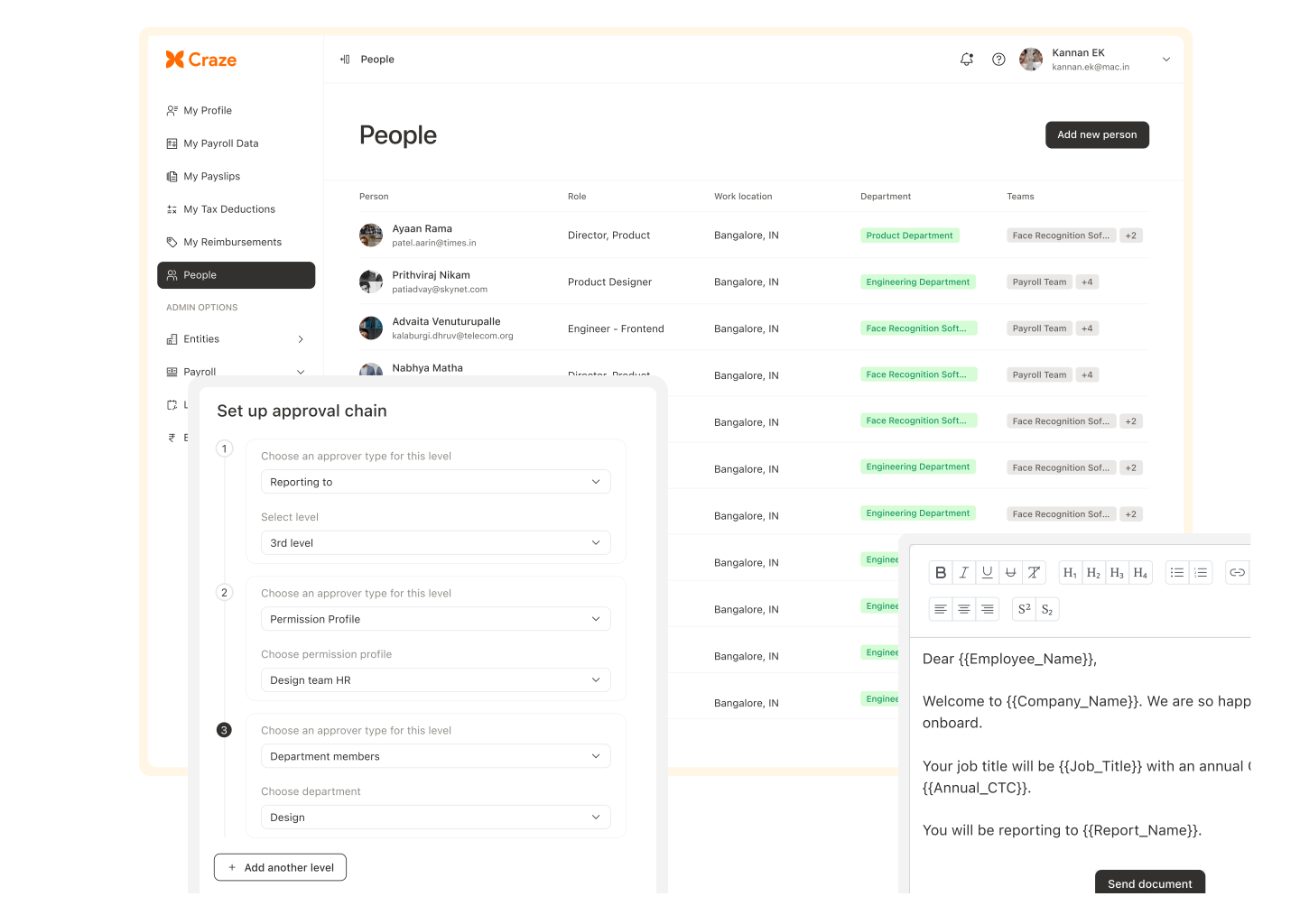
Craze is a unified Employee Records Management System (ERMS) platform that automates HR, Payroll, Finance, and IT workflows. It is built specifically for startups, mid-sized and fast-growing Indian businesses that want to replace disjointed systems with a unified solution.
Core ERMS Features
Central HR Hub: Serves as the single system of record, managing the full employee lifecycle, from onboarding to separation, including all data changes (promotions, salary revisions).
Document Management: Includes a reliable vault for creating, sending, and storing all personnel documents, with pre-built templates, approval workflows, and strong access controls.
Advanced Permissions: Provides role-based access control, allowing custom profiles and access levels to ensure data security and process control across different apps and functions (HR, Finance, IT).
Compliance
Full Statutory Compliance: Ensures compliance for PF, ESI, PT, and TDS, with error-free calculations and auto-sync to payroll, minimising compliance risk.
Document Compliance: Offers pre-built templates for standard Indian HR letters (Offer, Increment, Relieving) and compliance reports (Form 16, tax liabilities).
Integrations
Unified Core System: Deep, native integration across all modules, including HR (Leave, Attendance, Performance), Payroll, Finance (Reimbursements), and IT (Equipment/App Management), eliminating the need for external tools for core operations.
Best for: Startups, mid-sized and fast-growing Indian businesses with 50-500 employees seeking an all-in-one HR, Payroll, Finance, and IT operating system for complete administrative automation and a single, trustworthy data source.
Rippling
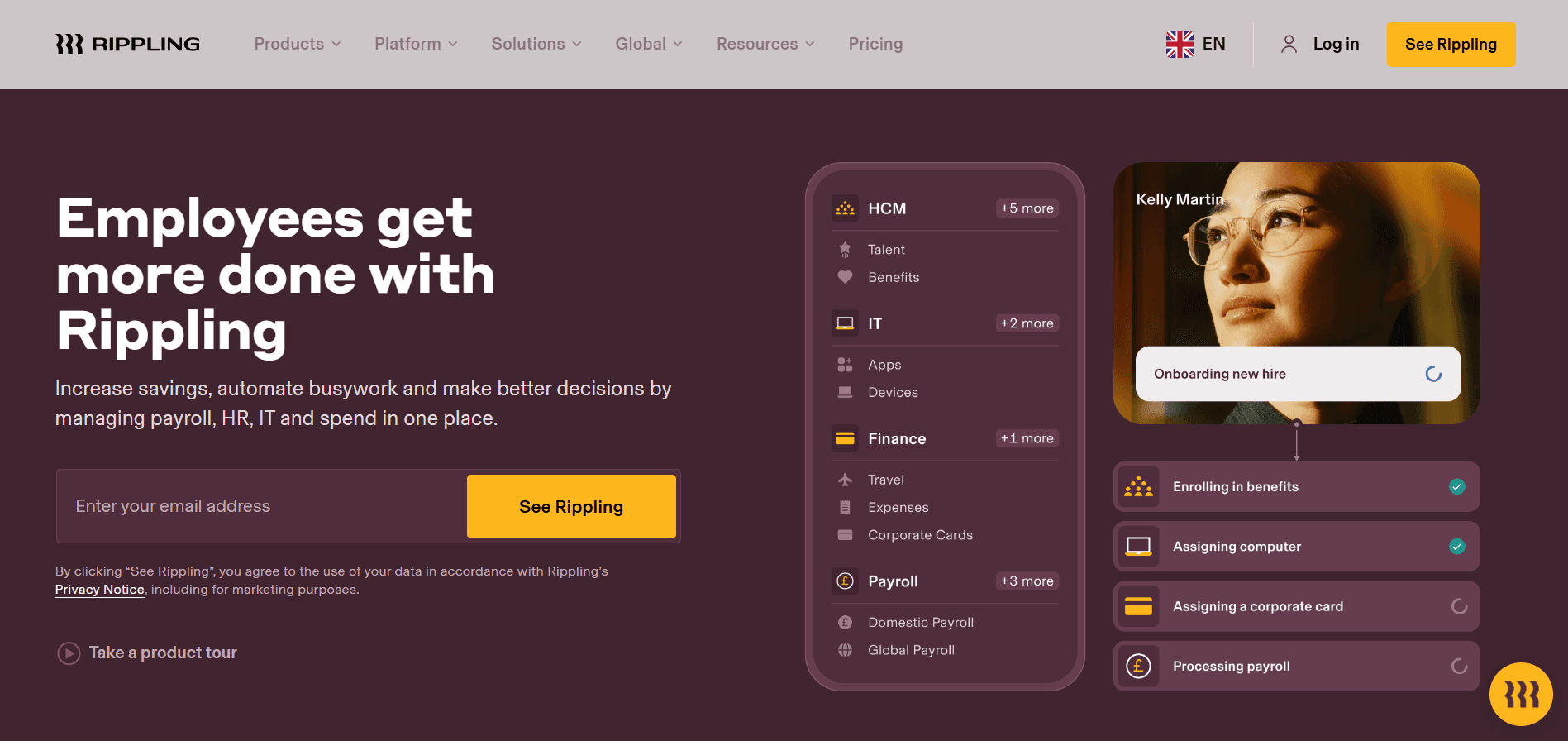
Rippling is positioned as a unified Workforce Management System that combines HR, Payroll, Finance, and IT operations. It is globally oriented, making it ideal for scaling distributed teams and global companies seeking central control over both people and technology assets.
Core ERMS Features
Single Source of Truth: Built on a singular employee record, ensuring data integrity across all four product suites (HR, Payroll, IT, Finance) and minimising errors from disconnected systems.
Unified IT Management: Its main advantage is linking employee records with IT automation, ensuring smooth setup and removal of software, accounts, and devices during onboarding and offboarding.
Core Global HRIS: Runs comprehensive global HR in one place, managing employee data across multiple countries with standardised workflows.
Compliance
Global Compliance Infrastructure: Strong infrastructure for hiring and managing employees in 185+ countries (via EOR/CoR models), managing localised payroll and employment laws.
Policy Enforcement: Automates the enforcement of company rules and policies, linking directly to location-specific regulations and ensuring permissions are correctly applied based on role and geography.
Integrations
Native IT & Finance: Uniquely integrates IT (Device Management, App Management) and Finance (Spend Management, Expense) natively using the core employee record.
Extensive App Library: Integrates with hundreds of external applications, using its platform approach to improve third-party app performance with accurate employee data.
Best for: Globally scaling companies and distributed teams needing unified HR, Payroll, and automated IT provisioning/de-provisioning linked to the employee record.
BambooHR
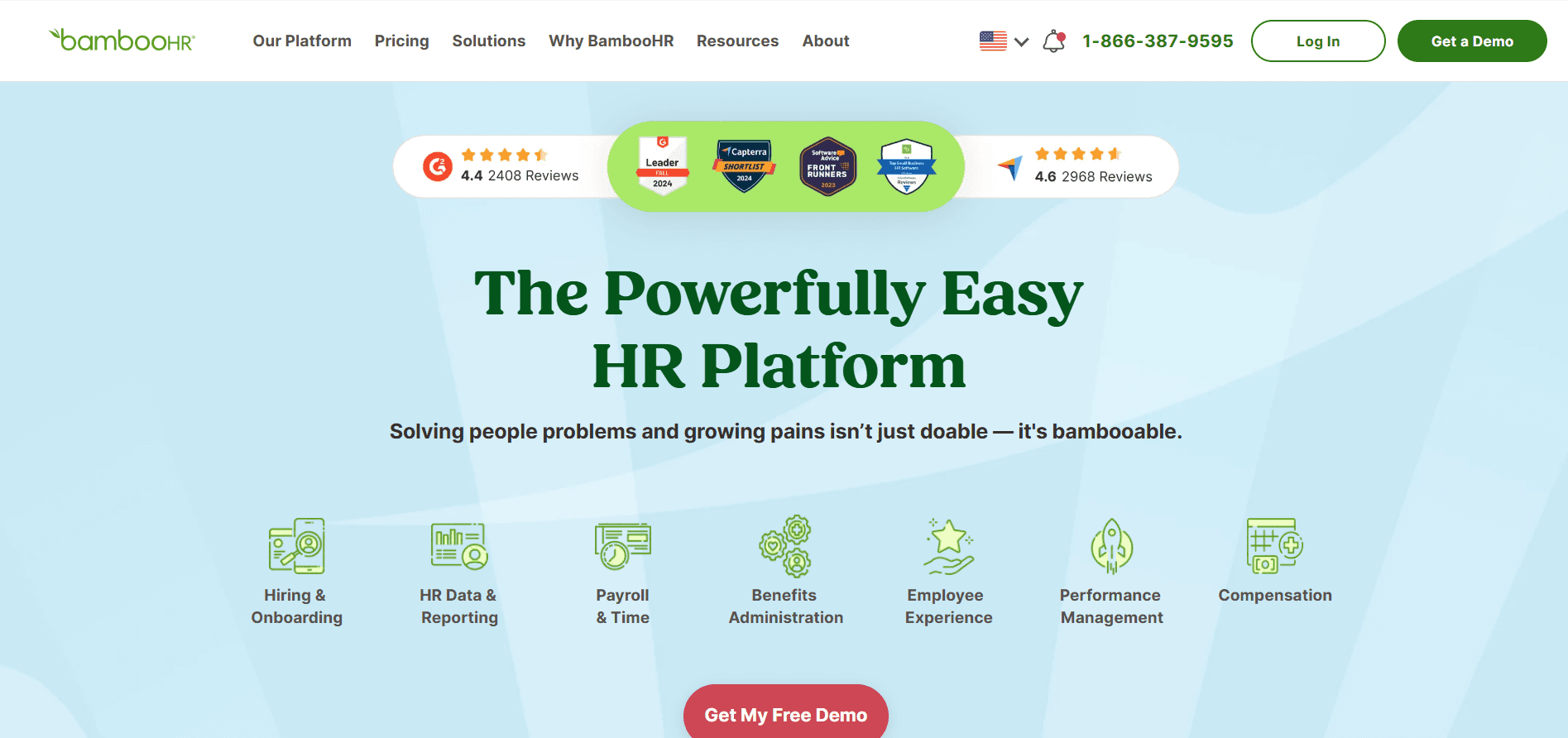
BambooHR is a highly praised HR software for small to mid-sized businesses (SMBs), known for its exceptional focus on user experience and creating better employee interactions by centralising data into one secure, intuitive platform.
Core ERMS Features
Secure Employee Record: Acts as a single, central source of truth for all employee data (contact info, job history, compensation, documents), eliminating disconnected systems and ensuring data integrity.
Custom Fields & Data Control: Offers unlimited custom fields, tabs, and tables, giving HR complete control over organising unique data points (such as equipment or certifications) tailored to their company's needs.
Workflows and Approvals: Automates administrative tasks and ensures compliance by routing data changes (e.g., employee updates, approvals) through pre-defined, easy-to-configure workflows.
Compliance
Compliance Framework (available for USA Only): Provides a reliable data-tracking framework for key HR data required for payroll and tax administration, supporting compliance reports for audits and government filings.
Integrations
Extensive Marketplace: Offers an open API and a large, established marketplace with over 150 partners, including specialised solutions for Payroll, Time Tracking, and Benefits Administration.
Internal Sync: Natively integrates all core modules (Hiring, Onboarding, Performance), ensuring a single data input is immediately reflected across the entire system. Payroll data (for US employees) is managed separately.
Best for: Small to mid-sized organisations seeking a highly user-friendly interface and a platform that simplifies core HR data management.
Zoho People
Zoho People is a cloud-based HRMS solution that benefits significantly from being part of the larger Zoho ecosystem. It offers a comprehensive, highly customisable platform for Core HR, Talent, and Time management, making it particularly attractive to businesses that already use or plan to use other Zoho products.
Core ERMS Features
Centralised Database: Manages and organises all employee details, allowing classification by department, location, and role, supporting complex organisational structures.
Document Management: A reliable module for storing, managing, and securing sensitive documents, with custom access controls to limit visibility to authorised users.
HR Help Desk: Simplifies employee query management by providing case management, ensuring that requests related to documents or data are tracked and resolved efficiently.
Compliance
Integrated Payroll Compliance: When paired with Zoho Payroll, it handles nationwide compliance across all offices in India for PF, ESI, LWF, PT, and IT.
Tax Forms: Can generate crucial tax forms (e.g., Form 16) with built-in e-signature capability, streamlining the tax documentation process.
Integrations
Zoho Ecosystem: Deep, native integration with the entire Zoho Suite (Recruit, Expense, Sign, etc.) for unparalleled data consistency and unified operations.
Third-Party Sync: Supports synchronisation with external tools, including Office 365, Google Workspace, and Zapier.
Best for: Startups and SMBs in India and globally that seek a highly customisable HR solution and value the smooth integration offered by the wider Zoho product suite.
Keka HR
Keka HR is a comprehensive, cloud-based HRMS platform primarily serving large organisations, especially those with a blue-collar workforce. It is highly regarded for its employee-centric design and effective connection between its core HR and India-specific payroll modules.
Core ERMS Features
Central Repository (CoreHR): Centralises all employee data, including personal details, compensation history, and documents, ensuring the data is synced across all modules (payroll, time, performance).
Employee Self-Service (ESS): Promotes employee autonomy by providing a mobile-first portal where staff can access payslips, manage tax declarations, update personal information, and raise queries through an integrated helpdesk.
Document Management with E-Sign: Features a complete digital document management system for collecting pre-joining documents, storing employee certificates, generating HR letters (Appointment, Increment, Relieving), and securing them with Keka Sign (e-signature).
Advanced Access and Audit: Supports Custom Roles & Privileges for granular data control and maintains detailed Audit Trails to track every system change and ensure data integrity.
Compliance
Security & Data Residency: Security and compliance are built for India, with data hosted on secure cloud servers within India, ensuring complete data residency alignment (CERT-In Alignment).
Full Compliance Automation: Automates statutory compliance calculations and filings for PF, ESI, Professional Tax (PT), and TDS across various Indian states and adapts to local labour laws.
Tax and Forms: Simplifies annual compliance by automating the generation of mandatory tax forms, such as Form-16, and facilitating the submission of tax declaration proofs by employees.
Integrations
Native Integration: The strongest integration is native, linking Core HR, Time & Attendance, and Payroll in real time, eliminating data errors and manual reconciliations.
Third-Party Connectors: Integrates with third-party accounting applications, background verification (BGV) portals, and communication tools like Slack and MS Teams.
Best for: Large-sized Indian organisations, especially those with a blue-collar workforce, seeking a modern, employee-friendly HRMS with reliable, error-free statutory and payroll compliance.
HROne
HROne is an HRMS software designed to simplify complex HR operations across the full employee lifecycle (hire-to-retire). It is a highly customisable, cloud-based solution from India, known for its focus on HR efficiency and a unique inbox feature.
Core ERMS Features
Centralised Data and Customisation: The Core HR module centralises data and allows HR teams to configure the system to fit the company's specific needs, including setting user access, customising data fields, and defining multiple policies for different levels.
Workforce Management: Manages the entire employee journey, from auto-syncing candidate data for pre-onboarding to confirming processes and single-click full and final (F&F) settlement at exit.
Compliance
Payroll Accuracy: The system processes payroll with high accuracy, automatically handling calculations for salary distribution and deductions (e.g., EMI, PF, TDS).
Compliance with Laws: Payroll functionality is designed to meet tax regulations and labour laws, generating challans in government-prescribed formats to ensure compliance.
Integrations
Platform Flexibility: Integrates with over 20 third-party platforms. It supports integrations with financial systems like SAP for unified data flow, and communication tools like WhatsApp Bot and Teams Bot for instant actions.
Best for: Organisations in India, especially from the retail & manufacturing industry, that need a highly configurable and efficient HRMS with a focus on reducing administrative time.
GreytHR
greytHR is a cloud based HR and payroll platform that centralises employee data and automates everyday HR tasks such as onboarding, attendance, leave, payroll and compliance.
Core ERMS Features
Central Employee Records: Keeps a single employee master with personal details, work history, documents and lifecycle changes so HR has one reliable record per employee.
Payroll and Compensation Records: Automates salary processing and statutory components while storing payslips and payroll history as part of each employee record.
Compliance
Security and Data Protection: Uses role based access and audit trails to help protect sensitive HR and payroll data.
Statutory Compliance: Focused on local labour law and payroll compliance, especially for Indian organisations that need accurate statutory calculations and reporting.
Integrations
HR and Finance Ecosystem: Connects with payroll banking, accounting tools, biometric devices and other HR systems so that key data flows automatically instead of being re keyed.
Best for: Healthcare & Educational organisations that want a practical HR and payroll system to manage core employee records, attendance and statutory payroll in one place.
With the top seven options reviewed, the next critical step is determining which platform aligns with your company's growth stage and specific administrative requirements.
Selecting the best employee record management system isn’t just about solving today’s administrative issues. It’s about choosing technology that aligns with your future growth. The system you adopt must be scalable and capable of handling upcoming compliance demands without forcing costly rework later.
To make an informed, value-driven decision, focus on these essential factors:
Statutory Compliance for India: Prioritise systems that offer deep, built-in support for Indian statutory filings like PF, ESI, TDS, and Professional Tax (PT). Verify that the platform automatically updates to reflect changes in labour laws, ensuring continuous compliance.
Data Security and Governance: Confirm that the ERMS adheres to strict global and Indian data protection standards (like the DPDP Act, 2023). Look for features like advanced role-based access control (RBAC), data encryption, and comprehensive audit trails to protect sensitive employee records.
Scalability and Performance: Ensure the platform can handle exponential growth in your employee headcount and transaction volume (e.g., thousands of document retrievals or policy changes) without slowing down or requiring costly migrations.
Unification and Integration: Avoid standalone systems. Choose an ERMS like Craze that is either natively unified with your Payroll and Core HR functions or offers reliable, real-time integration with your existing accounting and communication tools.
Employee Self-Service (ESS): The system should provide a clean, mobile-friendly interface allowing employees to view their records, download payslips, and update basic information. This drastically reduces the HR team's administrative burden.
Implementation Ease and Support: Evaluate the complexity of initial setup and data migration. Choose a vendor known for responsive, localised support and fast deployment, minimising disruption to ongoing HR operations.
Having covered the selection process, let's focus on the crucial steps that ensure a smooth and successful transition to your new system.
Successfully launching a new ERMS requires careful planning that extends beyond merely installing the software. The focus must be on ensuring clean data transfer and maximising user adoption to secure the long-term value of your investment.
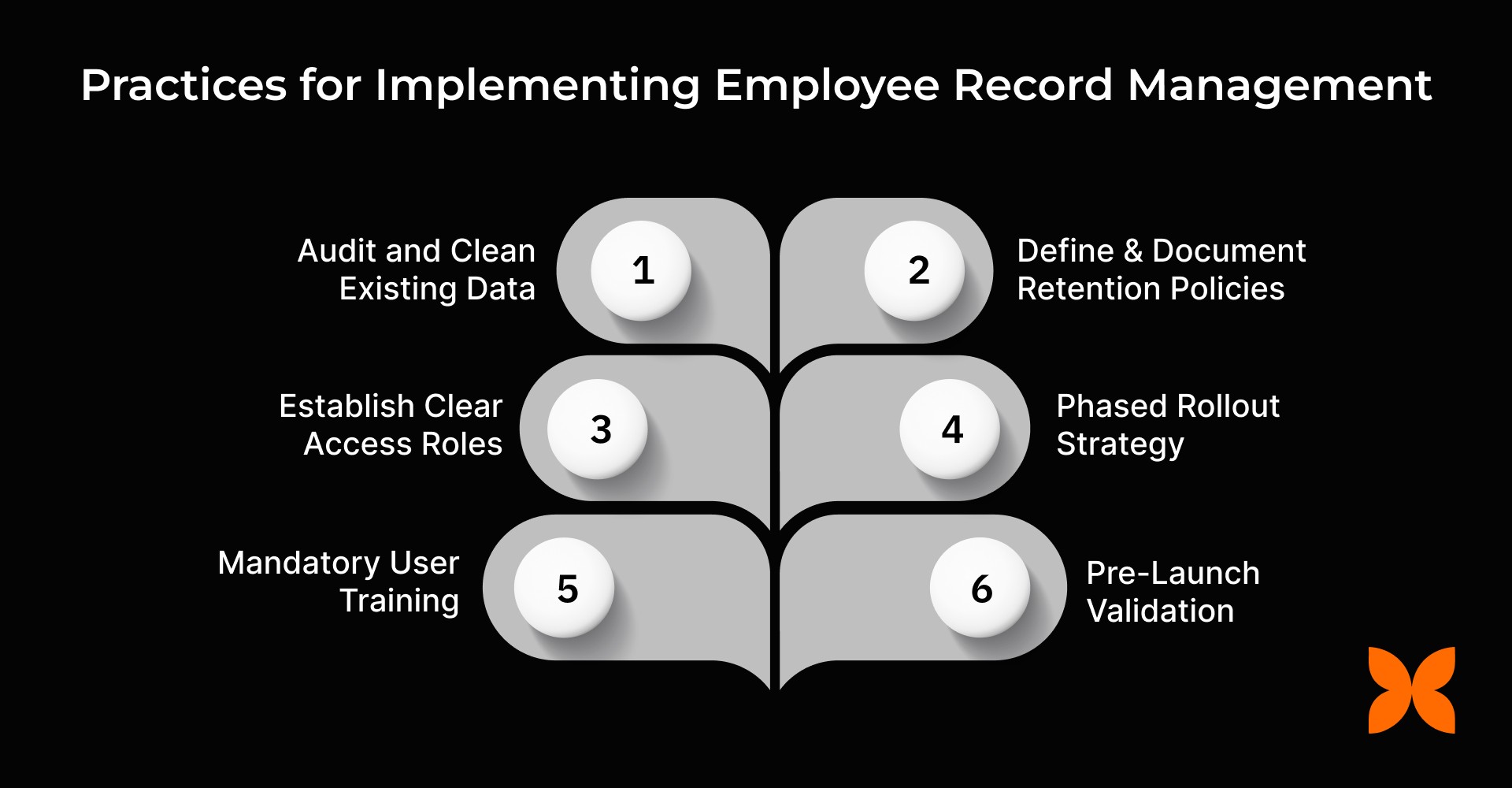
Follow these critical steps for a smooth and effective implementation:
Audit and Clean Existing Data: Before migration, conduct a thorough audit of all existing records (spreadsheets, paper, and legacy systems). Identify and correct inconsistencies, redundancies, and missing fields to ensure only clean, accurate information is transferred.
Define and Document Retention Policies: Clearly specify the legal retention periods for each type of record (e.g., payroll, performance reviews, exit documents), in accordance with Indian labour laws. Configure the ERMS to automatically enforce these retention and archival policies.
Establish Clear Access Roles: Set up granular role-based access control (RBAC) before launch. Only grant access to the specific data and functions necessary for each user group (HR, Finance, Managers, Employees) to maintain data privacy and security.
Phased Rollout Strategy: Avoid a sudden, company-wide launch. Implement the system in manageable phases (e.g., first with Core HR/Finance teams, then with managers, and finally with the entire workforce) to identify and fix issues early.
Mandatory User Training: Conduct mandatory, role-specific training sessions. Focus on how employees will use the Employee Self-Service (ESS) portal, how managers will approve changes, and how HR will run compliant reports.
Pre-Launch Validation: Run a parallel test with a small test group using the new ERMS alongside the old system for one or two critical processes (like payroll or attendance). Verify that the new system delivers identical, error-free results before full deployment.
By prioritising these foundational practices, your business can ensure a successful, risk-free transition to your new ERMS.
Managing critical employee information in spreadsheets and paper files is inefficient and error-prone. Modern employee record management systems centralise data, ensure compliance with India’s statutory requirements, and streamline administrative processes. This reduces manual work, prevents mistakes, and provides HR teams with a clear, organised view of workforce operations.
By providing a single source of truth for HR, payroll, and employee workflows, these systems make team management easier, more accurate, and scalable. Adopting a reliable employee record management platform helps businesses optimise operations, support growth, and stay agile in fast-evolving work environments.
1. Which is the best employee record management software in India?
A. Craze stands out as the best employee record management software in India for startups and mid-sized businesses. It simplifies HR processes, centralises employee data, and ensures compliance, making record management effortless and reliable. Its user-friendly interface and India-ready features make it particularly suitable for growing organisations seeking efficiency and accuracy.
2. Which India-specific compliance items should an ERMS support?
A reliable ERMS for the Indian market should automatically handle compliance calculations, deductions, and filings for significant items, including the Employees' Provident Fund (EPF), Employees' State Insurance (ESI), Tax Deducted at Source (TDS), and Professional Tax (PT).
3. How is an ERMS different from HRIS or HRMS?
The terms are often used interchangeably, but generally, ERMS focuses on the secure storage, retrieval, and governance of employee files and data. HRIS (Human Resources Information System) is a foundational system for core data and basic processes (payroll, benefits). HRMS (Human Resource Management System) is a broader, more comprehensive suite that includes HRIS functions and talent and workforce management.
4. How long should businesses retain employee records in India?
Retention periods vary by document type, but most critical records, such as payroll registers, compensation details, and Form 16 (tax forms), must be preserved for a minimum of 3 to 10 years after the employee's last entry or exit date, as per various Indian labour laws.
5. What are the key security features an ERMS must have?
Essential security features include Role-Based Access Control (RBAC) to limit who can view/edit specific data, encryption (e.g., AES 256-Bit) for data protection, and full audit trails to track every change made to a record.
Looking to optimise other aspects of your HR operations? Check out these top HRMS tools and software for your use case:
