
Warning Letter to Employee: Key Elements and 8 Free Samples


Writing an effective warning letter is often harder than it seems. Even when an employee’s misconduct or performance issue is obvious, putting it into words that are firm, clear, and professional can be challenging.
A vague or poorly structured letter can have serious consequences, including repeated HR follow-ups, employee dissatisfaction, or legal complications. Handling multiple warning cases without a structured approach can lead to delays and undermine overall workforce discipline.
In this blog, you’ll learn how to draft a legally compliant Warning Letter to an employee, including key elements and ready-to-use templates designed specifically for Indian organisations.
Key Takeaways
A warning letter formally records employee misconduct or performance issues and sets clear expectations for improvement.
Standardised warning letters help employers demonstrate fairness, consistency, and due process.
Each letter should include factual incidents, policy references, and corrective expectations.
Ready-to-use templates simplify disciplinary communication across various warning scenarios.
Professionally drafted warning letters reduce disputes and support compliant workforce management.
What is a Warning Letter to an Employee?
A warning letter is a formal written communication issued by an employer to address documented misconduct, performance deficiencies, attendance issues, or policy violations. It clearly states the concern, references applicable company rules or expectations, and specifies the corrective action required.
The letter becomes part of the employee’s official personnel record and often serves as the basis for progressive disciplinary action, including suspension or termination. Warning letters are typically issued for attendance irregularities, behavioural lapses, sustained performance gaps, and breaches of organisational policies.
Why Are Warning Letters Important?
Warning letters are not meant to intimidate employees. They are a structured way to communicate concerns while giving the employee a fair opportunity to improve. Their importance includes:
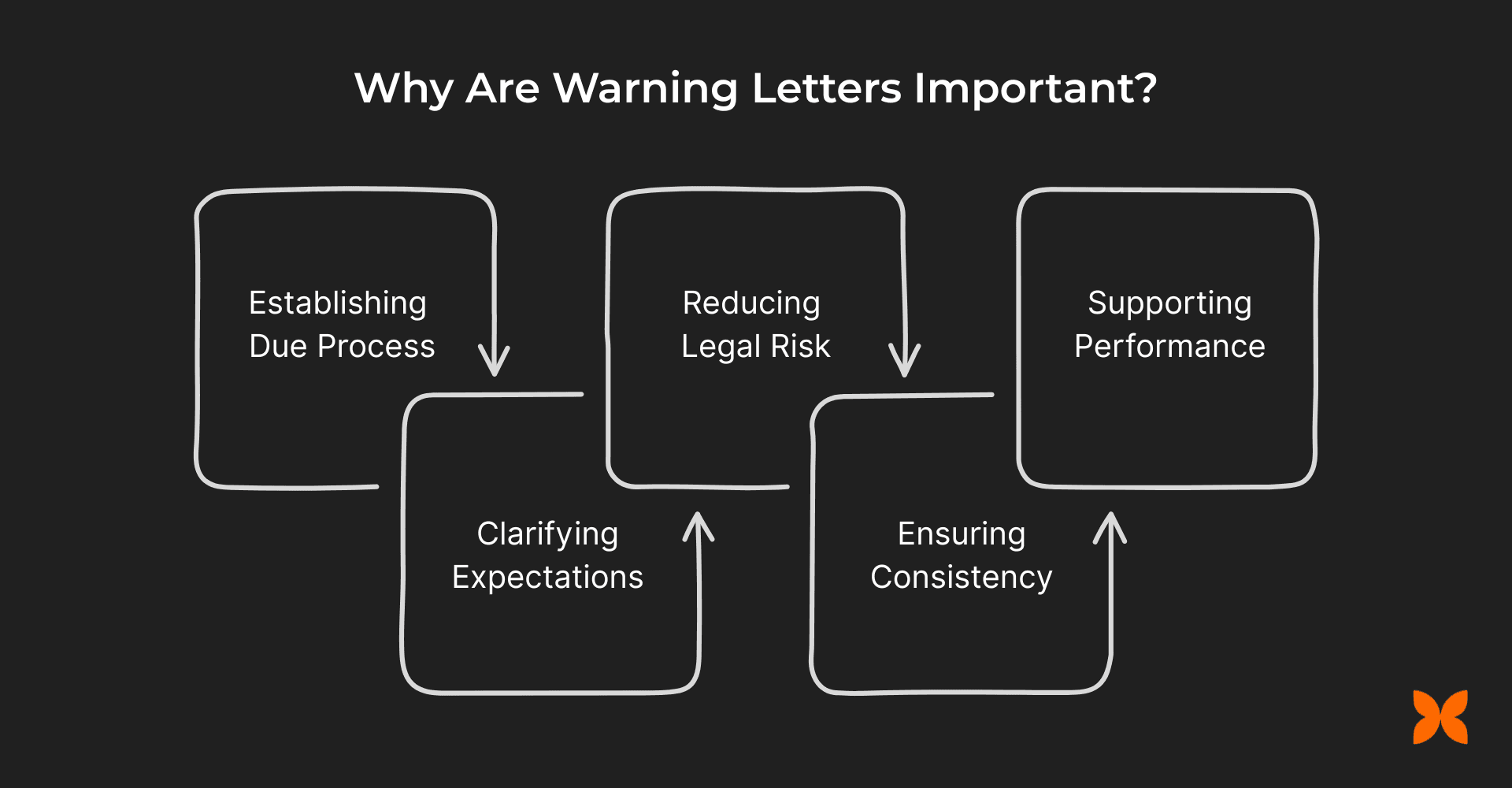
Establishing Due Process: Demonstrates that the organisation followed a fair and documented disciplinary process.
Clarifying Expectations: Clearly communicates what behaviour or performance must change and by when.
Reducing Legal Risk: Provides evidence of warnings issued before escalation to termination or stricter action.
Ensuring Consistency: Helps apply disciplinary actions uniformly across teams and roles.
Supporting Performance Improvement: Encourages corrective action rather than immediate punitive measures.
Before drafting the letter itself, employers must understand the procedural steps to follow when issuing a warning to ensure fairness, accuracy, and legal defensibility.
How to Issue a Warning Letter to an Employee: 6 Key Steps
Issuing a warning is a delicate process that requires a balance of firm discipline and procedural fairness. Following a structured approach ensures that the conversation remains professional, protects the organisation from legal disputes, and gives the employee a genuine opportunity to improve:
Formally Initiate the Discussion: Request a meeting with the employee via email or written documentation. Clearly state that the meeting concerns performance or conduct.
Ensure the Employee Understands the Seriousness: Reinforce the meeting request through a follow-up call or direct communication. This avoids ambiguity and confirms that the matter is formal and time-sensitive.
Conduct the Meeting in a Confidential Setting: Hold the discussion in a private, professional space such as a meeting room or manager’s office. Confidentiality and dignity are essential in disciplinary conversations.
Prepare the Warning Letter in Advance: Draft the warning letter beforehand on official company letterhead. Ensure it is accurate, specific, and aligned with company policy, employment terms, and prior discussions.
Communicate the Issue and Expectations Clearly: Explain the concerns with factual examples and invite the employee’s response. Clearly outline expected corrective actions, timelines, and consequences if improvement does not occur.
Document Acknowledgement and Maintain Records: Provide a signed copy of the warning letter to the employee and retain acknowledgement on the company copy. If refused, document the refusal and retain proof of delivery.
Also Read: Relieving Letter Format: Elements & 7 Free Templates
This approach ensures warning letters are issued consistently, professionally, and with procedural fairness. The next step is to understand the essential components that make a warning letter clear, enforceable, and aligned with company policy.
Key Elements of an Effective Warning Letter Format
To ensure clarity, fairness, and professional accountability, a warning letter must follow a clearly defined structure. The following 7 components establish the standard framework for a well-drafted and compliant warning document.
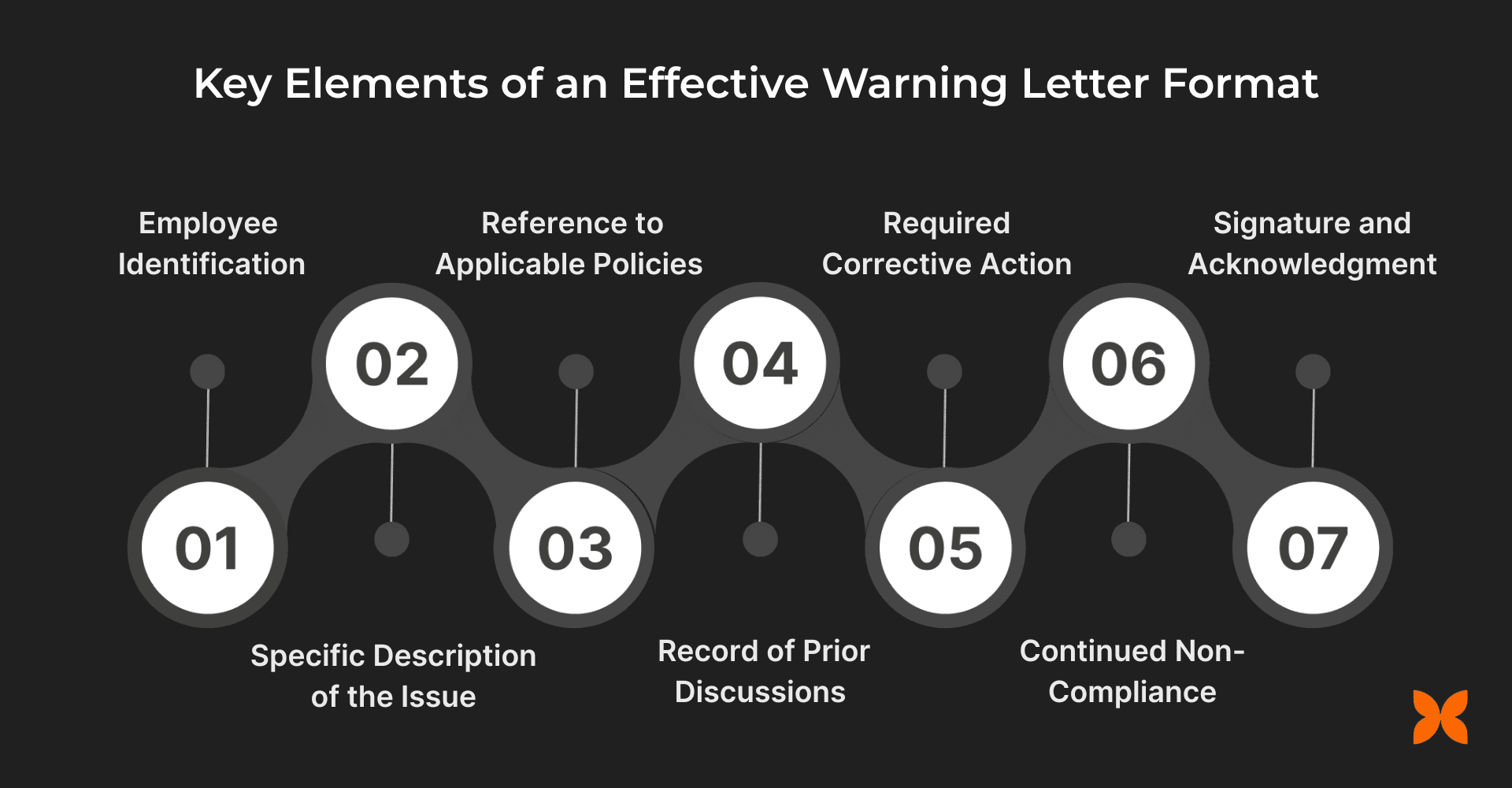
1. Company and Employee Identification
Include the company name on official letterhead, the date, and the employee’s full name, designation, department, and employee ID. This establishes authenticity and ensures accurate record-keeping.
Tip: Always verify employee details before issuing the letter to avoid administrative errors.
2. Specific Description of the Issue
Clearly describe the misconduct, performance gap, attendance issue, or policy breach using factual information such as dates and observed behaviour. Avoid assumptions or subjective language.
Tip: Focus on verifiable facts rather than opinions to maintain objectivity.
3. Reference to Applicable Policies or Standards
Cite the relevant company policy, code of conduct, or performance standards that have not been met. This links the warning to established organisational rules.
Tip: Reference specific policy clauses wherever possible to strengthen legal defensibility.
4. Record of Prior Discussions or Warnings
Document any previous verbal warnings, counselling sessions, or written feedback related to the issue, along with corresponding dates. This demonstrates that the employee was given a fair opportunity to improve.
Tip: Ensure consistency between prior records and the current warning letter.
5. Required Corrective Action and Timeline
Clearly state the corrective steps the employee must take and specify a realistic, measurable timeframe for improvement. Expectations should be role-specific and achievable.
Tip: Set clear review or follow-up dates to track progress objectively.
6. Consequences of Continued Non-Compliance
Explain the potential consequences if improvement is not achieved, such as further disciplinary action or escalation, in line with company policy and employment terms.
Tip: Keep consequences proportional and factual to minimise legal risk.
7. Signature and Acknowledgment
Include the signature of the authorised signatory, along with space for the employee’s acknowledgement. If the employee refuses to sign, record the refusal and retain proof of delivery.
Tip: An acknowledgement confirms receipt, not agreement, and strengthens the document’s evidentiary value.
Also Read: Joining Letter Format: How to Write it, Key Details, and 6 Samples
Once you know what must be included, the next step is to see how this structure works in real situations.
Warning Letter Formats and Templates
Relying on pre-approved templates eliminates the risk of using inconsistent language or omitting mandatory legal clauses during a high-stress disciplinary event. These samples are designed to help you issue professional, compliant notices in minutes, regardless of the specific misconduct or performance issue involved.
1. Warning Letter for Discipline - Template
Employees who violate key sections of the company’s policy are subject to formal disciplinary action, including the issuance of a warning letter. Common examples include harassment, violence, or other serious misconduct.
[Date: Date of letter issuance]
[Name: Full name of employee]
[Address: Employee address]
Subject: Warning for Disciplinary Incident
Dear [Employee First Name],
This letter is being issued as an official warning regarding the incident on <Date of Incident>. It has come to our attention that <briefly describe incident>. Such misconduct is unacceptable and violates Company Policy <mention policy name, page number, section number, or clause>.
Our policies are designed to maintain a safe, open, and respectful work environment for all employees. We expect everyone to adhere to these guidelines to foster a collaborative, performance-oriented workplace culture.
As a result of this violation, you are placed on a warning period of <duration>, during which your conduct will be closely monitored.
Any further misconduct may lead to more serious disciplinary actions, including:
Suspension without pay
Termination without prior notice
We recognise your contributions to the organisation and trust that you will take immediate steps to improve your behaviour. Positive outcomes from this discussion are expected and appreciated. Should you have any questions or require clarification, please reach out to me directly. You are requested to sign a copy of this letter to acknowledge receipt and discussion.
Sincerely,
[Your Name]
[Your Job Title]
[Company Name]
[Contact Information]
2. Warning Letter for Poor Performance - Template
This warning letter formally addresses concerns about the employee’s performance and serves as a documented step toward improvement. Continued underperformance may result in further disciplinary action, including termination.
[Date: Date of letter issuance]
[Name: Full Name of Employee]
[Address: Employee Address]
Subject: Warning for Unsatisfactory Work Performance
Dear [Employee First Name],
This letter serves as a written warning regarding your performance, which has not met the objectives outlined in your <Appointment Letter / Job Description / Prior Performance Appraisal / Agreed Goals>.
Following our discussion on <date>, we want to formally document the areas where your performance has fallen short of expectations. As communicated by <management / your supervisor>, you will be placed on a Corrective Action Plan starting <date>. This plan is designed to support you in meeting the required performance standards, taking into account your role and capabilities.
Every employee in the organisation is expected to contribute fully and achieve their assigned objectives. We request that you take immediate steps to improve your performance and align with your supervisor's and management's expectations.
We are confident in your potential to be a productive contributor and expect commitment and diligence in improving your performance. Should you require guidance or support, please feel free to reach out at any time. You are requested to sign a copy of this letter to acknowledge receipt and understanding. Please also document any specific outcomes or commitments in the notes section below.
Sincerely,
[Your Name]
[Your Job Title]
[Company Name]
[Contact Information]
3. Warning Letter for Dress Code Violation - Template
Dress code violations occur when an employee’s attire does not meet the company’s professional standards, such as wearing overly casual or revealing clothing, displaying offensive imagery or language, or neglecting personal hygiene and grooming. This warning letter ensures employees understand and adhere to workplace appearance guidelines.
[Date: Date of issuance]
[Name: Full Name of Employee]
[Address: Employee Address]
Subject: Warning for Dress Code Violation
Dear [Employee First Name],
It has been observed that your attire on <date of violation> did not comply with the company’s dress code policy, specifically <mention specific violation>. While occasional oversights may occur, maintaining professional attire is essential at all times. Your appearance represents the organisation and impacts workplace professionalism.
As a result of this violation, we are issuing this warning letter. Continued non-compliance with the dress code may result in further disciplinary action.
We expect your immediate adherence to the dress code guidelines. If you have any questions or require clarification, please consult your manager or the HR department.
Sincerely,
[Your Name]
[Your Job Title]
[Company Name]
[Contact Information]
4. Warning Letter for Sexual Harassment - Template
Sexual harassment in the workplace includes any inappropriate conduct, verbal, non-verbal, physical, visual, or quid pro quo, that creates a hostile environment. Organisations have a legal and ethical responsibility to maintain a safe, respectful workplace and to provide mechanisms for reporting and addressing complaints.
[Date: Date of issuance]
[Name: Full Name of Employee]
[Address: Employee Address]
Subject: Warning for Sexual Harassment
Dear [Employee First Name],
It has come to our attention that your actions constitute sexual harassment in the workplace. Such behaviour is unacceptable and violates the principles of respect, professionalism, and integrity upheld at <Company Name>.
Sexual harassment not only creates an uncomfortable environment for colleagues but also breaches company policy and legal obligations, exposing the organisation to potential liabilities.
This letter serves as a formal reprimand. Any recurrence of such behaviour will result in severe disciplinary action, including possible termination of employment. You are expected to show immediate and sustained improvement and are encouraged to participate in any training or counselling programmes provided by the company to prevent recurrence.
Sincerely,
[Your Name]
[Your Job Title]
[Company Name]
[Contact Information]
5. Warning Letter for Frequent Absence - Template
This warning letter is issued when an employee repeatedly fails to maintain regular attendance or follow assigned work schedules.
[Date: Date of issuance]
[Name: Full Name of Employee]
[Address: Employee Address]
Subject: Warning for Irregular Attendance
Dear [Employee First Name],
Due to repeated attendance irregularities during <specify period>, we are issuing this formal written warning. Upon review, the following issues have been observed (remove any items that do not apply):
a) Excessive leaves taken without prior approval from your supervisor
b) Instances of late arrival or early departure from the office
c) Shortfall in total required working hours
d) Deviations from assigned shift timings
It has come to our attention that your supervisor has already addressed these concerns with you multiple times, yet no improvement has been observed. Please treat this letter as an official warning from the management.
Regular attendance is crucial, as every employee’s presence impacts team productivity, performance outcomes, and overall workplace discipline. Repeated absence can also negatively affect team morale.
You are hereby placed on a warning period of <specify duration>, during which your attendance will be closely monitored. Failure to demonstrate improvement or to comply with continued violations may result in termination of employment without further notice.
If you have any questions or require assistance, please feel free to reach out. You are requested to sign a copy of this letter to acknowledge receipt and understanding, and to document any outcomes in the notes section below.
Sincerely,
[Your Name]
[Your Job Title]
[Company Name]
[Contact Information]
6. Warning Letter for Leave Without Information - Template
This warning letter addresses instances where an employee takes leave without prior notice or approval. It clarifies the breach of company policy and emphasises the importance of adhering to attendance rules.
[Date: Date of issuance]
[Name: Full Name of Employee]
[Address: Employee Address]
Subject: Warning for Unauthorised Absence
Dear [Employee First Name],
It has been observed that you were absent from work without prior notification or your manager's approval. Unapproved leave constitutes a serious violation of company policy.
We understand that emergencies may occur, but it is your responsibility to promptly inform your manager or HR and follow proper leave procedures. Failure to do so disrupts workflow, inconveniences colleagues, and affects productivity.
As a result, this letter serves as a formal warning. Any recurrence of unapproved leave may lead to further disciplinary measures, up to and including termination of employment.
We expect your full compliance with company leave policies going forward. Should you have questions regarding procedures, please consult your manager or HR.
Sincerely,
[Your Name]
[Your Job Title]
[Company Name]
[Contact Information]
7. Warning Letter for Negligence - Template
This warning letter is issued when an employee’s lack of diligence or care negatively impacts operations. It outlines expectations for improvement and reinforces accountability.
[Date: Date of issuance]
[Name: Full Name of Employee]
[Address: Employee Address]
Subject: Warning for Negligence at Work
Dear [Employee First Name],
On [mention date], an incident occurred demonstrating negligence on your part, specifically [describe negligence; e.g., failure to follow procedures, inaccurate reporting, incomplete tasks]. This has directly affected team productivity and business operations.
Going forward, you are expected to:
a) Perform all duties with accuracy and diligence.
b) Follow company guidelines and operational procedures consistently.
Repeated negligence or disregard for company policies may result in disciplinary action, including termination. We expect you to take this warning seriously and improve your performance. For clarification or support, please reach out to your manager or the HR team.
Sincerely,
[Your Name]
[Your Job Title]
[Company Name]
[Contact Information]
8. Warning Letter for Unprofessional Behaviour - Template
This warning addresses conduct that violates the company’s code of conduct or professional standards. It serves as a formal notice to correct behaviour and maintain a respectful workplace.
[Date: Date of issuance]
[Name: Full Name of Employee]
[Address: Employee Address]
Subject: Warning for Unprofessional Behaviour
Dear [Employee First Name],
It has been noted that on [mention date], you engaged in unprofessional behaviour, specifically [briefly describe behaviour; e.g., inappropriate communication, ignoring workplace decorum, or disrespectful conduct]. This conduct violates the company’s standards and affects team morale.
You are required to maintain professionalism at all times, treat colleagues with respect, and adhere to the code of conduct. Any further instances may lead to disciplinary action, including termination.
If you need clarification on expectations or guidance on professional conduct, please contact your manager or HR.
Sincerely,
[Your Name]
[Your Job Title]
[Company Name]
[Contact Information]
With templates in place, it’s equally important to be mindful of common mistakes that can compromise the effectiveness of a warning letter and create legal or procedural risks.
Common Mistakes to Avoid While Writing a Warning Letter
A poorly worded warning letter can inadvertently turn a simple performance correction into a costly legal dispute or a grievance claim. Avoiding these common mistakes ensures your documentation remains a professional shield for the company rather than a liability:
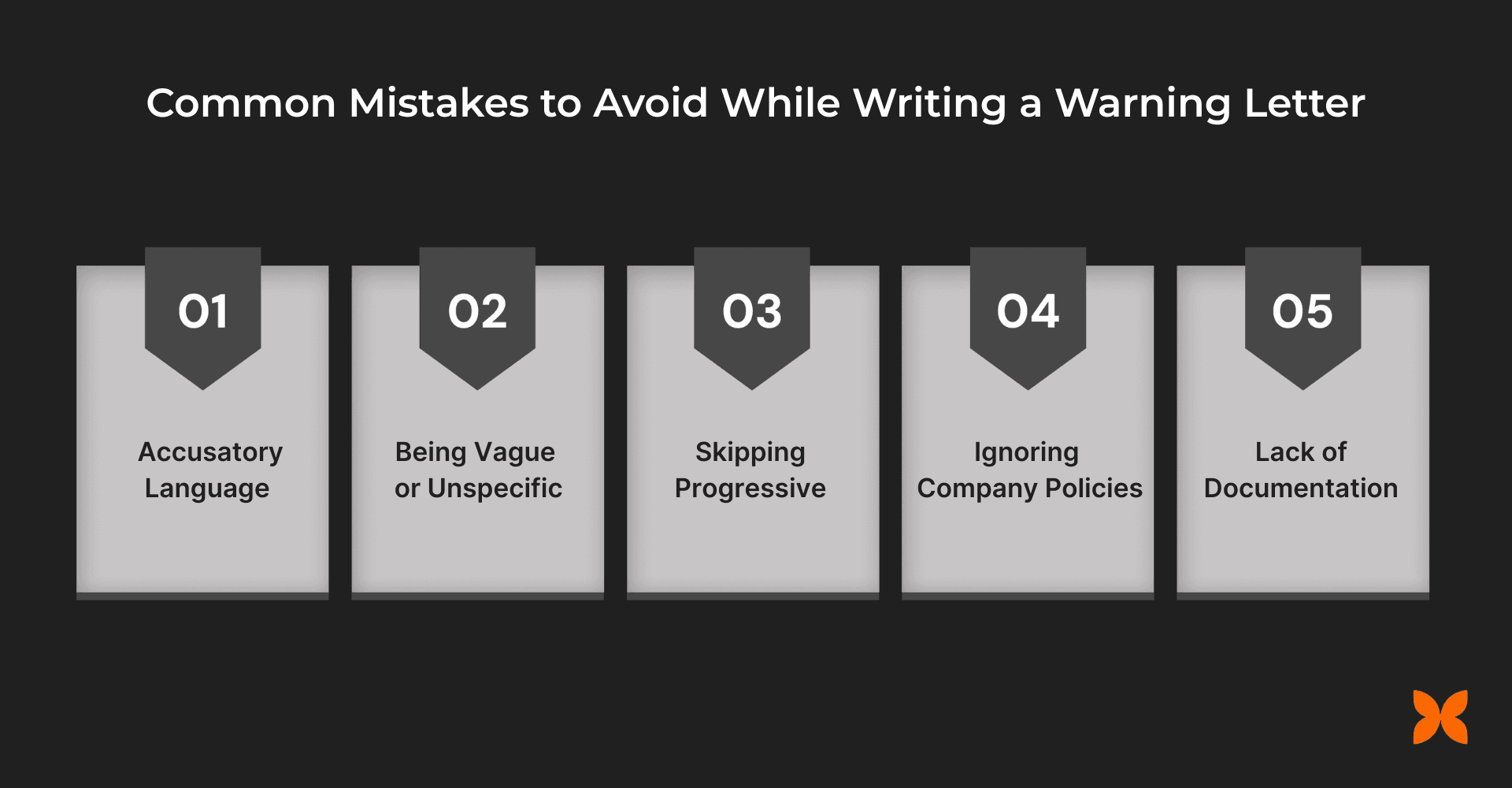
Using Emotional or Accusatory Language: Framing the letter with anger, judgement, or personal opinions can escalate tension and reduce employee receptiveness. Stick to neutral, factual language focused on behaviour or performance.
Being Vague or Unspecific: Failing to provide precise dates, incidents, or policy references weakens the letter’s credibility. Always cite exact examples of the behaviour, missed deadlines, or policy violations.
Skipping Progressive Discipline: Issuing a severe warning without prior counselling or documentation can appear arbitrary. Follow a structured, stepwise approach consistent with company policy.
Ignoring Company Policies and Legal Requirements: Failing to align the letter with internal HR guidelines or labour laws can expose the organisation to disputes. Ensure the content references the relevant policies and complies with local regulations.
Lack of Documentation and Record-Keeping: Failure to retain copies of the warning letter or related communications can hinder follow-up actions or legal defence. Maintain proper records in the employee file.

By avoiding these mistakes, organisations can issue transparent, fair, and effective warning letters that address workplace issues while mitigating risk.
Final Thoughts
Poorly handled warnings can quickly escalate into disputes, attrition, or legal challenges. Many organisations still rely on informal communication, which weakens their disciplinary framework.
Structured, clear, and policy-aligned warning letters protect your organisation, encourage employee improvement, and create a defensible HR process. Platforms like Craze help standardise employee documentation, reduce errors, and bring clarity to workforce management.
FAQs
1. Is a warning letter mandatory before termination in India?
A warning letter is not always legally required, but issuing one demonstrates procedural fairness and strengthens legal defensibility in case of disputes.
2. Can a warning letter be sent by email?
Yes, email is acceptable. Ensure acknowledgement from the employee and securely maintain records for HR and legal purposes.
3. How many warning letters should be issued before termination?
The number depends on company policy, the nature of the misconduct, and applicable labour laws. Severe violations may require fewer warnings.
4. Should employees sign warning letters?
Employee acknowledgement is recommended to confirm receipt. If the employee refuses, document the refusal formally to maintain compliance.
5. Do warning letters apply to probationary employees?
Yes, probationary employees may receive warning letters, but expectations, timelines, and language may vary depending on the employment terms.
