Employee Relocation Policy: What to Include [+Free Sample]
Build a fair employee relocation policy with our guide on benefits, costs, and tax implications. Download the ready-to-use template now.

Share
TABLE OF CONTENTS
An employee relocation policy is a standardised document that converts ad-hoc, costly employee moves into a predictable business process, ensuring fairness and budget control.
The policy offers several benefits, helping to attract top talent and guarantee day-one productivity by removing the financial and logistical burden from the new hire.
Key components must include eligibility & tiers, covered benefits (e.g., moving costs, temporary housing), financial/tax clarity, and a repayment clause to protect the company's investment.
Successful execution requires educating managers, establishing a single point of contact (SPOC), and integrating the policy directly with finance and payroll systems for seamless reimbursement.
Formalising your policy with a ready-to-use template protects your budget, minimises legal risk, and builds a reputation for supporting your talent, boosting long-term retention.
An employee relocation policy is your company’s official guide detailing the financial and logistical support a relocating employee will receive. It’s an essential tool that transforms a complex, one-off event into a standardised business process, ensuring consistency across all job levels and transfers.
This formal document protects your budget by clearly defining covered expenses and eliminating expensive, ad-hoc negotiations that can lead to resentment among employees. Its core purpose is to guarantee a fair, predictable transition, allowing your new hire to settle in quickly and focus on their job rather than the move.
Read More: Essential Employee Onboarding Checklist Templates for Success
With the definition established, let's explore exactly why this policy is vital to your business success.
Recruiting top talent often means looking beyond local borders and current payrolls. A formal policy transforms relocation from a necessary headache into a strategic competitive advantage that supports growth and ensures your business is truly mobile.
Here are the critical benefits of having a documented relocation policy:
Win the War for Talent: A compelling relocation package is a non-salary benefit that immediately makes your job offer more competitive, attracting high-calibre candidates who might otherwise decline a move.
Guarantee Day-One Productivity: By taking the financial and logistical burden of the move off the new employee, you ensure they arrive focused and ready to contribute immediately, accelerating their time-to-value.
Control Costs and Budget: A pre-approved structure prevents costly, one-off exceptions and gives your finance team predictability, allowing for accurate budget forecasting for all future moves.
Ensure Fair Treatment: A transparent, written policy eliminates the risk of favouritism or bias, guaranteeing that all employees, regardless of seniority, receive support based on clear, justifiable criteria.
Minimise Legal and Tax Risk: A formal policy helps ensure compliance with local tax regulations and employment law, greatly reducing the risk of disputes or penalties down the line.
Knowing why you need the policy is only the beginning; now, let’s look at the essential components every effective relocation policy must include.
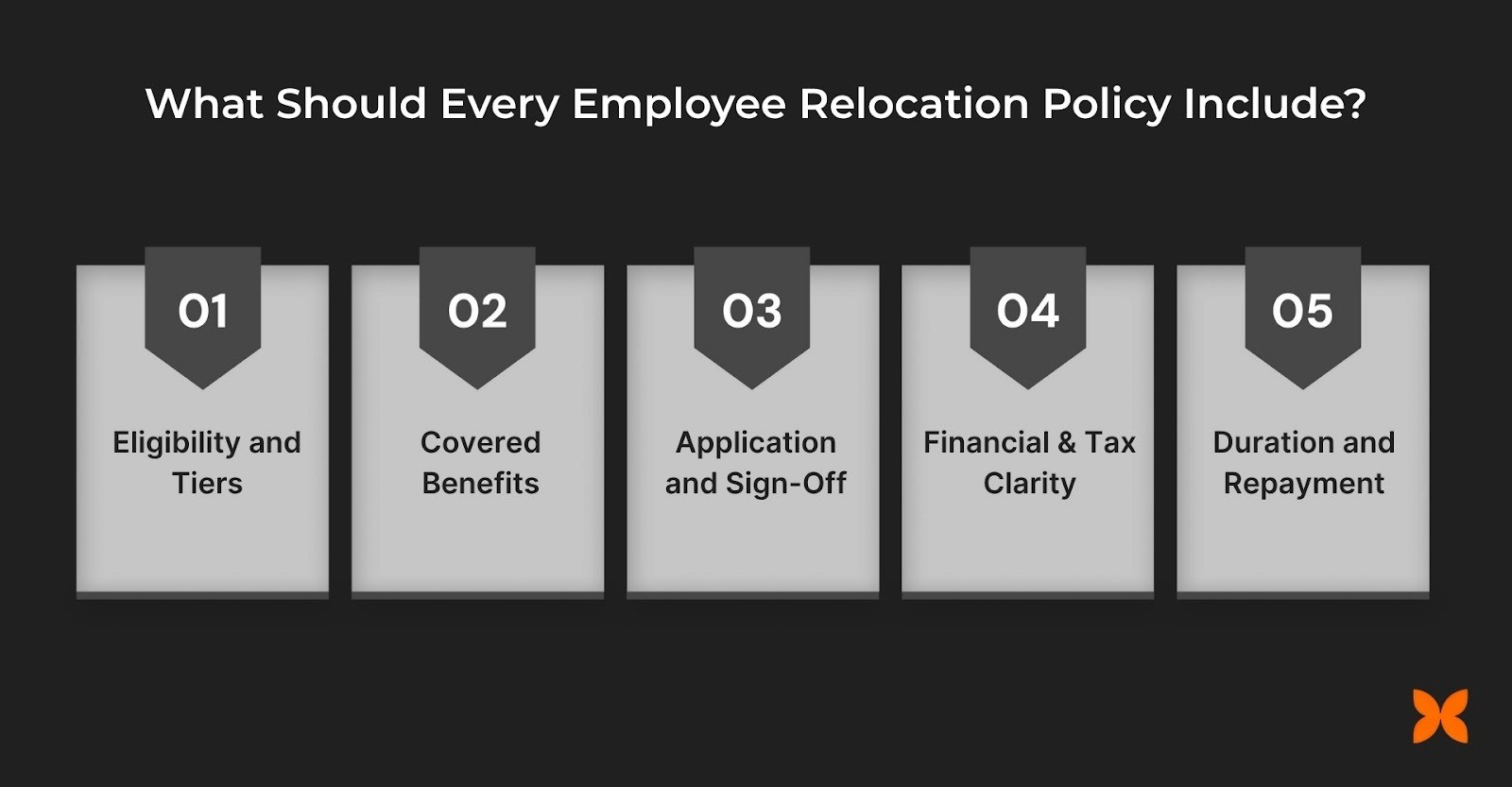
A policy is only as effective as its structure. To avoid grey areas and control expenses, your document must clearly articulate who gets support, what that support is, and how the entire process is managed from start to finish.
Here are the essential sections that form the backbone of a comprehensive relocation policy:
Eligibility and Tiers: Define the criteria for who qualifies for assistance (e.g., internal transfers, new hires, specific job grades) and establish tiered support levels based on seniority or move distance.
Covered Benefits: Explicitly list the financial support provided, such as professional moving costs, temporary accommodation limits, travel expenses for the employee and family, and any specific allowances (e.g., school search, spousal support).
Application and Sign-Off: Detail the steps the employee must follow to initiate the process, the required documentation, and the clear management approval workflow to maintain governance.
Financial & Tax Clarity: Set clear reimbursement procedures, including receipt deadlines and claim caps. Critically, clarify the tax treatment of the benefits to prevent unexpected liabilities for both the employee and the business.
Duration and Repayment: Define the time limit for accessing benefits (e.g., 30 days of temporary housing) and establish any necessary conditions, such as a repayment clause if the employee leaves within a specified period.
With these components in mind, you’re ready to see how this translates into a usable document.
Also Read: Recording Advances to Employees: A Complete Guide
You have identified the need for a formal policy; this section provides the precise structure required to create one. Each section below is designed to eliminate ambiguity, manage risk, and guide your teams through every stage of the relocation process.
1. Policy Objectives and Scope
Before detailing the benefits, the policy must clearly state its purpose and who it applies to. This sets the expectation for fairness and consistency from the very first page.
Objective: The core reason for the policy’s existence is to provide equitable support, reduce disruption for the employee, and protect the company’s investment in talent.
Scope: Specifies which employee groups and move types are covered, such as internal transfers, new senior hires requiring relocation, and whether the policy applies to domestic or international moves.
2. Eligibility and Tiers of Support
To maintain budget control and fairness, not all relocations can be treated equally. Define the mandatory conditions for receiving assistance, often determined by the business's need for the move.
Eligibility Criteria: Mandate clear requirements, typically that the move is company-initiated for a defined business need and that the employee is in a full-time, permanent role.
Tiered Support: Establish varying levels of assistance based on job grade, seniority, or family size. For example, a senior executive might receive a full-service move, while a mid-level hire receives a set cash allowance.
3.Covered Relocation Benefits
This is the central part of the policy, detailing the specific support the company will provide. Being precise about limits and inclusions is crucial for managing employee expectations and finance approval.
Moving Household Goods: Specify coverage for professional packing, shipping, and insurance. Clearly state any weight limits, and whether storage costs are covered, and for how long.
Temporary Housing and Travel: Define the maximum period (e.g., 30 days) and financial cap for temporary housing (e.g., corporate apartment or hotel stay). Cover travel costs for the employee and their immediate family, including flights or mileage reimbursement.
Settling-In Allowance: Outline a fixed, non-accountable lump sum to cover miscellaneous start-up costs like utility connection fees, driver’s license transfers, and initial essentials.
Optional Family Assistance: If offered, detailed support for dependents, such as school search assistance or job search aid for a spouse/partner.
4. Process, Reimbursement, and Tax
The process sections ensure governance and clear financial reporting. Your teams need strict rules on how expenses are submitted and how the resulting tax implications are handled.
Application and Approval: Outline the necessary administrative steps, requiring the employee to submit a formal request to HR/Management 4-6 weeks before the move. Clearly define the authorisation flow, including mandatory sign-off from the hiring manager and Finance.
Reimbursement Procedure: Specify deadlines for submitting original receipts (e.g., 30 days post-move) and define the payment timeline, such as reimbursement within the next payroll cycle.
Tax Implications: Clarify the tax treatment of the provided benefits. State whether the company will perform a tax gross-up on taxable benefits or if the tax liability falls to the employee, ensuring compliance with local laws.
5.Duration and Repayment Clause
These clauses are essential for risk management and protecting the company's significant financial investment in the employee's move.
Duration of Support: Define hard cut-off dates for all benefits. For example, all claims for temporary housing or miscellaneous allowances must be submitted within 90 days of the start date.
Return of Expenses (Clawback): Include a clause that requires the employee to repay a portion of the relocation costs if they voluntarily resign or are dismissed for cause within a specific tenure (e.g., 12 to 24 months).
6.Roles, Responsibilities, and Review
A policy is only useful if its maintenance and execution are clearly assigned. This section defines accountability within your organisation.
Stakeholder Responsibilities: Detail the clear division of labour: HR manages policy interpretation and employee communication; Finance handles expense verification and payroll; and Managers support the employee's integration.
Policy Review: Mandate a scheduled annual review of the policy to ensure benefits remain competitive and comply with the latest tax and labour regulations.
This detailed guide will help you create a document that is both employee-friendly and financially sound. Now you can get your copy of this exact structure to start drafting your policy today.
Also Read: Taxable and Non-Taxable Salary Allowances in India: Definition & Types
Successful execution of the policy requires clear action and cross-departmental alignment. Effective implementation hinges on clear communication and transparent processes that remove confusion for the relocating employee.
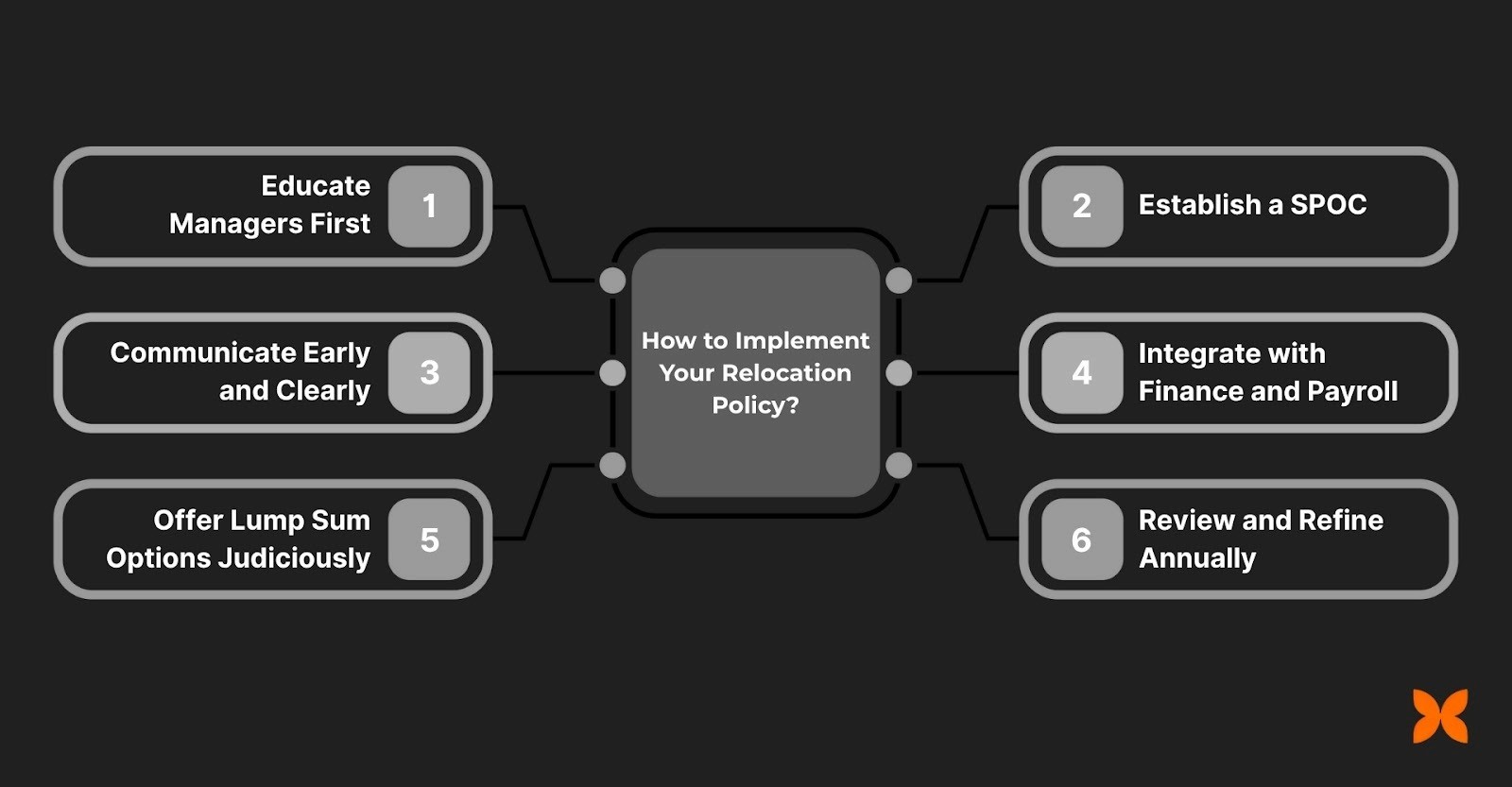
Here are essential tips for successfully embedding your policy into your operations:
Educate Managers First: Do not rely on HR alone. Train department managers to understand the policy's rules, eligible benefits, and approval process so they can accurately communicate terms to potential hires or transfers.
Establish a Single Point of Contact (SPOC): Designate one person or a small team within HR or Admin to serve as the dedicated relocation coordinator. This prevents employees from chasing multiple departments for answers.
Communicate Early and Clearly: Provide the complete policy document to the employee before they formally accept the transfer or offer. Highlight specific financial limits and the repayment clause up front.
Integrate with Finance and Payroll: Ensure your reimbursement process aligns directly with Finance deadlines. Map out the exact steps for submitting receipts and the timeline for receiving funds to avoid payment delays.
Offer Lump Sum Options Judiciously: While a fixed lump sum simplifies administration, be aware that it pushes all the logistical burden onto the employee. Consider using it only for junior roles or very short-distance moves.
Review and Refine Annually: Treat the policy as a living document. Conduct a yearly review of costs, employee feedback, and recent tax law changes to keep the policy competitive and compliant.
Consistent and clear implementation turns your policy from a document into a dependable talent attraction tool.
Also Read: Practical Guide to Labour Law Audits for Businesses
Conclusion
A formal relocation policy is not just a necessary document; it’s a direct commitment to your employees and to business continuity. When you remove the financial and emotional burden of a major move, you eliminate the biggest initial distraction for your new hire, allowing them to focus entirely on their job from day one.
The real benefit is long-term: building a clear, fair policy creates a reputation for caring for your talent, which boosts retention and makes recruitment easier tomorrow. By using a ready-made template to formalise your support, you are actively protecting your investment in people and securing future success.
Disclaimer
The downloadable template and the information provided in this article are intended for general guidance and educational purposes only. They do not constitute legal advice or a legally binding document. Craze does not accept any responsibility or liability for any decisions made or actions taken based on this content. We recommend reviewing your final policy with legal or HR professionals before implementation.