Occupational Health and Safety Policy: Sample Template and Free Download
Craft a compliant occupational health and safety (OHS) policy with clear roles, hazard control, and procedures. Get a free, editable template now! Read more.
Share
TABLE OF CONTENTS
An occupational workplace health safety policy is a formal, documented commitment that defines standards and responsibilities to protect personnel and ensure mandatory compliance.
Key elements include clear risk control measures, mandatory reporting, assigned roles for accountability, worker consultation and participation, and a commitment to employee welfare and continual improvement.
Download the editable policy template to implement safety protocols in your organisation.
Successful implementation requires mandatory training, active employee involvement in hazard reporting, and the use of HR/Safety tech to monitor compliance.
A fully implemented OHS policy reduces incident costs, protects your reputation, and transforms your company culture into one of safety and high accountability.
An occupational health and safety (OHS) policy is a formal, documented commitment outlining the specific standards and procedures your organisation uses to protect its personnel. It defines the responsibilities for everyone, from the senior leadership down to every employee, to maintain a healthy and risk-free environment.
The policy's primary role is to set out clear procedures for hazard management, help prevent injuries, and ensure your business meets applicable OH&S laws and other requirements in India. This policy is essential for building a high-accountability culture while legally mitigating exposure.
Defining the policy's purpose is only the start; a practical OHS framework is built upon its core elements.
Also Read: Comprehensive Guide to Workplace Harassment Prevention Policy
The real benefit of an OHS policy is that it gives your team a clear, formal document on how to manage risk and protect your business. It serves as your official safety roadmap.
These are the essential components that ensure your policy is effective and legally sound:
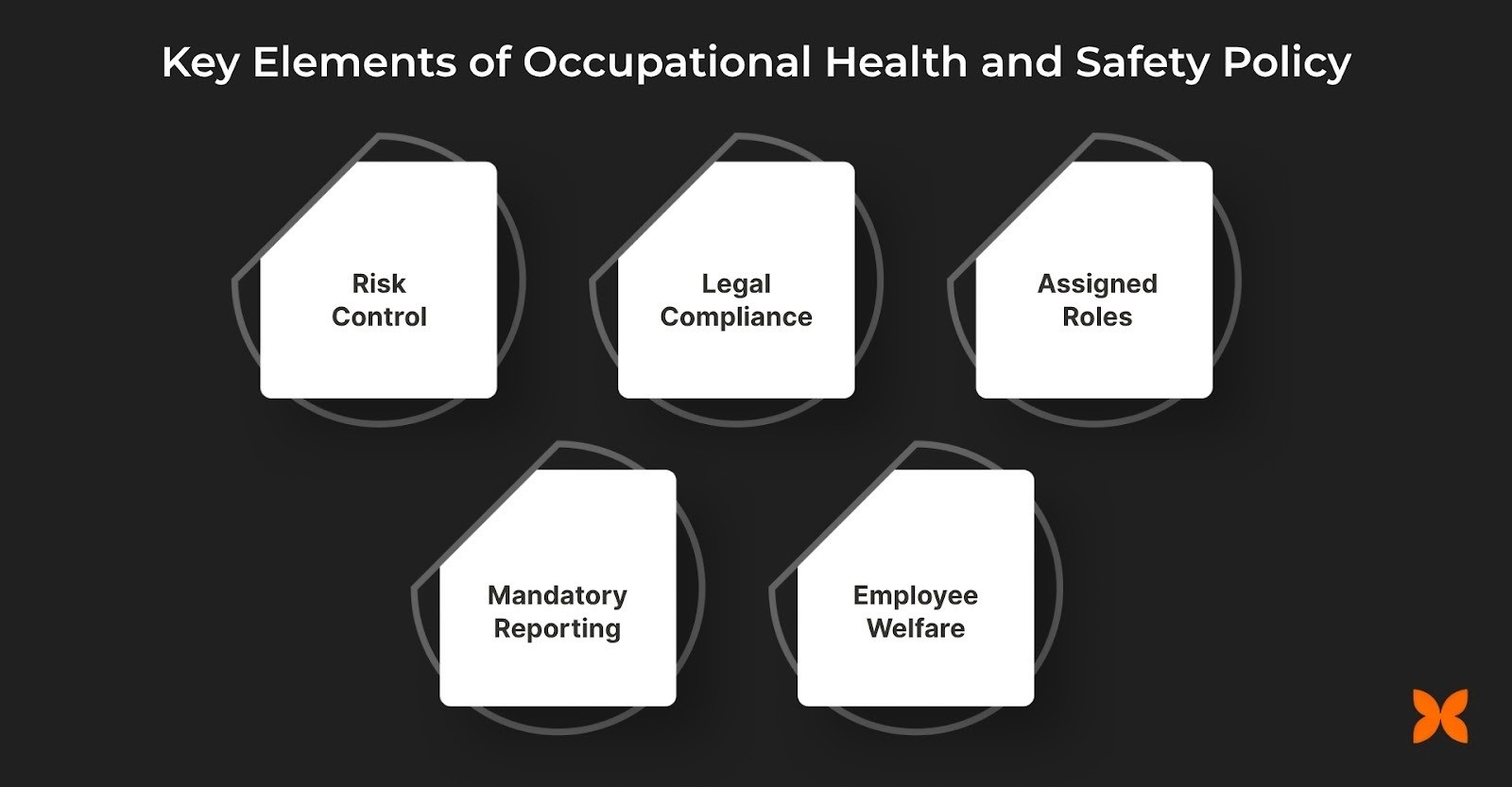
Risk Control: Clearly defining the steps your team must take to find and eliminate specific physical and mental hazards in the workplace.
Legal Compliance (India): Demonstrating that your business adheres to applicable OH&S laws, rules, and notifications in India, including the Occupational Safety, Health and Working Conditions (OSH) Code, 2020, and relevant state rules as and when notified.
Assigned Roles: Formally assigning safety duties to supervisors and managers, ensuring accountability and preventing confusion about who is responsible for what.
Mandatory Reporting: Requiring the reporting of every injury or "near-miss," allowing your business to continuously fix problems and improve safety over time.
Employee Welfare: Committing to support the overall well-being of your staff, which includes managing stress and mental health alongside physical safety.
To help you establish these standards quickly, here is a comprehensive OHS policy template you can use today.

A well-structured OHS policy is one of your strongest tools for operational resilience. It's more than just a document; it's a legally sound manual that dictates staff action and ensures your business maintains its commitment to safety.
This comprehensive template gives you a great starting point that you can fully customise for your business today, ensuring compliance with laws like the OSH Code, 2020.
1. Policy Statement and Objective
[Company] commits to:
Provide safe and healthy working conditions for the prevention of work-related injury and ill health;
Fulfil applicable legal and other requirements;
Consult and ensure participation of workers and, where they exist, worker representatives; and
Continually improve the OH&S management system and performance.
The policy's primary objective is to protect the well-being of all personnel, prevent workplace injury and illness, and continually improve OHS performance. It reflects the organisation's non-negotiable commitment to maintaining an injury-free workplace and meeting all statutory and regulatory requirements.
2.Scope and Applicability
To avoid gaps in coverage, your policy must clearly state who is covered and where the rules apply. This is critical for setting clear expectations across the entire organisation. This policy sets mandatory safety standards and applies to:
All Personnel: Full-time, part-time, temporary staff, and interns across all departments and locations.
External Parties: All contractors, vendors, clients, and visitors while present on company premises or site locations.
3.Risk Assessment and Hazard Control
This section outlines your proactive system for finding and eliminating danger before an incident occurs. It shows everyone how your company handles potential threats. The organisation commits to a systematic process of hazard identification and risk control.
Hazard Identification: Conducting regular site inspections and formal risk assessments for all work activities, machinery, chemicals, and psychological factors (e.g., workload, stress).
Preventive Measures: Implementing appropriate control measures, prioritising elimination or substitution of the hazard before relying on Personal Protective Equipment (PPE).
Employee Reporting: Requiring all employees to report hazards, near-misses, or unsafe conditions immediately to their supervisor or the designated Safety Officer.
Also Read: Work-Life Balance Explained: How HR Can Make It Better?
4.Roles and Responsibilities
Safety is a shared responsibility, but clear accountability must be assigned to specific roles to ensure duties are enforced and nothing is overlooked.
Management/Employer: You must provide adequate resources, ensure regular audits, appoint trained Safety Officers, and hold managers accountable for safety performance in their respective areas.
Supervisors/Managers: They are responsible for conducting regular team safety talks, enforcing safe work practices, ensuring all team members use required PPE, and immediately addressing any reported hazards.
Employees: They must strictly follow all defined safety procedures, correctly use assigned PPE, take reasonable care for their own safety and that of colleagues, and actively participate in safety training.
5.Essential Safety Procedures
These are the non-negotiable operational guidelines that personnel must follow to manage common risks and emergencies every day.
Emergency Response: Displaying clear evacuation routes, maintaining functional fire suppression equipment, and conducting regular fire and emergency evacuation drills as per legal requirements.
First Aid and Medical: Maintaining fully stocked and easily accessible first aid kits. Ensuring a sufficient number of personnel are trained and certified as First Aiders.
Incident and Near-Miss Reporting: All accidents resulting in injury, occupational illness, and any near-misses (incidents that could have caused harm) must be reported to the HR/Safety Officer within 4 hours of occurrence. Statutory reporting to authorities will be completed as required by applicable Indian laws and rules within prescribed timelines.
PPE: Providing appropriate, certified PPE (e.g., helmets, gloves, safety footwear) at no cost to the employee, and enforcing its mandatory use in designated areas.
Ventilation & Lighting: Ensuring adequate ventilation and illumination in all work areas, with emergency lighting where required.
Electrical & Tools: Safe selection, use, and maintenance of electrical equipment and hand tools; checks for insulation integrity, earthing, and tool condition before use.
No-Smoking Controls: Smoking prohibited in/near hazardous operations and designated no-smoking zones.
Stop-Work Authority: Any worker may stop unsafe work and escalate to a supervisor/Safety Officer without fear of reprisal.
6.Training and Competence
Your policy must ensure everyone has the knowledge needed to work safely. All personnel, including contractors, must be competent to perform their tasks safely through the following ways:
Induction: Mandatory OHS induction training covering site-specific hazards and emergency procedures for all new hires and contractors.
Refresher Training: Annual refresher training on key safety protocols, including manual handling, chemical safety, and emergency response.
Specialised Training: Providing specialised training for high-risk tasks or the use of heavy machinery.
Training Matrix & Competence Verification: Maintain a role-based training matrix (who needs what, and how often) and verify competence via assessments/observations.
7.Monitoring, Audit, and Review
This system ensures your safety policy remains effective and adapts to new threats over time. Checking performance regularly is essential to maintain safety standards.
Monitoring: The OHS Committee will conduct regular, scheduled workplace inspections (e.g., monthly) to monitor compliance.
Audit: A full OHS performance audit will be conducted annually to review documentation, incident trends, and legal adherence.
Management Review: Senior management will formally review the policy and safety performance data annually to ensure the policy remains relevant to the organisation's current risk profile and after significant incidents or major organisational changes.
8.Performance & KPIs
Track and review: Total Recordable Incident Rate (TRIR)/Lost Time Injury Frequency Rate (LTIFR), near-miss reporting rate, corrective-action closure times, and training completion/competence metrics.
9.Documentation & Records
The policy, procedures, risk assessments, training records, medical surveillance (where required), inspection/audit reports, and incident investigations will be controlled, retained, and retrievable per a defined retention schedule.
10.Contractor and Visitor Management
Contractors: Pre-qualification, method statements/JSAs, toolbox talks, and permit-to-work where applicable; contractors must meet or exceed company safety standards.
Visitors: Site-specific inductions for relevant risks and escorted access where required.
11.Non-Compliance and Enforcement
A safety policy must clearly state the consequences for not following the rules to maintain a serious safety culture. Adherence to this policy is a condition of employment. Any failure to comply with safety procedures, refusal to use required PPE, or wilful negligence will result in disciplinary action. The action will range from verbal warnings to immediate termination for severe breaches, especially those that endanger colleagues.
This detailed structure provides all the essential sections. To reduce implementation time, grab the fully editable OHS template.
Also Read: Understanding the Role and Responsibilities in HR Compliance
A great policy is only as good as its execution. Effective implementation ensures your safety document lives in your daily operations, not just in a binder. Follow these key practices to embed a lasting safety culture:
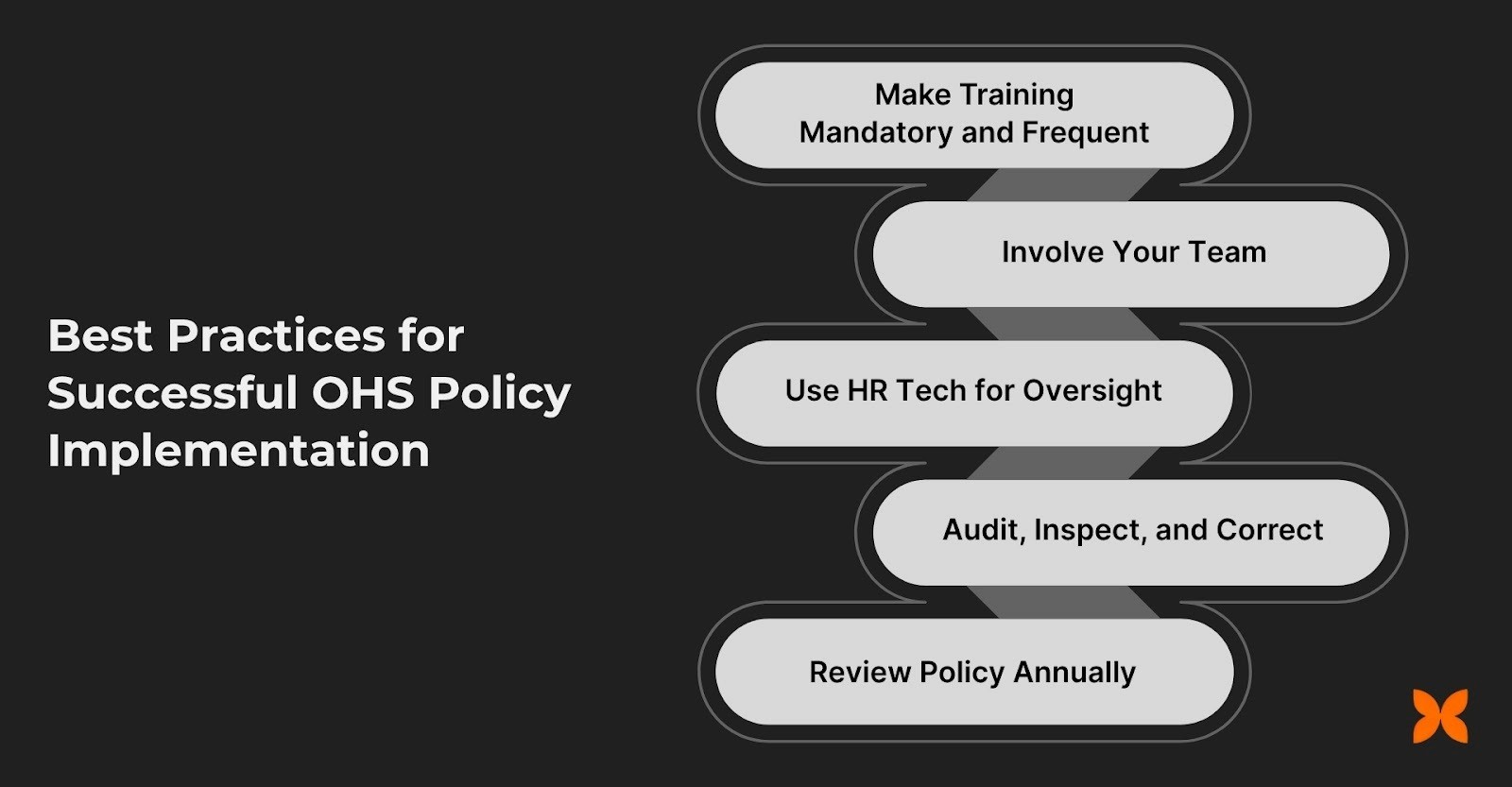
Make Training Mandatory and Frequent: Ensure all employees receive essential induction and annual refresher training on emergency procedures, equipment use, and hazard awareness.
Involve Your Team: Actively encourage staff to participate in hazard reporting and risk assessments to create ownership and strengthen your safety culture from the ground up.
Use HR Tech for Oversight: Adopt safety management software to track all training records efficiently, monitor reported incidents, and maintain a clear, audit-ready compliance trail.
Audit, Inspect, and Correct: Schedule periodic safety audits and site inspections to identify policy gaps and implement corrective measures before minor issues escalate and lead to major incidents.
Review Policy Annually: Commit to a yearly review of the entire policy by senior management to ensure it aligns with your business operations and the latest legal standards.
These practices turn your policy from a static document into a dynamic system that actively protects your business.
Conclusion
A strong occupational health and safety policy ultimately reflects your leadership quality, showing that you value human capital over short-term costs. When this policy is actively followed, it does more than satisfy compliance officers; it directly impacts your business continuity by preventing costly downtime and talent loss.
Effectively embedding these standards transforms your culture, replacing anxiety with accountability. It empowers your managers and staff to become active risk guardians, securing not just a safer office, but a more reliable, attractive, and productive organisation for years to come.
Disclaimer
The downloadable template and the information provided in this article are intended for general guidance and educational purposes only. They do not constitute legal advice or a legally binding document. Craze does not accept any responsibility or liability for any decisions made or actions taken based on this content. We recommend reviewing your final policy with legal or HR professionals before implementation.