Internet and Email Policy: Sample Template and Free Download
Safeguard your workplace with an effective internet and email policy. Set guidelines for responsible usage, mitigate risks, and ensure compliance. Read more!

Share
TABLE OF CONTENTS
An internet and email policy is a dedicated guide that defines how employees must use company digital resources and protects assets and the company's reputation.
The policy must cover acceptable use, prohibited activities, data security, monitoring rights, and consequences for misuse.
Implementing this policy drastically reduces your cyber liability and financial loss while strengthening your legal defence of Intellectual Property (IP) ownership.
Use a comprehensive, editable template to quickly set clear rules for digital conduct without starting the document from scratch.
Ensure policy effectiveness through mandatory training, required acknowledgement and consent, and consistent, fair enforcement across all staff.
An internet and email policy is a dedicated, formal set of guidelines that clearly defines how your employees must use the company’s internet access, network, and official email accounts.
Its primary purpose is to protect your business assets, including proprietary data and reputation, by setting non-negotiable standards for professional conduct, data security, and compliance during all online work activities.
While often confused, a dedicated internet and email policy and a general IT policy serve distinct purposes. A general IT policy is your overarching rulebook for all technology (hardware, software, network access, data backups). The internet and email policy is a specialised document that concentrates solely on human behaviour and content related to online communication and web access.
Feature | Internet and Email Policy | General IT Policy |
Focus Area | Employee behaviour when using email and browsing the web. | All aspects of technology assets (laptops, software, servers, mobile devices). |
Key Objectives | Defining acceptable use, professional communication standards, and data security through email/browsing. | Governing device security, software licensing, system maintenance, and data storage. |
Scope | Narrow and specific to network/email usage. | Broad and overarching, covering technology governance. |
Also Read: What is IT Asset Management Software? Key Benefits for Businesses
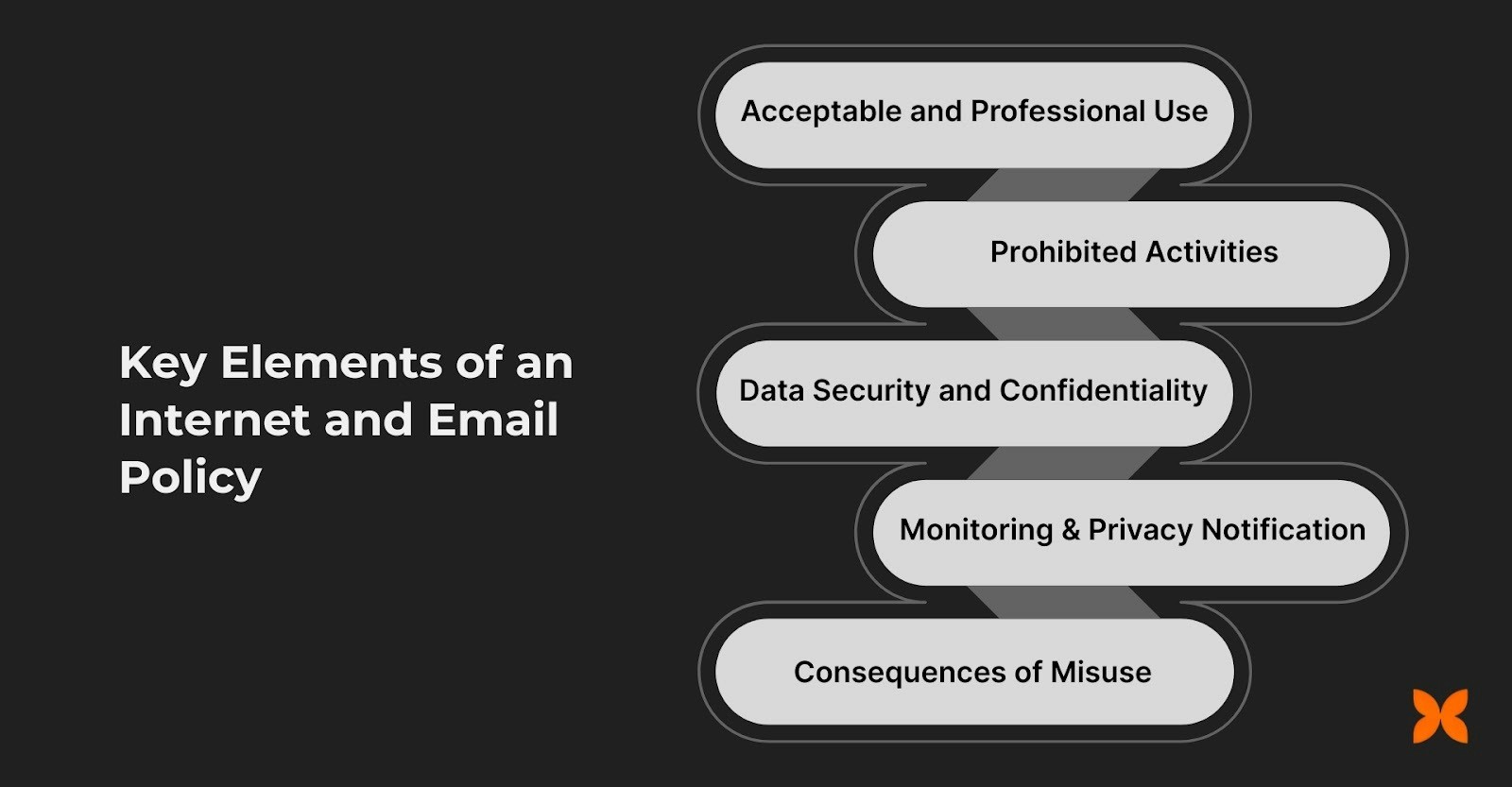
A strong policy provides the specific terms your business needs to manage digital risk. It not only sets clear employee expectations but also establishes your legal right to enforce them.
Here are the critical components you must include in your policy to ensure comprehensive coverage:
Acceptable and Professional Use: Clearly define that the internet and email are primarily for work purposes. Specify the professional tone and language required for all communication and outline clear limits on personal use, ensuring it never disrupts work or violates other policies.
Prohibited Activities: Detail the actions that lead to high risk. This must include accessing, storing, or transmitting illegal, offensive, or discriminatory content. Also, prohibit activities like using company resources for personal commercial gain, spamming, and accessing unauthorised files.
Data Security and Confidentiality: Explicitly forbid employees from sharing confidential or proprietary data outside the company network via email or cloud services without explicit authorisation. Mandate the immediate reporting of suspicious emails, phishing attempts, or security breaches.
Monitoring and Privacy Notification: State clearly that the company reserves the right to monitor and audit all usage of its network, email accounts, and devices. This eliminates any expectation of privacy when using company IT assets, which is essential for legal enforceability.
Consequences of Misuse: Establish a scale of disciplinary action, from verbal warnings to immediate termination, for policy violations. Outline that severe breaches, such as data theft or illegal activity, may result in criminal prosecution or civil liability.
Understanding these foundational elements makes it clear why having this policy is non-negotiable for business protection.
Also read: Understanding Compliance Reporting: Meaning and Importance
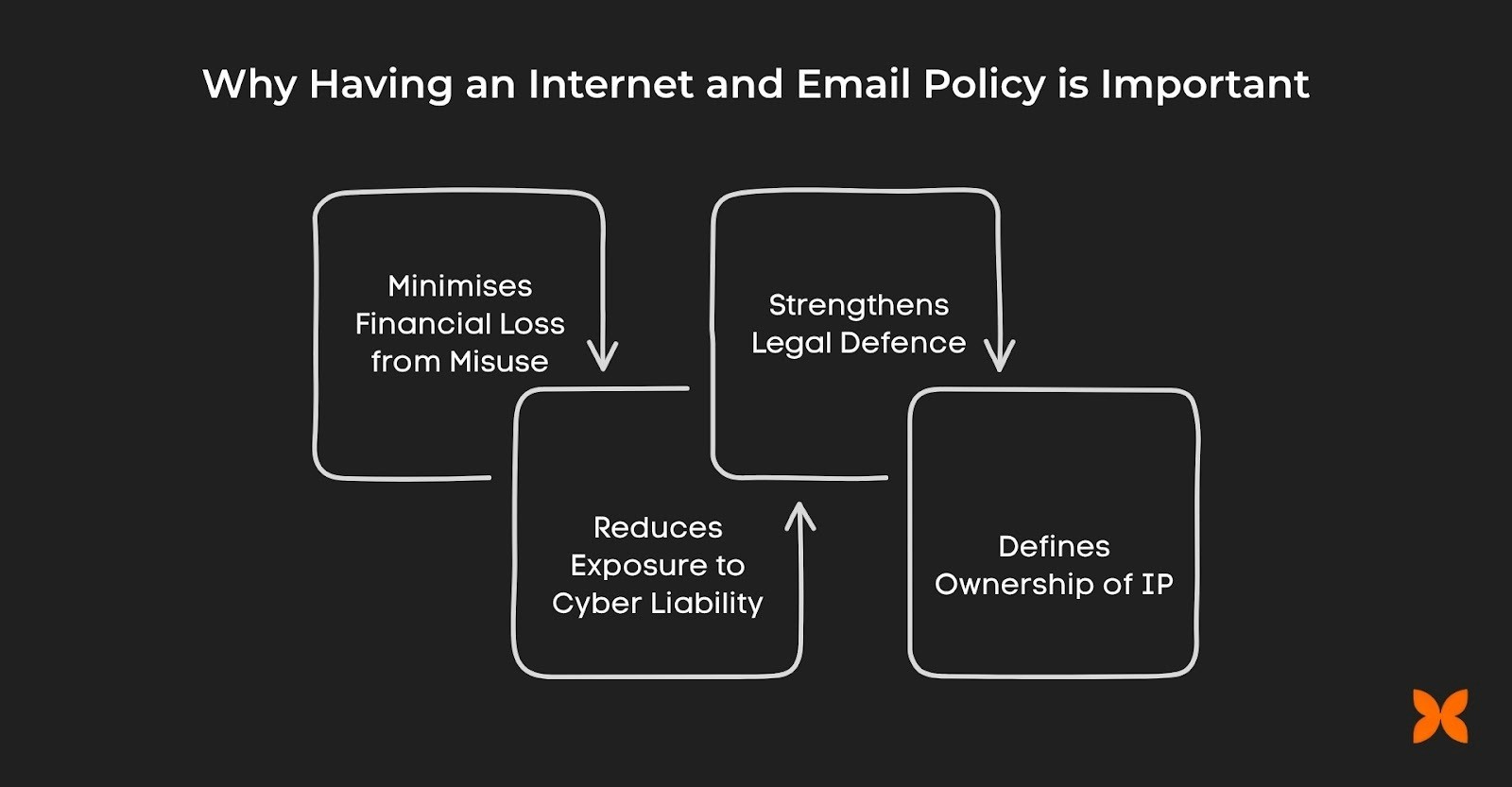
Every hour an employee spends on personal activity is a delay on a client project or a missed sales opportunity. This policy protects your balance sheet and your vital infrastructure from the daily chaos of employee misuse.
Here are the benefits of implementing a formal internet and email policy:
Minimises Financial Loss from Misuse: Unchecked personal use, like constant video streaming or large downloads, directly increases your bandwidth costs and slows down critical business operations. A clear policy ensures these digital resources are used as intended: for profit-generating work.
Reduces Exposure to Cyber Liability: A single employee error, like clicking a phishing link or downloading unauthorised software, can introduce malware or ransomware that harms your business. Your policy acts as a legally enforceable training document that reduces this expensive, human-error-based risk.
Strengthens Legal Defence and HR Compliance: The policy documents your due diligence. Should you face a lawsuit related to employee communication (e.g., harassment via email) or a regulatory audit, this written standard provides the necessary proof that you established and communicated acceptable standards of conduct under Indian law.
Defines Ownership of Intellectual Property (IP): Clarifies that all communication and data created using company email or network access is the property of the organisation. This is vital for startups where IP is the core asset, preventing disputes over ownership rights upon employee exit.
A clear understanding of these benefits naturally leads to the next step: structuring a policy that is legally robust and easy for your team to follow.
Also read: Improving Employee Attendance at Work: A Simple Guide
A robust policy is built on a strong, logical structure that leaves no room for misinterpretation. We have broken down the critical clauses and sections that must be included to create an enforceable, comprehensive document for your organisation.
Foundation and Applicability
This section establishes the formal basis of the document, ensuring every user understands why the policy exists and who it applies to. Establishing a clear scope is vital for legal enforceability.
Objective and Purpose: State clearly that the policy aims to protect company assets, ensure compliance, and maintain a professional work environment by governing the use of all company-provided digital resources.
Scope and Applicability: Define the range of users (all employees, contractors, interns, temporary staff) and the resources covered (all company-owned devices, networks, internet access, and email accounts).
Usage Guidelines (The 'Do's and Don'ts')
These clauses form the core of acceptable conduct, clearly separating allowed business use from discouraged or outright prohibited personal activity. Clarity here directly manages productivity and legal risk.
Acceptable Use: Mandate that internet and email services are primarily for business communication and tasks. If you allow limited personal use, define its boundaries, emphasising that it must not interfere with job duties or consume excessive bandwidth.
Prohibited Activities: List high-risk behaviours to avoid liability. This includes accessing or distributing illegal, offensive, discriminatory, or sexually explicit content. Specifically prohibit spamming, phishing attempts, using company email for personal commercial gain, or unauthorised downloading of any software (piracy).
Security and Data Protection
This is where you mandate the specific actions employees must take to protect the company's network and sensitive data. User vigilance is your first line of defence against modern cyber threats.
Security Measures: Require employees to use strong, unique passwords and update them routinely. Instruct users on the proper handling of email attachments and links, mandating that any suspicious activity, malware, or potential security breach be reported to the IT Security team immediately.
Confidentiality and IP: Explicitly state that company email and networks must never be used to transmit confidential, proprietary, or client-sensitive information to external personal accounts or unapproved cloud services.
Monitoring, Privacy, and Enforcement
These are the most critical legal clauses, as they establish the company's right to audit and the consequences for non-compliance. This eliminates any expectation of privacy when company assets are involved.
Monitoring and Privacy Notification: Clearly reserve the right for the company to monitor, intercept, and review all internet and email usage, content, and traffic on its systems. State that employees should not expect privacy when using company-provided resources.
Consequences of Misuse: Establish a graduated scale for disciplinary action, ranging from warnings and suspension to immediate termination of employment. Note that severe breaches (e.g., data theft, harassment) may also result in legal action or civil damages.
Administration and Review
A policy is a living document; these clauses ensure it remains relevant and functional over time, delegating administrative tasks to the correct departments.
Roles and Responsibilities: Assign ownership for the policy (e.g., HR for training, IT for technical implementation). This ensures accountability for both communication and enforcement.
Policy Review and Updates: State that the policy will be formally reviewed and updated (e.g., annually or biannually) to align with evolving technology, security threats, and new legal or regulatory requirements.
Reviewing these essential sections gives you a strong policy. You are now ready to download a fully developed version that you can adapt for your unique business needs.
Also read: Mastering HR Policies: 8 Key Policies Every HR Leader Needs to Draft Well
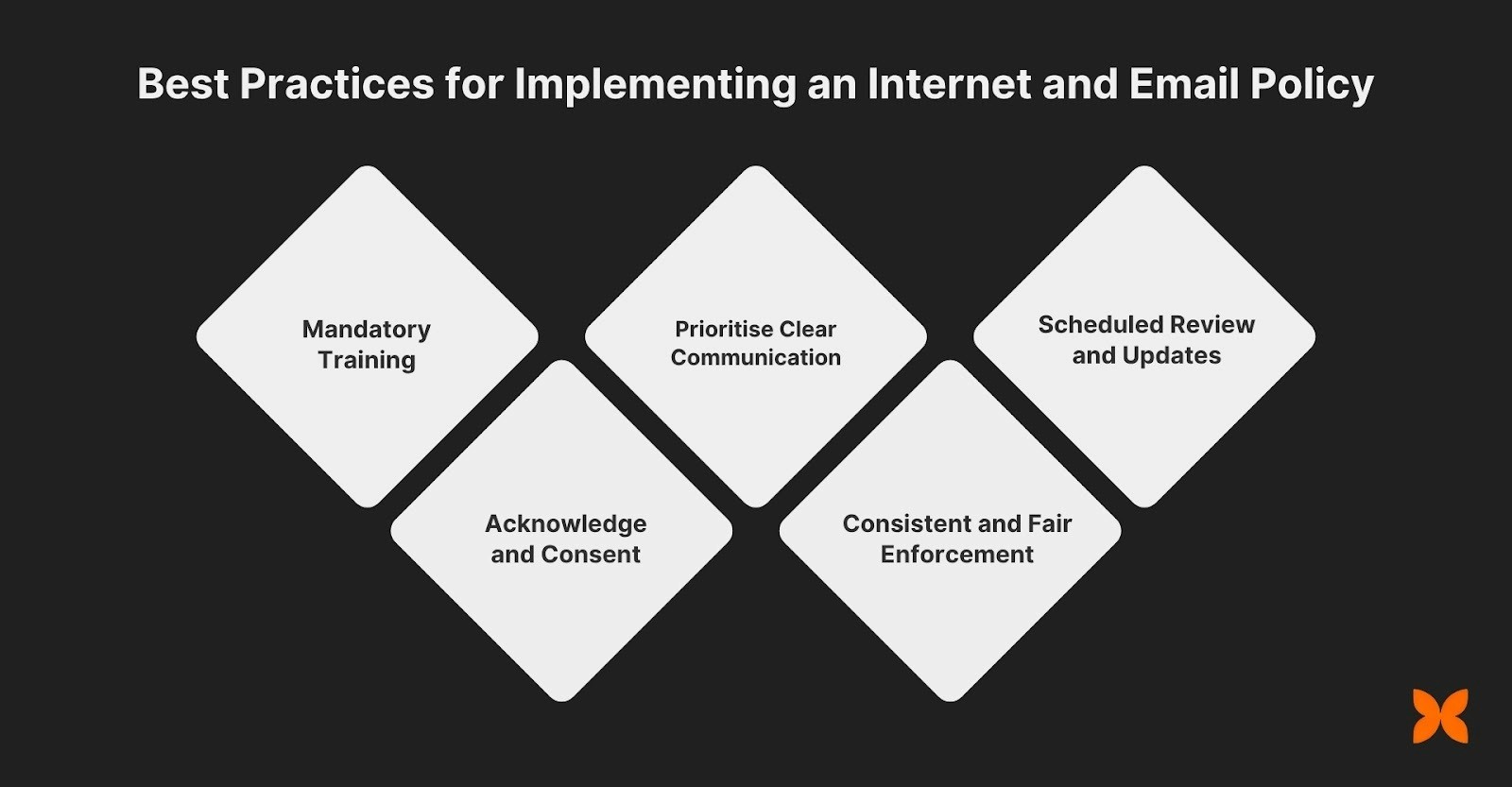
Having a policy document is only the first step; its true impact depends entirely on how you roll it out and maintain it across the organisation. Compliance is not automatic; it requires a focused, ongoing strategy from HR and IT leadership.
Here are the proven strategies for ensuring your internet and email policy works effectively:
Mandatory Training and Onboarding: Integrate policy training into the induction process for every new hire and schedule mandatory, regular refreshers for all existing staff.
Acknowledge and Consent: Require every user (employees, contractors, consultants) to formally sign or digitally confirm they have read, understood, and agree to abide by the policy.
Prioritise Clear Communication: Publish the policy on an easily accessible internal platform and use clear, non-legalistic language to explain expectations and consequences upfront.
Consistent and Fair Enforcement: Apply disciplinary action for non-compliance uniformly across all seniority levels, ensuring the policy is seen as credible and impartial.
Scheduled Review and Updates: Formally review the entire policy at least annually or immediately following a security incident to address new technology risks and changes in data regulations.
By following these implementation steps, you transform the policy from a simple document into a living part of your company's security culture.
Also Read: Best IT Asset Management Software Tools for 2025
Conclusion
An internet and email policy is the best tool for turning digital chaos into clarity. It moves you past hoping employees will do the right thing to providing clear, documented standards for conduct, which is the foundation of a legally defensible workplace.
A well-crafted policy, combined with consistent training and fair enforcement, immediately reduces your exposure to data breaches and legal claims. Don't wait for a crisis to define your boundaries; secure your business today by implementing this essential document.
Disclaimer
The downloadable template and the information provided in this article are intended for general guidance and educational purposes only. They do not constitute legal advice or a legally binding document. Craze does not accept any responsibility or liability for any decisions made or actions taken based on this content. We recommend reviewing your final policy with legal or HR professionals before implementation.